

Key takeaways
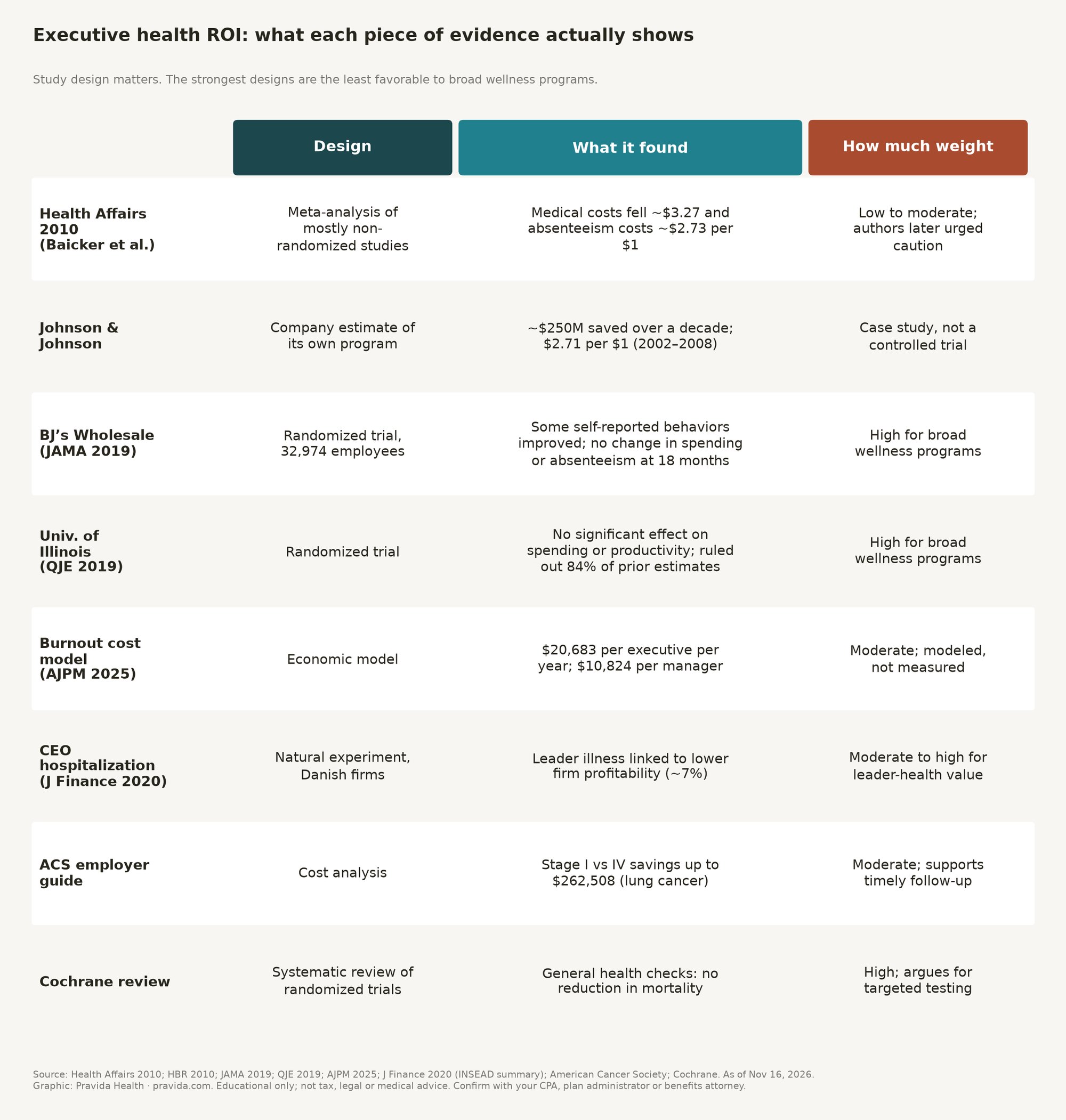
- The famous $3.27 figure is real, but dated. It comes from a 2010 meta-analysis of mostly observational studies, and its lead author later urged caution.
- Two large randomized trials of broad wellness programs found no savings. Neither the BJ’s Wholesale trial nor the University of Illinois trial showed lower spending or better productivity within 18 months to 2-plus years.
- The stronger case is about concentration of value. Burnout costs an estimated $20,683 a year per executive, and research using hospitalization events shows a CEO’s illness measurably lowers firm profitability.
- More testing is not automatically better care. A Cochrane review of general health checks found no mortality benefit, and whole-body screening tests remain unproven in people without risk factors.
- Fund targeted, physician-led, longitudinal care, and measure it in aggregate. Companies should see de-identified program metrics, never an individual’s results.
Why this question matters now
When I meet with a company about executive health, the first slide in most vendor proposals is a return-on-investment claim: three dollars back for every dollar spent, or more. CFOs are right to ask where that number comes from. In my experience, the honest answer makes a better case for leadership health than the marketing does, because it points you toward the kind of program that is worth paying for.
This post is written for CEOs, CFOs, HR and benefits leaders, and boards. It covers four questions: what the return-on-investment literature actually shows, what the human-capital risk looks like, which clinical approaches are supported by evidence, and how to measure a program without compromising anyone’s privacy. It ends with how companies can pay for executive physicals under current tax rules.
Sources: Health Affairs, 2010; JAMA, 2019; Quarterly Journal of Economics, 2019; American Journal of Preventive Medicine, 2025; INSEAD summary of Journal of Finance research.
Where the classic ROI numbers come from
The most quoted figure comes from a 2010 Health Affairs meta-analysis by Katherine Baicker, David Cutler and Zirui Song. Pooling published studies of employer wellness programs, they estimated that medical costs fell about $3.27 and absenteeism costs about $2.73 for every dollar spent (Health Affairs). It is a legitimate peer-reviewed paper. It is also often cited to secondary sources that don’t contain the figures, so if a proposal you’re reviewing cites it, check that the citation goes to Health Affairs.
Two cautions matter. First, most of the underlying studies compared employees who chose to participate with those who didn’t. People who sign up for wellness programs tend to be healthier to begin with, which makes programs look better than they are. Second, Baicker herself later said there was “some reason to be cautious in using [the study’s] estimates” and that “better evidence is needed” (Politico).
The other well-known example is Johnson & Johnson. In Harvard Business Review, company leaders estimated that their wellness programs saved about $250 million on health care over a decade, a return of $2.71 for every dollar spent from 2002 to 2008 (Harvard Business Review). That is a meaningful case study, but it is a company’s estimate of its own program, not a controlled trial.
Then came the randomized trials
Economists then did what medicine does with any promising intervention: they randomized it.
- BJ’s Wholesale Club (JAMA, 2019). Zirui Song and Katherine Baicker randomized worksites covering 32,974 employees. After 18 months, employees in the program were more likely to report exercising regularly (8.3 percentage points higher) and actively managing their weight (13.6 points higher). There were no significant differences in clinical markers, medical spending or use, absenteeism, job tenure or job performance (JAMA).
- University of Illinois (Quarterly Journal of Economics, 2019). Damon Jones, David Molitor and Julian Reif randomized employees into a comprehensive program. They found strong selection: healthier, lower-spending employees were more likely to take part. After more than two years, there were no significant effects on medical spending, productivity or health outcomes, and the authors’ confidence intervals ruled out 84% of the estimates in the prior literature (QJE).
My reading as a physician: broad, population-wide wellness programs built around screenings, health risk questionnaires and incentives don’t reliably pay for themselves in the short run. That does not settle the question for executive health. It does mean any proposal that promises a guaranteed multiple should show its method. One executive health company recently announced a 13-to-1 return over 10 years in a press release; the method was not disclosed and it has not been peer reviewed, so I would not use it in a board deck.
The stronger argument: value is concentrated in a few people
A broad wellness program spreads a small amount of money across everyone. Executive health does the opposite. The case for it rests on how much enterprise value depends on a small number of people, and on what happens to the company when one of them is unavailable.
Burnout has a price, and it is highest at the top
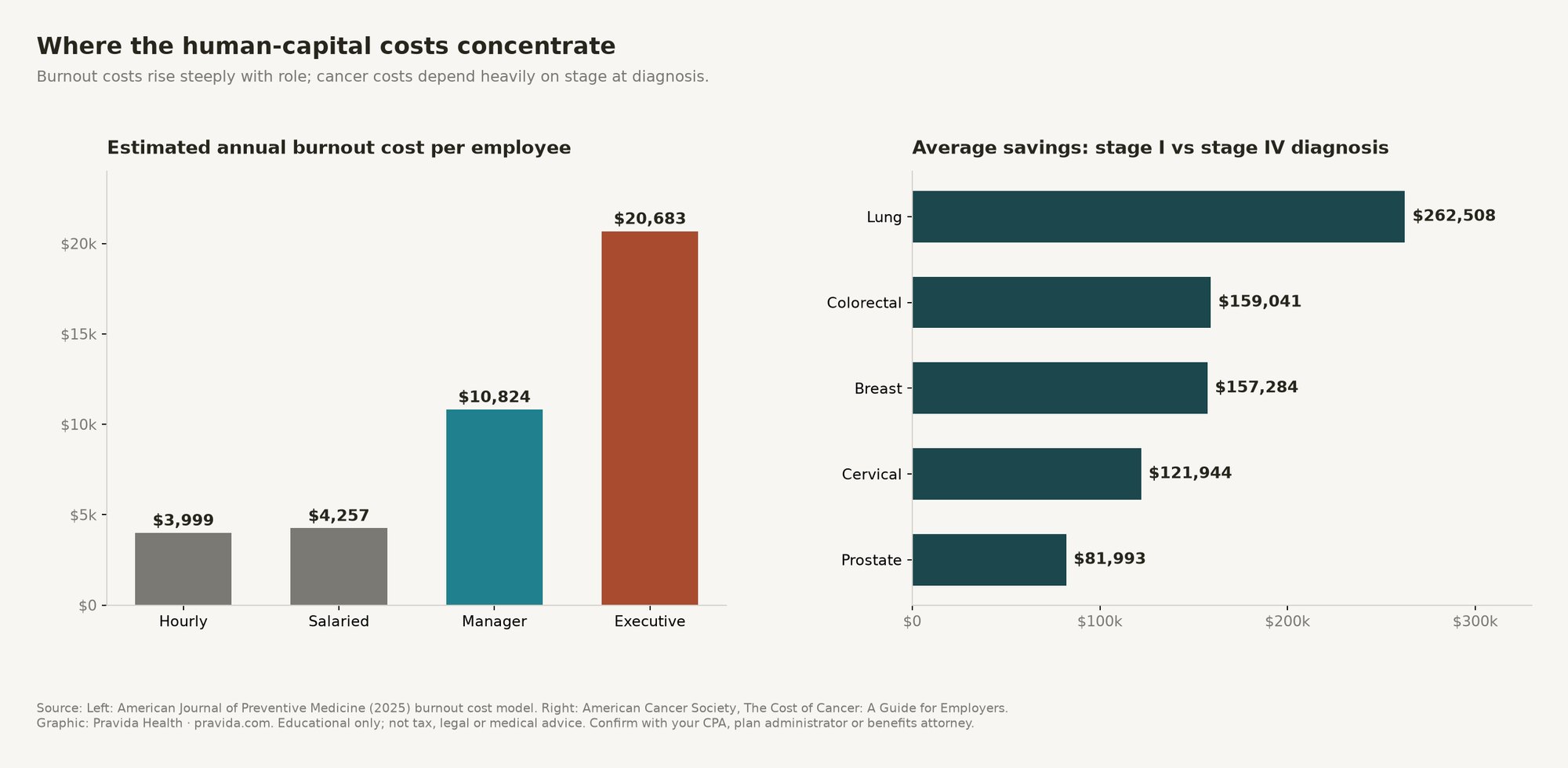
A 2025 computational model in the American Journal of Preventive Medicine, led by researchers at the CUNY School of Public Health, estimated the annual cost of burnout per employee at $3,999 for hourly workers, $4,257 for salaried staff, $10,824 for managers and $20,683 for executives. For a 1,000-employee company, that is about $5.04 million a year, and roughly 90% of the cost came from reduced performance at work rather than missed days (AJPM; CUNY SPH; Fortune). A model is not a trial, but it shows where the costs concentrate.
When a CEO is sick, the company feels it
The best evidence here comes from finance research. Morten Bennedsen, Francisco Pérez-González and Daniel Wolfenzon used hospitalization records to study what happens to firms when their leaders are sick. In the Journal of Finance, they reported that CEO hospitalization lowers firm profitability, with larger effects for younger CEOs, growing firms and human-capital-intensive industries. Hospitalizations of other senior executives did not have similar effects (Journal of Finance). An INSEAD summary of the work, based on about 13,000 Danish small and mid-sized firms, reported that 5- to 7-day hospitalizations cut profitability by about 7% in the year of the illness (INSEAD).
That finding doesn’t prove that an executive physical prevents hospitalization. It does give boards a concrete way to think about key-person risk: the health of the CEO and a few other leaders is a real business variable.
Stage at diagnosis drives cost and time away
The American Cancer Society’s employer guide estimates the average cost savings of diagnosing cancer at stage I rather than stage IV at $262,508 for lung cancer, $159,041 for colorectal, $157,284 for breast, $121,944 for cervical and $81,993 for prostate. In the same guide, 69% of people with cancer missed more than four weeks of work and 39% missed more than three months (American Cancer Society). That is the clearest argument for making sure every leader is current on guideline-recommended screening, which is still far from universal.
What good executive health is, and isn’t
If the business case rests on preventing a few high-cost events, the clinical program has to be built for that, not for volume of testing. Two pieces of evidence shape how I design programs.
- General health checks alone don’t reduce deaths. A 2019 Cochrane review of 17 randomized trials found that offering general health checks to unselected adults had little or no effect on total, cancer or cardiovascular mortality (Cochrane). Its lead author added that the findings don’t mean physicians should stop clinically motivated testing and prevention (Cochrane news). My interpretation: a once-a-year checklist isn’t the active ingredient.
- Whole-body screening is still unproven for people without risk factors. The American College of Radiology says there is not sufficient evidence to recommend total-body MRI screening for people with no symptoms, risk factors or family history (ACR). The largest randomized trial of a multi-cancer blood test, NHS-Galleri, did not meet its main goal of reducing stage III and IV cancers, though stage IV cancers were lower in the screened group (Queen Mary University of London). An FDA advisory panel has recommended approval of that test with the message that it does not replace guideline screening (FDA panel summary). I discuss both in more detail in full-body MRI and cell-free DNA cancer screening.
So the programs I think are worth funding share five features:
- Guideline screening completed first. Colonoscopy, mammography, cervical and lung screening where indicated, blood pressure, lipids and diabetes testing. Closing these gaps is where the cancer stage-shift data apply.
- Targeted advanced testing based on risk. Coronary imaging such as CT angiography with plaque analysis, advanced biomarkers, genetics or imaging chosen because of family history, symptoms or prior results, with a plan for incidental findings.
- Continuity with one physician. A relationship over years, not a one-day physical with a report mailed afterward. Follow-up is where risk is actually reduced.
- Attention to sleep, stress and burnout. These drive the performance costs above and are easy to miss in a lab-based physical.
- Measurement the company can see, without seeing anyone’s data. See the next section.
How to measure it without seeing medical records
The most common objection I hear from executives is “I don’t want my company to see my health information.” They are right. A well-designed program keeps a firewall between the physician and the employer:
| What the company sees | What the company never sees |
|---|---|
| Enrollment and engagement rates (for example, the share of eligible leaders who completed their visits) | Any individual’s results, diagnoses or medications |
| De-identified, aggregate risk-flag rates across the cohort | Who has a risk flag, or what it is |
| Time from a flagged finding to a follow-up plan (intervention speed) | Visit notes, imaging, genetic or lab reports |
| Aggregate trends in modifiable risk over time | Anything reported for a group too small to keep anonymous |
| Participant satisfaction | Whether a specific person used the program |
These are leading indicators, not proof of financial return. With a small executive cohort, you will not be able to show a statistically meaningful change in claims costs, and anyone who promises that from a group of 20 people is overselling. What you can show a board is that leaders are using the program, that risks are being found and acted on quickly, and that participants value it.
How companies pay for executive physicals
Executive physicals are usually funded in one of three ways: as a taxable fringe benefit, through a self-insured medical reimbursement plan, or as a separate executive health benefit. The tax treatment of the second and third depends on Internal Revenue Code section 105(h), which generally prohibits self-insured plans from favoring highly compensated employees.
There is a narrow exception. Treasury regulations exclude reimbursements for “medical diagnostic procedures” for an employee from the 105(h) nondiscrimination rules. That covers routine examinations, blood tests and X-rays. It does not cover treatment, testing for a known illness or symptoms, or exercise, fitness and nutrition programs, and it does not cover dependents. The procedures also have to be performed at a facility that provides only medical and ancillary services (26 CFR 1.105-11). Benefits advisors note that other rules, including the Affordable Care Act and ERISA, still need to be checked (Newfront; PLANSPONSOR).
In practice, that means a company can usually offer diagnostic executive physicals only to leaders without failing nondiscrimination testing, but follow-up treatment and coaching need a different structure. This is a design question for your benefits attorney and broker. The Section 105 and executive health plans post in the Wellness Wallet series goes into more detail.
Before you act on anything here. I am a physician, not a CPA, enrolled agent or benefits attorney. Tax treatment depends on your plan documents, your employment and entity structure, and facts I can’t see. Use this post to prepare better questions for your tax advisor and plan administrator, not as a substitute for them.
The Wellness Wallet series
If you are an individual or a business owner looking at how to fund prevention, the Wellness Wallet series covers each payment vehicle:
- The Wellness Wallet: 10 ways to pay for prevention insurance doesn’t cover
- HSAs and FSAs for prevention in 2026
- HRAs, QSEHRAs and ICHRAs (CHOICE arrangements)
- Section 105 MERPs and executive health plans
- Self-employed: the health insurance deduction and long-term care
- Paying for direct care and concierge memberships
Pravida’s programs are described on the memberships and executive health pages; pricing is provided at your consultation.
Designing an executive health program for your leadership team
Pravida works with employers on physician-led, longitudinal executive health programs in Midtown Atlanta. Individual results stay between each executive and their physician. The company receives only de-identified, aggregate program reporting. Learn more on our executive health in Atlanta page and our executive health services overview.
- Free 15-minute discovery call for HR, benefits and finance leaders
- Program design built around your existing benefits, broker and plan documents
- Program pricing is provided at your consultation
Pravida Health, 1801 Peachtree St NE, Suite 150, Atlanta, GA 30309. Call 404-900-7371, email info@pravida.com or request a conversation.
Frequently asked questions
Do executive health programs pay for themselves?
Not reliably, based on current evidence. The classic estimate of $3.27 in medical savings per dollar came from mostly observational studies, and two large randomized trials of broad wellness programs found no significant savings within 18 months to two-plus years. The stronger case for executive health is managing key-person risk and catching serious disease earlier in the few people a company depends on most.
Where does the $3.27 for every $1 figure come from?
It comes from a 2010 Health Affairs meta-analysis by Baicker, Cutler and Song, which also estimated $2.73 in absenteeism savings per dollar. The lead author later said there was reason to be cautious about the estimates and that better evidence was needed.
Will our company see an executive’s health results?
Not in a well-designed program. The company should receive only de-identified, aggregate reporting, such as engagement rates, cohort risk-flag rates and time to follow-up. Individual results stay between the executive and their physician.
Should executive physicals include full-body MRI or multi-cancer blood tests?
Not by default. The American College of Radiology does not recommend total-body MRI screening for people without symptoms or risk factors, and the largest randomized trial of a multi-cancer blood test did not meet its main goal. These tests can be reasonable in specific situations after a discussion of false positives and follow-up, but guideline screening should come first.
Can a company offer executive physicals only to senior leaders?
Often yes for diagnostic procedures. Treasury regulations exclude employee medical diagnostic procedures such as routine exams, blood tests and X-rays from the section 105(h) nondiscrimination rules, but not treatment, fitness or nutrition programs, or dependents. Plan design should be reviewed by a benefits attorney.
References
- Baicker K, Cutler D, Song Z. Workplace wellness programs can generate savings. Health Affairs. 2010;29(2):304-311. Health Affairs.
- Song Z, Baicker K. Effect of a workplace wellness program on employee health and economic outcomes: a randomized clinical trial. JAMA. 2019;321(15):1491-1501. JAMA.
- Jones D, Molitor D, Reif J. What do workplace wellness programs do? Evidence from the Illinois Workplace Wellness Study. Quarterly Journal of Economics. 2019;134(4):1747-1791. Oxford Academic.
- Berry LL, Mirabito AM, Baun WB. What’s the hard return on employee wellness programs? Harvard Business Review. December 2010. HBR.
- Politico. Interview coverage of workplace wellness evidence, including comments by Katherine Baicker. 2016. Politico.
- Martinez et al. Estimated costs of employee burnout to employers. American Journal of Preventive Medicine. 2025;68(4):645-655. PubMed.
- CUNY School of Public Health. Employee burnout news release. February 2025. CUNY SPH.
- Bennedsen M, Pérez-González F, Wolfenzon D. Do CEOs matter? Evidence from hospitalization events. Journal of Finance. 2020;75(4):1877-1911. Wiley.
- INSEAD. Research finds how much CEOs matter to firm performance. INSEAD.
- American Cancer Society. The Cost of Cancer: A Guide for Employers. 2025. American Cancer Society.
- Krogsbøll LT, Jørgensen KJ, Gøtzsche PC. General health checks in adults for reducing morbidity and mortality from disease. Cochrane Database of Systematic Reviews. 2019. Cochrane.
- American College of Radiology. ACR statement on screening total body MRI. April 2023. ACR.
- Queen Mary University of London. Major NHS trial provides new evidence on multi-cancer blood test. 2026. QMUL.
- U.S. FDA. Molecular and Clinical Genetics Panel 24-hour summary, September 23, 2026. FDA.
- Treas. Reg. §1.105-11, including the medical diagnostic procedures exception at §1.105-11(g). eCFR.
- Newfront. Executive health benefits. Newfront.