
Key takeaways
- 2026 HSA limits rose to $4,400 and $8,750. People 55 and older can add $1,000. The minimum plan deductible is $1,700 self-only and $3,400 family.
- Bronze and catastrophic plans now count. Starting January 1, 2026, those individual-market plans are treated as HSA-compatible, including off-Exchange versions.
- Some direct primary care fees are now allowed. A qualifying primary care membership up to $150 a month for one person, or $300 for a family, no longer blocks HSA contributions and can be paid from the HSA.
- You can pay now and reimburse later. Expenses incurred after you open the HSA can be reimbursed in a later year if you keep records, letting the balance stay invested.
- FSAs are use-it-or-lose-it, with limits. The 2026 health FSA limit is $3,400. A plan may allow a carryover of up to $680 or a short grace period, but not both.
Why the HSA is the core of most prevention budgets
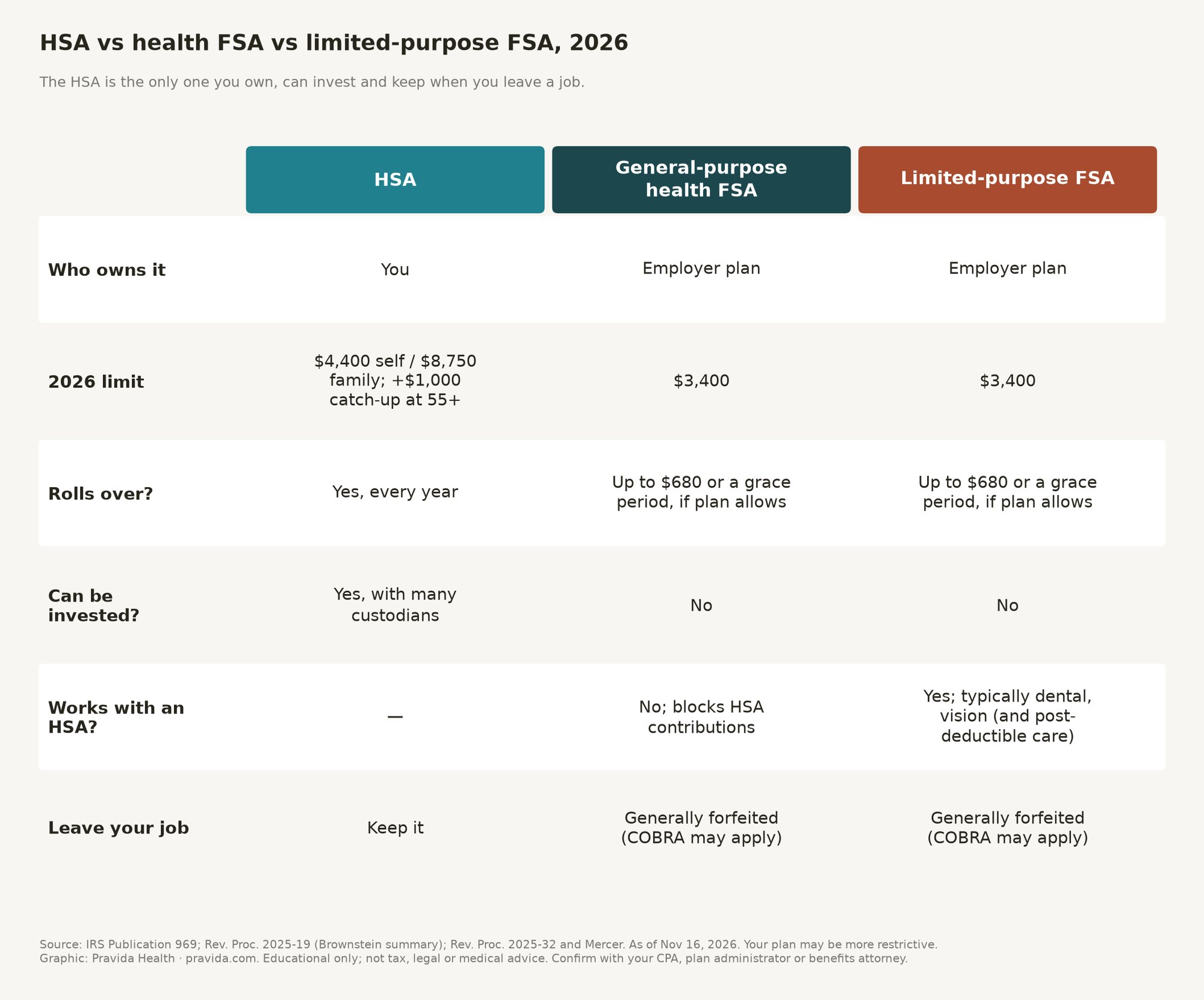
A health savings account is an account you own, not your employer. Contributions are tax-deductible or made pre-tax through payroll, the balance can be invested, and withdrawals for qualified medical expenses are tax-free. The money rolls over every year and stays with you if you change jobs (IRS Publication 969). If you withdraw money for something that isn’t a medical expense, it is taxable, and there is an extra 20% tax unless you are 65 or older, disabled, or the withdrawal follows death (IRS Publication 969).
For prevention and longevity care, that combination is powerful. Annual physicals and diagnostic tests by a physician, laboratory fees and electronic body scans are all listed as includible medical expenses in IRS Publication 502, even if you aren’t ill at the time (IRS Publication 502). Whether a given test is worth doing is a medical question; whether it can be paid from an HSA is usually answered by Publication 502.
Sources: Rev. Proc. 2025-19 summary (Brownstein); IRS Rev. Proc. 2025-32; Mercer.
Who can contribute in 2026
To contribute to an HSA, you need to be covered by a high-deductible health plan and generally have no other health coverage that pays before the deductible. For 2026 that plan must have a deductible of at least $1,700 for self-only coverage or $3,400 for family coverage, with out-of-pocket maximums no higher than $8,500 and $17,000 (Brownstein).
New: bronze and catastrophic plans
The 2025 budget law known as the One Big Beautiful Bill Act expanded eligibility. Starting January 1, 2026, bronze and catastrophic plans in the individual market are treated as HSA-compatible, even if they wouldn’t otherwise meet the high-deductible rules. IRS Notice 2026-5 confirms this includes matching plans bought outside the Exchange, but not bronze plans sold through the small-business SHOP marketplace (IRS; IRS Notice 2026-5; WTW). If you buy your own coverage, this may be the first year you can open an HSA.
New: direct primary care arrangements
Before 2026, many advisors worried that a direct primary care membership could count as disqualifying “other coverage.” The new law and Notice 2026-5 resolved that for a narrow type of arrangement. A direct primary care service arrangement doesn’t block HSA contributions if it provides only primary care from primary care practitioners for a fixed periodic fee, and the fee is no more than $150 a month for one person or $300 a month for a family. It can’t include procedures requiring general anesthesia, prescription drugs other than vaccines, or lab services beyond those typical of an ambulatory primary care practice (IRS Notice 2026-5; NFP). Fees for a qualifying arrangement can be paid from the HSA tax-free.
Most longevity, concierge and executive health programs, including Pravida’s, include advanced imaging, specialty testing or specialist care, so they are unlikely to meet that definition. I cover what that means in the direct care and concierge memberships post.
The pay-now, reimburse-later strategy
You don’t have to take money out of an HSA in the year you have an expense. The IRS rule is that the expense must be incurred after you establish the HSA, and you aren’t required to make withdrawals each year (IRS Publication 969). Some people use that to treat the HSA as a long-term health reserve:
- Contribute the maximum you can afford, including catch-up contributions after 55.
- Pay for this year’s medical care from regular savings if you can.
- Keep every itemized receipt and explanation of benefits in one folder, with the date and who received the care.
- Leave the HSA invested, and reimburse yourself for those documented expenses in a later year when you need the cash.
This only works with good records, and you can’t reimburse an expense that was already paid by insurance, an FSA or another plan. Ask your tax advisor how long to keep documentation.
What an HSA can’t pay for
- Most insurance premiums. Exceptions include qualified long-term care insurance, COBRA continuation coverage, coverage while receiving unemployment compensation, and Medicare and other coverage after 65, but not Medigap (IRS Publication 969).
- General wellness. Gym and spa dues, most supplements and diet food don’t qualify unless tied to treatment of a specific diagnosed condition (IRS Publication 502). The IRS has warned that purchased doctor’s notes don’t change that (IRS).
- Cosmetic procedures that don’t meaningfully promote the proper function of the body or treat disease (IRS Publication 502).
Flexible spending accounts
A health FSA is offered by an employer through a cafeteria plan. You choose a payroll amount at open enrollment, and the full annual amount is generally available from the start of the plan year. For 2026, the limit is $3,400 (IRS Rev. Proc. 2025-32).
The trade-off is that FSAs are generally use-it-or-lose-it. A plan may allow a grace period of up to two and a half months, or a carryover of unused funds, but not both for a health FSA (IRS Publication 969). For plan years beginning in 2026, the maximum carryover is $680 (Mercer). Because the money doesn’t roll over the way an HSA does, an FSA works best for planned expenses, such as an annual prevention visit and scheduled testing.
The limited-purpose FSA
A general-purpose health FSA counts as other coverage and blocks HSA contributions. A limited-purpose FSA doesn’t. Publication 969 says these arrangements can pay for items such as dental and vision care, and can also pay preventive care expenses (IRS Publication 969). Your plan document decides exactly what yours covers. If your employer offers both an HSA-eligible plan and a limited-purpose FSA, using the FSA for predictable dental, vision and covered preventive costs leaves more of your HSA invested for other care.
Two special rules worth knowing
- More-than-2% S-corporation owners are not treated as employees for cafeteria plan purposes and can’t participate in a health FSA (IRS).
- Direct primary care fees can’t be double-dipped. According to Notice 2026-5, an HSA can’t reimburse direct primary care fees that were paid by an employer or through pre-tax salary reduction (IRS Notice 2026-5; WTW).
Putting it together for prevention
For a household planning a year of prevention care, a practical sequence is: confirm you have an HSA-eligible plan; decide with your physician which tests are actually indicated for you; fund the HSA to the limit if you can; use a limited-purpose FSA for dental and vision if it’s offered; and keep itemized invoices for every visit and test. Ask your provider for an itemized invoice that lists each service, rather than a single bundled fee, so your plan administrator can see what was medical care.
Before you act on anything here. I am a physician, not a CPA, enrolled agent or benefits attorney. Tax treatment depends on your plan documents, your employment and entity structure, and facts I can’t see. Use this post to prepare better questions for your tax advisor and plan administrator, not as a substitute for them.
The Wellness Wallet series
This post is part of the Wellness Wallet series on tax-advantaged ways to pay for longevity and prevention care that a typical commercial plan doesn’t cover. The series:
- The Wellness Wallet: 10 ways to pay for prevention insurance doesn’t cover
- HRAs, QSEHRAs and ICHRAs (CHOICE arrangements)
- Section 105 MERPs and executive health plans
- Self-employed: the health insurance deduction and long-term care
- Paying for direct care and concierge memberships
For employers, see the business case for executive health. Pravida’s programs are described on the memberships and executive health pages; pricing is provided at your consultation.
Talk through your plan with our care team
Bring a list of what you spent on health care last year and which accounts you have (HSA, FSA, HRA or a business plan). We will explain which Pravida services are medical diagnostic or treatment services, and we can provide itemized invoices and documentation for your CPA or plan administrator. We can’t tell you whether a fee will qualify under your plan; that decision belongs to your plan administrator and tax advisor.
- Free 15-minute discovery call with our care coordinator
- Virtual consultation: 45 minutes, $295 (adults located in Georgia or Florida during the visit)
- In-person consultation in Midtown Atlanta: 60 minutes, $495
- Membership and program pricing is provided at your consultation
Pravida Health, 1801 Peachtree St NE, Suite 150, Atlanta, GA 30309. Call 404-900-7371, email info@pravida.com or request an appointment. Please don’t send health details by email or website form.
Frequently asked questions
What are the 2026 HSA contribution limits?
For 2026, you can contribute up to $4,400 with self-only coverage or $8,750 with family coverage, plus a $1,000 catch-up contribution if you are 55 or older. The plan must have a deductible of at least $1,700 self-only or $3,400 family.
Can I open an HSA with a bronze Marketplace plan in 2026?
Yes, in most cases. Starting January 1, 2026, bronze and catastrophic individual-market plans are treated as HSA-compatible, including matching plans bought outside the Exchange. Bronze plans bought through the small-business SHOP marketplace don’t qualify under IRS Notice 2026-5.
Can I pay for a direct primary care membership with my HSA?
Yes, if it qualifies as a direct primary care service arrangement: primary care only, a fixed periodic fee of no more than $150 a month for one person or $300 for a family, and no general anesthesia procedures, prescription drugs other than vaccines, or labs beyond typical primary care. Memberships that include specialty testing or imaging are unlikely to qualify.
Can I reimburse myself from my HSA years later?
Generally yes, if the expense was incurred after you established the HSA, it wasn’t reimbursed by another source, and you keep records. The IRS doesn’t require you to take withdrawals each year. Ask your tax advisor about documentation.
Can I have an FSA and an HSA at the same time?
Not a general-purpose health FSA, because it counts as other coverage. A limited-purpose FSA, which typically covers dental, vision and preventive care depending on the plan, is compatible with an HSA.
References
- IRS. Publication 969, Health Savings Accounts and Other Tax-Favored Health Plans. IRS.
- IRS. Publication 502, Medical and Dental Expenses. IRS.
- Brownstein. Employee benefits-related limits for 2026 (summarizing Rev. Proc. 2025-19). Brownstein.
- IRS. Revenue Procedure 2025-32. IRS.
- Mercer. 2026 health FSA and other health and fringe benefit limits. Mercer.
- IRS. Treasury, IRS provide guidance on new tax benefits for health savings account participants under the One, Big, Beautiful Bill. December 2025. IRS.
- IRS. Notice 2026-5. IRS.
- WTW. IRS issues guidance on HSA provisions in the One Big Beautiful Bill Act. December 2025. WTW.
- NFP. IRS releases OBBBA guidance on expanded availability of HSAs. NFP.
- IRS. S corporation compensation and medical insurance issues. IRS.
- IRS. IR-2024-65 alert on nutrition, wellness and general health expenses. IRS.