
Key takeaways
- Qualifying direct primary care fees are now HSA-eligible. This applies for months beginning after December 31, 2025, and you can still contribute to your HSA.
- The definition is narrow. It covers primary care only, for a fixed fee up to $150 a month for one person or $300 for more than one, with no separate billing.
- Fees an employer pays don’t qualify for HSA reimbursement. That includes fees paid by salary reduction through a cafeteria plan.
- Most concierge and longevity memberships don’t fit the definition. Advanced imaging, specialty testing and higher fees fall outside it. How the IRS treats those fees isn’t settled.
- Documentation does the heavy lifting. Ask for itemized invoices that separate medical services from everything else.
What changed in 2026
For years, people in direct primary care practices worried that their membership would cost them HSA eligibility. The One Big Beautiful Bill Act and IRS Notice 2026-5 addressed that. For months beginning after December 31, 2025, being in a qualifying direct primary care service arrangement doesn’t disqualify you from contributing to an HSA, and the fees can be paid from the HSA as qualified medical expenses (IRS; IRS Notice 2026-5).
Sources: IRS Notice 2026-5; WTW.
The test for direct primary care
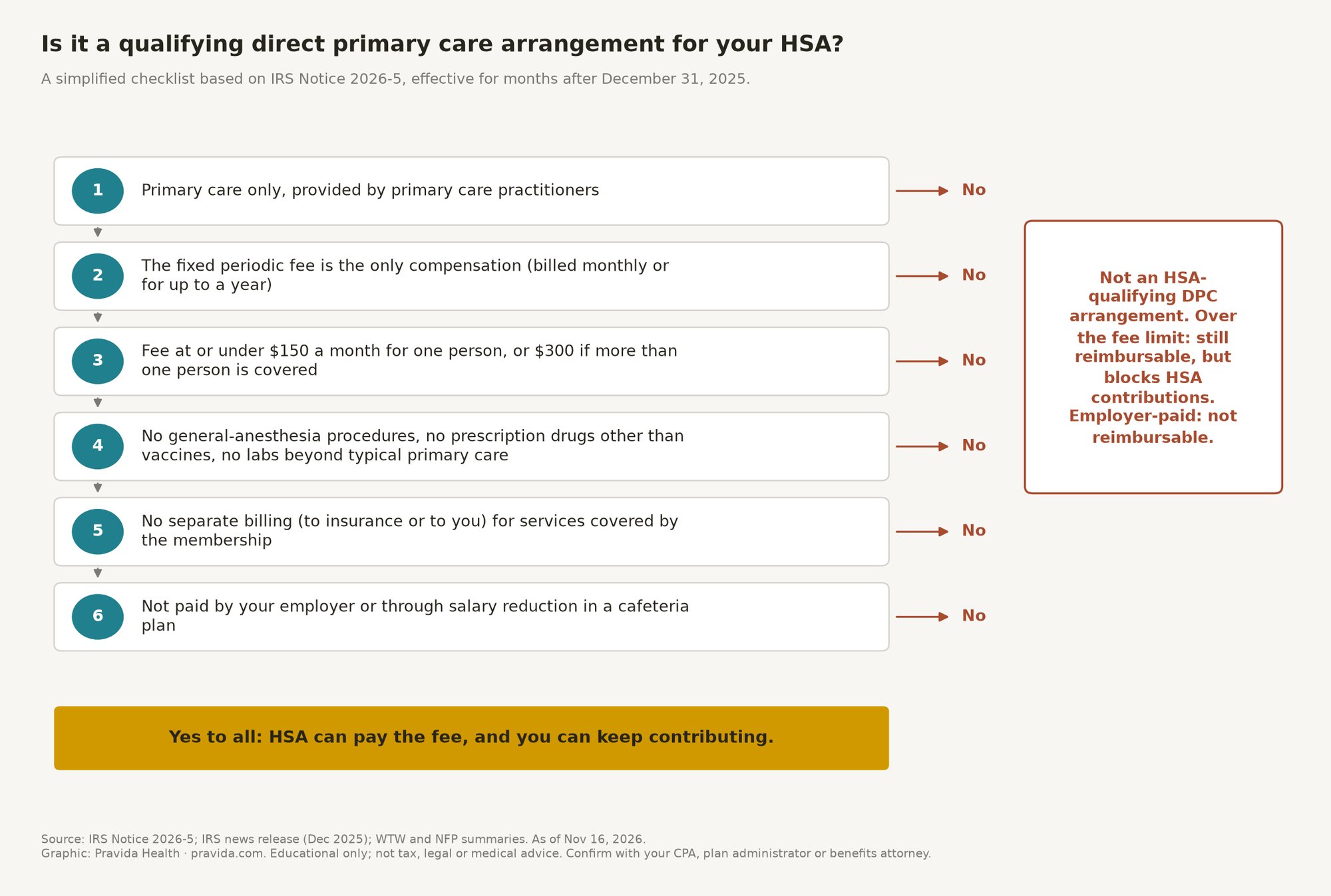
Based on the IRS notice and benefits-law summaries (WTW; NFP), an arrangement generally qualifies if:
- It is primary care only, provided by primary care practitioners.
- The only compensation is a fixed periodic fee. Fees can be billed monthly or for longer periods up to a year.
- The fee stays within the limit: $150 a month for one individual or $300 if more than one individual is covered, for 2026.
- It doesn’t include excluded services: procedures requiring general anesthesia, prescription drugs other than vaccines, and lab services not typically given in an ambulatory primary care setting.
- It doesn’t bill separately for covered services, through insurance or otherwise. A practice can still bill separately for services it offers to members and non-members outside the arrangement.
Whether an arrangement qualifies depends on its terms, not on the services you happen to use (WTW).
Three details that catch people
Fees above the limit
Fees above the monthly limit can still be reimbursed from an HSA as medical expenses, but they make the covered person ineligible to contribute to an HSA while enrolled (WTW).
Employer-paid fees
Direct primary care fees can’t be reimbursed from an HSA if your employer paid them, including payment by salary reduction through a cafeteria plan (WTW). If your employer sponsors the membership, you can’t also claim it from your HSA.
Your health plan’s deductible
An HSA-qualified plan can’t pay direct primary care fees before the deductible is met, and the plan can’t count your membership fees toward its deductible or out-of-pocket maximum (WTW).
Where concierge and longevity memberships fit
This is the part I want to be most candid about, because it applies to practices like ours. Most concierge, executive health and longevity memberships include things the direct primary care definition excludes or doesn’t contemplate: specialty physician care, advanced imaging, extensive laboratory panels, genomic testing, or fees above $150 a month. Those memberships are not qualifying direct primary care arrangements.
That doesn’t automatically mean every dollar is ineligible, and it doesn’t mean it’s eligible either. IRS Publication 502 doesn’t list concierge or retainer fees as a category (IRS Publication 502). It does list many of the underlying services, such as physical exams, diagnostic tests and laboratory fees, as medical care. How the IRS treats a non-DPC membership fee that bundles medical services with access or convenience isn’t settled, and reasonable advisors differ. The IRS has also warned about companies that misrepresent general wellness expenses as medical care (IRS).
Practically, that means:
- Itemized services are easier to substantiate than a flat fee. A physical exam, a diagnostic test or a lab panel can usually be documented as medical care.
- Pure access or convenience components are hard to defend as medical expenses.
- Before you pay from an HSA, ask your tax advisor how the specific fee should be treated, and keep the documentation.
FSAs, HRAs and business plans
A health FSA follows similar medical-expense rules, but timing and substantiation are set by your plan administrator. With an HRA, QSEHRA or Section 105 plan, reimbursement depends on the plan document and the administrator’s substantiation rules (IRS Publication 969). Some employers deliberately write executive health and preventive programs into the plan. See HRAs, QSEHRAs and ICHRAs and Section 105 plans.
How Pravida handles this
Pravida’s memberships aren’t direct primary care arrangements as the IRS defines them, and we don’t represent that any fee qualifies for HSA, FSA or HRA reimbursement. What we do:
- Provide itemized invoices that separate medical diagnostic and treatment services from other components.
- Supply visit documentation and, where appropriate, a letter of medical necessity when a physician has a specific clinical reason for a service.
- Encourage you to review the documentation with your CPA or plan administrator before you seek reimbursement.
Membership and program pricing is provided at your consultation.
Questions to ask any practice
- Is this a direct primary care arrangement under IRS Notice 2026-5? If so, what’s the monthly fee and who is covered?
- Do you bill separately, to insurance or to me, for any services included in the membership?
- Can you give me itemized invoices that separate medical services?
- Is my employer paying any part of this fee?
- Does your fee or service list change during the year?
Before you act on anything here. I am a physician, not a CPA, enrolled agent or benefits attorney. Tax treatment depends on your plan documents, your employment and entity structure, and facts I can’t see. Use this post to prepare better questions for your tax advisor and plan administrator, not as a substitute for them.
The Wellness Wallet series
This post is part of the Wellness Wallet series on tax-advantaged ways to pay for longevity and prevention care that a typical commercial plan doesn’t cover. The series:
- The Wellness Wallet: 10 ways to pay for prevention insurance doesn’t cover
- HSAs and FSAs for prevention in 2026
- HRAs, QSEHRAs and ICHRAs (CHOICE arrangements)
- Section 105 MERPs and executive health plans
- Self-employed: the health insurance deduction and long-term care
For employers, see the business case for executive health. Pravida’s programs are described on the memberships and executive health pages; pricing is provided at your consultation.
Talk through your plan with our care team
Bring a list of what you spent on health care last year and which accounts you have (HSA, FSA, HRA or a business plan). We will explain which Pravida services are medical diagnostic or treatment services, and we can provide itemized invoices and documentation for your CPA or plan administrator. We can’t tell you whether a fee will qualify under your plan; that decision belongs to your plan administrator and tax advisor.
- Free 15-minute discovery call with our care coordinator
- Virtual consultation: 45 minutes, $295 (adults located in Georgia or Florida during the visit)
- In-person consultation in Midtown Atlanta: 60 minutes, $495
- Membership and program pricing is provided at your consultation
Pravida Health, 1801 Peachtree St NE, Suite 150, Atlanta, GA 30309. Call 404-900-7371, email info@pravida.com or request an appointment. Please don’t send health details by email or website form.
Frequently asked questions
Can I use my HSA to pay for direct primary care in 2026?
Yes, if the arrangement qualifies under IRS Notice 2026-5: primary care only, a fixed periodic fee of no more than $150 a month for one person or $300 for more than one, no excluded services and no separate billing. The fee must not be paid by your employer.
What happens if my direct primary care fee is more than $150 a month?
The fee can still be reimbursed from an HSA as a medical expense, but you can’t contribute to an HSA while you’re enrolled in that arrangement.
Can I pay a concierge medicine membership with my HSA?
Most concierge and longevity memberships aren’t qualifying direct primary care arrangements. IRS Publication 502 doesn’t list concierge fees, and the treatment of those fees isn’t settled. Itemized medical services such as exams and diagnostic tests are easier to document. Ask your tax advisor first.
Can my employer pay for my direct primary care membership?
An employer can sponsor a membership, but direct primary care fees paid by an employer, including through salary reduction in a cafeteria plan, can’t also be reimbursed from your HSA.
Does Pravida guarantee my membership is HSA- or FSA-eligible?
No. Pravida provides itemized invoices and visit documentation, but does not represent that any fee qualifies. Eligibility depends on IRS rules, your plan documents and your circumstances.
References
- IRS. Notice 2026-5: Expanded availability of health savings accounts under the One Big Beautiful Bill Act. IRS.
- IRS. Treasury, IRS provide guidance on new tax benefits for HSA participants. December 2025. IRS.
- WTW. IRS issues guidance on HSA provisions in the One Big Beautiful Bill Act. December 2025. WTW.
- NFP. IRS releases OBBBA guidance on expanded availability of HSAs. NFP.
- IRS. Publication 502, Medical and Dental Expenses. IRS.
- IRS. Publication 969, Health Savings Accounts and Other Tax-Favored Health Plans. IRS.
- IRS. Beware of companies misrepresenting nutrition, wellness and general health expenses as medical care. IRS.