
Key takeaways
- A MERP is a self-insured employer reimbursement plan. Under section 105(b), reimbursements of an employee’s medical expenses, including a spouse’s and dependents’, can be tax-free.
- The spouse-employee strategy is built for sole proprietors. If a spouse genuinely works in the business as a W-2 employee, the plan can cover the family, including the owner.
- It generally doesn’t work in an S corporation. More-than-2% shareholders are treated like partners for fringe benefits, and family attribution pulls in the spouse.
- Self-insured plans can’t favor executives. Section 105(h) can make reimbursements taxable for highly compensated people if a plan discriminates.
- Executive physicals have a narrow exception. Diagnostic procedures for employees, such as routine exams, blood tests and X-rays, are excluded from 105(h) testing. Treatment, fitness and dependents are not.
Two strategies, one section of the tax code
Section 105 of the Internal Revenue Code governs how employer reimbursements for medical care are taxed. Two planning ideas come up in almost every conversation I have with business owners about paying for prevention: the medical expense reimbursement plan, or MERP, and executive health benefits offered only to leaders. They rely on the same code section but solve different problems, and both are easy to get wrong.
This post explains how they work in plain terms so you can have a more productive conversation with your CPA and benefits attorney. It is not a plan design.
How a MERP works
A MERP is a written plan under which an employer reimburses employees for qualified medical expenses. Because the employer bears the cost directly rather than buying insurance, it is a self-insured plan. When the requirements are met, reimbursements aren’t taxable income to the employee, and section 105(b) coverage extends to the employee’s spouse and children under 27 (Tim CPA). The core requirements CPAs describe are a written plan, real employment, substantiation of each expense and compliance with nondiscrimination and other health-plan rules (Bharmal CPAs).
The spouse-employee strategy
A sole proprietor isn’t an employee of their own business, so they can’t cover themselves directly. If their spouse genuinely works in the business as a W-2 employee, though, the spouse can be covered by a Section 105 plan, and the spouse’s family coverage reaches the owner (Tim CPA). When structured correctly, the business deducts the reimbursements as a business expense (Bharmal CPAs).
The word that matters most is “genuinely.” Advisors are consistent that the spouse must perform real, non-trivial work and be paid reasonably for it, and that putting a spouse “on the books” to get the tax benefit doesn’t work (XY Planning Network). Employment documentation, such as job descriptions and time records, is part of the plan, not an afterthought. One CPA describes the employment question as the most litigated part of the arrangement (Tim CPA).
Why entity type changes everything
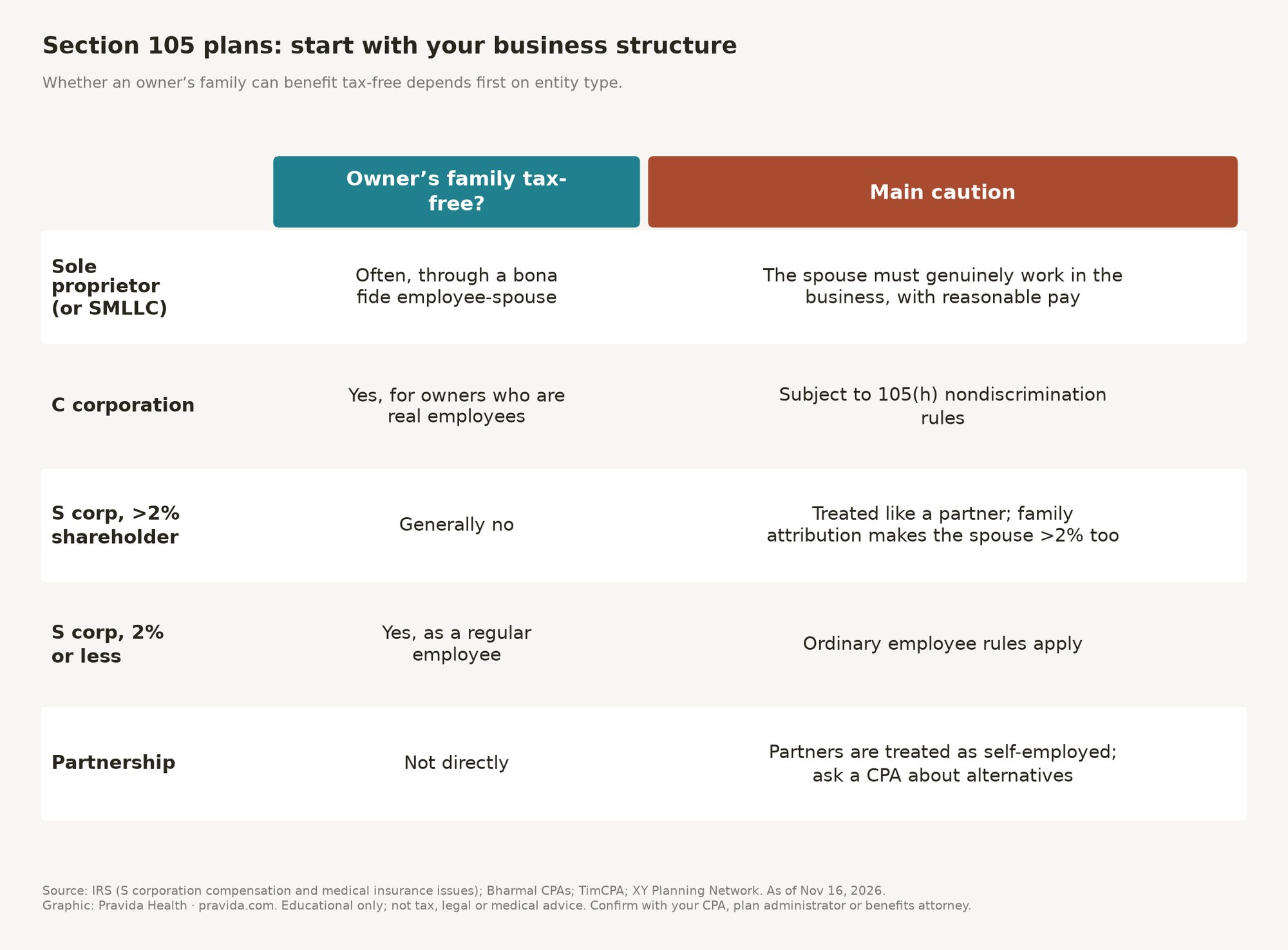
| Business structure | Can the owner’s family benefit tax-free? | Notes |
|---|---|---|
| Sole proprietorship (or single-member LLC taxed as one) | Often, through a bona fide employee-spouse | The setting the spouse-employee strategy is built for |
| C corporation | Yes, for owners who are genuine employees | Subject to section 105(h) nondiscrimination rules |
| S corporation, more-than-2% shareholder | Generally no | Shareholders are treated like partners for fringe benefits, and family attribution makes the spouse a 2% shareholder too |
| S corporation, 2% or less | Yes, as a regular employee | Ordinary employee rules apply |
| Partnership | Not directly | Partners are generally treated as self-employed; ask a CPA about alternatives |
Sources: Tim CPA; Bharmal CPAs; IRS; BenefitComply.
The S-corporation row is the one I see cause the most confusion. Under section 1372, a more-than-2% shareholder is treated like a partner for fringe-benefit purposes, and the section 318 family-attribution rules treat the owner’s spouse as a more-than-2% shareholder too, purely because of the marriage (Tim CPA). The IRS says these shareholders can’t participate in an HRA or other self-insured arrangement on a tax-free basis (IRS). S-corporation owners usually rely on having the corporation pay health premiums, reporting them as W-2 wages, and taking the self-employed health insurance deduction (Bharmal CPAs).
Section 105(h): the nondiscrimination rule
Self-insured medical reimbursement plans, which include MERPs and most HRAs, are subject to section 105(h). In broad terms, a plan can’t favor highly compensated individuals in who is eligible or in the benefits provided. If it does, some or all reimbursements to those individuals become taxable income (26 CFR 1.105-11). That matters for a small business with non-family employees: a plan that covers the owner’s household but not the rest of the team is likely to fail.
Benefits advisors also point out that a reimbursement plan has to fit other rules, including the Affordable Care Act’s market reforms and ERISA (Newfront). Those rules are a big reason small employers with several employees often use a QSEHRA or ICHRA instead. See HRAs, QSEHRAs and ICHRAs.
Executive health plans and the diagnostic exception
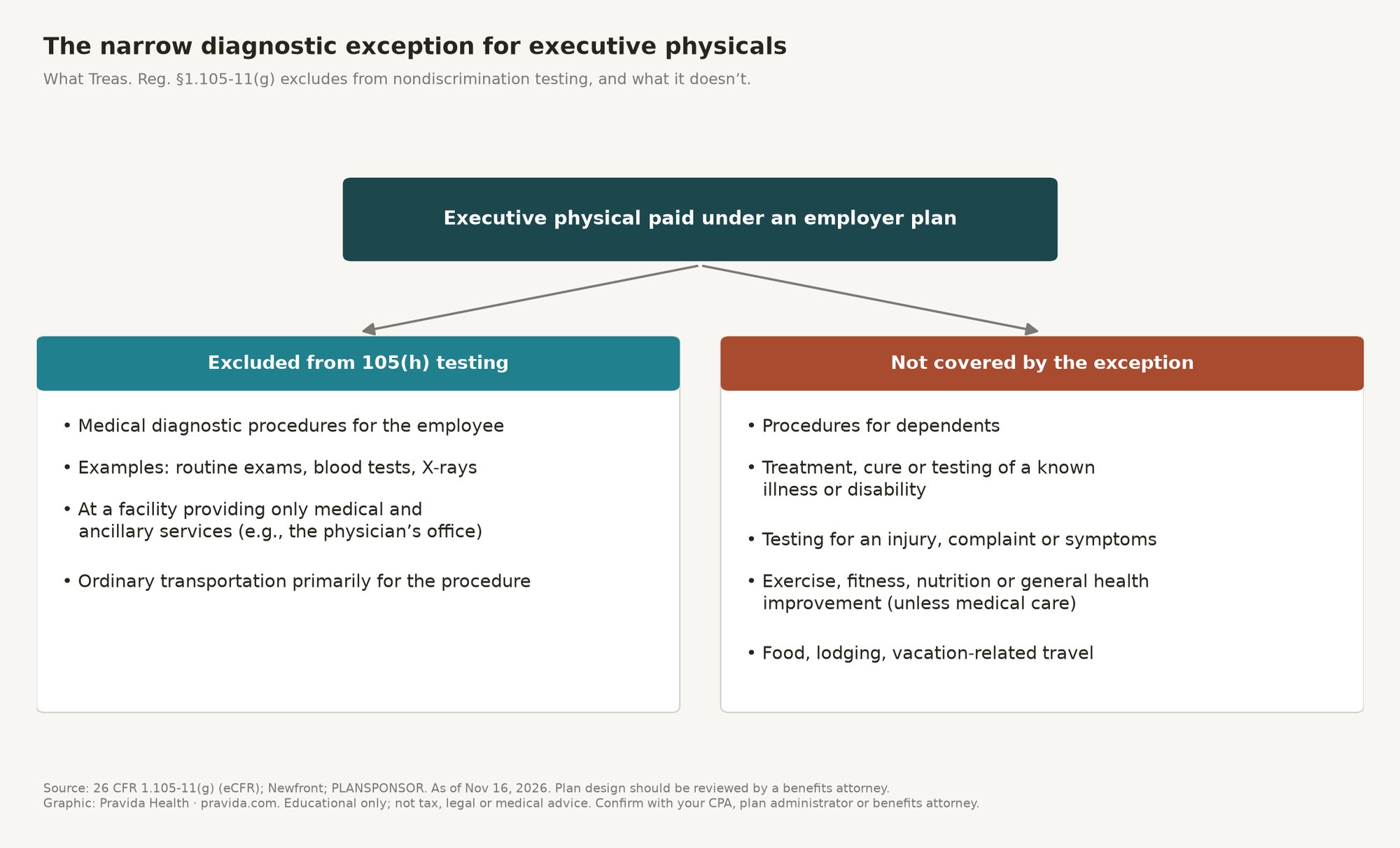
Companies often want to offer comprehensive physicals only to executives. Some marketing materials describe executive health plans as “bypassing” nondiscrimination rules. That overstates it. What exists is a specific, narrow exception in the Treasury regulations (26 CFR 1.105-11(g)):
- What is excluded from 105(h) testing: reimbursements paid under a plan for medical diagnostic procedures for an employee. The regulation gives routine medical examinations, blood tests and X-rays as examples.
- What is not excluded: procedures for dependents; expenses for treatment, cure or testing of a known illness or disability; treatment or testing for a physical injury, complaint or symptoms; and exercise, fitness, nutrition, recreation or general health improvement, unless it is medical care.
- Where it must happen: the procedures must be performed at a facility that provides only medical and ancillary services. Being physically near nonmedical facilities doesn’t by itself disqualify a medical facility, and the regulation’s own example is an annual physical at the employee’s personal physician’s office.
- Travel: ordinary and necessary transportation primarily for the diagnostic procedure is included, but food, lodging and travel connected with a vacation are not.
In practice, an employer can usually offer diagnostic executive physicals to a select group of leaders without failing nondiscrimination testing. What follows the physical, such as treatment of a finding, coaching, or care for a spouse, needs a different structure: the company’s regular health plan, a nondiscriminatory reimbursement plan, or a taxable benefit (Newfront; PLANSPONSOR).
Why this lines up with good medicine
The exception maps onto how I think a good executive program should be built anyway. The diagnostic visit finds risk. The value comes from what happens next: follow-up, treatment and continuity over years. Planning for that second phase from the start, both clinically and in the plan design, avoids the common problem of a thorough physical that produces a report and no follow-through. I make the broader business case in the business case for executive health.
Questions to bring to your CPA or benefits attorney
- Given my entity type, can my family benefit tax-free from a Section 105 plan at all?
- If I employ my spouse, what documentation of the work and compensation do you want to see?
- Do I have non-family employees who would need to be covered under 105(h)?
- For an executive physical program, which parts fit the diagnostic exception, and how should follow-up care be handled?
- Who will administer and substantiate claims?
Before you act on anything here. I am a physician, not a CPA, enrolled agent or benefits attorney. Tax treatment depends on your plan documents, your employment and entity structure, and facts I can’t see. Use this post to prepare better questions for your tax advisor and plan administrator, not as a substitute for them.
The Wellness Wallet series
This post is part of the Wellness Wallet series on tax-advantaged ways to pay for longevity and prevention care that a typical commercial plan doesn’t cover. The series:
- The Wellness Wallet: 10 ways to pay for prevention insurance doesn’t cover
- HSAs and FSAs for prevention in 2026
- HRAs, QSEHRAs and ICHRAs (CHOICE arrangements)
- Self-employed: the health insurance deduction and long-term care
- Paying for direct care and concierge memberships
For employers, see the business case for executive health. Pravida’s programs are described on the memberships and executive health pages; pricing is provided at your consultation.
Talk through your plan with our care team
Bring a list of what you spent on health care last year and which accounts you have (HSA, FSA, HRA or a business plan). We will explain which Pravida services are medical diagnostic or treatment services, and we can provide itemized invoices and documentation for your CPA or plan administrator. We can’t tell you whether a fee will qualify under your plan; that decision belongs to your plan administrator and tax advisor.
- Free 15-minute discovery call with our care coordinator
- Virtual consultation: 45 minutes, $295 (adults located in Georgia or Florida during the visit)
- In-person consultation in Midtown Atlanta: 60 minutes, $495
- Membership and program pricing is provided at your consultation
Pravida Health, 1801 Peachtree St NE, Suite 150, Atlanta, GA 30309. Call 404-900-7371, email info@pravida.com or request an appointment. Please don’t send health details by email or website form.
Frequently asked questions
What is a Section 105 plan?
A Section 105 plan, often called a medical expense reimbursement plan or MERP, is a written, self-insured employer plan that reimburses employees for qualified medical expenses. When the requirements are met, reimbursements are tax-free to the employee and can cover the employee’s spouse and children under 27.
Can I hire my spouse to deduct our family’s medical costs?
For a sole proprietor, it may be possible if your spouse is a bona fide W-2 employee who performs real work for reasonable pay, and the business adopts a written plan with proper substantiation. The IRS scrutinizes these arrangements, so review the facts with a CPA.
Does the spouse-employee Section 105 strategy work in an S corporation?
Generally not for the owner’s family. More-than-2% S-corporation shareholders are treated like partners for fringe-benefit purposes, and family attribution rules treat the owner’s spouse as a more-than-2% shareholder too. S-corporation owners usually use W-2 premium reporting and the self-employed health insurance deduction instead.
Can executive health plans be offered only to executives?
Diagnostic procedures can be. Treasury regulations exclude employee medical diagnostic procedures, such as routine exams, blood tests and X-rays, from section 105(h) nondiscrimination testing. Treatment, testing for known conditions or symptoms, fitness and nutrition programs, and dependents aren’t covered by that exception.
Is an executive physical a taxable benefit?
It depends on how it is provided. Diagnostic physicals under a qualifying arrangement can be excluded from income. Other components or poorly structured plans may be taxable. A benefits attorney should review the plan.
References
- Treas. Reg. §1.105-11, Self-insured medical reimbursement plans, including the diagnostic procedures exception at §1.105-11(g). eCFR.
- IRS. S corporation compensation and medical insurance issues. IRS.
- Tim CPA. The Section 105 medical reimbursement plan. Tim CPA.
- Bharmal CPAs. Section 105 plans for family health coverage. Bharmal CPAs.
- XY Planning Network. A small business owner’s guide to Section 105 plans. XY Planning Network.
- BenefitComply. Owner and directors benefits: eligibility and taxation. BenefitComply.
- Newfront. Executive health benefits. Newfront.
- PLANSPONSOR. Are executive physical programs impacted by the PPACA’s new nondiscrimination rules? PLANSPONSOR.