
Key takeaways
- The test is “medical care,” not “healthy.” Tax-advantaged accounts pay for diagnosis, treatment and prevention of disease. General wellness, gym fees and most supplements don’t qualify.
- Physicals and body scans can qualify. IRS Publication 502 includes annual physicals and diagnostic tests, even if you aren’t ill, and the cost of an electronic body scan.
- A doctor’s note doesn’t convert wellness into medicine. The IRS has warned about companies selling letters of medical necessity based on self-reported information.
- Your work situation decides which vehicles you can use. Employees, small-business owners, S-corporation owners and the self-employed have very different options.
- 2026 brought real changes. Bronze and catastrophic plans became HSA-compatible, and certain direct primary care fees can now be paid from an HSA.
The gap between insurance and prevention
Most health plans must cover a set of preventive services, such as screening tests and immunizations, at no cost when you use an in-network provider (HealthCare.gov). That list is valuable, and I want every patient current on it. But it was built around population screening. Much of what my longevity patients ask about falls outside it: coronary plaque imaging when standard risk scores look normal, advanced lipid and metabolic testing, genetic panels, body composition and fitness testing, longer physician visits, and ongoing access to a physician who follows the data over years.
Those services usually end up paid out of pocket. The good news is that the tax code offers more than one way to pay for medical care with pre-tax or tax-deductible dollars. The catch is that each vehicle has its own eligibility rules, limits and definitions. This series walks through them. This first post is the map.
Sources: Rev. Proc. 2025-19 summary (Brownstein); IRS Rev. Proc. 2025-32; IRS Topic 502.
What the IRS counts as medical care
Every vehicle in this series pays for, or deducts, “medical care” as defined in the tax code: the diagnosis, cure, mitigation, treatment or prevention of disease. IRS Publication 502 is the practical reference (IRS Publication 502). A few entries matter most for prevention and longevity care:
- Physical examinations. You can include the cost of an annual physical examination and diagnostic tests by a physician. You don’t have to be ill at the time.
- Body scans. Publication 502 lists the cost of an electronic body scan as an includible medical expense.
- Laboratory fees and diagnostic services that are part of medical care.
- Weight-loss programs only when they treat a specific disease diagnosed by a physician, such as obesity, hypertension or heart disease. Programs to improve general health don’t count.
- Nutritional supplements, vitamins and gym memberships generally don’t count unless recommended by a medical practitioner as treatment for a specific diagnosed condition.
Being eligible as a medical expense is not the same as being recommended. Whole-body MRI is includible as a medical expense, but the American College of Radiology does not recommend it for people without symptoms or risk factors (ACR). Tax rules tell you how to pay; they don’t tell you what is worth doing. That conversation belongs with your physician.
The letter-of-medical-necessity trap
In 2024 the IRS issued an alert warning that some companies were selling doctors’ notes, based only on self-reported health information, that claimed to make food, wellness and exercise expenses reimbursable. The IRS said those notes don’t establish that an expense is related to a targeted, diagnosis-specific treatment. It also warned that a plan that reimburses non-medical expenses is not a qualified plan, which can make all of its payments taxable, including legitimate ones (IRS). A legitimate letter follows a real diagnosis from a clinician who is treating you. It is not a product.
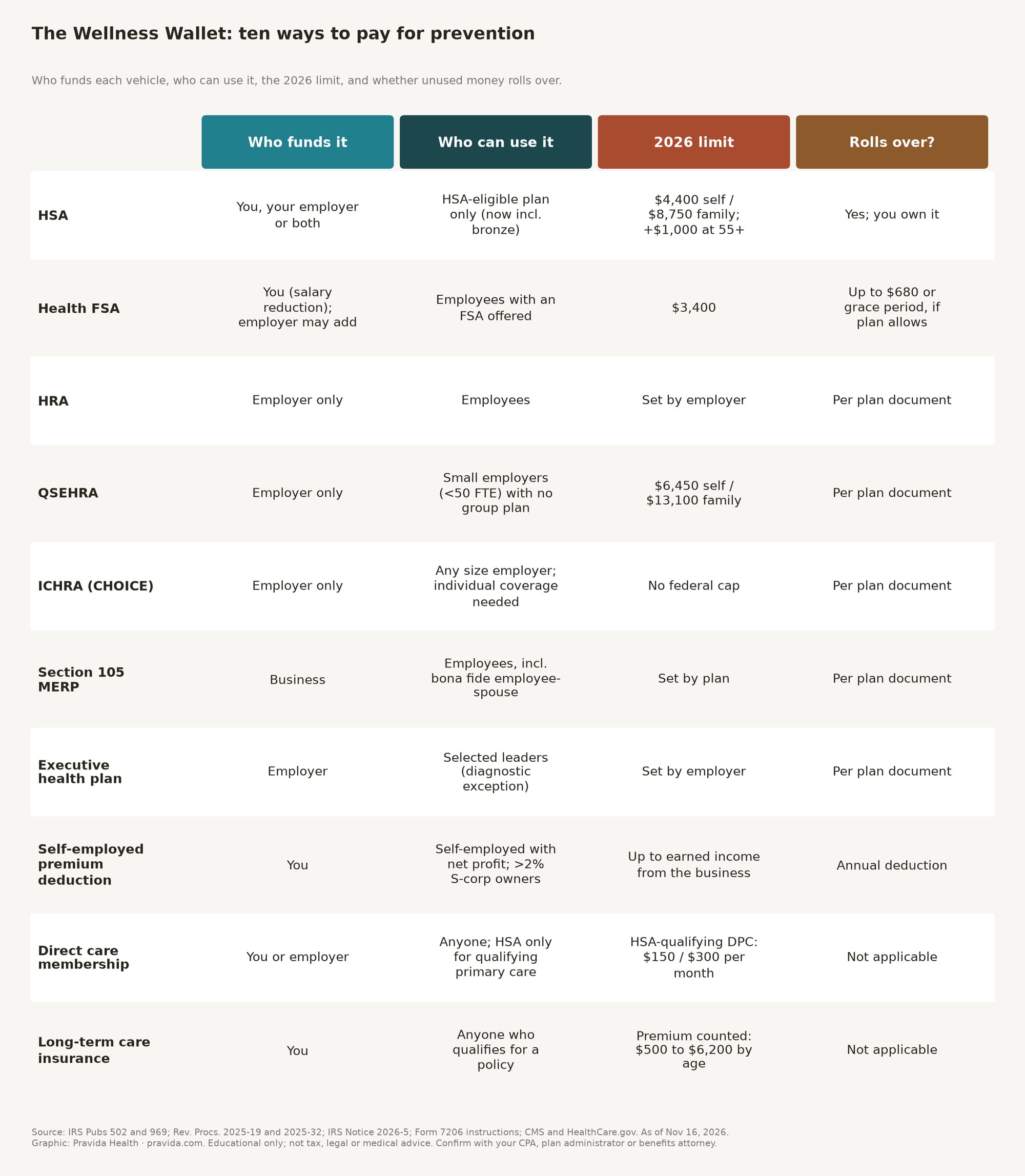
The 10 vehicles at a glance
| Vehicle | Who can use it | 2026 limit | Key point |
|---|---|---|---|
| Health savings account (HSA) | People covered only by an HSA-eligible high-deductible plan, now including bronze and catastrophic plans | $4,400 self / $8,750 family; +$1,000 at 55+ | Contributions, growth and medical withdrawals can all be tax-free. Funds roll over and are yours. |
| Health FSA | Employees whose employer offers one | $3,400; carryover up to $680 if the plan allows | Mostly use-it-or-lose-it. A limited-purpose FSA can sit alongside an HSA. |
| Health reimbursement arrangement (HRA) | Employees only; employer funds it | Set by the employer | Reimburses what the plan document allows, up to the employer’s amount. |
| QSEHRA | Employees of employers with fewer than 50 full-time employees and no group plan | $6,450 self / $13,100 family | Small-employer reimbursement of premiums and medical costs. |
| ICHRA (now called a CHOICE arrangement) | Employees of employers of any size; must have individual coverage | No federal cap | Employer gives a set amount for individual insurance and medical expenses. |
| Section 105 medical expense reimbursement plan (MERP) | Employees, including a bona fide employee-spouse of a sole proprietor | Set by the plan | Classic small-business strategy. Doesn’t work the same way in an S corporation. |
| Executive health benefit plan | Employers choosing to fund physicals for leaders | Set by the employer | Diagnostic procedures for employees have a narrow exception from 105(h) nondiscrimination rules. |
| Self-employed health insurance deduction | Self-employed people with net profit and no subsidized employer plan available | Up to net self-employment earnings | Above-the-line deduction for health, dental, vision and qualified long-term care premiums. |
| Direct care and concierge memberships | Anyone; payment route depends on the account | HSA-compatible primary care fees up to $150 / $300 per month | Only narrow primary care arrangements fit the new HSA rule. |
| Long-term care insurance | Anyone; tax benefit depends on age and vehicle | Deductible premium caps by age, $500 to $6,200 | HSA funds can pay qualified premiums up to the age-based limit. |
Sources for limits: Rev. Proc. 2025-19 summary; IRS Rev. Proc. 2025-32; Mercer; IRS Notice 2026-5; HealthCare.gov.
Which vehicles fit your situation
The fastest way to narrow the list is to start with how you earn your income:
- W-2 employee at a larger company. Your options are whatever your employer offers: an HSA with a qualifying plan, a health FSA, possibly an HRA, and in some companies an executive physical benefit. Ask HR for the plan documents. Start with HSAs and FSAs.
- Owner of a small business with employees. A QSEHRA, an ICHRA or a group plan with an HRA may fit. See HRAs, QSEHRAs and ICHRAs.
- Sole proprietor with a spouse who genuinely works in the business. A Section 105 plan may cover the family’s medical expenses. See Section 105 MERPs.
- Self-employed, partner or more-than-2% S-corporation owner. The self-employed health insurance deduction and an HSA, if you have a qualifying plan, are often the core. See the self-employed post.
- Considering a direct care or concierge membership. The payment route depends heavily on how the membership is structured. See paying for memberships.
The fallback: itemizing medical expenses
If none of the accounts fits, unreimbursed medical expenses can still be deducted if you itemize, but only the amount that exceeds 7.5% of your adjusted gross income (IRS Topic 502). For many households that threshold is high, which is why the account-based options matter.
A note on donor-advised funds
Some planning guides list donor-advised funds alongside health accounts. A donor-advised fund supports charities; it can’t pay for your own medical care. Starting in 2026, itemizers can deduct charitable gifts only above 0.5% of adjusted gross income, and the 60%-of-income limit for cash gifts to public charities is now permanent (The Tax Adviser; Vanguard Charitable). If giving is part of your plan, a donor-advised fund may help with timing, but it belongs in a conversation with your financial advisor, not your health budget.
Three conversations to have this year
- With your CPA or tax advisor. Which vehicles are open to you given your employment and entity structure? For a business owner, is a QSEHRA, ICHRA or Section 105 plan worth the administration?
- With your benefits administrator or HR. Does your FSA allow carryover? Is there an HRA or executive physical benefit you haven’t been shown? Are you contributing the full HSA amount, including catch-up after 55?
- With your physician. Which tests and services are actually indicated for you, based on your history and risk? That keeps your spending on care that is likely to matter.
Before you act on anything here. I am a physician, not a CPA, enrolled agent or benefits attorney. Tax treatment depends on your plan documents, your employment and entity structure, and facts I can’t see. Use this post to prepare better questions for your tax advisor and plan administrator, not as a substitute for them.
The Wellness Wallet series
This post is part of the Wellness Wallet series on tax-advantaged ways to pay for longevity and prevention care that a typical commercial plan doesn’t cover. The series:
- HSAs and FSAs for prevention in 2026
- HRAs, QSEHRAs and ICHRAs (CHOICE arrangements)
- Section 105 MERPs and executive health plans
- Self-employed: the health insurance deduction and long-term care
- Paying for direct care and concierge memberships
For employers, see the business case for executive health. Pravida’s programs are described on the memberships and executive health pages; pricing is provided at your consultation.
Talk through your plan with our care team
Bring a list of what you spent on health care last year and which accounts you have (HSA, FSA, HRA or a business plan). We will explain which Pravida services are medical diagnostic or treatment services, and we can provide itemized invoices and documentation for your CPA or plan administrator. We can’t tell you whether a fee will qualify under your plan; that decision belongs to your plan administrator and tax advisor.
- Free 15-minute discovery call with our care coordinator
- Virtual consultation: 45 minutes, $295 (adults located in Georgia or Florida during the visit)
- In-person consultation in Midtown Atlanta: 60 minutes, $495
- Membership and program pricing is provided at your consultation
Pravida Health, 1801 Peachtree St NE, Suite 150, Atlanta, GA 30309. Call 404-900-7371, email info@pravida.com or request an appointment. Please don’t send health details by email or website form.
Frequently asked questions
Can I use my HSA for a longevity or executive physical?
Often yes for the medical parts. IRS Publication 502 includes annual physical examinations and diagnostic tests by a physician, even if you aren’t ill, and the cost of an electronic body scan. Fitness programs, general wellness services and most supplements don’t qualify. Membership fees are a separate question covered in the direct care post in this series.
Does a letter of medical necessity make supplements or a gym membership HSA-eligible?
Only in narrow cases. The expense has to be recommended by a medical practitioner as treatment for a specific diagnosed condition. The IRS has warned that notes based only on self-reported information, often sold online, don’t convert general wellness expenses into medical expenses.
What are the 2026 HSA and FSA limits?
For 2026, HSA contributions are limited to $4,400 for self-only coverage and $8,750 for family coverage, plus a $1,000 catch-up at age 55 or older. The health FSA limit is $3,400, with up to $680 carryover if the plan allows it.
Can a donor-advised fund pay for my medical care?
No. A donor-advised fund supports charities and can’t pay for your own expenses. Starting in 2026, itemizers can deduct charitable gifts only above 0.5% of adjusted gross income.
If something is HSA-eligible, does that mean it’s recommended?
No. Tax eligibility and medical value are separate questions. Whole-body MRI, for example, is an includible medical expense, but the American College of Radiology doesn’t recommend it for people without symptoms or risk factors. Decide what is worth doing with your physician first.
References
- IRS. Publication 502, Medical and Dental Expenses. IRS.
- IRS. Topic No. 502, Medical and dental expenses. IRS.
- IRS. Publication 969, Health Savings Accounts and Other Tax-Favored Health Plans. IRS.
- Brownstein. Employee benefits-related limits for 2026 (summarizing Rev. Proc. 2025-19). Brownstein.
- IRS. Revenue Procedure 2025-32. IRS.
- Mercer. 2026 health FSA and other health and fringe benefit limits. Mercer.
- IRS. Notice 2026-5. IRS.
- IRS. IR-2024-65: Beware of companies misrepresenting nutrition, wellness and general health expenses as medical care. IRS.
- HealthCare.gov. Preventive health services. HealthCare.gov.
- HealthCare.gov. CHOICE Arrangements (formerly ICHRAs). HealthCare.gov.
- American College of Radiology. ACR statement on screening total body MRI. 2023. ACR.
- The Tax Adviser. Current developments in taxation of individuals, 2026. AICPA & CIMA.
- Vanguard Charitable. Charitable deduction guide for 2026 taxes. Vanguard Charitable.