

Key takeaways
- The deduction covers premiums, not other care. Medical, dental, vision and qualified long-term care insurance premiums for you, your spouse, dependents and children under 27.
- It’s above the line, but limited. It can’t exceed your earned income from the business, and it doesn’t reduce self-employment tax.
- Any month you could join a subsidized employer plan is out. That includes your spouse’s employer plan, even if you don’t enroll.
- S-corporation owners follow a specific routine. The corporation pays or reimburses premiums, reports them as W-2 wages, and the owner takes the deduction.
- Long-term care premiums count, up to age-based limits. For 2026, the deductible amount ranges from $500 at 40 or under to $6,200 over 70.
Why this post exists
Many of my patients are physicians, consultants, founders and other independent professionals. They are often the most motivated about prevention, and the least served by the employer accounts covered elsewhere in this series. Sole proprietors and partners aren’t employees, so they can’t participate in an HRA or FSA, and more-than-2% S-corporation shareholders face similar limits (IRS Publication 969; IRS). Their core tools are different: the self-employed health insurance deduction, long-term care insurance rules and an HSA if they have a qualifying plan.
Sources: IRS Form 7206 instructions; IRS Rev. Proc. 2025-32; Mercer; Rev. Proc. 2025-19 summary.
The self-employed health insurance deduction
Who qualifies
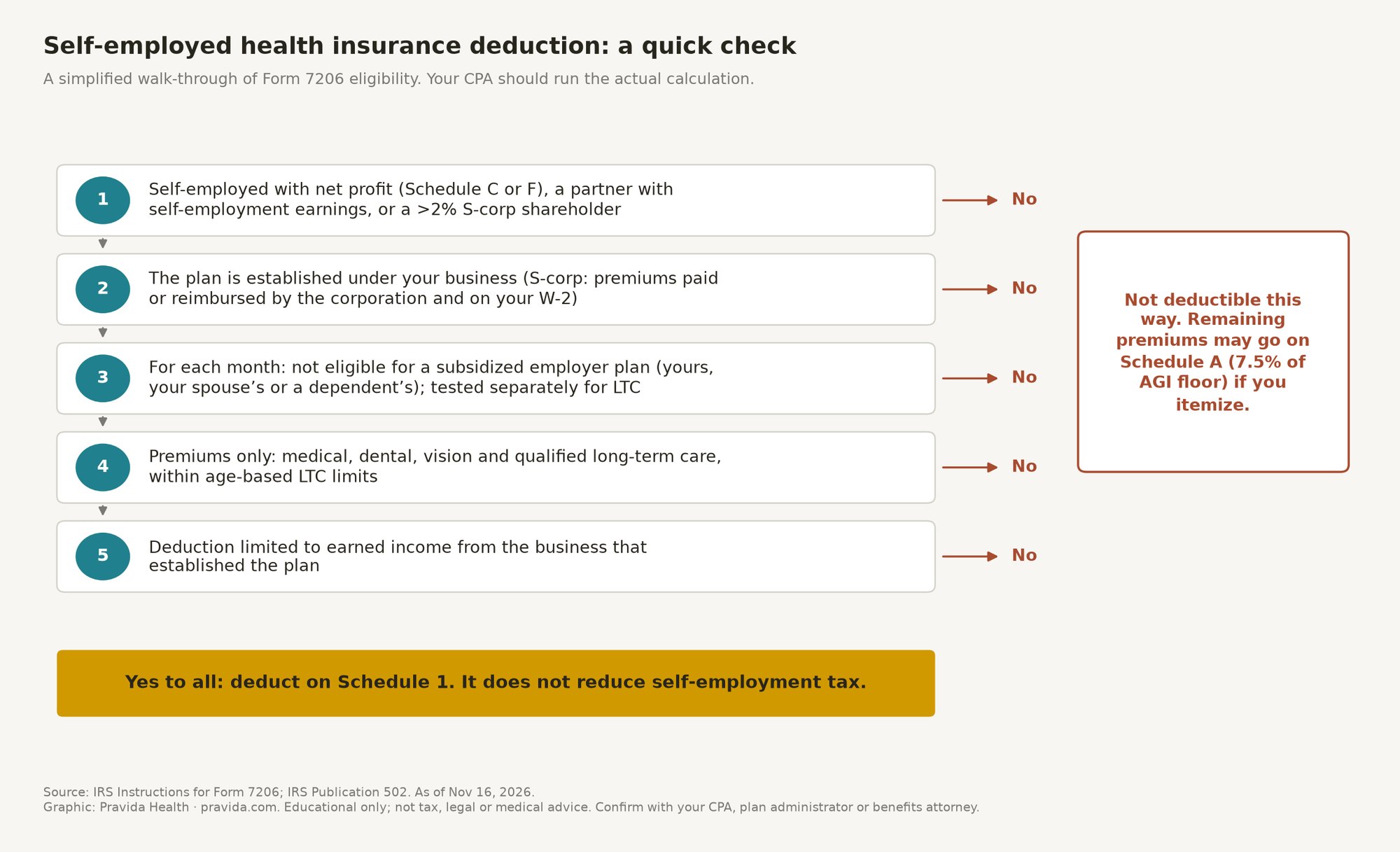
According to the IRS instructions for Form 7206, you may qualify if one of these is true: you were self-employed with a net profit reported on Schedule C or F; you were a partner with net earnings from self-employment; you used an optional method to figure self-employment earnings; or you received wages from an S corporation in which you were a more-than-2% shareholder. The insurance plan must be established under your business (IRS).
What it covers
The deduction covers amounts paid for medical, dental and vision insurance and qualified long-term care insurance for you, your spouse and your dependents. It can also cover a child who was under 27 at the end of the year, even if the child isn’t your dependent (IRS). It is taken on Schedule 1 of Form 1040, so you don’t need to itemize.
The limits that matter
- Earned income cap. The deduction can’t be more than your earned income from the business under which the plan is established (IRS Publication 502).
- Subsidized employer plans. You can’t deduct premiums for any month you were eligible to participate in a subsidized health plan through your employer, your spouse’s employer, or the employer of a dependent or child under 27, even if you didn’t enroll. That test is applied separately for long-term care coverage (IRS).
- Premiums only. The deduction covers insurance premiums, not out-of-pocket care, and it doesn’t reduce self-employment tax (Bharmal CPAs).
- Leftovers. Premiums you can’t deduct this way can be included with other medical expenses on Schedule A if you itemize, subject to the 7.5% floor (IRS).
- Marketplace coverage. If you also claim the premium tax credit, the two calculations interact; IRS Publication 974 explains how (IRS Publication 974).
The S-corporation routine
For a more-than-2% S-corporation shareholder, the plan is treated as established under the business when the corporation pays or reimburses the premiums and includes them in the shareholder’s W-2 wages. The shareholder then takes the deduction on their personal return (IRS; Bharmal CPAs). If the premiums are paid personally and never run through the corporation, the deduction can be lost. This is a once-a-year payroll step to set up with your CPA.
Long-term care insurance in a longevity plan
Most of my work is about keeping people independent for as long as possible. Long-term care insurance addresses the financial side of the same goal: paying for help if you lose the ability to care for yourself. It is a financial product, not medical care, and Pravida doesn’t sell or recommend specific policies. The tax rules are still worth knowing.
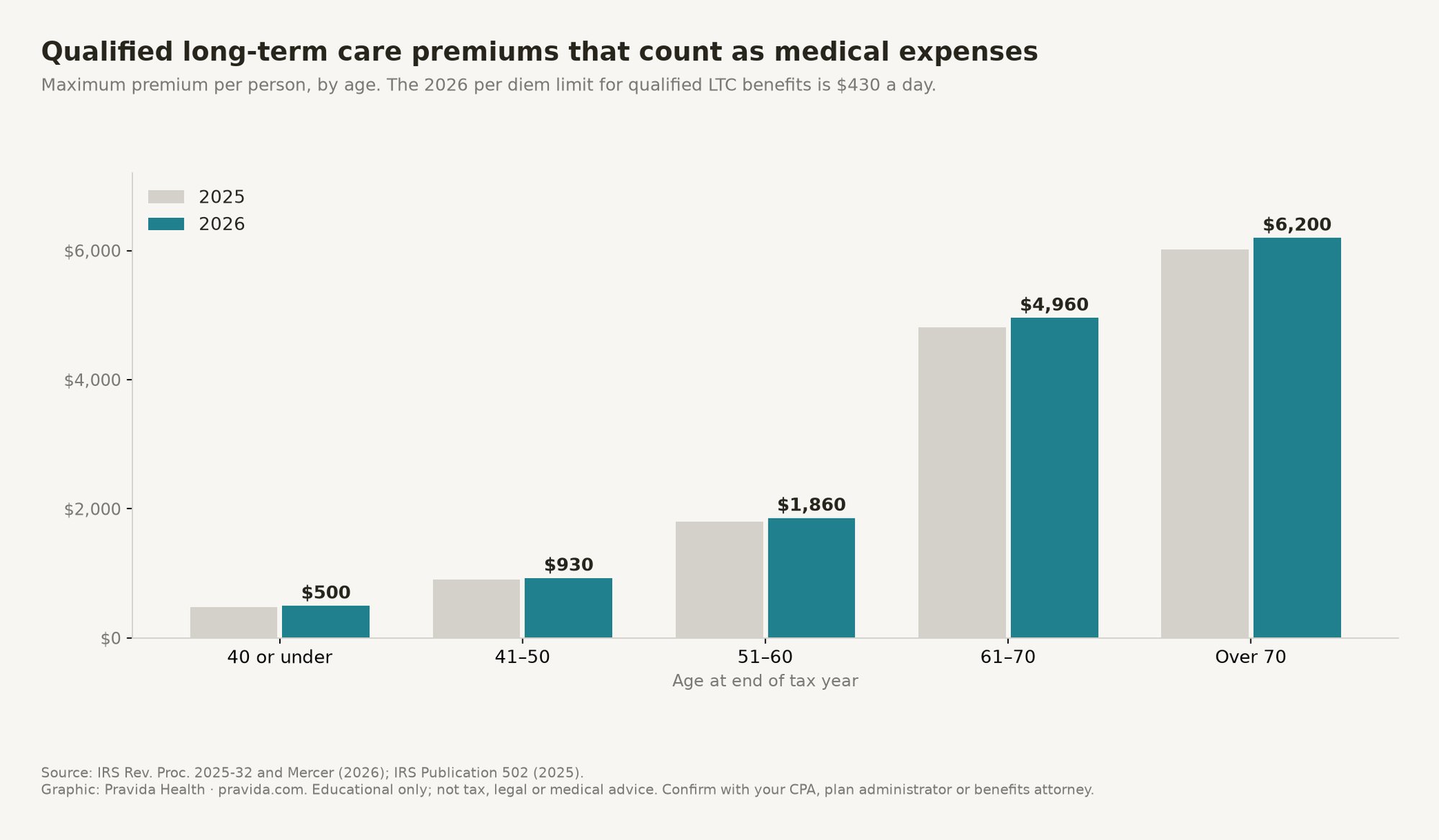
A qualified long-term care insurance contract must cover only qualified long-term care services, be guaranteed renewable, and have no cash surrender value, among other requirements (IRS Publication 502). Premiums count as medical expenses up to an age-based limit per person. For 2026, those limits are:
| Age at end of year | 2026 maximum premium counted |
|---|---|
| Age 40 or under | $500 |
| 41 to 50 | $930 |
| 51 to 60 | $1,860 |
| 61 to 70 | $4,960 |
| Over 70 | $6,200 |
Source: IRS Rev. Proc. 2025-32; Mercer. The 2026 per diem limit for qualified long-term care benefits is $430 a day.
Those amounts can be part of the self-employed health insurance deduction (IRS), and an HSA can pay qualified long-term care insurance premiums (IRS Publication 969). Ask your HSA custodian and tax advisor how the age-based limit applies to HSA withdrawals. Hybrid life and long-term care policies are more complicated; review them with a licensed financial professional.
Adding an HSA
An HSA is often the best complement for self-employed people, because it covers the out-of-pocket care the premium deduction doesn’t: physicals, diagnostic tests and other medical expenses. Contributions you make yourself are deductible whether or not you itemize (IRS Publication 969). Starting in 2026, bronze and catastrophic individual plans are HSA-compatible, which opens the door for many people who buy their own coverage (IRS). See HSAs and FSAs in 2026 for limits and strategy.
If you are a sole proprietor and your spouse genuinely works in the business, a Section 105 plan may be worth discussing too.
A practical sequence
- Confirm which entity you operate through, and whether you or your spouse can join a subsidized employer plan.
- Choose health coverage. If it’s HSA-eligible, open and fund the HSA.
- Make sure premiums are paid through the business in the way your CPA needs, especially in an S corporation.
- If long-term care insurance is part of your plan, review policy type and age-based limits with a licensed advisor.
- Plan your prevention care with your physician and keep itemized invoices for HSA reimbursement.
Before you act on anything here. I am a physician, not a CPA, enrolled agent or benefits attorney. Tax treatment depends on your plan documents, your employment and entity structure, and facts I can’t see. Use this post to prepare better questions for your tax advisor and plan administrator, not as a substitute for them.
The Wellness Wallet series
This post is part of the Wellness Wallet series on tax-advantaged ways to pay for longevity and prevention care that a typical commercial plan doesn’t cover. The series:
- The Wellness Wallet: 10 ways to pay for prevention insurance doesn’t cover
- HSAs and FSAs for prevention in 2026
- HRAs, QSEHRAs and ICHRAs (CHOICE arrangements)
- Section 105 MERPs and executive health plans
- Paying for direct care and concierge memberships
For employers, see the business case for executive health. Pravida’s programs are described on the memberships and executive health pages; pricing is provided at your consultation.
Talk through your plan with our care team
Bring a list of what you spent on health care last year and which accounts you have (HSA, FSA, HRA or a business plan). We will explain which Pravida services are medical diagnostic or treatment services, and we can provide itemized invoices and documentation for your CPA or plan administrator. We can’t tell you whether a fee will qualify under your plan; that decision belongs to your plan administrator and tax advisor.
- Free 15-minute discovery call with our care coordinator
- Virtual consultation: 45 minutes, $295 (adults located in Georgia or Florida during the visit)
- In-person consultation in Midtown Atlanta: 60 minutes, $495
- Membership and program pricing is provided at your consultation
Pravida Health, 1801 Peachtree St NE, Suite 150, Atlanta, GA 30309. Call 404-900-7371, email info@pravida.com or request an appointment. Please don’t send health details by email or website form.
Frequently asked questions
Who can take the self-employed health insurance deduction?
Generally, self-employed people with a net profit on Schedule C or F, partners with self-employment earnings, and more-than-2% S-corporation shareholders whose premiums are paid by the corporation and included in W-2 wages. The plan must be established under the business.
Can I take the deduction if my spouse has employer coverage?
Not for any month you were eligible to participate in a subsidized employer plan through your spouse’s employer, even if you didn’t enroll. The test is applied separately for long-term care insurance.
Does the self-employed health insurance deduction cover doctor visits or tests?
No. It covers insurance premiums only, including medical, dental, vision and qualified long-term care insurance. Out-of-pocket care can be paid from an HSA or included in itemized medical deductions above 7.5% of income.
How much long-term care insurance premium can I deduct in 2026?
The amount that counts as a medical expense depends on age: $500 at 40 or under, $930 at 41 to 50, $1,860 at 51 to 60, $4,960 at 61 to 70 and $6,200 over 70, per person.
Can my HSA pay long-term care insurance premiums?
Yes, qualified long-term care insurance premiums are one of the exceptions to the rule that HSAs can’t pay insurance premiums. Ask your HSA custodian and tax advisor how the age-based limits apply.
References
- IRS. Instructions for Form 7206, Self-Employed Health Insurance Deduction (2025). IRS.
- IRS. Publication 502, Medical and Dental Expenses. IRS.
- IRS. Publication 969, Health Savings Accounts and Other Tax-Favored Health Plans. IRS.
- IRS. Publication 974, Premium Tax Credit. IRS.
- IRS. Revenue Procedure 2025-32. IRS.
- Mercer. 2026 health FSA and other health and fringe benefit limits. Mercer.
- Brownstein. Employee benefits-related limits for 2026. Brownstein.
- IRS. Guidance on new HSA tax benefits under the One, Big, Beautiful Bill. December 2025. IRS.
- IRS. S corporation compensation and medical insurance issues. IRS.
- Bharmal CPAs. Section 105 plans for family health coverage. Bharmal CPAs.