
Key takeaways
- An HRA is employer money under a written plan. Only the employer can fund it, only employees can use it, and the plan document decides which medical expenses it reimburses.
- Small employers have the QSEHRA. Employers with fewer than 50 full-time employees and no group plan can reimburse up to $6,450 self-only or $13,100 family in 2026.
- Any size employer can offer an ICHRA. HealthCare.gov now calls it a CHOICE arrangement. Employees must have individual coverage, and there is no federal dollar cap.
- Owners are often excluded. Sole proprietors, partners and more-than-2% S-corporation shareholders can’t participate in an HRA as employees.
- Watch the HSA interaction. A general HRA blocks HSA contributions. A limited-purpose HRA doesn’t.
What an HRA is
A health reimbursement arrangement is a promise by an employer to reimburse employees for qualified medical expenses up to a set amount each year. IRS Publication 969 states the basics: an HRA must be funded solely by the employer, reimbursements are tax-free for qualified medical expenses, and self-employed people aren’t eligible (IRS Publication 969). Some HRAs let unused amounts carry over to the next year; the employer can’t refund the balance to the employee.
Unlike an HSA, the employee doesn’t own the money. Unlike an FSA, the employee doesn’t contribute through salary reduction. The employer’s written plan defines what is covered, which is why HRAs are flexible tools for prevention care: an employer can choose to include physicals and diagnostic testing that the group health plan covers only partly.
Sources: IRS Rev. Proc. 2025-32; Mercer; HealthCare.gov.
The four main types
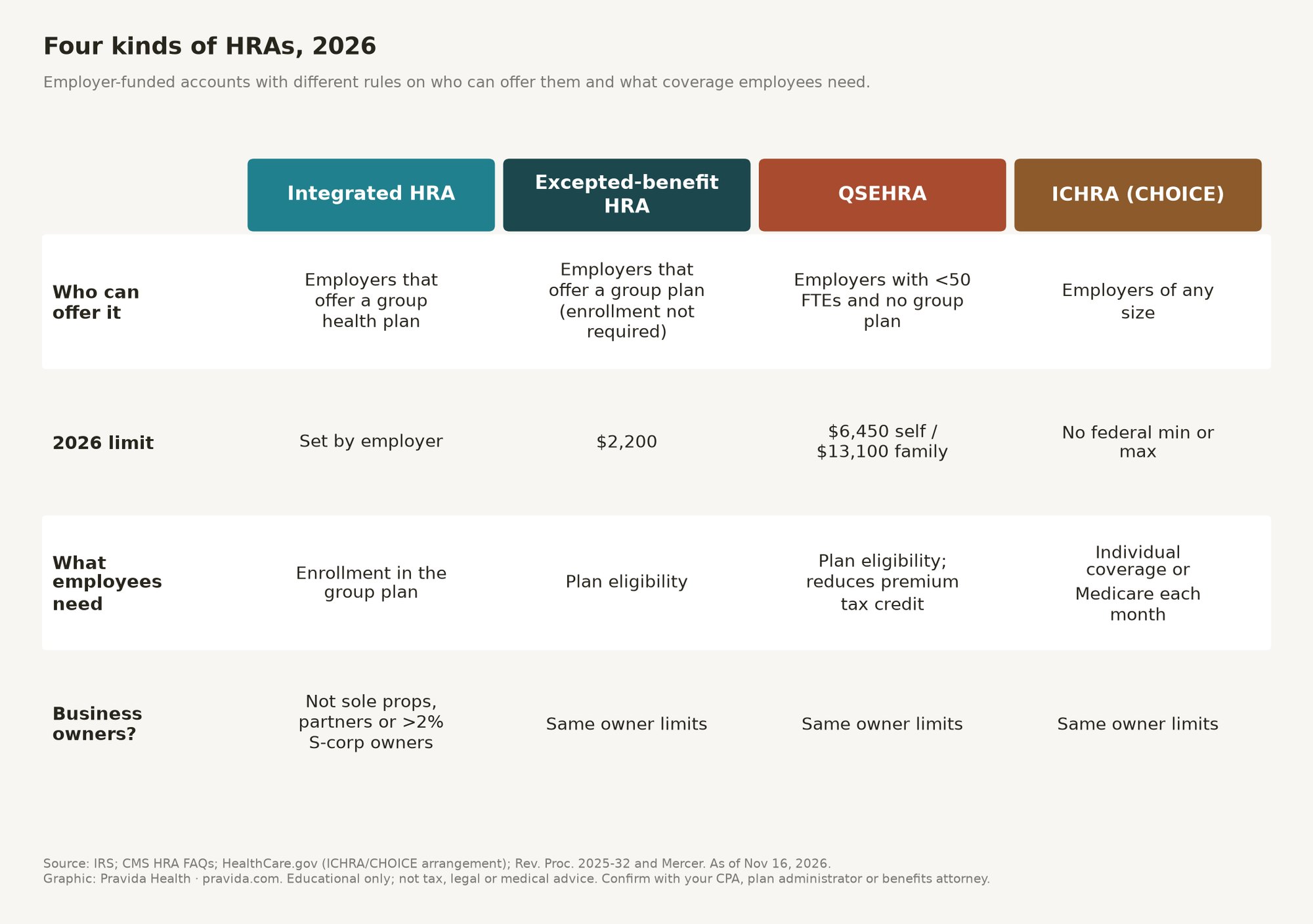
| Type | Who can offer it | 2026 limit | What employees need |
|---|---|---|---|
| Integrated HRA | Employers that also offer a group health plan | Set by the employer | Enrollment in the employer’s group plan |
| Excepted-benefit HRA | Employers that offer a group plan (employees don’t have to enroll in it) | $2,200 | Nothing beyond eligibility under the plan |
| QSEHRA | Employers with fewer than 50 full-time employees that offer no group health plan | $6,450 self-only / $13,100 family | Plan eligibility; premium tax credits are reduced by the QSEHRA amount |
| ICHRA (CHOICE arrangement) | Employers of any size | No federal minimum or maximum | Individual health insurance or Medicare for every month covered |
Sources: IRS Rev. Proc. 2025-32; Mercer; CMS HRA FAQs; HealthCare.gov; CMS.
QSEHRA: the small-employer option
A qualified small employer HRA was created for employers with fewer than 50 full-time employees, including full-time equivalents, that don’t offer a group health plan to anyone (CMS). For 2026, the maximum reimbursement is $6,450 for self-only coverage and $13,100 for family coverage (IRS Rev. Proc. 2025-32). It generally has to be offered to all eligible employees on the same terms (Bharmal CPAs). Employees can use it for premiums for their own individual coverage and for qualified medical expenses the plan allows, which can include prevention care.
ICHRA, now called a CHOICE arrangement
The individual coverage HRA lets an employer of any size give employees a fixed amount to buy their own individual health insurance and pay qualified medical expenses, instead of offering a traditional group plan. HealthCare.gov now refers to these as CHOICE arrangements (HealthCare.gov). Key rules:
- Employees and covered family members must be enrolled in individual health insurance or Medicare for each month they use it. Short-term plans and dental-only coverage don’t count (CMS).
- There are no federal minimum or maximum contribution amounts (HealthCare.gov).
- The employer must offer it on the same terms within each class of employees, such as full-time, part-time, salaried or hourly, though amounts can rise with age and family size (CMS). For age-based amounts, the oldest employee’s amount can’t exceed three times the youngest’s (CMS).
- Employers generally give written notice at least 90 days before the plan year, and an offer can affect an employee’s eligibility for premium tax credits (CMS).
One development worth noting: bronze and catastrophic individual plans became HSA-compatible in 2026 (IRS Notice 2026-5). Whether an employee using an ICHRA can also contribute to an HSA depends on how the ICHRA is designed, because an ICHRA that reimburses general medical expenses before the deductible can count as other coverage. Confirm the design with your administrator before promising employees both.
The owner problem
Many small-business owners are surprised to learn they can’t use the HRA they set up for their team. According to the IRS, a more-than-2% S-corporation shareholder can’t participate in a QSEHRA or an HRA, because the tax exclusion applies to employees and those shareholders are treated like self-employed partners for fringe benefits (IRS). Sole proprietors and partners are not employees either (IRS Publication 969). Family attribution rules can also make a shareholder’s spouse or children ineligible (Tim CPA).
Owners in those situations usually look at the self-employed health insurance deduction, an HSA, or, for a sole proprietor with a spouse who genuinely works in the business, a Section 105 plan.
HRAs and HSAs together
A general HRA that reimburses medical expenses before the deductible counts as other coverage and generally blocks HSA contributions. A limited-purpose HRA, which reimburses items such as dental, vision and preventive care, doesn’t (IRS Publication 969). Employers who want to support both can pair an HSA-eligible plan with a limited-purpose HRA.
Designing an HRA that supports prevention
From the physician side, the design questions I’d encourage employers to raise with their benefits advisor are:
- Does the plan document explicitly include annual physicals and diagnostic testing? Publication 502 lists both as medical expenses, even when the person isn’t ill (IRS Publication 502).
- Does it exclude general wellness? The IRS has warned that plans reimbursing non-medical expenses risk losing their tax-qualified status (IRS).
- Is it nondiscriminatory? HRAs are self-insured arrangements subject to section 105(h). An HRA offered only to executives can make their reimbursements taxable, with a narrow exception for diagnostic procedures (26 CFR 1.105-11). See the Section 105 post.
- How will claims be substantiated? Itemized invoices from the provider make this easier for everyone.
Before you act on anything here. I am a physician, not a CPA, enrolled agent or benefits attorney. Tax treatment depends on your plan documents, your employment and entity structure, and facts I can’t see. Use this post to prepare better questions for your tax advisor and plan administrator, not as a substitute for them.
The Wellness Wallet series
This post is part of the Wellness Wallet series on tax-advantaged ways to pay for longevity and prevention care that a typical commercial plan doesn’t cover. The series:
- The Wellness Wallet: 10 ways to pay for prevention insurance doesn’t cover
- HSAs and FSAs for prevention in 2026
- Section 105 MERPs and executive health plans
- Self-employed: the health insurance deduction and long-term care
- Paying for direct care and concierge memberships
For employers, see the business case for executive health. Pravida’s programs are described on the memberships and executive health pages; pricing is provided at your consultation.
Talk through your plan with our care team
Bring a list of what you spent on health care last year and which accounts you have (HSA, FSA, HRA or a business plan). We will explain which Pravida services are medical diagnostic or treatment services, and we can provide itemized invoices and documentation for your CPA or plan administrator. We can’t tell you whether a fee will qualify under your plan; that decision belongs to your plan administrator and tax advisor.
- Free 15-minute discovery call with our care coordinator
- Virtual consultation: 45 minutes, $295 (adults located in Georgia or Florida during the visit)
- In-person consultation in Midtown Atlanta: 60 minutes, $495
- Membership and program pricing is provided at your consultation
Pravida Health, 1801 Peachtree St NE, Suite 150, Atlanta, GA 30309. Call 404-900-7371, email info@pravida.com or request an appointment. Please don’t send health details by email or website form.
Frequently asked questions
Can an HRA pay for an executive physical or longevity testing?
It can if the employer’s written plan includes those expenses and they qualify as medical care. IRS Publication 502 includes annual physicals and diagnostic tests by a physician, even when the person isn’t ill. General wellness, fitness and most supplements don’t qualify.
What is the 2026 QSEHRA limit?
For 2026, a QSEHRA can reimburse up to $6,450 for self-only coverage and $13,100 for family coverage. It is available to employers with fewer than 50 full-time employees that don’t offer a group health plan.
What is a CHOICE arrangement?
HealthCare.gov now uses CHOICE arrangement as the name for the individual coverage HRA, or ICHRA. Employers of any size can offer one, there is no federal dollar cap, and employees must be enrolled in individual health insurance or Medicare to use it.
Can I participate in my own company’s HRA as an owner?
It depends on your entity. The IRS says more-than-2% S-corporation shareholders can’t participate in an HRA or QSEHRA, and sole proprietors and partners aren’t employees. C-corporation owners who are employees generally can. Ask your CPA about family attribution rules.
Does an HRA stop me from contributing to an HSA?
A general HRA usually does. A limited-purpose HRA, which covers items such as dental, vision and preventive care, is compatible with an HSA.
References
- IRS. Publication 969, Health Savings Accounts and Other Tax-Favored Health Plans. IRS.
- IRS. Publication 502, Medical and Dental Expenses. IRS.
- IRS. Revenue Procedure 2025-32. IRS.
- Mercer. 2026 health FSA and other health and fringe benefit limits. Mercer.
- HealthCare.gov. CHOICE Arrangements (formerly ICHRAs). HealthCare.gov.
- CMS. Employer initiatives: CHOICE Arrangements. CMS.
- CMS. FAQs on new health coverage options for employers and employees (HRA rule). CMS.
- IRS. S corporation compensation and medical insurance issues. IRS.
- IRS. Notice 2026-5. IRS.
- Treas. Reg. §1.105-11. eCFR.
- IRS. IR-2024-65 alert on nutrition, wellness and general health expenses. IRS.
- Bharmal CPAs. Section 105 plans for family health coverage. Bharmal CPAs.
- Tim CPA. The Section 105 medical reimbursement plan. Tim CPA.