
Key takeaways
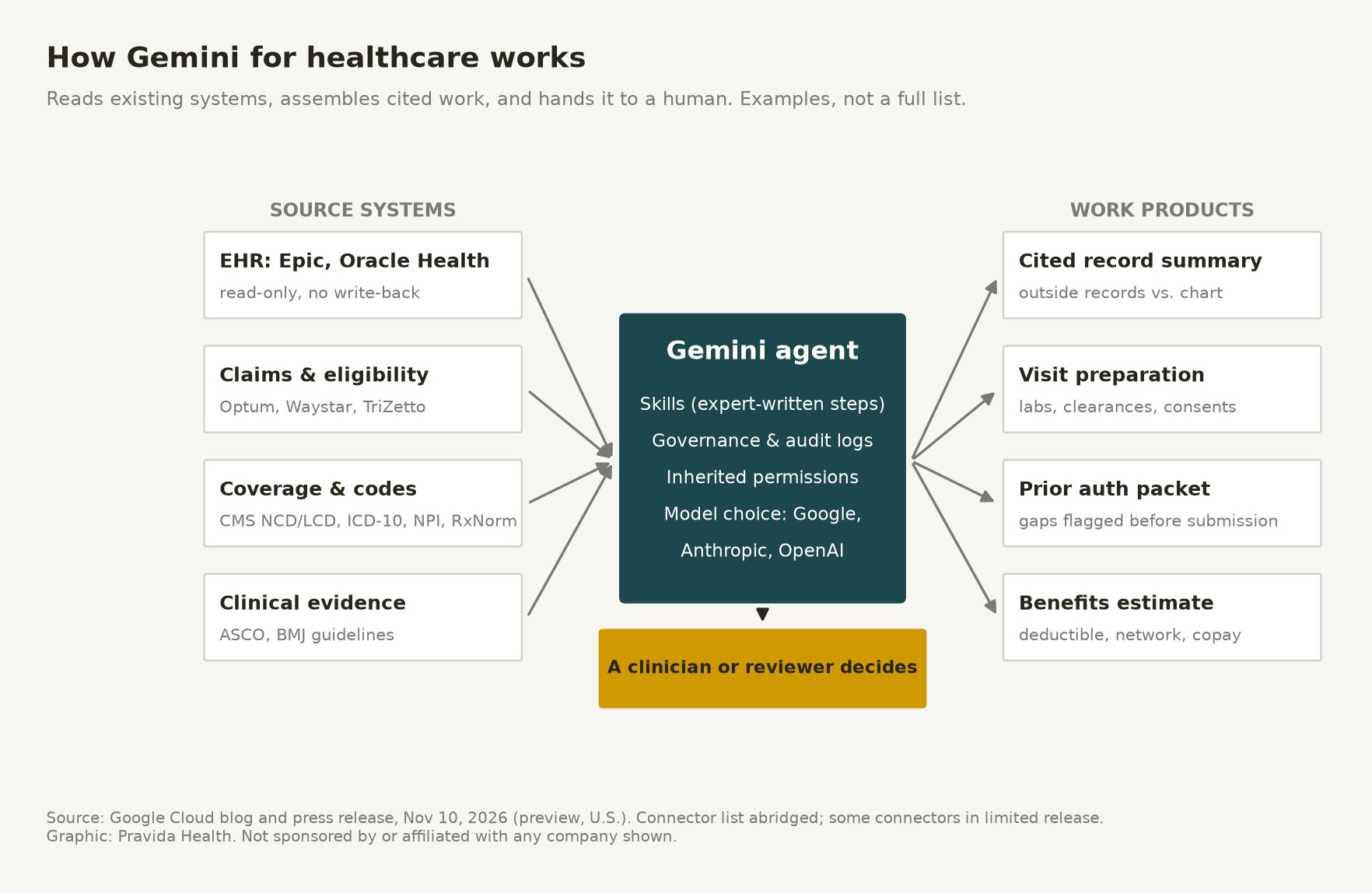
- On November 10, 2026, Google Cloud launched Gemini for healthcare in preview in the U.S. It is an AI agent for hospitals and health plans, not a consumer chatbot. It pulls information from records, billing and insurance systems and runs multi-step paperwork tasks such as prior authorization and benefits checks.
- It reads the chart but cannot change it. Google says its Epic and Oracle Health connectors are read-only, with no write-back to the medical record. A clinician still decides what goes in the chart.
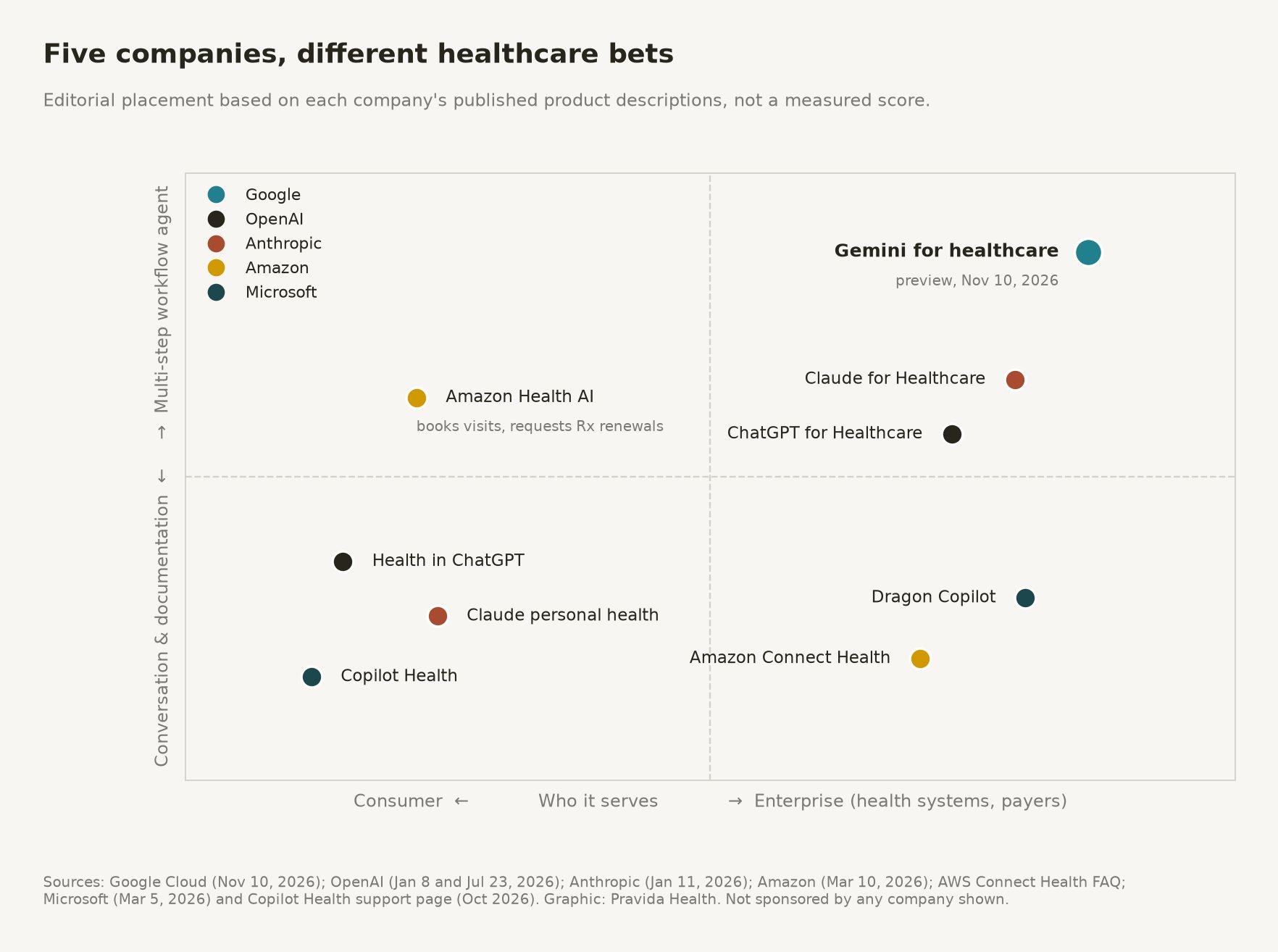
- The five big companies are solving different problems. Google is building the workflow layer for hospitals and payers. OpenAI and Anthropic sell general AI assistants to health systems and also offer personal health tools to consumers. Amazon runs its own care service through One Medical. Microsoft focuses on clinical documentation with Dragon Copilot.
- Google lets customers use rival models. Gemini for healthcare supports model choice across Google, Anthropic and OpenAI, so this is not a simple winner-take-all race.
- No patient outcome data exist yet. These are new products, and most of the claims come from the companies themselves. I explain below what I would ask before trusting any of them with patient care.
Why a physician is writing about a cloud product
Most of my AI writing is about tools patients touch directly, like the AI personal health agent for wearables and labs or spatial computing for procedure planning. Gemini for healthcare is different. Most patients will never see it. But if it works as described, it could change how fast your prior authorization comes back, whether your doctor sees the outside records you already sent, and whether anyone can tell you what a visit will cost before you arrive. Those are the frustrations my patients bring up most often, and they are mostly paperwork problems, not medical ones.
Google says clinicians spend nearly 28 hours a week manually reconciling information (Google Cloud). Fortune, citing the American Medical Association, reports that each physician completes about 40 prior authorizations a week, taking about 13 hours of physician and staff time. It also cites an American Hospital Association estimate that administrative costs make up 25% to 35% of U.S. health spending (Fortune). Those numbers come from different sources and methods, but they point the same way: a large share of healthcare effort goes into moving information between systems.
What Google actually launched
Gemini for healthcare is built on the “universal Gemini agent” that Google introduced a month earlier. It is available in preview in the U.S. (Google Cloud). Google describes it as agentic AI that connects clinical, operational and administrative systems and runs multi-step workflows “within defined guardrails and with human oversight” (Google Cloud press release). It has four parts (Google Cloud):
- Skills. Step-by-step instructions written by domain experts for specific jobs. Examples include medical records synthesis, pre-appointment preparation, coverage and policy review, and payer benefit determination. Organizations can also write their own.
- Connectors. Links to the EHR, claims, care management and administrative systems a health system already runs. Each connector keeps the existing role-based access controls.
- A partner ecosystem. Systems integrators and digital health companies can add specialized agents, such as an ASCO oncology guideline assistant.
- A governed platform with model choice. One place for clinical, security and IT leaders to set policy, with audit logging and citations. Google says it is “built to support HIPAA compliance.”
The connector list is long. It includes read-only access to Epic through open.epic APIs and to Oracle Health through FHIR, with NextGen Healthcare “in the coming months.” It also includes CMS coverage data, the NPI Registry, RxNorm, ICD-10, Optum eligibility (in limited release), Waystar, TriZetto, GoodRx, BMJ clinical content, ASCO guidelines, Suki, UiPath, Salesforce, ServiceNow, Microsoft 365 and Google Workspace (Google Cloud press release). Launch customers are Blue Cross Blue Shield of Massachusetts, Hartford HealthCare, HCA Healthcare, Highmark Health, Northwell Health, Optum and Stanford School of Medicine.
Access is through Gemini Enterprise Standard and Plus, with per-user subscription or pay-as-you-go pricing (Fierce Healthcare). Google has not published a price.
What it looks like in practice
In a demo for Fortune, a Google lead asked what was new in an outside specialist’s report that was not in the patient’s Epic chart. In 35 seconds the system pulled the patient’s conditions, medications, allergies and labs, compared them with the report, and flagged new lab results and an allergy missing from the chart, with each finding linked to its source (Fortune). A clinician then decides whether to update the chart.
Engadget’s read is that the product is focused on workflow efficiency rather than diagnosing patients or advising on treatment at the point of care (Engadget). I agree, and I think that is the right place to start.
How it compares with OpenAI, Anthropic, Amazon and Microsoft
All five companies now have a healthcare offering. They are not doing the same thing. The table below compares what each company says about its own products as of November 10, 2026.
| Company | Main healthcare products | Who it is for | EHR and data access | Status |
|---|---|---|---|---|
| Gemini for healthcare | Hospitals, health systems and health plans | Read-only Epic and Oracle Health connectors; claims, eligibility and CMS coverage data | Preview, U.S. (Nov 10, 2026) | |
| OpenAI | ChatGPT for Healthcare; OpenAI API; Health in ChatGPT | Health systems (enterprise); adults in the U.S. (consumer) | Enterprise: institutional policies and documents through integrations such as SharePoint. Consumer: Apple Health and connected medical records | Enterprise since Jan 8, 2026; consumer Health since Jul 23, 2026 |
| Anthropic | Claude for Healthcare (on Claude for Enterprise); personal health integrations | Providers, payers and health tech (enterprise); Pro and Max subscribers in the U.S. (consumer) | CMS Coverage Database, ICD-10, NPI Registry and PubMed connectors; consumer HealthEx, Function, Apple Health and Android Health Connect (beta) | Announced Jan 11, 2026 |
| Amazon | Health AI (One Medical, Amazon.com); Amazon Connect Health | Consumers (Health AI); health systems and software builders (Connect Health) | Consumer records through a health information exchange; Connect Health has an Epic App Market app | Health AI expanding since Mar 10, 2026; Connect Health features mix of GA and preview |
| Microsoft | Dragon Copilot; Copilot Health | Clinicians and nurses (Dragon); Microsoft 365 consumers (Copilot Health) | EHR-integrated documentation workflows; consumer health records and wearables | Dragon in use; Copilot Health preview, temporarily unavailable as of Oct 2026 |
OpenAI: a strong general assistant, with a big consumer reach
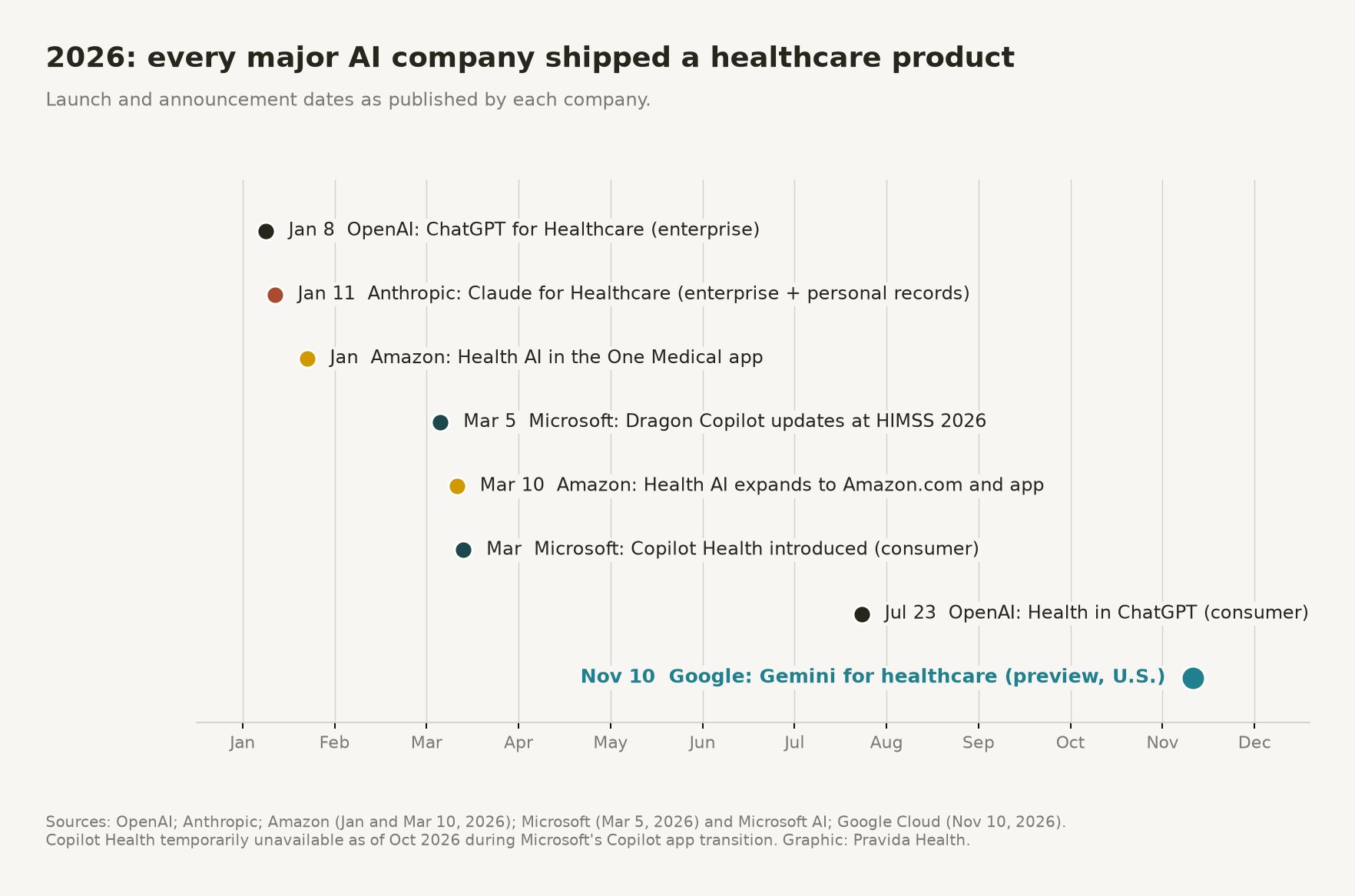
OpenAI launched ChatGPT for Healthcare on January 8, 2026. It is powered by GPT-5.2 models, offers a business associate agreement for HIPAA-compliant use, and gives answers with citations to research, guidelines and the institution’s own policies. Early customers include AdventHealth, Baylor Scott & White, Boston Children’s, Cedars-Sinai, HCA Healthcare, Memorial Sloan Kettering, Stanford Medicine Children’s Health and UCSF (OpenAI). On the consumer side, Health in ChatGPT rolled out on July 23, 2026 to U.S. adults on Free, Go, Plus and Pro plans. It can connect Apple Health, supported hospital records, One Medical and Function Health, and OpenAI says that data is not used to train its foundation models (OpenAI).
The difference from Google: ChatGPT for Healthcare is mainly a smart, cited assistant that clinicians and staff talk to. Gemini for healthcare is designed to go into the claims, eligibility and EHR systems and assemble finished work, like a prior authorization packet. OpenAI also speaks directly to patients. Google’s new product does not.
Anthropic: tools for builders, plus personal records
Anthropic announced Claude for Healthcare on January 11, 2026. HIPAA-compliant organizations on Claude for Enterprise get connectors to the CMS Coverage Database, ICD-10, the NPI Registry and PubMed, along with agent skills for FHIR development and a sample prior authorization review (Anthropic). In the U.S., Pro and Max subscribers can connect their own lab results and records through HealthEx and Function, and Apple Health and Android Health Connect in beta. Anthropic says it does not use that health data to train models (Anthropic). Anthropic also publishes open healthcare skills and connectors for developers (GitHub).
The difference from Google: Anthropic gives organizations building blocks and expects them, or their vendors, to wire up the workflow. Google ships a packaged, governed product with launch partners already connected. The two also overlap: Google says Gemini for healthcare supports models from Anthropic and OpenAI as well as its own (Google Cloud press release).
Amazon: the only one that also delivers care
Amazon’s approach is unusual because it owns a medical practice. Health AI launched for One Medical members in January 2026 (Amazon). Since March 10, 2026 it has been expanding to Amazon.com and the Amazon app, without requiring Prime or One Medical membership. It explains labs and records, books visits with One Medical clinicians, and sends prescription renewal requests to a One Medical provider. With consent, it can pull records through a health information exchange, and it hands the question to a human when it is uncertain (Amazon). For health systems, AWS offers Amazon Connect Health, a HIPAA-eligible service with ambient documentation and patient verification generally available, while appointment management, patient insights and medical coding are in preview (AWS).
The difference from Google: Amazon’s most visible agent works for the patient and routes them to Amazon’s own clinicians and pharmacy. Google’s agent works for the hospital or the health plan.
Microsoft: inside the clinician’s note
Microsoft’s core healthcare product is Dragon Copilot, an AI clinical assistant for ambient documentation, notes, nursing flowsheets and radiology reports. Microsoft says more than 100,000 clinicians use it, and its HIMSS 2026 updates added partner agents from companies including Optum and Regard for prior authorization, revenue cycle and decision support (Microsoft). On the consumer side, Microsoft introduced Copilot Health in March 2026 (Microsoft AI). Its October 2026 support page says it is temporarily unavailable during the move to a unified Copilot app, and that some features, such as wearables and health records, will return over time (Microsoft Support).
The difference from Google: Microsoft starts at the exam-room conversation and the note. Google starts with the record, the claim and the policy behind the visit. The two also connect: Microsoft 365 is one of Gemini for healthcare’s listed connectors.
What it means for patients
- Mostly invisible, possibly faster. If your hospital or insurer adopts it, you may notice fewer repeat questions, faster prior authorization decisions and clearer cost estimates. Highmark says 78% of approved outpatient prior authorizations submitted digitally now go through automatically, and that a clinician reviews every case before it issues a denial (Fortune). That figure describes Highmark’s own process, not a result of Gemini for healthcare.
- You cannot sign up for it. Unlike ChatGPT, Claude or Amazon Health AI, this is not a consumer app. If you want an AI to explain your own labs, the consumer products are where that happens, with their own privacy terms.
- Your data stays where it is, according to Google. Google says the agent queries each system with existing permissions rather than moving data (Google Cloud). It is still fair to ask your health system which AI tools touch your record.
What it means for clinicians
The design choices I like are read-only EHR access, source citations on every finding, inherited permissions and a human making the final call. I also like that health plans are a launch customer group. Prior authorization is a two-sided problem, and a tool that helps only one side tends to start an arms race. The open question is whether both sides using AI makes the process faster and fairer, or simply makes the paperwork bigger.
Northwell’s CEO told Fortune the system has about 400 employees whose only job is fighting insurance denials, and that it overturns more than 90% of them (Fortune). If that is typical, much of today’s denial work is avoidable rework, and that is exactly the kind of work these tools are aimed at.
Limits and risks
| Issue | Why it matters |
|---|---|
| Preview status | Gemini for healthcare is a preview product. Features, connectors and pricing can change, and some connectors, such as Optum eligibility, are in limited release. |
| No outcome data | None of the five companies has published peer-reviewed evidence that these products improve patient outcomes, denial rates or costs at scale. The benefits described so far are vendor claims, customer expectations and demos. |
| Accuracy | Citations help a human check the work, but they do not guarantee that the summary is right or complete. A missed allergy in a summary can be as harmful as a missed allergy in the chart. |
| “Built to support HIPAA” | This phrase means the platform can be configured for HIPAA-compliant use. It is not a certification, and compliance still depends on how each organization sets it up (Fierce Healthcare). |
| Automation creep | Read-only today does not mean read-only forever. Northwell described a future in which a system identifies a screening-eligible patient and offers appointments without a human reviewing the records first (Fortune). That may be helpful, but it needs clear oversight rules. |
| Concentration | A small number of companies now sit between patients, clinicians, insurers and records. Model choice and open connectors reduce lock-in, but governance still matters. |
How I think about it at Pravida
Pravida Health is an independent practice, not a large health system, and we are not a Gemini for healthcare customer. This post is my read of a public announcement. I follow these platforms closely because training physicians to work alongside AI is the focus of my work at Future Physician Academy, and because the same questions apply to any AI tool used in a clinic. I wrote about the limits of AI in the exam room in The 93% Myth, and about evaluating digital health tools in validated remote monitoring devices.
When I evaluate any clinical AI tool, I ask four questions:
- Can it change the record, or only read it?
- Does every claim link back to a source a human can check?
- Who reviews the output before it affects a patient, and is that review real or a rubber stamp?
- Is there independent evidence, or only the vendor’s description?
By those standards, Gemini for healthcare starts in a reasonable place on the first three. The fourth question is still open for every company in this post.
Have questions about AI and your health data?
At Pravida Health we help patients make sense of their records, labs and wearable data, and we are open about where AI helps and where it falls short.
- Physician-led review of your labs, imaging and wearable data
- Plain-language guidance on consumer AI health tools and their privacy terms
- Evidence-graded care plans, reviewed by a physician, not an algorithm
Pravida Health, 1801 Peachtree St NE, Suite 150, Atlanta, GA 30309. Call 404-900-7371, email info@pravida.com or request an appointment.
Frequently asked questions
What is Gemini for healthcare?
It is a Google Cloud AI agent for hospitals, health systems and health plans, launched in U.S. preview on November 10, 2026. It connects to EHRs, claims, eligibility and coverage systems and runs multi-step administrative tasks such as record synthesis, visit preparation, prior authorization and benefits estimates, with a human making final decisions.
Can Gemini for healthcare change my medical record?
No. Google says its Epic and Oracle Health connectors are read-only, with no write-back to the chart. A clinician reviews the findings and decides whether to update the record.
How is Gemini for healthcare different from ChatGPT for Healthcare?
ChatGPT for Healthcare is mainly a cited assistant that clinicians and staff talk to. Gemini for healthcare is designed to connect directly to claims, eligibility and EHR systems and assemble finished work, such as a prior authorization packet. OpenAI also offers a consumer product, Health in ChatGPT, while Google’s new product is enterprise-only.
Can patients use Gemini for healthcare directly?
No. It is sold to healthcare organizations through Gemini Enterprise. Consumer health AI tools include Health in ChatGPT, Claude’s personal health integrations, Amazon Health AI and Microsoft Copilot Health, each with its own eligibility and privacy terms.
Is Gemini for healthcare HIPAA compliant?
Google says it is built to support HIPAA compliance, with access controls, audit logging and data kept within the customer’s environment. That is not a certification. Compliance depends on how each healthcare organization configures and uses it.
Sources
- Introducing Gemini for healthcare. November 10, 2026. Google Cloud Blog.
- Google Cloud launches Gemini for healthcare. November 10, 2026. Google Cloud Press Corner.
- Gemini for healthcare product page. Google Cloud.
- Google launches Gemini for healthcare, and hospitals like Northwell hope it lowers your medical bill. November 10, 2026. Fortune.
- Google Cloud rolls out Gemini for healthcare. November 10, 2026. Fierce Healthcare.
- Google turns Gemini towards medical paperwork. November 10, 2026. Engadget.
- Introducing OpenAI for Healthcare. January 8, 2026. OpenAI.
- Health in ChatGPT. July 23, 2026. OpenAI.
- Advancing Claude in healthcare and the life sciences. January 11, 2026. Anthropic.
- Anthropic healthcare skills and connectors. GitHub.
- One Medical launches Health AI assistant. January 2026. Amazon.
- Amazon expands Health AI to Amazon.com and the Amazon app. March 10, 2026. Amazon.
- Amazon Connect Health FAQs. AWS.
- Unify, simplify, scale: Microsoft Dragon Copilot at HIMSS 2026. March 5, 2026. Microsoft.
- Introducing Copilot Health. March 2026. Microsoft AI.
- Copilot Health support page. Updated October 2026. Microsoft Support.