
Key takeaways
- “FDA-cleared” is not one thing. Clearance means a device does what its label says, for the people on its label. A cleared ECG, a cleared screening alert and a wellness score are very different tools.
- The devices with the strongest footing are specific. Prescription CGMs, AliveCor’s Kardia ECGs and blood pressure cuffs that have passed independent validation are the backbone of home monitoring we can act on.
- The list keeps growing. Over-the-counter CGMs arrived in 2024, the Kardia 12L in 2024, and Apple Watch hypertension notifications in 2025. In January 2026 the FDA also widened what wearables can show as “wellness” data without review.
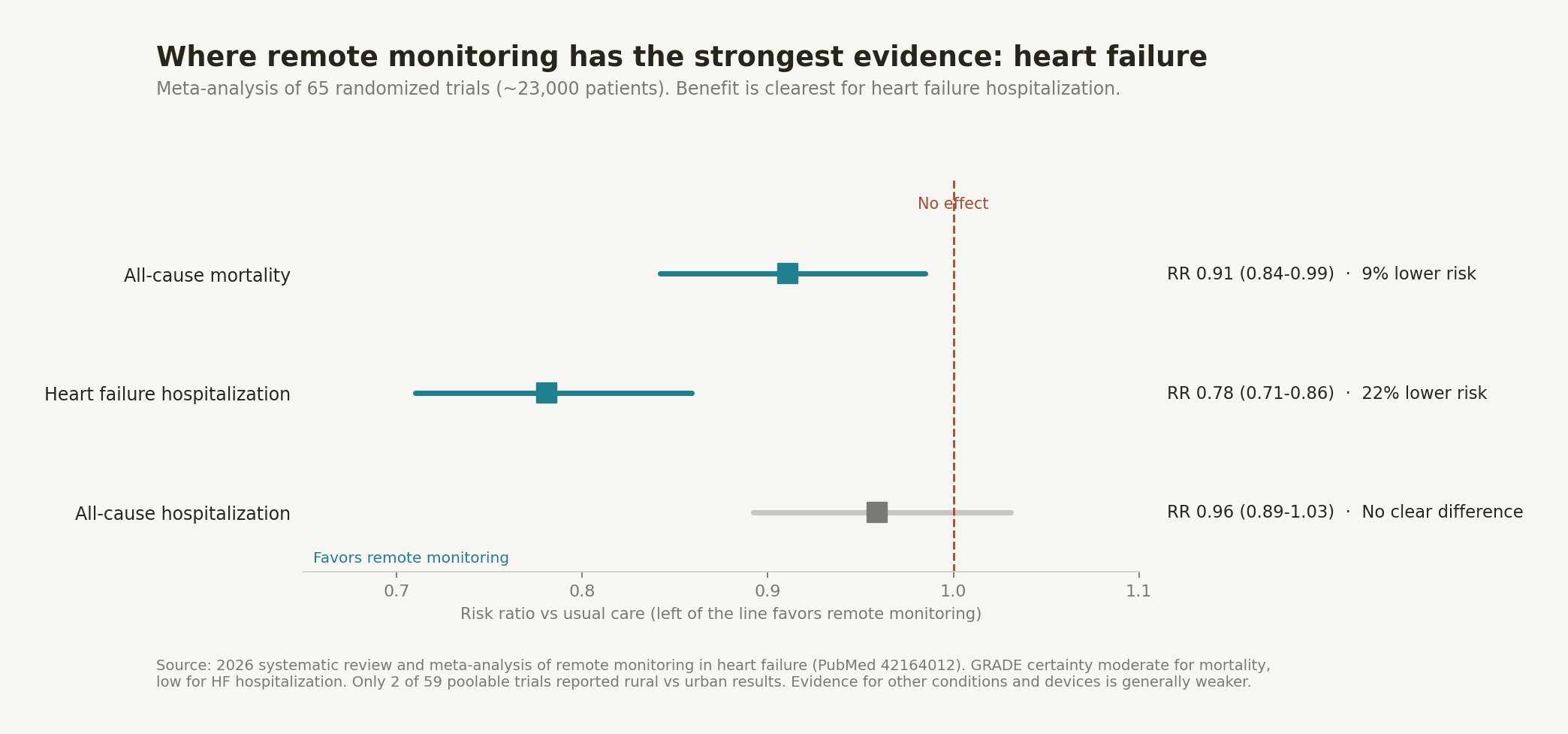
- Evidence is strongest in heart failure. A 2026 meta-analysis of 65 trials found about 22% fewer heart failure hospitalizations with remote monitoring. Evidence for sensor-guided rehab is weaker.
- Even good devices fail. Both major CGM makers have had accuracy-related FDA actions since 2025. A home reading should always be checked against how you feel and confirmed when it would change treatment.
Why this question matters now
In my last post I looked at how satellite and cellular networks could bring telehealth to places that are poorly connected today. A better network only helps if the device on the other end gives us data we can trust. Patients now bring me readings from watches, rings, patches, cuffs and apps. Some of that data can guide treatment. Some of it is a trend at best. This post is my attempt to sort the two, using the devices we actually use at Pravida Health as examples.
Four tiers of home health devices
I find it helpful to sort home devices into four groups, based on how much the FDA has reviewed them and what the label allows.
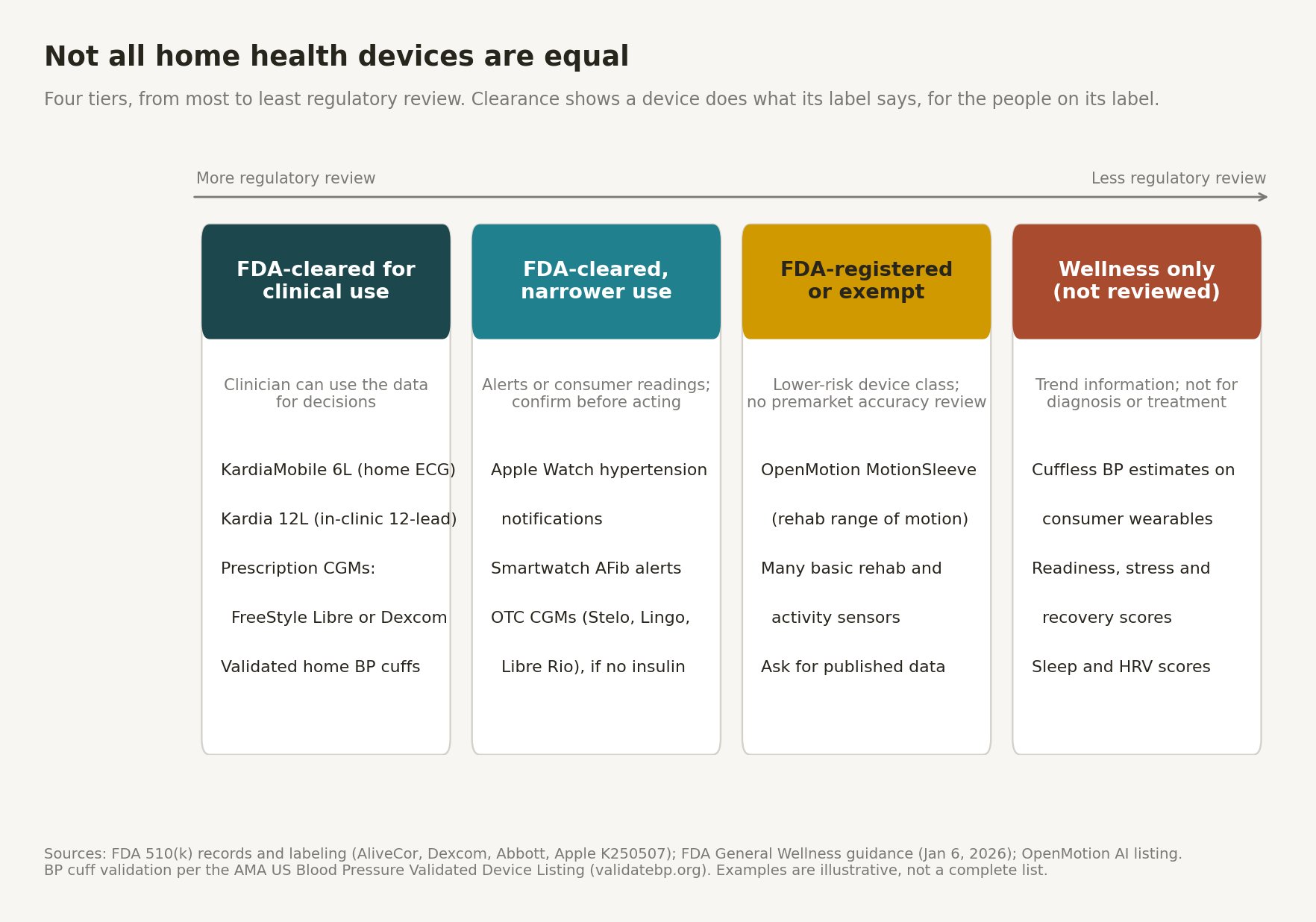
Tier 1: cleared for clinical use. These devices have FDA clearance for a measurement or finding a clinician can act on. Examples include prescription CGMs, AliveCor’s KardiaMobile 6L and Kardia 12L, and home blood pressure cuffs that have passed independent accuracy testing.
Tier 2: cleared, but for a narrower use. These are FDA-cleared, but either as a screening alert or for a limited group of users. Apple Watch hypertension notifications are a good example. Over-the-counter CGMs also fit here: they are cleared for adults who do not use insulin and do not have the alarms prescription systems have.
Tier 3: FDA-registered or exempt. Many lower-risk devices are listed with the FDA without a premarket review of accuracy. That does not mean they are inaccurate. It means the burden is on the company, and on us, to look for published validation.
Tier 4: wellness only. These devices make no medical claim and have not been reviewed. In January 2026 the FDA updated its General Wellness guidance so that wearables can show non-invasive estimates such as blood pressure, oxygen saturation, glucose and heart rate variability as wellness information, as long as they don’t claim to diagnose or treat disease (King & Spalding; FDA). In June 2026 the FDA closed out its earlier warning letter to Whoop over its blood pressure feature (MedTech Dive). That shift is good for innovation. It also means more numbers on your wrist that look medical but were never checked like medical devices.
Device by device
Continuous glucose monitors
Prescription CGMs from Abbott (FreeStyle Libre) and Dexcom are the most established home monitors we use. Dexcom’s G7 15 Day system was cleared in April 2025 for adults with diabetes, with a reported mean absolute relative difference (MARD) of 8.0% (Dexcom). Dexcom’s own provider materials note that about 26% of sensors may not last the full 15 days (Dexcom provider FAQ).
These systems are well studied, but they are not flawless. In March 2025 the FDA issued a warning letter to Dexcom after a change to a sensor component was linked to less accurate readings (FDA; MedTech Dive). In November 2025 Abbott began a correction for certain FreeStyle Libre 3 and 3 Plus sensors that could give incorrectly low readings, which the FDA later classified as its most serious type of recall (FDA; Breakthrough T1D). The lesson is not to avoid CGMs. It is to treat a reading that doesn’t match your symptoms as a reason to check with a fingerstick.
Over-the-counter CGMs are newer. Dexcom Stelo was the first, in March 2024, followed by Abbott’s Lingo and Libre Rio in June 2024. They are meant for people who do not use insulin and do not have urgent low-glucose alarms (MyMedicineAdvisor). In June 2026 the FDA cleared Stelo for children ages 2 and up (FDA). Clearance shows these devices measure glucose acceptably. It does not show that people without diabetes live longer or healthier lives by wearing one (PubMed Central).
Personal and clinic ECGs
AliveCor’s KardiaMobile 6L was the first FDA-cleared six-lead personal ECG, and its software can detect six common rhythm findings, including atrial fibrillation (AliveCor; FDA 510(k) K220350). In 2021 it was also cleared for clinicians to measure the QTc interval, which matters when patients take medicines that can affect heart rhythm (AliveCor). One limit is worth knowing: the automated analysis is not designed to detect long QT syndrome, and an FDA adverse event report describes a patient who was falsely reassured (FDA MAUDE). A “normal” result from the app is not the same as a clinician reading the tracing.
The Kardia 12L is a professional system, not a home device. It was cleared in June 2024 with AI that could flag 35 cardiac findings (AliveCor), and in January 2026 it was cleared for 39 (AliveCor). Its billing codes are still temporary Category III codes, priced by each payer (AliveCor 2026 reimbursement guide).
Blood pressure: cuffs and watches
For blood pressure, an upper-arm cuff that has passed independent accuracy testing is still the standard. The American Medical Association maintains a public list of validated devices at ValidateBP.org (AMA). Don’t rely on a chatbot to pick one: in an American Heart Association study, leading AI tools correctly identified validated monitors only about two-thirds of the time (American Heart Association).
Apple Watch hypertension notifications were cleared in September 2025 (FDA K250507). The feature looks at optical pulse signals over 30 days and alerts adults 22 and older without a hypertension diagnosis when patterns suggest high blood pressure. It does not measure blood pressure, and no alert does not mean you don’t have hypertension (Fortune India). If you get one, confirm it with a validated cuff.
Rehab and motion sensors
Rehab sensors are the newest group, and the one I’m most cautious about. We are currently evaluating OpenMotion’s MotionSleeve for orthopedic rehab. It uses two motion sensors joined by an elastic wrap, and its app reports 3D range of motion in degrees for the knee, hip, shoulder and elbow. Its software flags patterns, but clinicians make the decisions (OpenMotion; OpenMotion for providers). The company describes itself as FDA-registered (OpenMotion on LinkedIn), and its app listing describes a Class I device (App Store). I have not found an independent published study validating its measurements, which is one reason we are still evaluating it.
The broader evidence fits that caution. Reviews of sensor-guided rehab after knee replacement have found outcomes similar to standard care (PubMed Central), and a 2026 JMIR meta-analysis found no consistent benefit for remote rehab (JMIR). “Similar” can still be useful if it saves travel or helps patients stay on track. It is just not proof of better outcomes.
| Device type | Examples | What it can tell your clinician | Main limits |
|---|---|---|---|
| Prescription CGM | FreeStyle Libre, Dexcom G7 | Glucose trends, lows and highs to guide diabetes treatment | Sensor failures; recent accuracy-related FDA actions |
| OTC CGM | Stelo, Lingo, Libre Rio | Glucose patterns for people not using insulin | No alarms; no proven long-term benefit without diabetes |
| Personal ECG | KardiaMobile 6L | Rhythm strips for AFib and other findings; QTc review | Not designed to detect long QT syndrome |
| Clinic 12-lead ECG | Kardia 12L | Full 12-lead tracing with 39 AI-flagged findings | Professional use; temporary billing codes |
| Validated BP cuff | Devices on ValidateBP.org | Home blood pressure readings for diagnosis and treatment | Only accurate with correct cuff size and technique |
| Watch BP alert | Apple Watch | A prompt to check blood pressure | Doesn’t measure BP; misses some hypertension |
| Rehab motion sensor | OpenMotion MotionSleeve | Joint range of motion between visits | Limited independent validation so far |
| Wellness wearable | Rings, bands, watch scores | Sleep, activity and recovery trends | Not reviewed for medical accuracy |
What we use at Pravida Health
- Glucose: prescription FreeStyle Libre or Dexcom CGMs, chosen based on the patient’s needs and coverage.
- Heart rhythm at home: we recommend the KardiaMobile 6L to patients who need home ECG recordings.
- Heart rhythm in clinic: we use the Kardia 12L, a professional-use 12-lead ECG system.
- Rehab: OpenMotion’s MotionSleeve is currently under evaluation. We have not adopted it as a standard tool.
Pravida Health has no financial relationship with Abbott, Dexcom, AliveCor, Apple or OpenMotion. We name these brands because we use or are evaluating them, not because we are paid to.
The list has grown, and so have the rules
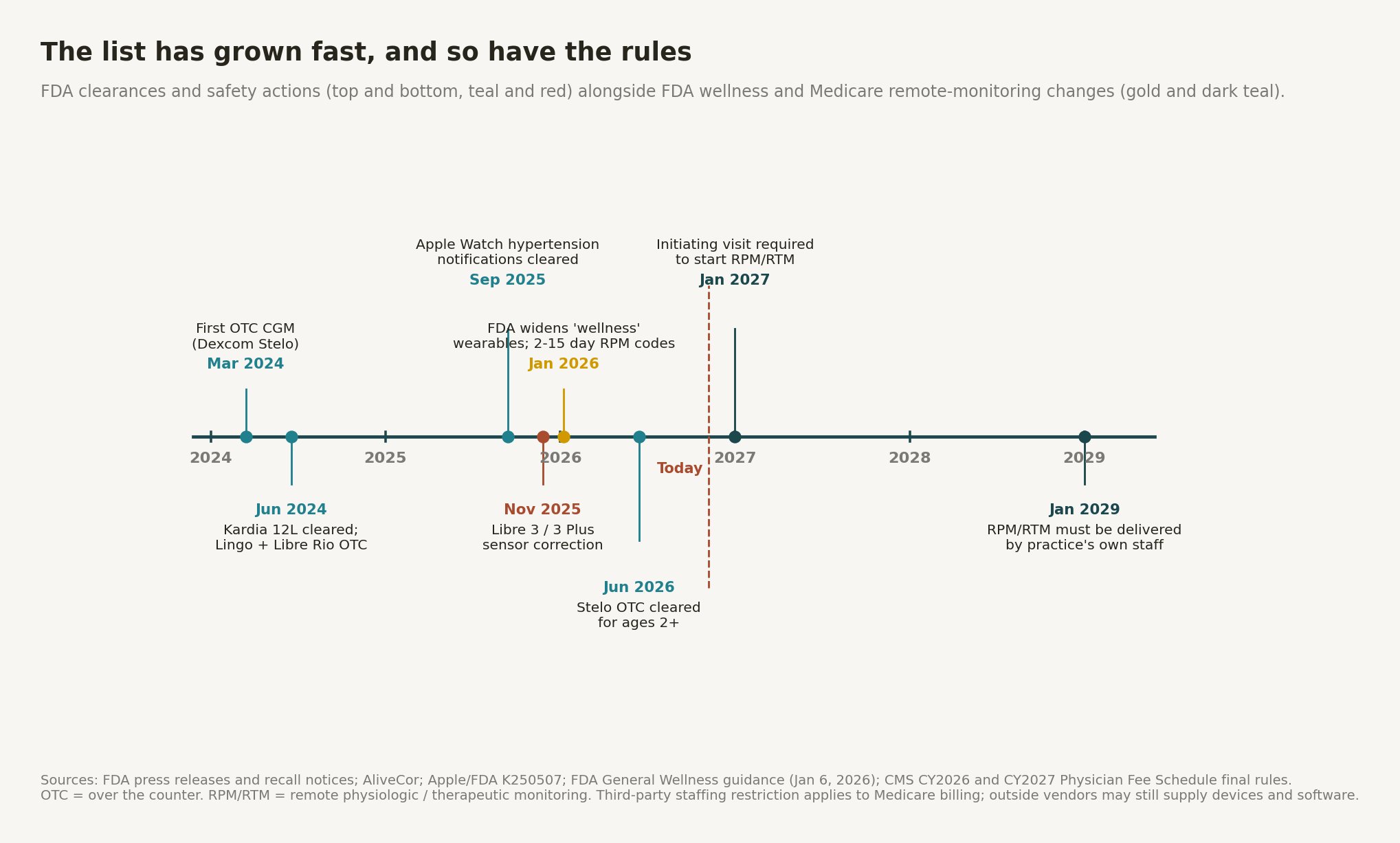
Medicare rules shape which devices clinics can use for remote monitoring. Starting in 2026, Medicare added remote physiologic monitoring and remote therapeutic monitoring codes for just 2 to 15 days of data in a month, plus a shorter 10-minute management code. The device must meet the FDA’s definition of a medical device, so wellness-only gadgets don’t qualify (CMS MLN; McDonald Hopkins). Medicare’s final 2027 rule, released November 4, 2026, requires an initiating visit before remote monitoring starts and pushes a restriction on outside staffing companies to January 1, 2029 (CMS; Becker’s).
What the evidence shows
The best evidence for remote monitoring is in heart failure. A 2026 meta-analysis of 65 randomized trials with about 23,000 participants found remote monitoring was linked to a 9% lower risk of death (moderate certainty) and a 22% lower risk of heart failure hospitalization (low certainty). There was no clear difference in hospitalization for any cause. Only 2 of 59 trials reported results for rural versus urban patients (PubMed).
Current limitations
- Accuracy varies by device and by person. Sensors fail early, readings drift, and fit and technique matter. A cuff that is the wrong size gives the wrong answer.
- Data without a workflow. In one 2026 review, fitting devices into clinical workflow was the most common barrier, cited in 27.1% of records (PubMed Central). Readings that nobody reviews don’t help anyone.
- Unanswered questions. Reviews point to gaps in cost-effectiveness, liability, privacy, equity and long-term adherence (PubMed Central).
- Equity and access. The FDA has issued draft guidance on how skin pigmentation affects pulse oximeter accuracy, which is still not final (FDA). Rural patients are also underrepresented in trials.
- Blurred lines. With the 2026 wellness changes, more consumer devices will show numbers that look clinical but are not reviewed as medical measurements.
Where this is heading
I expect three things over the next few years. First, more devices will move from wellness into cleared tiers, especially cuffless blood pressure, where the FDA has issued draft guidance (Vedder Price). Second, rehab sensors will need head-to-head studies against standard measurement before they become routine. Third, AI will do more of the first pass on incoming data. I wrote about that in my post on AI personal health agents. The clinician still needs to own the decision.
What to ask before you trust a device
- Is it FDA-cleared, and for what exactly? Check the label, not the ad.
- Was it tested in people like me (age, skin tone, condition, insulin use)?
- Is there published, independent validation?
- Who reviews my data, how often, and what happens if a reading is alarming?
- What should I do when a reading doesn’t match how I feel?
Want help making sense of your device data?
We help patients choose devices that fit their care and turn readings into a clear plan.
- Prescription CGM programs with physician review
- Home and in-clinic ECG with clinician interpretation
- Evidence-graded guidance on wearables and rehab sensors
Pravida Health, 1801 Peachtree St NE, Suite 150, Atlanta, GA 30309. Call 404-900-7371, email info@pravida.com or request an appointment.
Frequently asked questions
Does FDA-cleared mean a device is accurate?
It means the FDA agreed the device performs as its label claims for the intended users. It does not guarantee accuracy for everyone or for uses outside the label, and individual sensors can still fail.
Which home devices can doctors use for remote patient monitoring?
For Medicare remote monitoring, the device must meet the FDA’s definition of a medical device. Common examples include prescription CGMs, validated blood pressure cuffs and FDA-cleared personal ECGs such as the KardiaMobile 6L.
Can my Apple Watch measure my blood pressure?
No. Apple Watch hypertension notifications look for patterns that suggest high blood pressure over 30 days. They do not give a reading, and no alert does not rule out hypertension. Confirm with a validated cuff.
Are over-the-counter CGMs as good as prescription CGMs?
They are FDA-cleared but designed for people who do not use insulin, and they lack the urgent low-glucose alarms of prescription systems. People on insulin should use a prescription CGM.
Do wearable rehab sensors improve recovery?
Current studies, mostly after knee replacement, show outcomes similar to standard rehab rather than better. They may help with convenience and tracking, but more independent validation is needed.
Sources
- FDA. General wellness: policy for low risk devices (updated January 2026). FDA.
- FDA updates General Wellness and Clinical Decision Support guidance documents. King & Spalding.
- FDA drops Whoop warning letter over blood pressure feature. MedTech Dive.
- Whoop, blood pressure and FDA’s new wellness framework. Vedder Price.
- Dexcom G7 15 Day receives FDA clearance. April 2025. Dexcom.
- Dexcom provider FAQs. Dexcom.
- FDA warning letter to Dexcom, Inc. March 4, 2025. FDA.
- Dexcom warning letter tied to CGM coating change. MedTech Dive.
- Glucose monitor sensor recall: Abbott Diabetes Care removes certain FreeStyle Libre 3 and 3 Plus sensors. FDA.
- Navigating issues with your CGM. Breakthrough T1D.
- Over-the-counter CGMs: Stelo, Lingo and Libre Rio. MyMedicineAdvisor.
- FDA clears first over-the-counter continuous glucose monitor for children. June 2026. FDA.
- Review of over-the-counter CGM use. PubMed Central.
- KardiaMobile 6L product information. AliveCor; 510(k) K220350. FDA.
- FDA clears personal ECG device for measurement of QTc interval. AliveCor.
- MAUDE adverse event report, KardiaMobile 6L. FDA.
- AliveCor launches Kardia 12L. June 2024. AliveCor.
- AliveCor announces FDA clearance of new cardiac determinations for Kardia 12L. January 2026. AliveCor.
- Kardia 12L reimbursement guide 2026. AliveCor.
- Validation of blood pressure measurement devices. AMA; US Blood Pressure Validated Device Listing. ValidateBP.org.
- Top AI tools accurately identified validated home BP monitors only about two-thirds of the time. American Heart Association.
- FDA 510(k) summary K250507, hypertension notification feature. FDA.
- Apple no threat to BP devices business: Omron CEO. Fortune India.
- OpenMotion platform and provider pages. OpenMotion; OpenMotion providers; LinkedIn; App Store.
- Review of sensor-based rehabilitation after knee replacement. PubMed Central.
- Meta-analysis of remote rehabilitation. JMIR, 2026. JMIR.
- Telehealth and remote patient monitoring. MLN901705. CMS.
- CMS lowers time thresholds for remote patient monitoring. McDonald Hopkins.
- CY 2027 Medicare Physician Fee Schedule final rule fact sheet. CMS.
- CMS delays third-party remote patient monitoring ban. Becker’s Payer Issues.
- Remote patient monitoring in heart failure: systematic review and meta-analysis, 2026. PubMed.
- Review of structural gaps in remote patient monitoring. PubMed Central.
- Review of barriers to remote monitoring implementation. PubMed Central.
- Pulse oximeters. FDA.