Key takeaways
- A Google Research team published one of the largest evaluations of an AI personal health agent to date in Nature on October 21, 2026: 11 benchmark tasks, more than 7,000 human annotations and 1,350 hours of expert and end-user review.
- The design is a team, not a single chatbot: a data science agent, a domain expert agent and a health coach agent, coordinated by an orchestrator, reasoning over wearable data and blood test results.
- The coordinated team beat a single chatbot. Health experts ranked it best in 66.7% of conversations, versus 12.6% for a single-agent system.
- It is not a doctor. Top-1 diagnostic accuracy from self-reported symptoms was 46%, and an expert safety review rated 2% of health summaries as having moderate-to-severe potential for harm.
- Best use today: spotting trends in your wearable data, preparing for appointments and building habits. Diagnosis, medication changes and urgent symptoms still belong with a clinician.
Why this study matters
Many of my patients already wear an Oura Ring, Apple Watch, Fitbit or Pixel Watch, and many bring their lab results on their phones. The question I hear most is no longer “should I track this?” It’s “what does all of this mean, and what should I do about it?” AI health coaches promise to answer that question around the clock. So when a peer-reviewed study in Nature tests exactly that kind of system, it is worth reading carefully, both for what it shows and for what it doesn’t.
The paper, “The anatomy of a personal health agent,” comes from Google Research, with co-authors from Google DeepMind, Vituity and Columbia University. The system was built on the Gemini 2 family of language models. Google says this line of research underpins its consumer coaching product: the Fitbit app became the Google Health app in May 2026, with a Gemini-based Google Health Coach for Premium subscribers (Google Health Help; Google Research blog). The study system and the commercial product are not the same thing, and the results below apply to the research prototype.
What people actually ask an AI about their health
Before building anything, the researchers studied real demand. They analyzed 1,370 consumer health questions from search and health forums, surveyed 555 users of a Fitbit Labs chatbot and ran a design workshop with 14 experts (Heydari et al., Nature 2026). Four kinds of need came out of that work:
| User need | Example question from the study | What it requires |
|---|---|---|
| General health knowledge | “What are the pros and cons of HIIT?” | Accurate, sourced facts |
| Personal data insights | “How did my steps impact my resting heart rate in the past month?” | Real numerical analysis of your own data |
| Wellness advice | “To improve my sleep score, what time should I go to bed?” | Personalized, coaching-style guidance |
| Symptoms | “My throat is itchy and I have trouble swallowing. What might be going on?” | Careful clinical reasoning and safe limits |
Those needs pull in different directions. Data questions need precise calculation, coaching needs open-ended, empathetic conversation, and symptom questions need factual grounding. The authors found that a single, all-purpose model struggled to balance them, which led to the team design.
How the personal health agent works
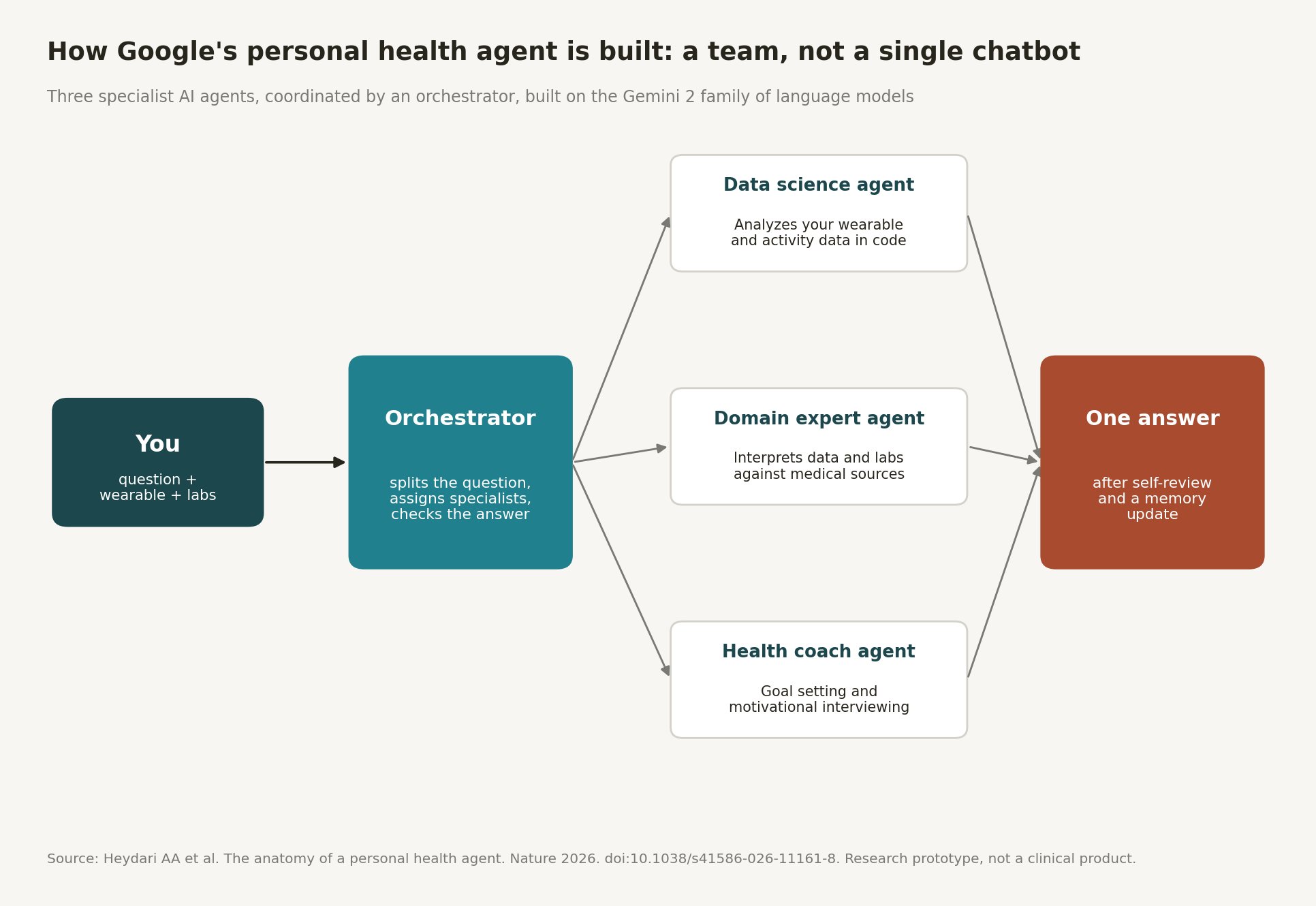
- Data science agent. Turns a vague question like “am I getting more fit?” into an analysis plan, then writes and runs code against your daily wearable data, compared with population percentiles for your age and sex.
- Domain expert agent. Interprets results in medical context. It can use web search, the National Center for Biotechnology Information (NCBI) and Data Commons to ground answers in sources. In this study, “medical records” meant blood test results only.
- Health coach agent. Uses motivational interviewing to set goals, identify barriers and guide behavior change over multiple turns of conversation.
- Orchestrator. Breaks down the question, assigns a main and supporting agents, checks the draft answer, and updates memory for the next turn.
A sleep example from the paper shows the idea. Asked “what is my biggest problem in sleep?”, the system first pointed to the user’s data (low deep sleep and a low readiness score), tied it to sleep guidance and then asked about bedtime routines before giving advice. That is close to how a good clinician works. One caveat from my own practice: consumer devices are reasonable for sleep versus wake but much weaker at staging deep and light sleep, as I covered in our evidence-based sleep guide. An AI agent can only be as good as the data it is reasoning over.
What the results showed
Analyzing your own data
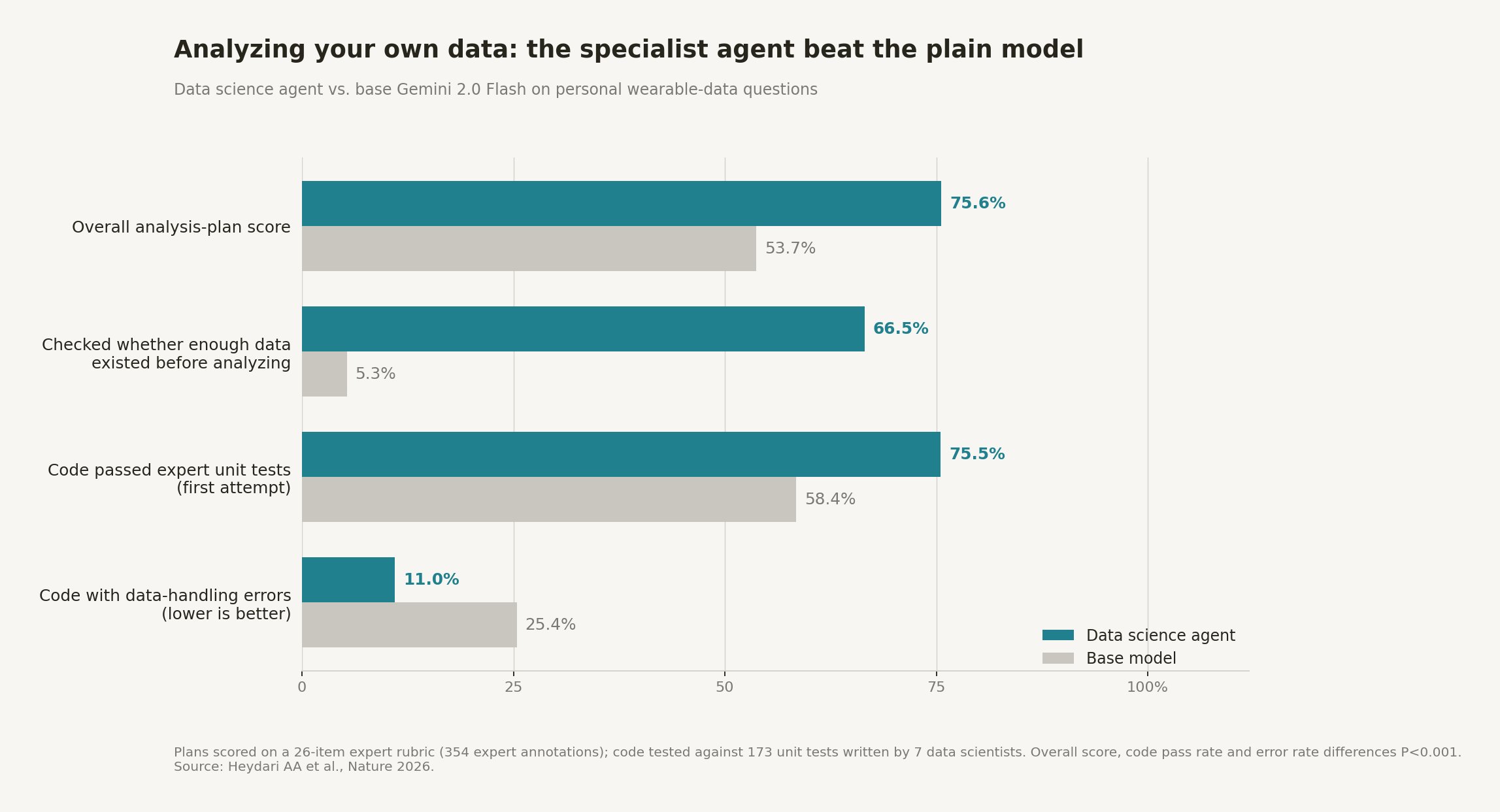
This is the finding I’d most like patients to remember. A general-purpose AI asked about your data will often answer confidently even when there are big gaps from nights you didn’t wear your device. The specialized agent checked for missing data far more often (66.5% versus 5.3%), and its code passed expert-written tests more often (75.5% versus 58.4% on the first try, rising to 79.0% after self-correction), per Heydari et al.
Interpreting data and lab results
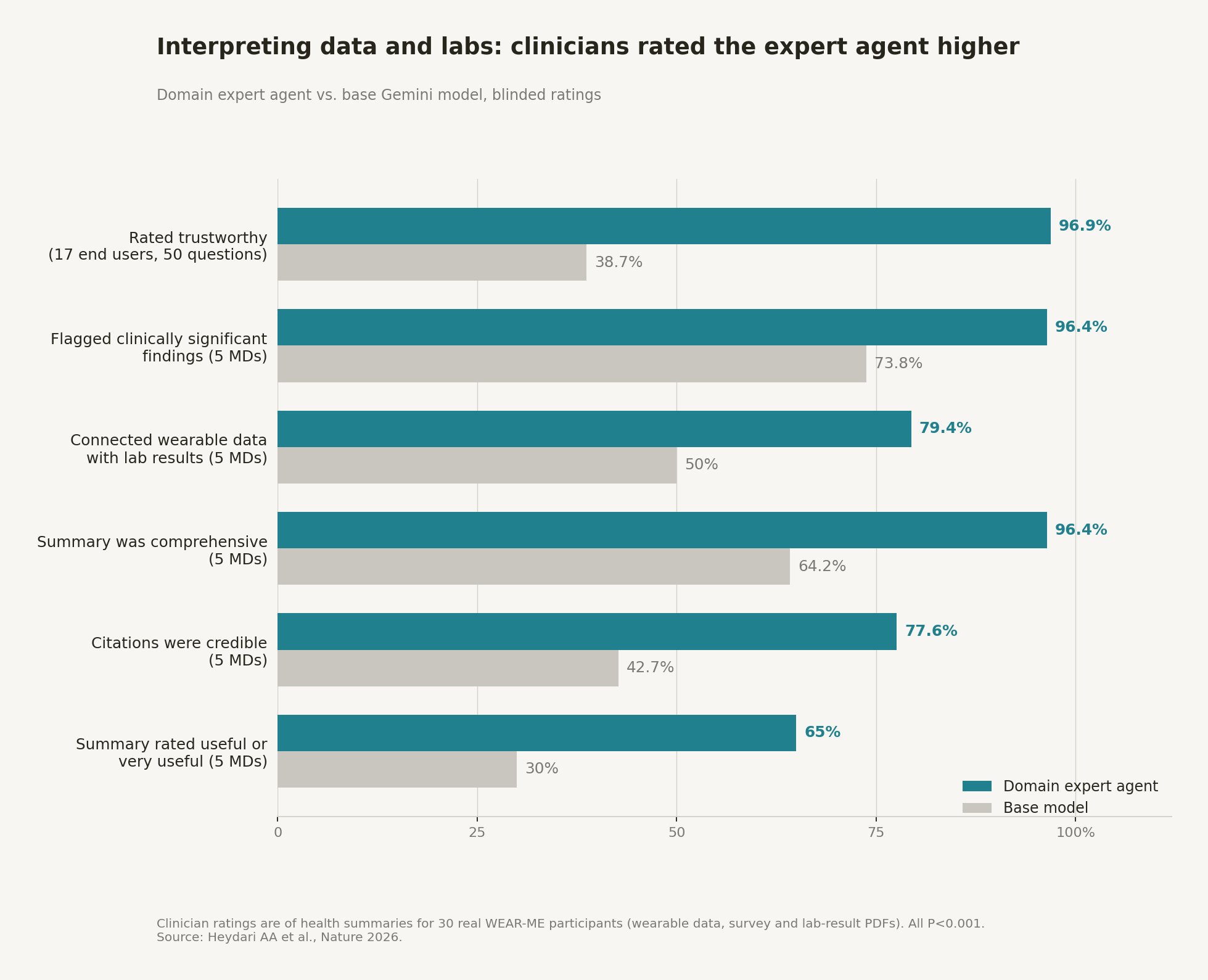
When five physicians compared health summaries built from wearable data, survey answers and lab-result PDFs, the expert agent did better on flagging clinically significant findings, connecting wearable trends with lab values and citing credible sources. It also scored slightly higher on more than 2,000 board- and certification-style questions in endocrinology, cardiology, fitness and sleep medicine (83.6% versus 81.8%). Still, only 65% of its summaries were rated “useful” or “very useful,” which tells you there is room to improve.
Coaching and the full team
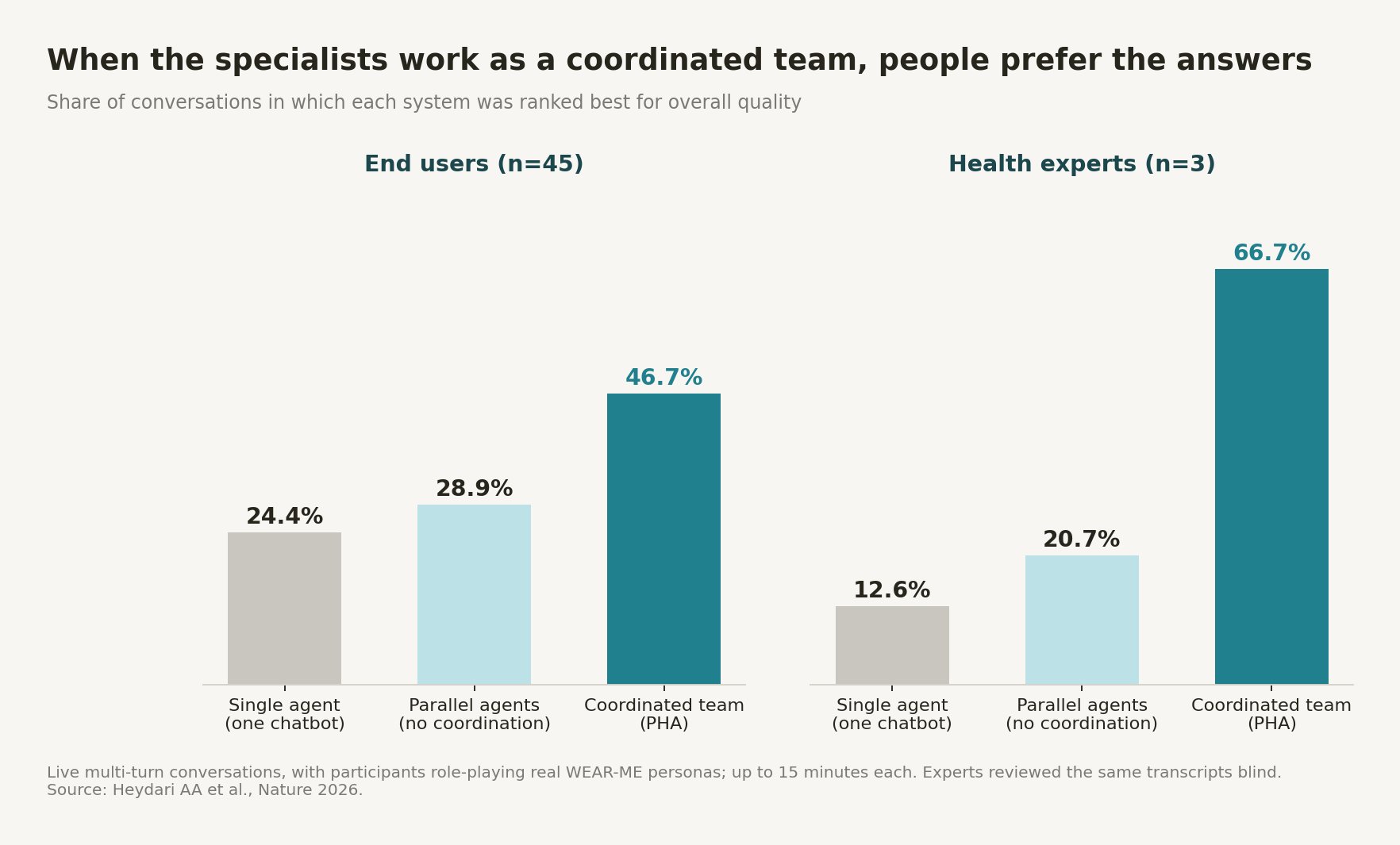
In live conversations, 45 people role-played real study participants, from healthy people training for a goal to people managing high blood pressure or diabetes. They ranked the coordinated agent best 46.7% of the time. Three health coaching experts who reviewed the same transcripts ranked it best 66.7% of the time and gave it the highest overall quality rating (72.8% versus 54.4% for a single chatbot). The health coach agent on its own was preferred on most coaching themes, though the simpler baseline did better at measuring progress.
That gap between users and experts is the most useful lesson in the paper. A response can feel helpful and still miss something a professional would catch. It’s the same reason a polished chatbot answer about your labs can feel reassuring without being complete.
The limits: what the study did not show
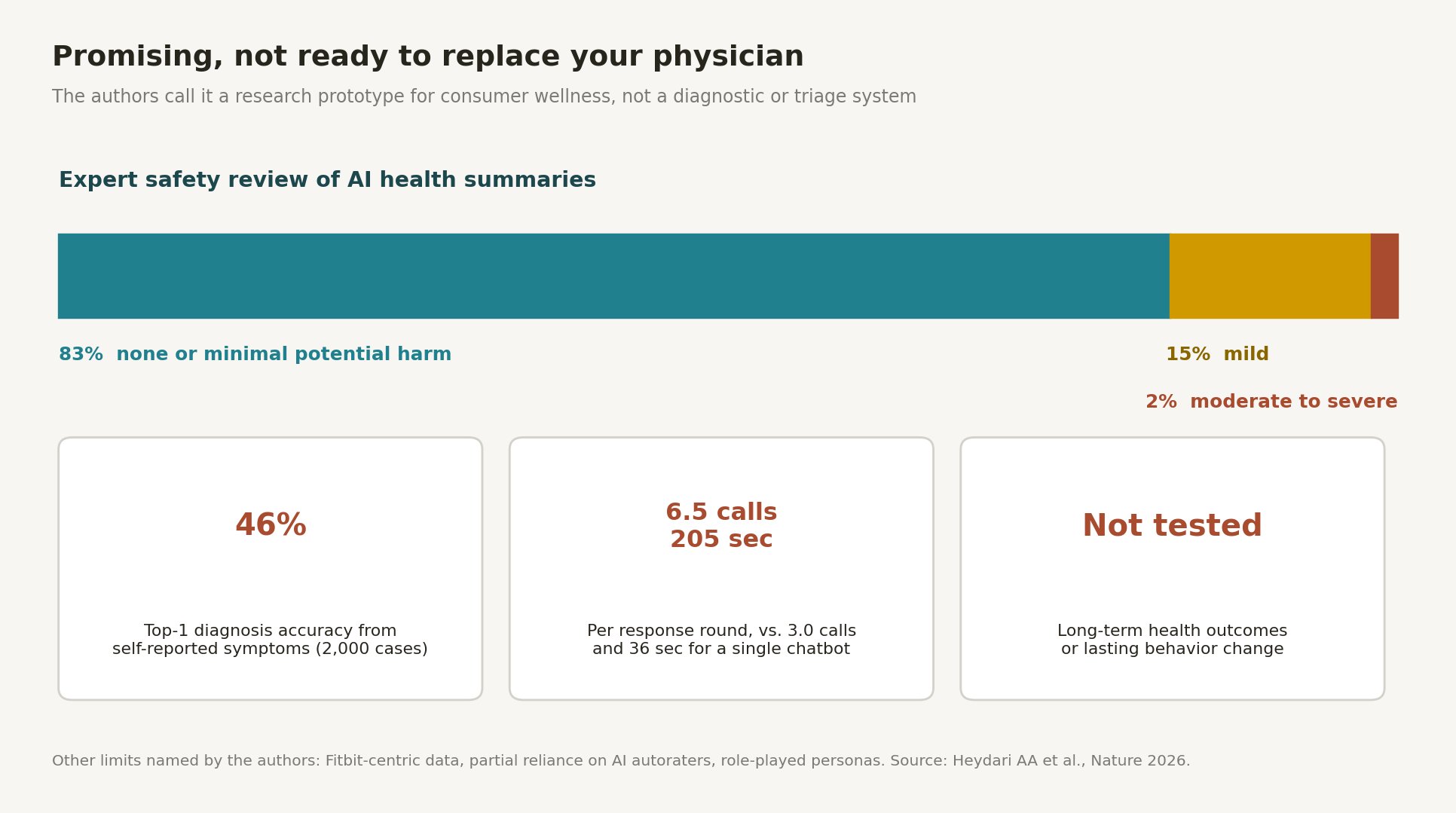
To their credit, the authors spell out the weaknesses (Heydari et al., Nature 2026):
- It is a research prototype. The authors describe it as a consumer wellness tool, “not a diagnostic or clinical triage system,” that “should not replace professional care.”
- Diagnosis is still hard. On 2,000 real self-reported symptom cases, its single most likely diagnosis was correct 46.1% of the time. That beat an earlier Google diagnostic agent by 4.7 points, but it is still wrong more often than right.
- Some summaries could cause harm. An expert safety review rated 83% of summaries as having no or minimal potential harm, 15% mild and 2% moderate to severe.
- No long-term outcomes. The study measured conversation quality and short-term task performance. It did not test whether anyone’s health or habits actually improved over time.
- Narrow data. The data came mostly from Fitbit devices, “medical records” meant blood tests only, and older adults and people with disabilities need further study.
- Who did the grading. Several results relied partly on AI “autoraters,” many comparisons were against the team’s own baselines, and the study was conducted by the company that sells a related product. The code and benchmark are open source, which allows independent groups to check the work, but independent replication hasn’t happened yet.
- It is slow and costly. The full agent averaged 6.5 model calls and about 205 seconds per response, compared with 3.0 calls and 36 seconds for a single chatbot.
The authors also recommend safeguards that I’d want in any health AI: restricting health retrieval to curated sources such as WHO, PubMed, NICE and CDC, showing sources next to each recommendation, detecting high-risk questions and handing them to a clinician, and meeting HIPAA-level privacy and security controls.
How to use an AI health coach safely
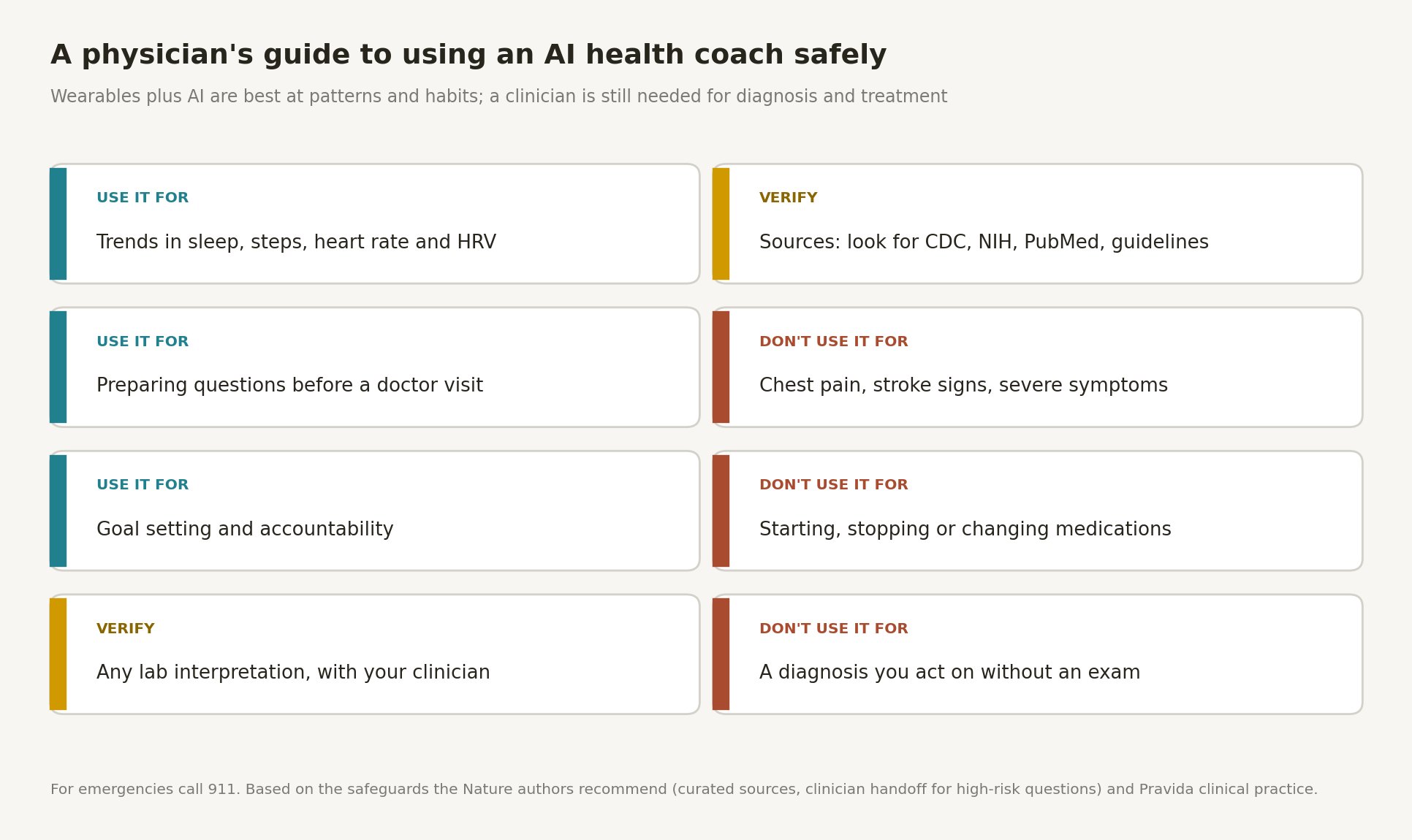
- Use it for patterns, not one-off numbers. Ask about trends over weeks, and ask the AI how many days of data it actually used.
- Use it to prepare. Have it summarize your sleep, activity and recent labs into a short list of questions for your next visit. The authors suggest this kind of preparatory role as a promising future direction.
- Check the sources. Favor answers that cite guidelines or peer-reviewed research, and be skeptical of answers without any.
- Give it context, carefully. Advice changes with your age, medications and conditions such as heart or kidney disease. Share what matters, and read the app’s privacy terms before linking medical records.
- Know the red lines. Chest pain, fainting, stroke signs, severe shortness of breath or thoughts of self-harm need emergency care, not a chatbot. Call 911.
- Never change medications on AI advice alone. Starting, stopping or adjusting a prescription should go through your clinician.
Where a physician still fits
I’m optimistic about this research. The team design mirrors how good care works: someone analyzes the data, someone interprets it and someone helps you act on it. I’ve written about the same shift toward AI-assisted care in multimodal clinical communication and digital twins in medicine.
What AI can’t do yet is examine you, order the right next test, weigh your history or take responsibility for a decision. At Pravida Health, I’d rather you bring your wearable trends and AI summaries to a visit than ignore them. We can put them next to validated measurements, such as advanced biomarkers, DEXA body composition and VO2 max testing, and turn them into a plan.
Bring your data. We’ll help you make sense of it.
If your watch, ring or AI coach is raising questions about your sleep, heart rate, recovery or lab results, a physician review can separate signal from noise.
- Review of your wearable trends alongside your lab results
- Advanced biomarker, body composition and fitness testing when it’s appropriate
- A clear, prioritized plan with follow-up
Pravida Health, 1801 Peachtree St NE, Suite 150, Atlanta, GA 30309. Call 404-900-7371, email info@pravida.com or request an appointment.
Frequently asked questions
What is a personal health agent?
A personal health agent is an AI system that combines your wearable data, health records and medical knowledge to answer health questions and coach behavior change. In Google’s 2026 Nature study, it was built as a team of three specialist agents (data science, domain expert and health coach) coordinated by an orchestrator, using the Gemini 2 family of models.
How accurate are AI health coaches?
In the Nature study, the coordinated agent was ranked best by health experts in 66.7% of conversations and beat a single chatbot on most quality measures. But its top-1 diagnostic accuracy from self-reported symptoms was 46.1%, and experts rated 2% of its health summaries as having moderate-to-severe potential for harm. It is a research prototype, not a diagnostic tool.
Can an AI health coach replace my doctor?
No. The study authors state that the system is not a diagnostic or clinical triage system and should not replace professional care. AI coaches are most useful for spotting trends in wearable data, preparing questions for appointments and supporting habits. Diagnosis, medication changes and urgent symptoms should go to a clinician.
Is the Google Health Coach the same system as the one in the Nature study?
Not exactly. Google says its personal health agent research underpins the Gemini-based Google Health Coach in the Google Health app, which replaced the Fitbit app in May 2026. The published results apply to the research prototype. Google labels the consumer coach as informational guidance that is not intended for medical purposes.
Should I share my lab results and medical records with an AI health app?
It can make the advice more personalized, but read the app’s privacy policy first, understand who can access your data, and treat any lab interpretation as a starting point to review with your clinician. The study authors note that real-world deployment requires HIPAA-level privacy and security controls.
Sources
- Heydari AA, Gu K, Srinivas V, et al. The anatomy of a personal health agent. Nature, published online October 21, 2026. doi:10.1038/s41586-026-11161-8. Nature.
- Google Health. Personal health agent open-source code and benchmark (Apache 2.0). GitHub.
- Google Research. A New Era of Discovery: Google Research at I/O 2026. Google Research blog.
- Google Research. Google Research at The Check Up, March 2026. Google Research blog.
- Google Health Help. What is new with the redesigned Google Health app. Google.
- Google Health Help. Explore the Google Health app. Google.
- Accuracy of Three Commercial Wearable Devices for Sleep Tracking in Healthy Adults. Sensors, 2024. MDPI.