
Key takeaways
- Spatial computing has crossed into real clinical use, but only in specific jobs. In July 2026 the FDA authorized the first app for using Apple Vision Pro during surgery, Stryker’s SportSuite Vision for hip arthroscopy.
- The strongest evidence is for augmented reality spine navigation. In a 150-patient randomized trial, 98.0% of AR-guided screws were placed excellently, compared with 91.7% using the conventional method.
- Most Vision Pro research is early. A 2026 review found 69 articles, but only 2 controlled confirmatory studies. Neither measured long-term patient outcomes.
- VR helps most with short-term pain and training. It works well as distraction during procedures. For chronic pain, benefits are mostly short term and modest.
- At Pravida we use Vision Pro for planning, not diagnosis. Before CartiNova knee and spine procedures, I review a patient’s MRI next to the planned approach to the lesion. The headset is not an FDA-cleared diagnostic display.
Why this question matters now
In my last post I sorted home health devices by how much your doctor can trust their data. Spatial computing needs the same treatment. The term covers headsets and software that place digital images, such as scans, 3D models and live video, into the space around you. It includes augmented reality (AR), which layers images over the real world, and virtual reality (VR), which replaces it. In 2026 it moved from conference demos into a handful of real operating rooms, and the headlines have moved even faster than the evidence. This post sorts what is authorized, what is proven, and what is still a demo.
Sorting spatial computing by evidence
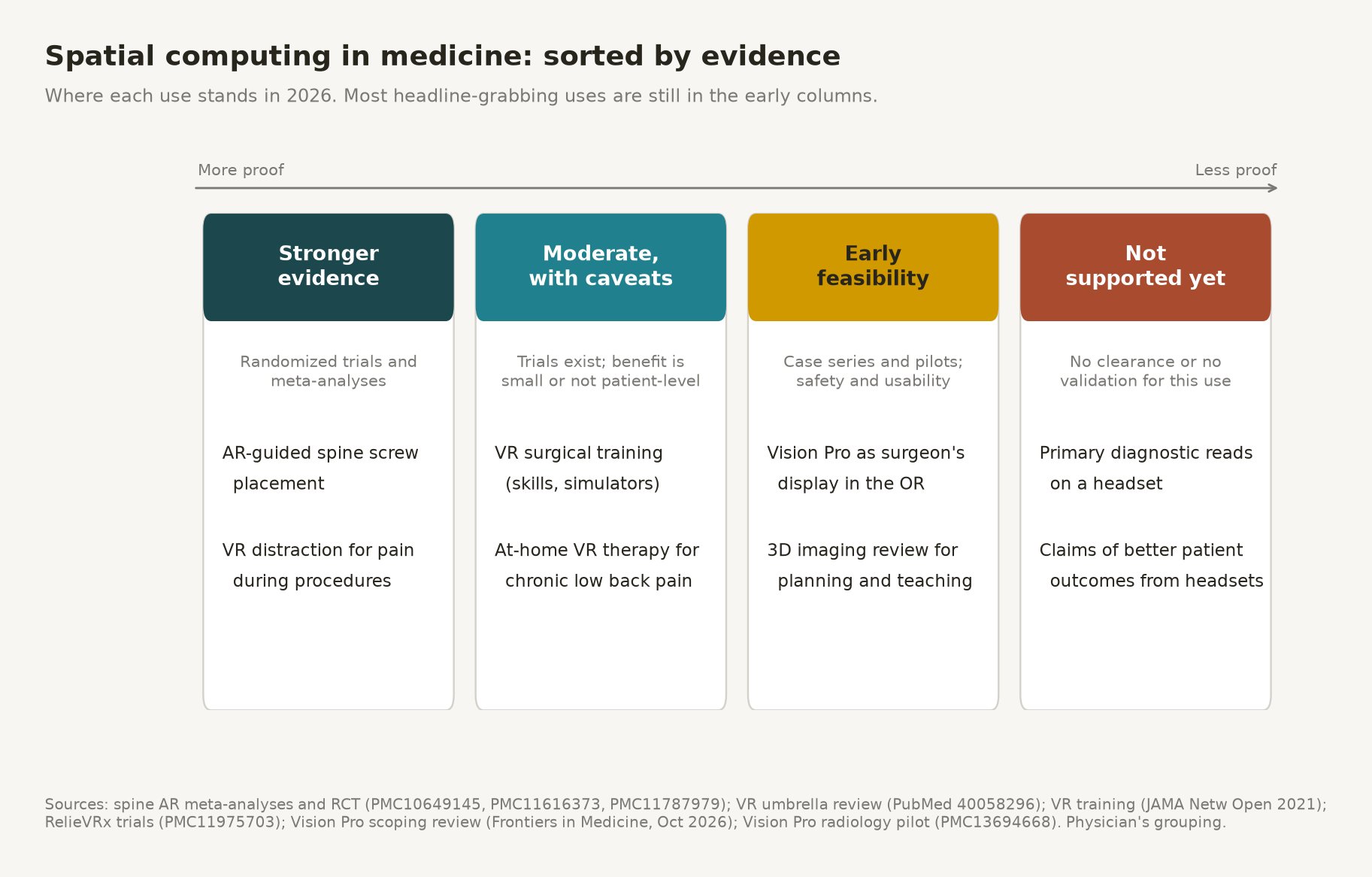
I group clinical uses into four levels, based on the quality of the evidence behind them.
The operating room: what changed in 2026
On July 17, 2026 the FDA granted De Novo authorization to Stryker’s SportSuite Vision. It was the first app authorized for use with Apple Vision Pro during surgery. The first case, a hip arthroscopy, was performed by Dr. Chad Mather III at Duke Health (Stryker via PR Newswire; Becker’s Hospital Review). The app works as a display. It places live arthroscopic video, CT images and Stryker’s hip-planning tools in the surgeon’s view, so the surgeon no longer has to look at several wall monitors. It does not make surgical decisions.
Early safety data are reassuring, but small. One academic center reported 227 headset uses across 174 procedures from August 2024 to January 2026, mostly minimally invasive surgery. No complications or conversions were attributed to the headset. Surgeons removed it in 6 uses (2.6%), and standard monitors stayed on as backup (npj Digital Surgery). In a 45-patient cataract study, 44 cases were completed on the headset. One case was switched to the standard microscope after a brief image freeze, and no patient was harmed (PubMed Central). A 32-case study of endoscopic tear-duct surgery found operations about 19% faster with the headset, which the authors called small and preliminary (MacRumors).
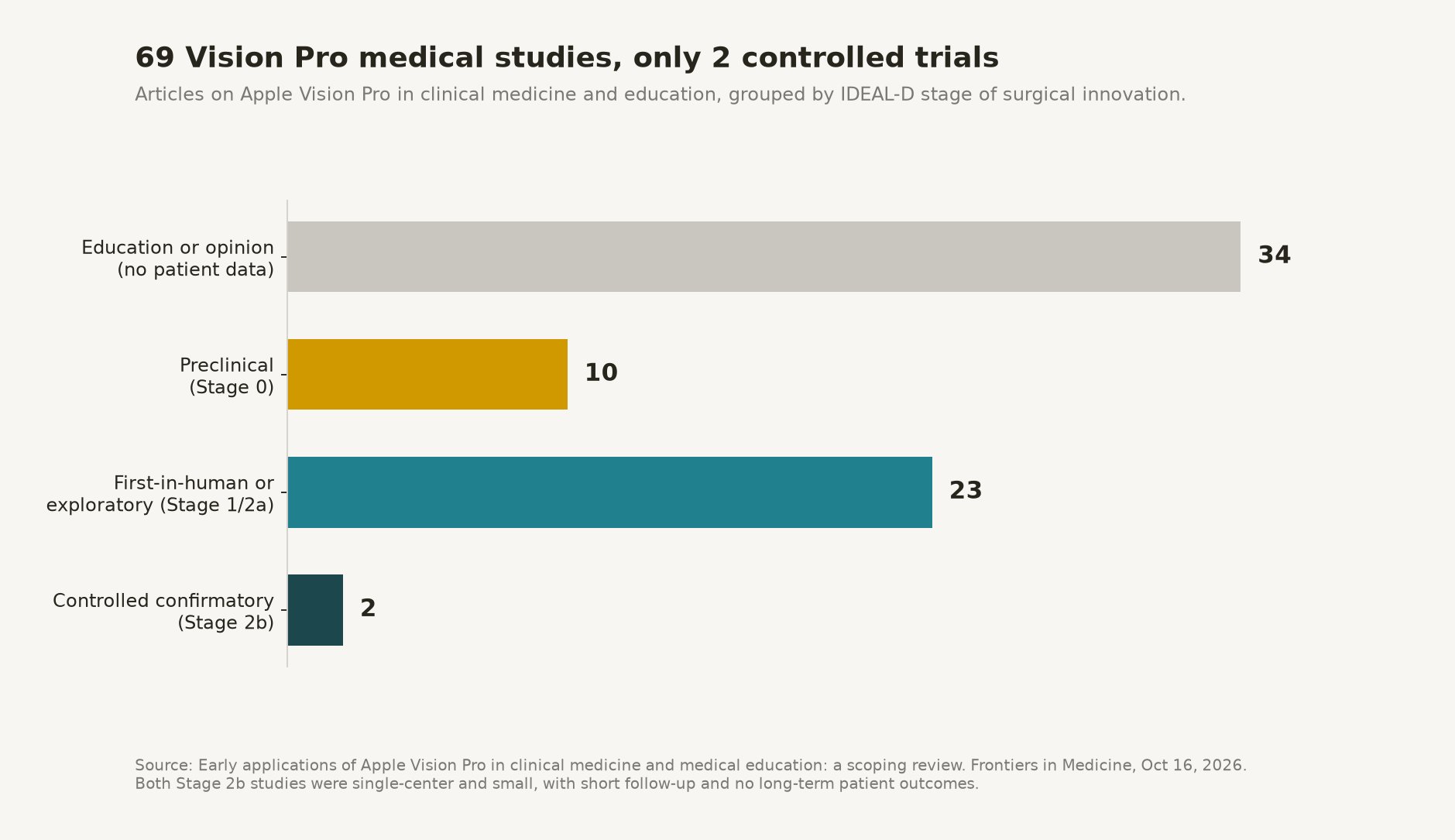
The bigger picture is sobering. An October 2026 scoping review found 69 articles on Vision Pro in medicine and medical education. Ten were preclinical, 23 were first-in-human or exploratory, and 34 were education or opinion pieces without patient data. Only 2 were controlled confirmatory studies, and both were small, single-center and short. The authors concluded that headset-assisted procedures should be considered experimental until larger trials show benefit for patients (Frontiers in Medicine).
Where the evidence is strongest: AR navigation
The most mature use of spatial computing is not the newest. AR surgical navigation overlays a patient’s imaging onto the surgical field to guide instruments. It is the largest category on the FDA’s AR/VR device list, making up about 38% of devices in one third-party count (Axis Intelligence).
Spine surgery has the best data. A meta-analysis of 8 studies with 1,259 screws found 97.2% accuracy for AR-guided screw placement (PubMed Central). A network meta-analysis of 61 studies, including 13 randomized trials and 17,023 patients, found that AR produced significantly more perfectly placed screws than the conventional technique, ranking second behind robotics (PubMed Central). In a 150-patient multicenter randomized trial using a head-mounted display, 98.0% of AR-guided screws were placed excellently, compared with 91.7% with conventional CT-guided surgery (Orthopaedic Surgery, 2025).
Two caveats matter. A systematic review found AR accuracy similar to other navigation, with better workflow, but one headset study had more major breaches (Acta Neurochirurgica). And screw accuracy is a technical result. It is not the same as showing patients feel better or need fewer revision surgeries.
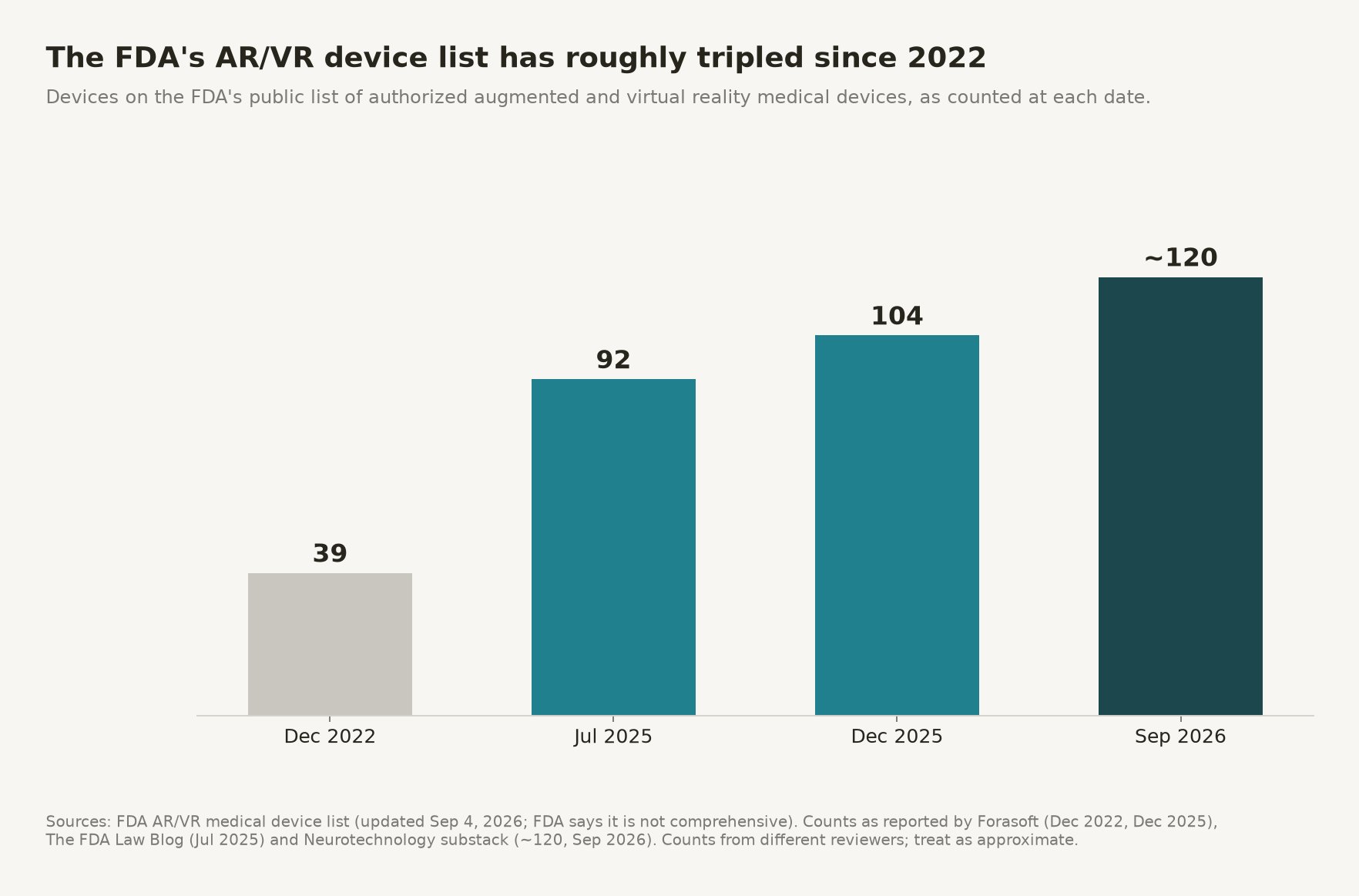
The FDA list keeps growing. It was last updated on September 4, 2026, and the agency says it is not comprehensive (FDA). It held 92 devices in July 2025 (The FDA Law Blog) and about 120 by September 2026, 11 of them dated 2026 (Neurotechnology). Recent orthopedic additions include the Pixee Knee+ AR system for knee replacement (Business Wire).
VR as therapy
I wrote earlier about RelieVRx, the first FDA-authorized at-home VR treatment for chronic low back pain. Its randomized trial showed an 8-week program beat a sham VR program (PubMed Central). Critics point out that the difference between groups was small, with an effect size of 0.24 (PubMed Central). Medicare created a dedicated equipment code, E1905, in 2023, but coverage is decided claim by claim (DLA Piper).
Across the wider field, a review of 54 meta-analyses found VR works well as a distraction for pain during procedures, but gives mostly short-term benefit for chronic pain (PubMed). For chronic spinal pain, a 2026 meta-analysis comparing VR with exercise found very low certainty evidence, and the differences fell short of what patients would notice (Physiotherapy Research International).
Training the next generation
Surgical training is one of the clearest uses. In a randomized trial of orthopedic residents, 60 minutes of VR training was worth about 47 minutes of practice in the operating room (JAMA Network Open). A meta-analysis of 11 randomized trials found VR training improved operating room performance, though results varied widely between studies (PubMed). For laparoscopic gallbladder surgery, VR beat no training but was not better than other kinds of simulation (PubMed Central). An orthopedic review found immediate skill gains but little data on how long they last, cost-effectiveness or patient outcomes (Current Reviews in Musculoskeletal Medicine).
How we use it at Pravida
At Pravida Health I use Apple Vision Pro for procedural planning before CartiNova knee and spine procedures. The headset lets me place a patient’s MRI next to a view of the planned approach, so I can line up positioning with the exact location of the cartilage or disc lesion before we start. Seeing both together at a larger scale makes the plan easier to think through and easier to explain to the patient.
I want to be clear about its limits. Vision Pro is not an FDA-cleared display for diagnostic imaging, and the medical imaging viewers available for it carry disclaimers that they are not for diagnosis (PubMed Central). In our workflow it is a planning and visualization aid. The MRI is still formally read by a radiologist, and the headset does not guide the procedure itself. There is no published evidence yet that headset-based planning improves outcomes for these procedures, so I treat it as a tool that helps me think, not as a reason to expect better results.
The limits that remain
| Limit | What it means in practice |
|---|---|
| Comfort and battery | The original Vision Pro weighs about 600 to 650 g, and battery life is about 2 hours. Long wear can cause neck fatigue (Frontiers in Medicine). |
| Image reliability | Camera passthrough adds delay, and image freezes have caused cases to switch back to standard displays. Backup monitors remain essential (PubMed Central). |
| Hardware churn | Microsoft has stopped making HoloLens 2, with security support ending December 31, 2027 and no successor (Eurogamer). Medical AR products built on it now face a platform problem (The XR Beat). |
| Privacy and security | Headsets capture eye-tracking and camera data, which raises privacy concerns, and some users get cybersickness (ITIF). Hospital security review can add 3 to 6 months to a rollout (Treeview). |
| Payment | No mainstream payment system covers surgery assisted by Vision Pro, and good cost-effectiveness studies are missing (Frontiers in Medicine). |
What to watch next
Three things will tell us whether spatial computing becomes routine. First, whether randomized trials show patient-level benefits, such as fewer complications or faster recovery, not just faster operations. Second, whether the new FDA category created for SportSuite Vision brings more authorized surgical apps. Third, whether health systems connect headsets to records and imaging. Sharp HealthCare, for example, runs a spatial computing center with Epic and Elsevier (NUBC). Competition matters too: Samsung’s Galaxy XR launched in October 2025 at $1,799 (UC Today).
My view: spatial computing is a genuine advance for seeing anatomy in three dimensions and for training. Where it touches patients, the honest description today is promising, authorized in a few narrow uses, and still unproven on outcomes. That is a good reason to use it carefully and keep measuring, and not a reason to choose a doctor or procedure because of a headset.
Considering a CartiNova procedure?
At Pravida Health we review your imaging with you, explain the plan in plain language and give you an honest read on the evidence for your situation.
- Imaging review and procedure planning for knee and spine
- Clear discussion of risks, alternatives and expected recovery
- Evidence-graded guidance on new technology
Pravida Health, 1801 Peachtree St NE, Suite 150, Atlanta, GA 30309. Call 404-900-7371, email info@pravida.com or request an appointment.
Frequently asked questions
What is spatial computing in healthcare?
It is technology, usually a headset, that places digital images such as scans, 3D anatomy and live video into the space around a clinician or patient. It includes augmented reality and virtual reality, and is used for surgery, planning, training and some therapies.
Is Apple Vision Pro FDA-approved for surgery?
The headset itself is not. In July 2026 the FDA authorized Stryker’s SportSuite Vision, an app that runs on Vision Pro, for use during certain hip arthroscopy procedures. It was the first app authorized for intraoperative use on the headset.
Does augmented reality make surgery more accurate?
In spine surgery, the evidence is fairly strong for screw placement accuracy, including a 150-patient randomized trial. Evidence that AR improves long-term patient outcomes is still limited.
Does virtual reality help with pain?
VR works well as distraction during procedures. For chronic pain, benefits are usually modest and short term. One at-home VR program for chronic low back pain is FDA-authorized.
Can doctors diagnose from an MRI on a headset?
Not currently. Vision Pro is not an FDA-cleared diagnostic display, and its imaging viewers say they are not for diagnosis. Headsets can help with planning and explaining, but formal reads use cleared workstations.
Sources
- Stryker introduces first-of-its-kind FDA-authorized surgical application for Apple Vision Pro. September 2026. PR Newswire via Morningstar.
- Duke Health performs first surgery with Stryker’s Apple Vision Pro app. Becker’s Hospital Review.
- Institutional deployment of Apple Vision Pro in procedural care. npj Digital Surgery.
- Feasibility of Apple Vision Pro in cataract surgery. PubMed Central.
- Apple Vision Pro speeds up surgery in new study. MacRumors.
- Early applications of Apple Vision Pro in clinical medicine and medical education: a scoping review. October 2026. Frontiers in Medicine.
- Feasibility of using the Apple Vision Pro for diagnostic radiology. PubMed Central.
- Augmented reality and virtual reality medical devices (updated September 4, 2026). FDA.
- FDA’s latest lists for digital health technologies. The FDA Law Blog.
- Regulatory update on AR/VR devices. Neurotechnology.
- AR/VR in modern healthcare. Forasoft.
- Virtual reality statistics (third-party count of FDA AR/VR devices). Axis Intelligence.
- Pixee Medical announces FDA 510(k) clearance for Knee+ NexSight. April 2026. Business Wire.
- Meta-analysis of AR-guided pedicle screw accuracy. PubMed Central.
- Network meta-analysis of pedicle screw placement techniques. PubMed Central.
- AR-based navigation for pedicle screw placement: a randomized, multicenter, parallel-controlled clinical trial. Orthopaedic Surgery, 2025. PubMed Central.
- Systematic review of augmented reality in spine surgery. Acta Neurochirurgica.
- Randomized trial of home-based VR for chronic low back pain. PubMed Central; response letter PubMed Central.
- CMS issues first HCPCS code and Medicare DME benefit category determination for a VR device. DLA Piper.
- Umbrella review of 54 meta-analyses of VR for pain. PubMed.
- VR versus exercise for chronic spinal pain: meta-analysis. Physiotherapy Research International.
- Transfer of VR training to the operating room: randomized trial. JAMA Network Open.
- Meta-analysis of randomized trials of VR training and operating room performance. PubMed.
- VR training for laparoscopic cholecystectomy: meta-analysis. PubMed Central.
- VR in orthopedic surgical training: review. Current Reviews in Musculoskeletal Medicine.
- Microsoft’s HoloLens is officially being discontinued. Eurogamer.
- HoloLens 2’s exit exposes a hardware problem for medical AR. The XR Beat.
- AR/VR’s potential in health care. ITIF.
- Best AR/VR headsets for healthcare. Treeview.
- Sharp HealthCare spatial computing center. NUBC.
- Samsung Galaxy XR review, ten months on. UC Today.