

Key takeaways
- The Starlink–Qualcomm deal is a 5G build, not 6G. SpaceX will use Qualcomm Dragonwing equipment for a nationwide ground-based 5G network starting in 2027, paired with Starlink satellites. Both companies describe it as a step toward “AI-native 6G.”
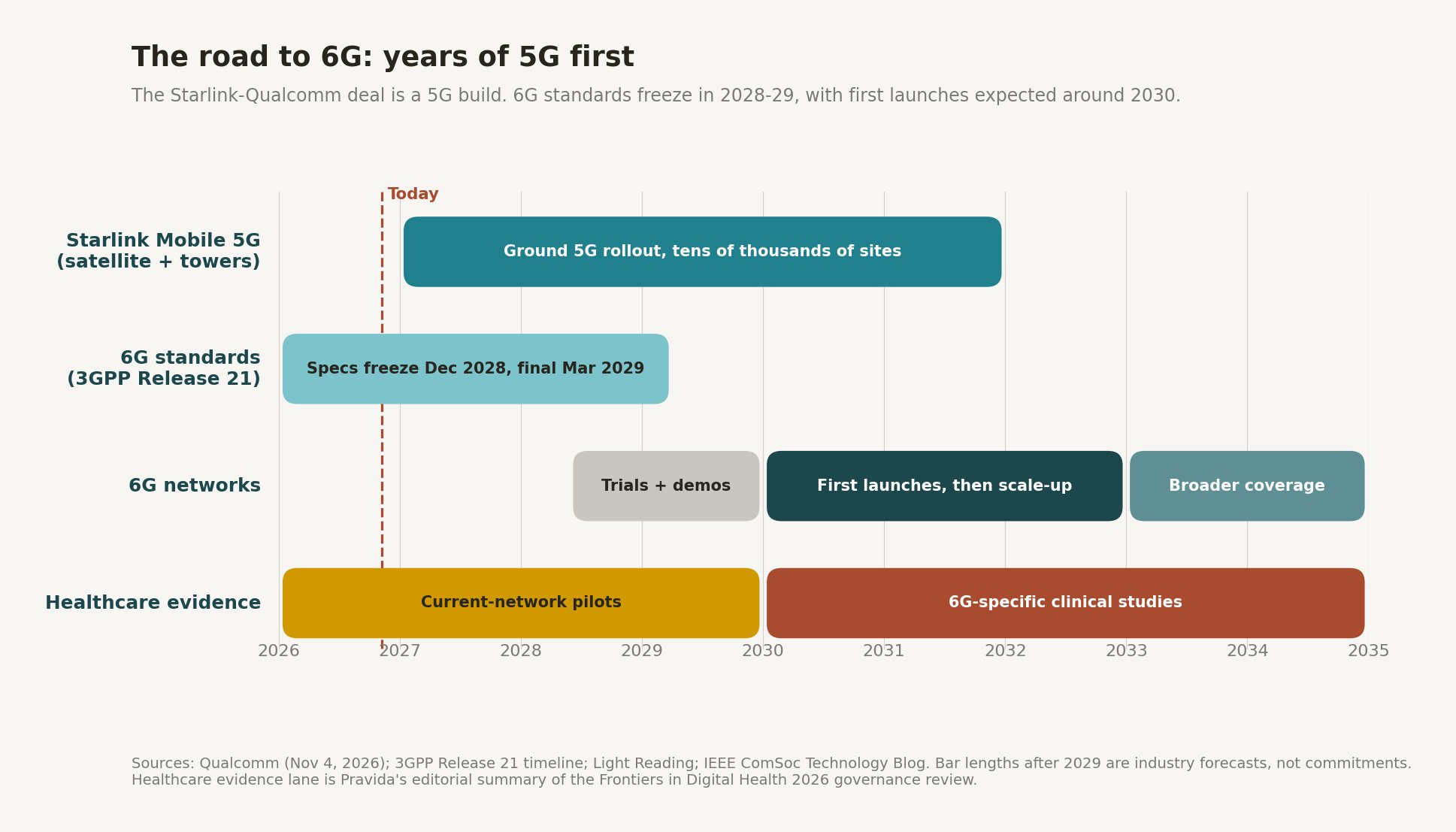
- 6G is still years away. The first 6G standards are due to freeze in December 2028, with the final code in March 2029. First commercial networks are expected around 2030, and they will start small.
- The “agentic” part is real, but early. Standards groups are designing 6G so AI agents can register, prove who they are, find each other and work together over the network.
- The biggest near-term health effect may be simple coverage. About 11.9 million people in the states studied live where internet is too slow for reliable telehealth, and 88% of them are rural.
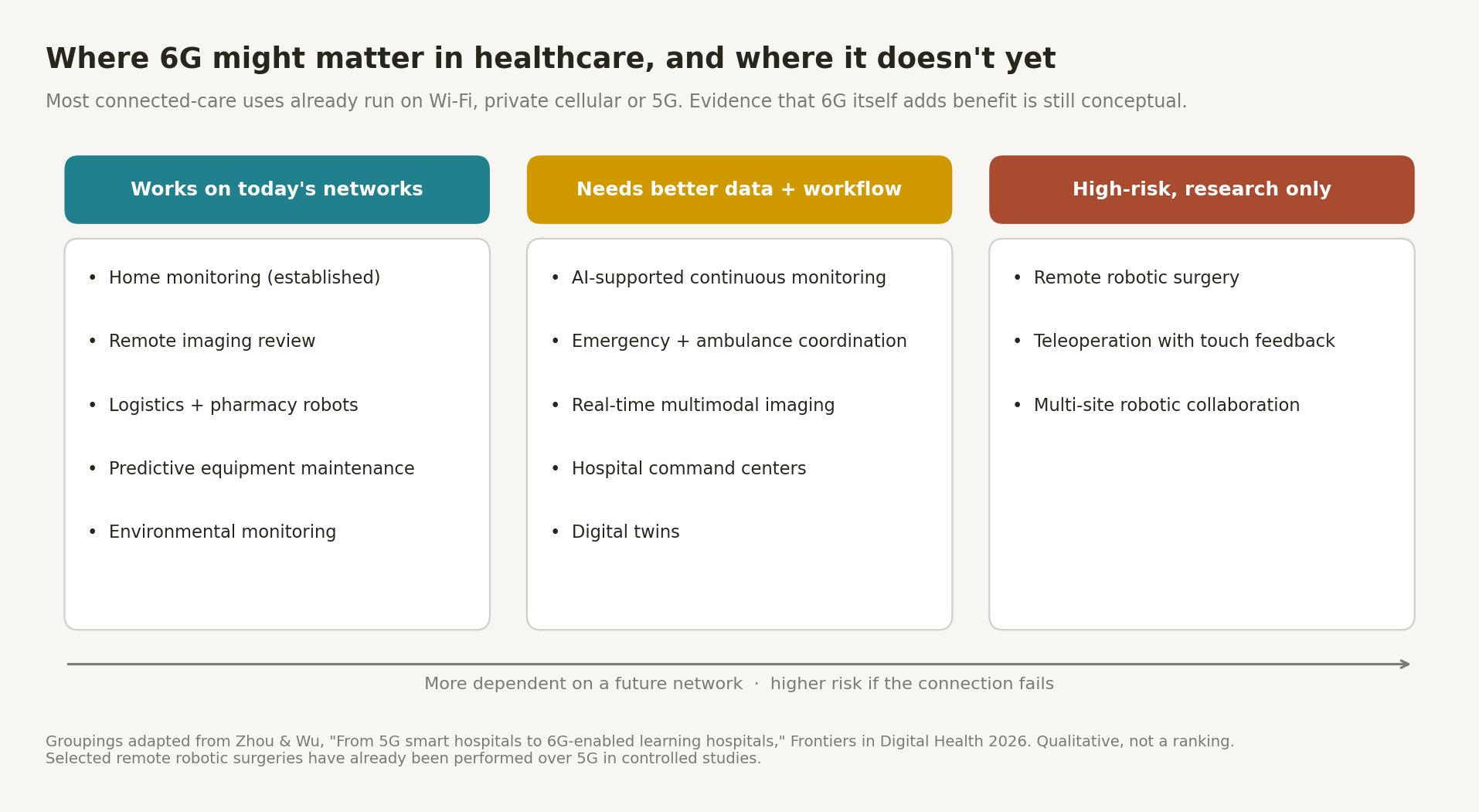
- Be skeptical of 6G medical claims. Several remote robotic surgeries have already been done over 5G. Evidence that 6G itself improves patient outcomes does not exist yet.
What was actually announced
On November 4, 2026, Qualcomm announced that SpaceX had selected its Dragonwing cellular infrastructure platforms for Starlink Mobile’s nationwide ground-based 5G network in the United States. SpaceX plans to begin the rollout in 2027 and deploy “tens of thousands of sites” over a multi-year agreement (Qualcomm). The towers will use large multi-antenna radios (64 transmit and 64 receive paths) in the 2 GHz band (SatNews), and they are meant to work alongside Starlink’s direct-to-cell satellites, not replace them (Teslarati). The deal follows SpaceX’s $17 billion agreement to buy wireless spectrum from EchoStar (Yahoo Finance).
The 6G part is a vision, not a product. Qualcomm called the deal “a commercial step toward SpaceX and Qualcomm Technologies’ broader vision for AI-native 6G infrastructure,” with “an opportunity to lay the foundation for AI-native 6G in the years ahead.” The announcement does not mention healthcare. Everything below is about what this kind of network could make possible, not what has been promised.
The timeline: years of 5G first
3GPP, the group that writes global mobile standards, has approved a schedule for Release 21, the first release with formal 6G specifications. The key freeze dates are March 2027 for requirements, June 2028 for architecture, December 2028 for protocols and March 2029 for the final code (3GPP). That puts 6G on a path to commercial launch around 2030 (Light Reading). Analysts expect early launches in dense cities and corporate campuses, with the main buildout in 2031–2033 and broader coverage after that (IEEE ComSoc Technology Blog).
What an “agentic” network means
Today, networks carry data. They don’t know or care what an app is trying to do. The idea behind an “AI-native” or “agentic” 6G network is that AI agents become recognized participants. 3GPP is working on protocols for communication between AI agents on phones and devices, between those agents and the network, between AI agents inside the network, and with third-party AI agents. The requirements include agent identity, security and authorization, and the ability for agents to register their skills and discover each other (3GPP). Nokia describes the goal as networks that take a high-level intent and let cooperating agents carry it out across domains (Nokia).
In plain language: your health AI could tell the network what it needs, such as “keep this cardiac monitor connected with guaranteed priority while my patient drives to the hospital,” and the network could arrange it. I wrote recently about AI personal health agents that read wearable and lab data. An agentic network is the plumbing those agents might eventually run on.
Where healthcare could change
1. Coverage in rural areas (now through 2030). This is the most concrete benefit, and it doesn’t need 6G. A September 2026 study in JAMA Health Forum found that 11.9 million people in 41 states live in “broadband deserts,” meaning internet slower than the FCC’s 100/20 Mbps threshold, and 88% of them are rural. About 650,000 rural residents lack broadband, nearby ambulance service and nearby health care all at once (JAMA Health Forum). A network built from both satellites and towers is aimed at exactly these gaps.
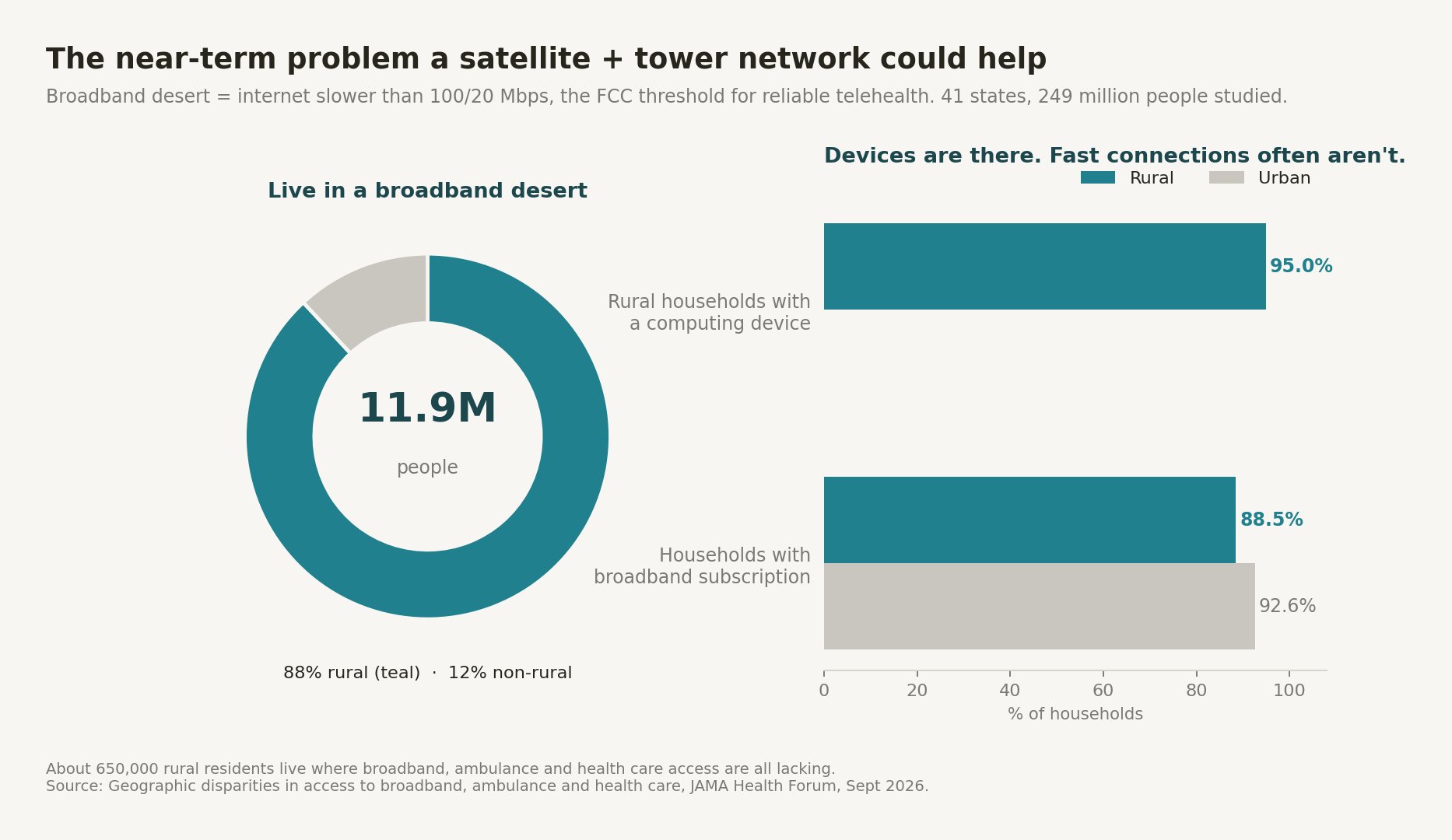
A caution from the same study: having broadband does not guarantee people will use telehealth. Cost, digital literacy, clinician availability and reimbursement all matter too.
2. Monitoring that doesn’t drop. Remote monitoring of heart rhythm, glucose, blood pressure or recovery after surgery is only as good as its connection. A network that switches smoothly between towers and satellites could reduce gaps when patients travel or live off the grid.
3. Networks that sense, not just connect. 6G research includes using radio signals for positioning and sensing. One commentator described a hospital network that detects a patient fall without a wearable alarm, alerts the nearest qualified clinician and clears a route for an autonomous medical cart (Fierce Network). That is a vision, but it shows where the field is headed. It also connects to my earlier posts on autonomous patient transport and robots in the operating room.
4. Remote surgery, a much later and higher-risk use. This is the most hyped 6G health use case, but selected remote robotic surgeries, including gallbladder removal and prostatectomy, have already been studied over 5G (Frontiers in Digital Health). The barriers that remain are predictable end-to-end delay, backup connections and safety, not raw speed.
Hype versus evidence
A 2026 review in Frontiers in Digital Health makes a point I agree with. Most connected-care tools already run on Wi-Fi, private cellular or 5G. Hospitals should first get the most out of the networks they have, prove a tool works, and move to 6G only where a real gap remains. The authors classify 6G-specific evidence across hospital use cases as still conceptual (Zhou & Wu, Frontiers in Digital Health 2026).
| Claim you may read | Status | What we actually know |
|---|---|---|
| Starlink is building a 6G network | Not accurate | The announced deal is ground-based 5G starting in 2027. 6G is a stated future goal. |
| Better rural connectivity | Plausible soon | Rollout starts 2027; real coverage and pricing are not yet known. |
| AI agents built into the network | In standards work | 3GPP is defining agent identity and discovery for the first 6G release. |
| 6G makes remote surgery possible | Overstated | Some remote surgeries already work on 5G in controlled studies. |
| Networks that sense falls or movement | Research stage | Being studied for 6G; no clinical validation yet. |
| 6G improves patient outcomes | Unknown | No 6G clinical studies exist; networks aren’t built yet. |
The risks worth discussing now
The same review lists the main risks: cybersecurity and dependence on networks that can fail, privacy when networks sense continuously, unclear responsibility when an AI agent acts on a patient’s behalf, unequal access and cost (Frontiers in Digital Health). I would add one more: concentration. If more of health care’s connectivity runs through a small number of very large network owners, outages and pricing decisions carry more weight. Health data moving between AI agents must still meet HIPAA and patient-consent rules, and those rules were not written with agent-to-agent networks in mind. I covered some of the human side of this in my post on AI and clinical communication.
What you can do now
- Patients: if you use remote monitoring or telehealth, ask what happens when your connection drops, and whether your device stores data until it reconnects.
- Rural patients: satellite and hybrid networks may become an option in the next few years. Compare real-world speed and reliability, not marketing.
- Clinics: pick tools for proven clinical value on today’s networks. Plan for backup connections and data security before adding more connected devices.
- Everyone: be wary of products sold as “6G health” before 2030. The networks don’t exist yet.
Pravida Health has no financial relationship with SpaceX, Starlink or Qualcomm, and this post is not sponsored.
Want a clear-eyed view of health technology?
We help patients separate useful tools from hype, from wearables and remote monitoring to AI health agents.
- Review of your wearable and remote-monitoring data with a clear plan
- Advanced biomarkers and imaging when they change decisions
- Evidence-graded guidance on new health technology
Pravida Health, 1801 Peachtree St NE, Suite 150, Atlanta, GA 30309. Call 404-900-7371, email info@pravida.com or request an appointment.
Frequently asked questions
Is Starlink building a 6G network?
Not yet. The November 2026 deal with Qualcomm is for a ground-based 5G network that will work with Starlink satellites, starting in 2027. Both companies describe it as a foundation for AI-native 6G in the future.
When will 6G be available?
The first 6G standards are scheduled to freeze in December 2028, with final code in March 2029. First commercial networks are expected around 2030, mostly in limited areas, with wider rollout in the early 2030s.
What is an agentic 6G network?
It is a network designed so AI agents can be recognized participants. Agents could register, prove their identity, find other agents and ask the network for what they need, such as guaranteed connectivity for a medical device.
Will 6G enable remote surgery?
Remote robotic surgery has already been performed over 5G in selected studies. 6G may improve reliability and timing, but the main barriers are safety, backup systems and validation, not speed alone.
How could satellite and cellular networks help rural health care?
About 11.9 million Americans in the states studied lack internet fast enough for reliable telehealth, mostly in rural areas. Hybrid satellite and tower networks could close some of that gap, though cost, digital skills and reimbursement still matter.
Sources
- Qualcomm. SpaceX selects Qualcomm to accelerate Starlink Mobile’s nationwide 5G network. November 4, 2026. Qualcomm.
- SpaceX selects Qualcomm to supply terrestrial base stations for Starlink Mobile network. SatNews.
- SpaceX moves to challenge AT&T, Verizon with Qualcomm-powered 5G. Teslarati.
- Qualcomm, SpaceX team up to build Starlink cell network. Yahoo Finance.
- 3GPP. Release 21 timeline. 3GPP.
- 3GPP. AI and agentic protocols for 6G. 3GPP.
- It’s official: 6G specs are set for early 2029. Light Reading.
- IEEE ComSoc Technology Blog. 6G deployment timeline forecasts. IEEE ComSoc.
- Nokia. White paper on cognitive, autonomous 6G networks. Nokia.
- Study of broadband, ambulance and health care deserts in 41 US states. JAMA Health Forum, September 18, 2026. PubMed Central.
- Zhou G, Wu L. From 5G smart hospitals to 6G-enabled learning hospitals Frontiers in Digital Health, 2026. Frontiers.
- Opinion: You’re thinking about 6G wrong. Fierce Network.