
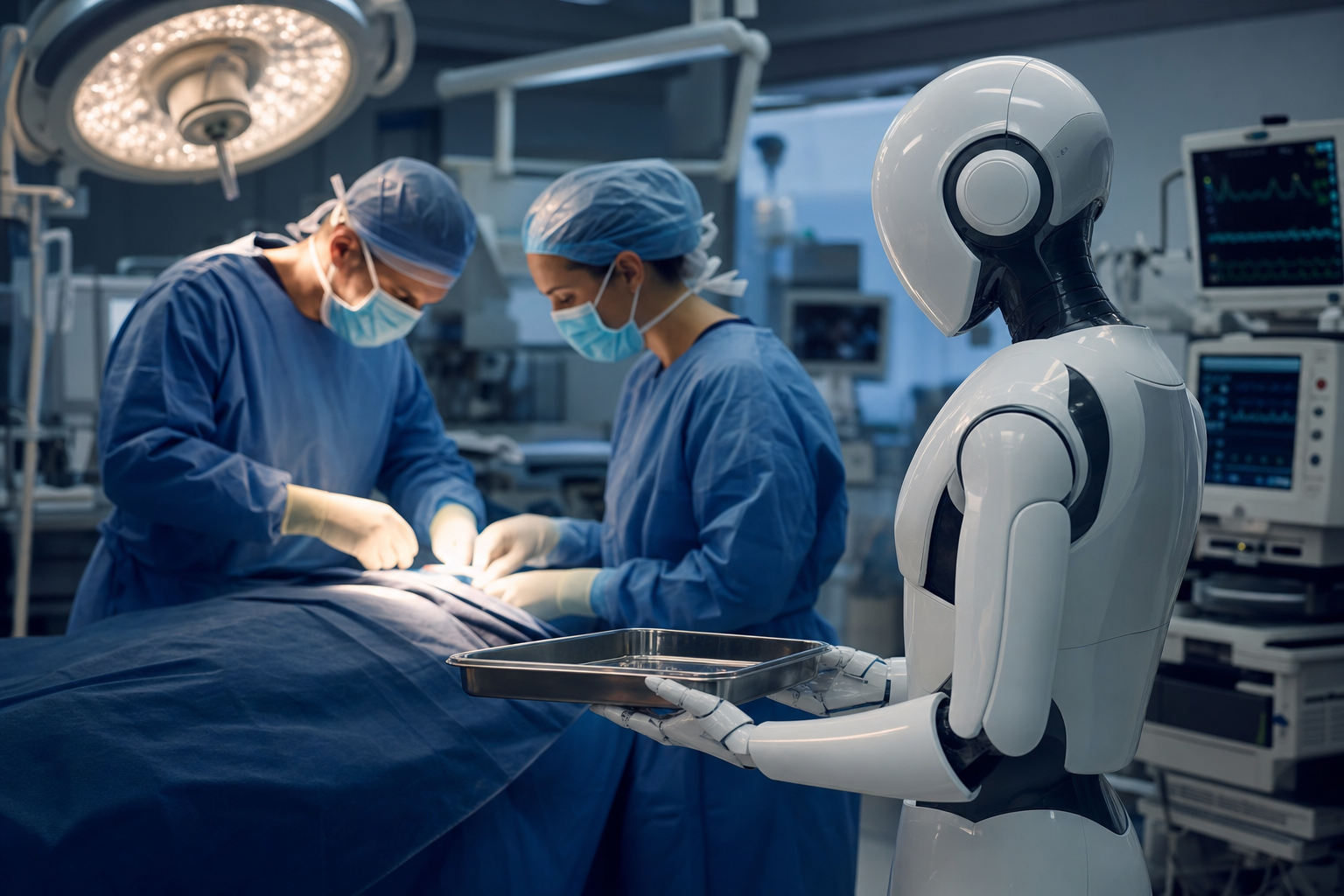
A new kind of surgical teammate
Two weeks ago a group of physicians and AI researchers led by Julius Kernbach (Heidelberg), Gabriel Brat (Beth Israel Deaconess / Harvard), Eric Topol (Scripps), and Pranav Rajpurkar (Harvard) published a perspective in npj Digital Medicine that reframes what the “next wave” of robotics in the operating room might actually look like. Their argument is not that humanoid robots will replace the surgeon. It is that humanoid robots — the general-purpose, bipedal, bimanual systems being built by 1X Technologies, Boston Dynamics, Figure AI, Tesla, and Unitree — may reasonably enter the OR to do the invisible work at the periphery: turning rooms over, retrieving supplies, holding trays, minimizing door openings, and eventually assisting the scrub and circulating nurses who form the operational backbone of intraoperative care.
I read this paper as a physician, not as a robotics engineer, and I read it against the backdrop of the last twenty years of surgical robotics — a story dominated by Intuitive Surgical’s da Vinci and Stryker’s Mako SmartRobotics platforms, systems designed to enhance the surgeon’s dexterity within the operative field. Over a million robot-assisted surgeries are now performed each year using those precision platforms. The Kernbach-Topol framework is deliberately a different animal: not a precision tool for the surgeon’s hand, but a general-purpose teammate for the room around the hand.
This post walks through what the paper actually proposes, what the evidence base behind it looks like today, and why I think the framework matters even for a small regenerative medicine and longevity practice a thousand miles from a large academic OR.
The paper in one paragraph
The Kernbach et al. framework rests on a simple observation: most preventable harm in the OR does not come from the procedure itself. It comes from the environment around the procedure. Prior systematic reviews of adverse events in the OR show that missing or malfunctioning equipment, staffing shortages, communication breakdowns, unfamiliar team compositions, and environmental disruptions account for most complications — and nearly half of those complications are preventable. Reducing that preventable harm means supporting the roles that already exist to prevent it: scrub nurses, circulating nurses, and the physical infrastructure of the OR itself. That is where the paper places general-purpose humanoids — not at the tip of the scalpel, but at the edges of the room.
The core contribution of the perspective is not a new robot. It is a staged deployment framework — a pathway with defined gates that a humanoid platform would have to pass through before graduating from one clinical role to the next. In an environment as fault-intolerant as an operating room, that structured, gated progression may matter more than any specific piece of hardware.
Why humanoids and not more specialist robots?
This is the question I asked first. If the goal is to hand instruments accurately or manage supply logistics, why build a bipedal humanoid at all? Why not just build a better wheeled cart or a better ceiling-mounted arm? The paper anticipates this. The value of a humanoid is not primarily its two legs; it is its native compatibility with the human-centered infrastructure that already fills an OR — touchscreens, drawers, foot pedals, laparoscopic hand-controls, C-arm positioners, cabinets of different heights, sinks. A generalist platform can flex across all of those without hardware modification. Kernbach and colleagues describe this compact idea sharply: the humanoid can act as a “walking physical API” — a mobile bridge across a slow-to-evolve infrastructure of disconnected systems that do not talk to each other digitally.
The paper also cites a first proof-of-concept study of a teleoperated Unitree G1 humanoid performing laparoscopic surgery using an unmodified, standard laparoscopic setup — simultaneously manipulating instruments and operating foot pedals, using bipedalism for its actual functional value rather than as an aesthetic choice. Similar demonstrations show a teleoperated humanoid performing bag-valve-mask ventilation with up to 93.3% accuracy in the clinically desirable tidal-volume range and more consistent timing than human operators.
The word to hold onto in those sentences is teleoperated. Every clinical demonstration described in the paper today is a human operator driving the robot. That is a very different thing from an autonomous system. The Kernbach framework does not gloss over that gap. It builds around it.
The two staged deployment tiers
Pre-clinical validation must come first: laboratory competency benchmarks (perception, grasping, hand-off), generalization across environments, then high-fidelity patient-free OR simulations. The paper cites concrete published gains: object placement improving from 32% → 71%, object sorting from 57% → 78%, and up to ~50% higher success rates under cross-embodiment scaling — real numbers, but numbers from home and caregiving benchmarks, not surgical ones. In parallel, deployment in home and eldercare settings acts as a healthcare-adjacent real-world sandbox where safety and reliability can be established under lower stakes.
Stage 1 is deliberately unglamorous. Room turnover. Cleaning. Environmental services. Supply retrieval. Reducing the number of door openings during a case — a variable directly linked to increased surgical site infection risk in cardiac surgery. None of this is the humanoid handing a surgeon a scalpel. It is the humanoid making sure the room is ready, stocked, clean, and stable so the humans can focus on the work only humans can do.
Stage 2 moves closer to the sterile field, into responsibilities traditionally performed by circulating and scrub nurses — instrument organization, counting, anticipation of the next step, adjusting equipment. High-risk surgical maneuvers remain explicitly out of scope until validated performance across all prior stages justifies the narrowing margin for error. The paper is clear on this: the framework is not a roadmap to autonomous humanoid surgeons in the near term.
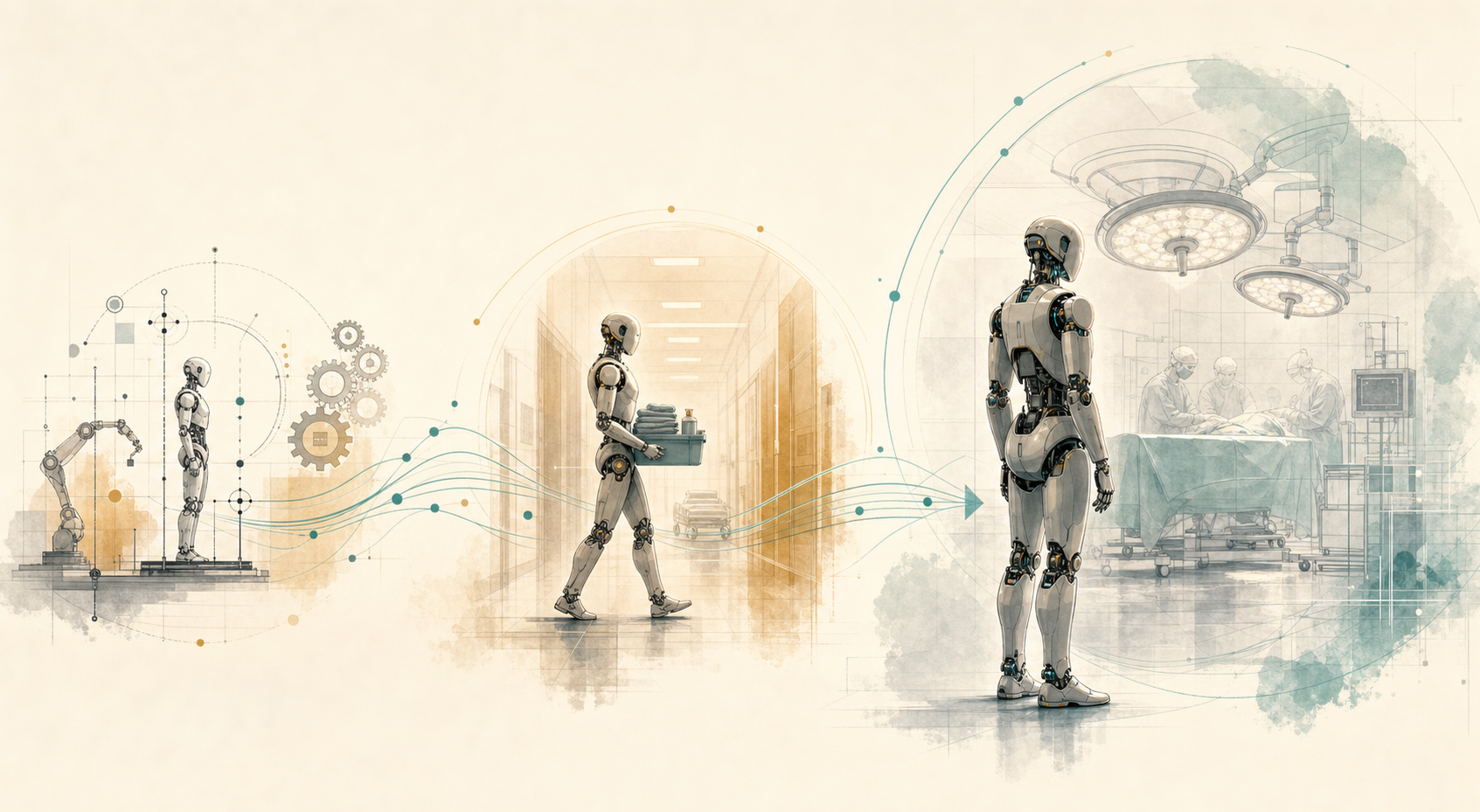
Where humanoids fit in the surgical team
The scrub nurse role
The scrub nurse is a highly technical position — maintaining sterility, organizing instruments, anticipating procedural steps, delivering instruments in the correct orientation and timing, and counting sponges and instruments to prevent retained-item events. The paper cites several existing task-specific robotic systems already addressing pieces of this role: Penelope from Robotic Surgical Tech uses speech recognition, machine vision, and path planning for autonomous instrument delivery; Quirubot demonstrated >98% mean instrument-recognition accuracy across 27 surgical instruments and a 94.2% success rate on 82 spoken commands in controlled evaluations; the Adaptive Scrub Nurse Robot uses multilevel intraoperative motion modeling; the “Deep-Onto” network integrates deep learning and knowledge representation for phase and step recognition.
The Kernbach framing is candid about what humanoids add over these existing task-specific systems. Wheeled platforms doing predefined actions in structured settings can already handle a lot. What humanoids theoretically add is generalization — the ability to move from one unstructured OR to another, to inherit human movement patterns without retraining, and to handle the edge cases that break rule-based systems. That generalization has been demonstrated in home and lab settings. It has not yet been demonstrated in a clinical environment.
The circulating nurse role
The circulating nurse coordinates all non-sterile aspects of the OR — equipment retrieval, inventory management, external communication, repositioning of large hardware like C-arms, and continuous responsiveness to fast-changing needs. The paper notes that a humanoid with bimanual manipulation and native compatibility with existing hospital touchscreens and drawers could plausibly extend the circulating role. Early hospital delivery robots — TUG (Aethon), SpeciMinder (CCS Robotics), and Moxi — have demonstrated autonomous supply delivery and room turnover in non-surgical clinical environments. Extending those capabilities into the space, cable, and equipment density of a real OR is the technical hurdle.
The paper frames a longer-horizon possibility that I find genuinely compelling — a humanoid circulating nurse acting as a mobile extension of an OR monitoring system, silently capturing time-stamped multimodal data (video, audio, patient monitoring including ECG, respiratory rate, medication delivery) and using AI to detect early warning signs before patient safety is compromised. It also flags the substantial privacy and governance challenges that kind of continuous intraoperative data capture would create.
The surgical assistant — a role the framework deliberately does not fill
The paper is unambiguous: fully autonomous humanoid surgeons or first-assistants are not appropriate for the near term. Performing surgery safely requires extensive theoretical and practical training, and the OR has a minimal tolerance for error during learning. Current surgical AI systems can be described as operating within “supervised autonomy” — delegated authority with human accountability. Fully autonomous humanoid surgical assistants would require a fundamental redefinition of existing accountability and liability models, and current regulatory frameworks are not equipped to fill that gap. The framework treats this honestly rather than as a marketing point.
Safety, regulation, and the honest read
The engineering constraint the paper identifies most clearly is that the OR is fault-intolerant. Home and industrial settings can tolerate a robot that occasionally falls or drops something. An OR cannot. The engineering objective shifts from robust to fail-safe. Bipedal humanoids in particular have to solve for near-zero-tolerance fall prevention in small, cable-dense, equipment-rich rooms — alongside OR-specific stressors like fluid exposure, electromagnetic interference, and communication instability during teleoperation.
The regulatory framing tracks the technical framing. Under the European AI Act, risk classification depends on intended use rather than form factor. A humanoid confined to environmental services in a non-clinical space is generally not high-risk. The same physical robot handling sterile instruments in patient-adjacent contexts qualifies as high-risk and requires formal risk management, documentation, and attentive human oversight. Regulatory escalation runs in parallel with functional escalation.
The paper’s own conclusion is worth quoting because it does not overreach: “the autonomous embodied AI necessary for independent clinical execution remains premature despite rapid technological advancement and growing industry investment.” Proof-of-concept hardware compatibility has been demonstrated. Autonomy has not. Meaningful integration will demand rigorous validation and prospective clinical studies to establish both added value and, critically, the absence of harm.
What this means for surgical and regenerative medicine practices
I run a regenerative medicine and longevity practice in Atlanta, not a Level 1 trauma OR at a major academic center. Why should I care about a framework paper on humanoid robots in the operating room? Because the same forces driving that framework — staffing pressure, environmental complexity, the difficulty of moving high-frequency low-consequence tasks off the plates of skilled clinical staff — are the exact forces reshaping small and midsize clinical practices right now. The gap between what a physician-owner can automate in the office and what a hospital OR can automate is narrowing quickly, and Kernbach and colleagues have written the first genuinely serious framework for how to do that automation gate by gate rather than all at once.
The pattern I take away from this paper — and from parallel work I’ve been following in large language models in medicine and the broader wave of AI in surgery — is that responsible clinical AI integration in the next five years will look less like a moonshot and more like a checklist. Staged deployment. Predefined safety thresholds. Explicit boundaries on what stays a human decision. Continuous monitoring after deployment, not just before. That is exactly the kind of framework a small practice can borrow when it decides how much of its own workflow to hand to software, or to a robot, or to a language model.
The other reason I care: our field, regenerative orthopedic medicine, sits closer to the surgical world than most people realize. Ultrasound-guided injections, image-guided procedures, small-scope surgical adjuncts. If humanoids ever do reach the OR periphery in the way this framework proposes, the ripple effects on ambulatory procedure suites, imaging suites, and interventional clinics will follow the same staged pattern. The framework is worth understanding now, even for those of us whose day-to-day patients never see the inside of a large academic OR.
The paper does not promise humanoid surgeons. It proposes something more modest and, in my read, more useful: a framework for putting embodied AI to work at the edges of the room, gate by gate, while human expertise stays where it belongs — on the patient in the middle of it.
Interested in how AI and robotics are reshaping longevity and regenerative care?
Book a consultation to talk through where these technologies fit into your care plan today — and where they don’t yet. We keep the framing honest and the interventions evidence-based.
Book ConsultationCall 404.900.7371 · info@pravida.com