For most of human history, the practice of medicine relied on two data sources: what you told your doctor, and what your doctor could measure in the room.
The problem is that your health is not a simple, stable quantity that can be captured in a 20-minute office visit with a blood pressure cuff and a stethoscope. Your health is a dynamic, complex system — continuously influenced by thousands of variables, interacting nonlinearly, changing over time.
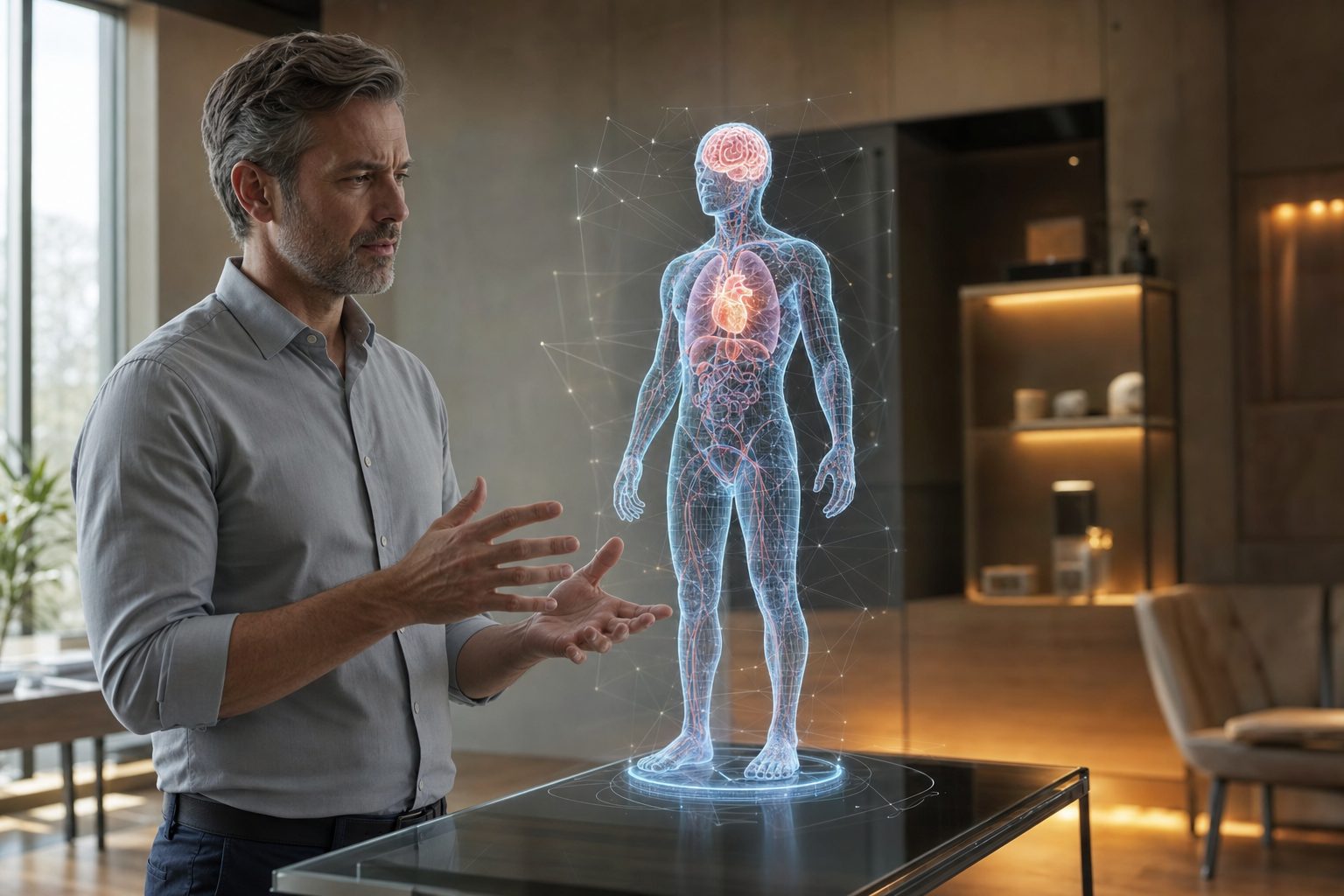
A digital twin is an attempt to model that complexity computationally. In medicine, it means creating a continuously updated virtual model of an individual patient’s biology — integrating genomics, proteomics, metabolomics, wearable sensor data, lab values, and clinical history into a single data structure that can be used to predict disease risk, optimize treatment, and personalize clinical recommendations.
This is not science fiction. The technology is in clinical use. At Pravida Health, we use the Bioscope.ai digital twin platform as the unifying layer of our precision medicine program. Let me explain what that means and why it matters.
What Is a Digital Twin in Medicine?
The concept of a digital twin originated in aerospace engineering — NASA created digital models of physical systems (spacecraft, engines) that could be updated in real time with sensor data, allowing simulations and predictive maintenance without touching the physical system itself.
Applied to human health, a digital twin creates a dynamic, data-driven model of an individual patient that integrates:
- Genomic data: Your baseline genetic architecture — disease risks, drug metabolism, inflammatory tendencies
- Epigenomic data: DNA methylation patterns that reflect how genes are currently being expressed
- Proteomic data: Which proteins your cells are actually producing and at what levels
- Metabolomic data: The downstream metabolic products of your cellular activity — the “exhaust” that reflects real-time biological function
- Wearables data: Continuous heart rate, HRV, sleep architecture, oxygen saturation, activity levels
- Lab values: Traditional biomarkers (CMP, CBC, lipid panel) plus advanced biomarkers (ApoB, Lp(a), hs-CRP, insulin, hormones)
- Electronic health record data: Clinical history, medications, procedures, diagnoses
The AI platform integrates these data streams — which individually provide limited insight — into a unified model that generates predictions and clinical recommendations that no single data source could produce alone. As a 2025 paper in the Journal of Personalized Medicine articulated: “Digital Twins are poised to transform personalized medicine by enabling real-time, multiscale simulations of individual patients.”
Why It Matters: The Multi-Omics Integration Problem
The Limitation of Siloed Data
Here is the challenge with modern precision medicine: we are generating more biological data about individual patients than ever before. But data sitting in silos is not the same as insight.
Your cardiologist looks at your ApoB. Your endocrinologist looks at your testosterone. Your rheumatologist looks at your CRP. Your dermatologist has no idea what your metabolomics showed. And none of them know your genome.
The connection between these data streams — the way your genetic variants interact with your current metabolic state, influenced by your sleep quality and inflammatory load, expressed through your protein levels — that pattern is not visible to any single specialist looking at any single dataset. A digital twin makes those connections visible.
AI-Driven Multi-Omics: The Evidence Base
A 2026 review published in Biomedicines summarized the state of AI-enabled multi-omics research: by integrating genomics, transcriptomics, proteomics, and metabolomics, AI approaches provide “biologically meaningful representations” that enable earlier detection, better patient stratification, and improved treatment prediction compared to any single omics layer.
Specific examples from the literature:
Protein-based organ aging (Nature Medicine 2025, Olink, 11 organs): A 2025 Nature Medicine study using plasma proteomics from 44,498 UK Biobank participants — measured with Olink’s approximately 3,000-protein platform — derived organ-specific biological age estimates for 11 organs including brain, heart, kidney, liver, and lung. These organ age estimates were associated with modifiable lifestyle factors, providing a dynamic, personalized picture of biological aging that static genomics alone cannot provide.
Metabolomic aging clocks (Sweet Spot Clock, Nature Communications 2026): A 2026 study in Nature Communications built a biological age predictor from 178 plasma metabolites in nearly 3,000 individuals aged 45–85, achieving a C-index of 0.841 for all-cause mortality — outperforming chronological age and models using raw metabolite levels alone.
Metabolomic longevity signatures (Cell Reports 2024): A 2024 Cell Reports study of 2,764 participants identified 308 metabolites associated with aging, 230 linked to extreme longevity, and 152 predictive of mortality risk — organized into 19 distinct “signatures” that differentiate healthy aging from accelerated aging.
This research is the scientific foundation for digital twin health platforms — demonstrating that multi-omics data, analyzed computationally, reveals patterns of biological aging and disease risk that are invisible to conventional medicine.
The Gap in Standard Care
The current standard of care operates on a fundamentally different philosophy. You get tested when you have symptoms. Your test results are interpreted in isolation. Your treatment is selected from a population-average evidence base.
This model is optimized for acute disease management. It is not optimized for identifying the specific combination of factors driving your biological aging rate, predicting which interventions will have the greatest impact on your particular biology, detecting early deviations from your personal baseline before they become clinical diagnoses, or integrating the full data picture across all of your health parameters simultaneously.
The digital twin philosophy reframes health monitoring from episodic and reactive to continuous and predictive.
“The AI doesn’t replace the physician. It helps the physician see what the physician couldn’t otherwise see.”
How We Use This at Pravida Health
The Bioscope.ai digital twin platform serves as the integrated data architecture for all Pravida Health members. Here’s what that means in practice:
- Data ingestion. Your WGS data, advanced lab panels, hormone analysis, epigenetic age testing, DEXA scan results, VO2 max measurements, CGM data, and wearable metrics all feed into your Bioscope.ai dashboard. Learn how our membership integrates these data streams.
- Unified patient view. Rather than receiving 15 separate reports from 15 separate tests, you see a single integrated picture of your health — organized by system (cardiovascular, metabolic, hormonal, inflammatory, musculoskeletal) with AI-assisted interpretation.
- Trend monitoring. The platform tracks changes in your biomarkers over time, identifying deviations from your personal baseline. A rising hs-CRP in the context of a specific NLRP3 genetic variant and declining sleep quality metrics tells a story that no single data point could.
- Clinical decision support. When I sit down with a patient to review their quarterly data, the digital twin platform surfaces the most clinically relevant patterns and flags potential interventions. This is AI as a tool for clinical intelligence augmentation — not AI replacing the physician, but AI helping the physician see patterns in complex multidimensional data.
- Longitudinal modeling. Over time, the platform builds a more refined model of each patient’s individual biology. Early indicators suggest this longitudinal data will enable predictive capabilities — identifying, for example, that a patient is trending toward insulin resistance 3–5 years before a standard fasting glucose would flag it.
I had a 49-year-old patient last year whose individual biomarker values looked unremarkable in isolation. Normal fasting glucose. Normal testosterone. Normal lipid panel. But his Bioscope.ai multi-omics integration flagged elevated metabolomic markers of oxidative stress, a rising but still-normal hs-CRP trend over 18 months, declining HRV on his wearable data, and proteomic markers suggesting early immune dysregulation — all converging. His integrated biological age was running 7 years older than his chronological age. That pattern prompted a deeper investigation and a focused intervention protocol. Nothing in his standard labs would have caught it.
What You Can Do Today
- Stop thinking about your health tests in isolation. Every biomarker you measure has context — and that context is your other biomarkers, your genetics, your lifestyle patterns. Demand an integrated interpretation, not a list of individual values.
- Start wearing a continuous monitor. HRV, resting heart rate, sleep architecture, and activity data are continuous streams of physiological information that spot-check exams miss entirely. This data is a meaningful input to any integrated health model.
- Get your complete omics picture. A digital twin is only as good as its data inputs. That means at minimum: whole genome sequencing, advanced metabolomics panel, proteomics assessment, and comprehensive lab panel — not a basic annual physical.
- Find a physician who thinks in systems. The digital twin framework requires a clinician who can integrate information across domains — not one who refers you to a separate specialist for each isolated finding.
- Expect this technology to mature rapidly. The multi-omics AI field is advancing extraordinarily fast. The platforms available in 2026 are substantially more powerful than those available in 2022. Getting your baseline data established now means future models have longitudinal data to work with. Explore our precision medicine membership to start building your baseline today.
Frequently Asked Questions
What makes a “digital twin” different from just having a comprehensive health record?
A digital twin is not a passive record — it’s an active, computational model of your biology. It integrates data streams from multiple sources, identifies patterns and correlations across them, generates predictions about future health trajectories, and provides clinical decision support. A health record tells you what happened; a digital twin model attempts to tell you what’s coming and what to do about it.
What data does the Bioscope.ai platform use?
Bioscope.ai integrates wearable sensor data (heart rate, HRV, sleep, activity), EMR/lab data, and multi-omics data (genomics, proteomics, metabolomics) into a unified clinical dashboard. It provides AI-assisted interpretation and alerts, clinician-facing decision support, and patient-facing health visualization tools.
Is my data secure in a digital twin platform?
HIPAA-compliant digital health platforms maintain the same security standards as electronic health records — encryption at rest and in transit, role-based access controls, and audit logging. Bioscope.ai is designed for clinical deployment and operates within these standards.
How accurate are digital twin health predictions?
Current platforms provide clinically useful pattern recognition and trend analysis, but they are in early stages of validated predictive modeling. The evidence base is building rapidly — the multi-omics aging clock research, protein-based organ age modeling, and metabolomic mortality prediction studies cited above all demonstrate the biological validity of the approach. Clinical translation is where the field is actively advancing.
Does a digital twin replace regular visits with my physician?
No — and this is an important distinction. A digital twin is a tool for clinical intelligence augmentation. It helps physicians see patterns in complex multidimensional data that they couldn’t otherwise perceive. The clinical judgment about what those patterns mean and what to do about them requires a physician. The Bioscope.ai platform is designed for physician-supervised deployment.
Ready to see your complete health picture in one integrated view?
A consultation at Pravida Health includes a review of your multi-omics data potential — genomic, proteomic, metabolomic, and wearable — to determine which digital twin inputs are most clinically relevant for your health goals. Our precision medicine program integrates these technologies with experienced physician oversight throughout. Let’s build your personalized longevity strategy from your actual biology.
Schedule a Consultation