Key takeaways
- Muse launched September 8, 2026. It is Meta’s personal AI agent for adults 18 and older in the U.S., on iOS, Android, the web at muse.ai and in WhatsApp.
- It can connect your medical records. HealthEx lets you link records from the care sites you choose. Function lab results, Apple Health and other health apps can also connect.
- It acts, not just answers. With your records, Muse can assemble a visit summary, draft questions for your doctor and set refill reminders. Meta says it checks with you before sensitive actions.
- AI training is on by default. Meta says your Muse interactions can be used to train its models unless you turn that off under Settings, Data controls. Do this before you connect health data.
- It is not a clinician. Meta’s launch announcement includes no medical disclaimer. Treat Muse’s plans and reminders as drafts for your physician to review.
Why Meta belongs in this series
When I started this series on consumer AI health tools, I focused on chat assistants. Meta’s Muse is different, and it is likely to reach more patients than most of them. Muse is an agent: it keeps working after you close the app, connects to your other accounts and can take actions on your behalf (Meta). Two weeks after launch, CNN reported it was the most popular free app in Apple’s App Store, with more than 2.5 million downloads according to Sensor Tower (CNN).
For health, that combination is useful and risky at the same time. An agent that can read your records and follow up on an unscheduled referral could genuinely help. An agent that is trained on your conversations by default needs careful setup first. This post covers both, as of November 15, 2026.
Two Meta products, one model
Meta has two consumer products that touch health, and they are easy to confuse:
- Meta AI is the chat assistant inside the Meta AI app, WhatsApp, Instagram and Facebook. Since April 2026 it runs on Muse Spark, a model Meta says it trained with health data curated by more than 1,000 physicians (Meta AI).
- Muse is the personal agent Meta launched on September 8, 2026. It runs on its own dedicated cloud computer, which Meta calls the Muse Secure VM, and connects to apps such as email, calendars, payments and health services (Meta; Reuters).
This guide focuses on Muse, because that is where your medical records can connect. Muse is available to people 18 and older in the U.S. (AP). It is free for most uses, with paid plans that TechCrunch reported at $20 and $100 a month, and it asks for a payment card to get started (TechCrunch).
What you can connect
| Connector | What it adds | Notes |
|---|---|---|
| HealthEx | Medical records from the care sites you choose | Identity check required; nothing is shared with Muse without your consent; revoke in HealthEx Wallet |
| Function Health | Your Function lab results and clinician-reviewed summaries | For Function members; you authorize it from inside Meta’s account controls |
| Apple Health | Activity, sleep and other device data | Named in Meta’s Help Center; managed in your phone’s settings after setup |
| Other health and fitness apps | Workouts, weight, other metrics | Reported connectors include Withings and Peloton; each has its own terms |
Details are from HealthEx, Function and Meta’s Help Center (HealthEx; Function; Meta Help Center). Meta notes that each connector has its own terms and privacy policy, and that Meta does not review custom connectors you ask Muse to build (Meta Help Center).
Five things patients can do with it before a visit
- Assemble a visit summary. HealthEx says Muse can use your shared records to put together a visit summary and draft the questions worth raising with your doctor (HealthEx). Then trim it with the one-page prompt below.
- Catch loose ends. HealthEx also says Muse can surface follow-up items in your records, such as a referral that was never scheduled or a refill running low (HealthEx). That is exactly the kind of thing that slips through the cracks between visits.
- Compare a lab result with your range. Function says members can ask Muse how a result compares with their optimal range before deciding whether to act on it (Function). Bring the question to your physician rather than acting on the answer.
- Set reminders. Refill reminders and a reminder to book your next lab draw are low-risk, high-value uses (HealthEx; Function).
- Turn a plan into steps. After a visit, ask Muse to turn your physician’s recommendations into a checklist. Don’t ask it to invent a plan your physician hasn’t made.
Privacy and control: what Meta says
- Training is on by default. Meta says the setting that lets your interactions train its AI models is on when you first use Muse. You can turn it off under Settings, Data controls, and Meta says the change also applies to previous interactions. If you leave it on, Meta says it removes certain identifiers, such as names, email addresses, phone numbers and Social Security numbers (Meta Help Center).
- Ads: Meta says Muse doesn’t share your conversations or the data in your virtual machine with its ad systems (Meta).
- Approvals and audit trail: Meta says Muse checks with you before sensitive actions such as sending an email or making a purchase, and shows a complete audit trail of what it has done and plans to do (Meta).
- Disconnecting isn’t forgetting. Disconnecting a connector stops new data. Meta says information Muse already used may remain in its memories and your conversation history, and you can ask Muse to forget it (Meta Help Center). Meta’s privacy policy adds that you can reset Muse to delete all your Muse data (Muse Privacy Policy).
- Encryption is still coming. Meta says it will introduce a Muse Confidential VM later in 2026, encrypted with a key only you hold (Meta). It was not available when this post was written.
Where it falls short
Meta says Muse Spark led its own tests on HealthBench Hard, a difficult subset of OpenAI’s health benchmark (DeepLearning.AI). A benchmark is not the same as safe advice for you. In WIRED’s early testing of Meta AI, as reported by Digital Trends, the chatbot encouraged uploading raw lab and glucose data and produced an extremely low-calorie meal plan after flagging the risks (Digital Trends). Reuters also reported internal concerns at Meta about how the agent handled sensitive personal data before launch (Reuters).
Meta’s launch announcement and the Muse privacy policy do not say whether Muse is medical advice (Meta; Muse Privacy Policy). I would treat it the way the other companies in this series describe their own tools: useful for understanding and organizing, not for diagnosis or treatment decisions. My practical advice is to connect one health source at a time, keep approvals set to ask you first, and read the audit trail after anything that touched your records.
How to bring Muse work to your physician
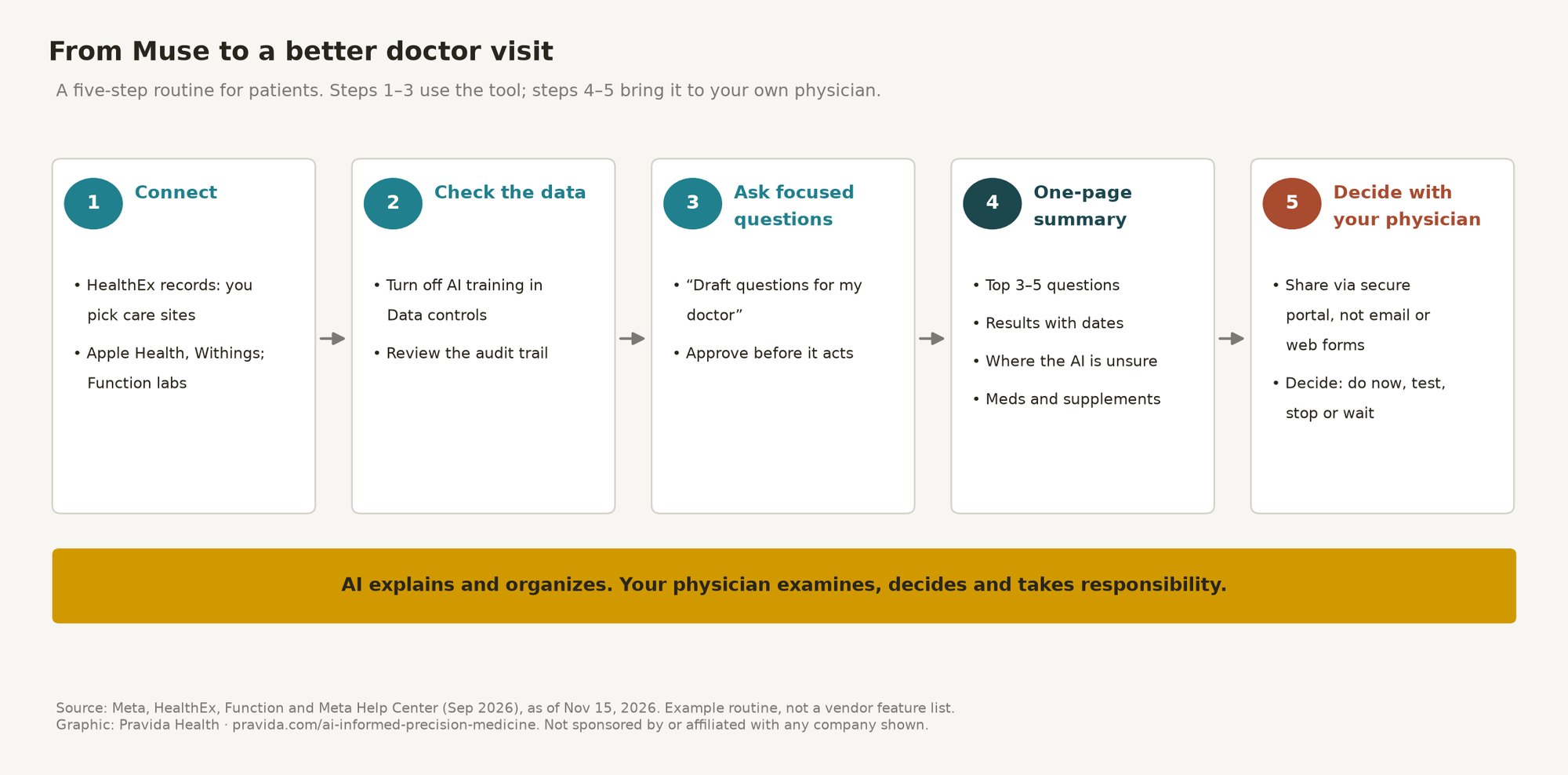
The most useful thing you can bring to a visit is not a long chat transcript. It is a short, honest summary that separates what your records show from what the AI suggested. Here is the routine I recommend to my own patients:
- Check the data first. Before you ask anything, look at what the tool pulled in. Records can be incomplete or out of date, and a medication you stopped last year may still be listed.
- Ask your questions, then ask for the summary. Use the prompt below at the end of your conversation so the AI lists its own uncertainty.
- Add what the AI does not know. Symptoms you haven’t typed in, family history, supplements and anything that happened outside the records.
- Share it securely. Bring it to the visit or upload it through your physician’s patient portal. Don’t send health details by regular email or a website form.
- Let the visit decide. Your physician’s job is to decide which of the AI’s ideas apply to you, what to test, what to stop and what can wait.
One-page physician summary prompt (from our visit preparation guide; works in any of these tools)
“I’m preparing for a visit with my physician. Using only what we’ve discussed and the health information I’ve shared with you, write a one-page summary for my doctor with these sections: 1. My top 3–5 questions, in priority order. 2. Relevant results or data (with dates and units), and what changed over time. 3. What you suggested I consider, and how confident you are in each suggestion. 4. What you could not determine without an exam, testing, or my full history. 5. My current medications and supplements, as I’ve told you. Keep it under one page. Do not add diagnoses. Mark anything uncertain as uncertain.”
The AI health tools series
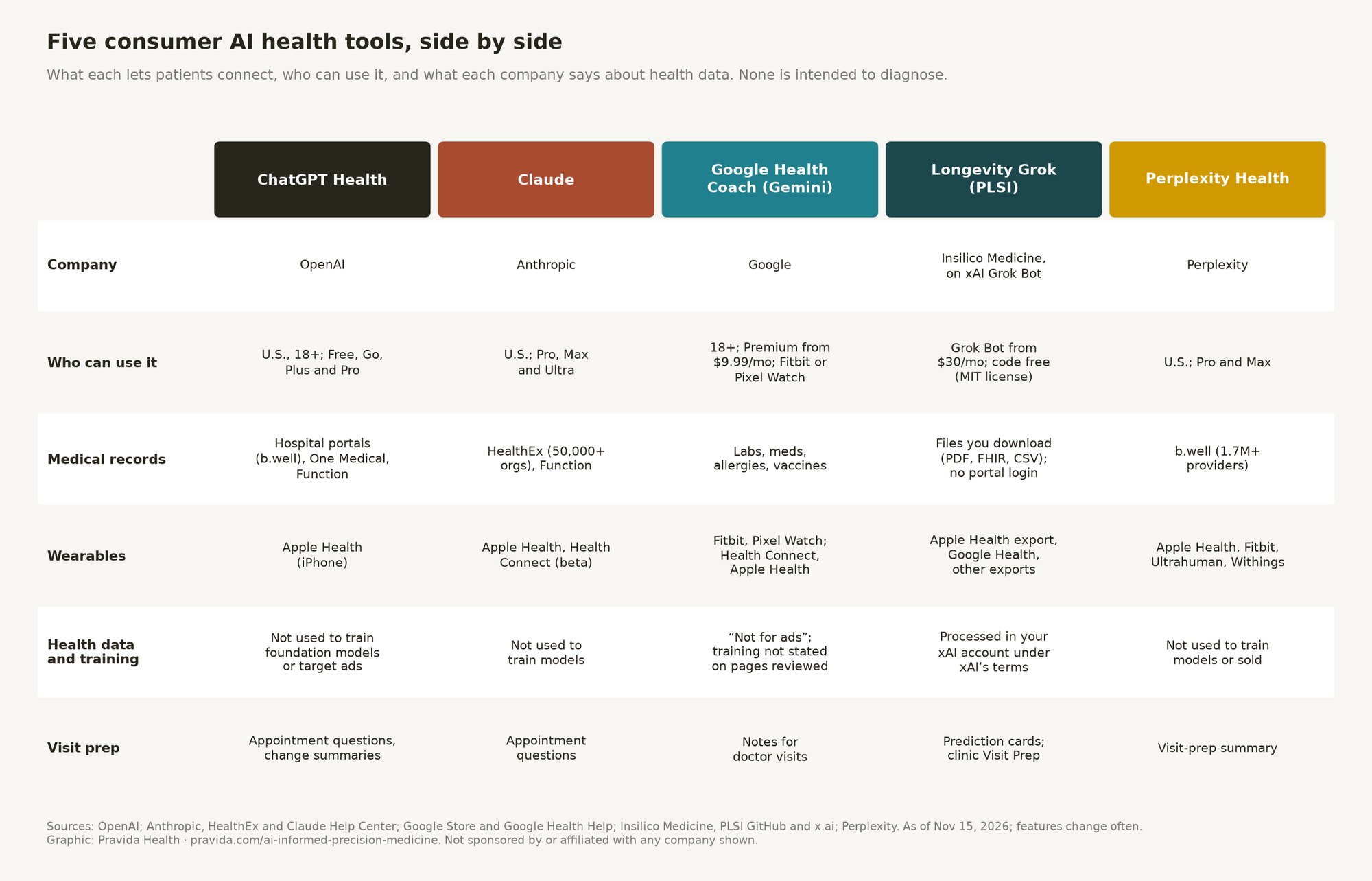
This post is part of a seven-part series on what patients can do with consumer AI health tools to work better with their own physicians. The others:
- ChatGPT Health
- Claude and your health records
- Gemini and the Google Health Coach
- Longevity Grok (PLSI)
- Perplexity Health
- Microsoft Copilot Health
For the health-system side, see Gemini for healthcare vs. OpenAI, Anthropic, Amazon and Microsoft. For how I work with patients who bring AI research to a visit, see AI-Informed Precision Medicine at Pravida.
Bring your AI research to a physician who uses these tools
Pravida’s AI-Informed Precision Medicine consultation is built for patients who have already done the research. You upload your one-page AI summary, recent labs and wearable exports through our secure patient portal. Dr. Turner reviews them before the visit, then works through them with you.
- Free 15-minute discovery call with our care coordinator
- Virtual consultation: 45 minutes, $295 (adults located in Georgia or Florida during the visit)
- In-person consultation in Midtown Atlanta: 60 minutes, $495
- You leave with prioritized recommendations: what to do now, what to test, what to stop and what can wait
Please don’t send health details through our website form or email; you’ll get a secure portal link after booking. Details and credit terms are on the consultation page.
Pravida Health, 1801 Peachtree St NE, Suite 150, Atlanta, GA 30309. Call 404-900-7371, email info@pravida.com or request an appointment.
Frequently asked questions
What is Meta’s Muse?
Muse is a personal AI agent from Meta, launched September 8, 2026 for adults 18 and older in the U.S. on iOS, Android, muse.ai and WhatsApp. It runs on Meta’s Muse Spark model and can connect to apps and take actions on your behalf, checking with you before sensitive ones.
Can Muse connect to my medical records?
Yes. Through HealthEx, people in the U.S. can connect records from the care sites they choose after verifying their identity. Function members can connect lab results, and Meta’s Help Center names Apple Health as a connector.
Does Meta train its AI on my Muse conversations?
By default, yes. Meta says the training setting is on when you first use Muse. You can turn it off under Settings, Data controls, and Meta says the change also applies to previous interactions.
Is Meta’s Muse free?
Muse is free for most uses, with paid plans reported at $20 and $100 a month for heavier use. TechCrunch reported that it asks for a payment card to get started.
Should I use Muse for health advice?
Use it to organize records, draft questions and set reminders, then review everything with your physician. Meta’s launch materials do not describe Muse as a medical device or as a source of diagnosis or treatment.
References
- Introducing Muse: the world’s first personal AI agent built for everyone. September 8, 2026. Meta Newsroom.
- How Muse handles your privacy, safety and security. Meta Help Center.
- How Muse works with Connectors. Meta Help Center.
- Muse Privacy Policy. Muse.
- HealthEx empowers consumers to bring their personal health history to Muse. September 8, 2026. HealthEx via GlobeNewswire.
- Function now connects to Meta’s Muse. September 8, 2026. Function via PR Newswire.
- Introducing Muse Spark: scaling towards personal superintelligence. Meta AI.
- Meta launches personal AI agent, Muse, emphasizes safety and privacy. September 8, 2026. AP.
- Meta debuts its Muse AI agent. Will consumers trust it? September 8, 2026. TechCrunch.
- Meta launches AI agent that can access other apps, send emails, make payments. September 8, 2026. Reuters.
- Meta says its Muse AI agent can do things for you. I put it to the test. September 23, 2026. CNN.
- With Muse Spark, Meta pivots away from its open-weights Llama strategy. DeepLearning.AI.
- You don’t want to trust Meta’s new Muse Spark AI with health advice. Digital Trends.