
Key takeaways
- Perplexity Health launched March 19, 2026. It is for Pro and Max subscribers in the United States, on iOS and the web.
- It connects records and wearables. Medical records come through b.well, which Perplexity says reaches more than 1.7 million care providers. Wearables connect through Terra API and direct integrations, plus Apple Health on iPhone.
- Its distinctive feature is citations. Perplexity says answers draw on clinical guidelines and peer-reviewed journals, with citations linked to the source.
- It includes a visit-prep summary. Perplexity lists generating a visit-prep summary before a doctor’s appointment as a core use.
- It is educational, not diagnostic. Perplexity says it is not intended to diagnose, treat or prevent disease. A citation shows where a claim came from, not whether it applies to you.
Why citations matter in a health answer
When a patient tells me “the AI said,” my first question is: based on what? A guideline, a single small study and a supplement company’s blog are very different kinds of evidence. Perplexity Health is built on an answer engine that shows its sources, so you and your physician can look at them together.
A disclosure before I go further: this website was built with Perplexity Computer, a Perplexity product. Pravida Health is not affiliated with or sponsored by Perplexity, and Perplexity did not review this post. I have tried to hold it to the same standard as the other four tools in this series.
What Perplexity Health is
Perplexity introduced Perplexity Health on March 19, 2026 as a way to ask questions using your medical records, lab results and wearable data together, with a personal dashboard for tracking biomarkers and activity over time (Perplexity). It is available to Pro and Max subscribers in the U.S. on iOS and at perplexity.ai/health, and the rollout is phased (Perplexity Help Center).
Perplexity also announced a Health Advisory Board of physicians, researchers and health technology leaders to pressure-test product decisions and clinical safeguards, but its announcement did not name the members (Perplexity).
What you can connect
| Source | What it adds | Notes |
|---|---|---|
| Medical records | Labs, visit summaries, medications, conditions | U.S. only; powered by b.well; depends on what each provider makes available |
| Wearables and apps | Steps, workouts, heart rate, sleep, recovery, cycle data | Through Terra API and direct integrations; Fitbit, Ultrahuman and Withings named at launch |
| Apple Health | Activity, sleep and other data you choose to share | iPhone only, 18+; personalizes answers but does not yet appear on the Health dashboard |
| Uploaded files | Health documents you upload | Stored in a dedicated Health files area |
Details are from Perplexity’s announcement and help center (Perplexity; Perplexity Help Center). At launch, Perplexity said Oura and Function were coming soon (Perplexity).
Six things patients can do with it before a visit
- Generate a visit-prep summary. Perplexity lists this as a core use (Perplexity). Then trim it with the one-page prompt below.
- Ask about a result in context. Perplexity’s own example is asking about resting heart rate in light of recent activity, cardiac history and the latest bloodwork (Perplexity). Context is what makes a number meaningful.
- Open the sources. For any recommendation you want to discuss, click through to the cited guideline or study and note what kind of evidence it is. Bring the two or three that matter most.
- Check a medication question. Ask about side effects or interactions, then confirm with your physician or pharmacist before changing anything.
- Track a biomarker over time. The Health dashboard shows biomarker and activity trends (Perplexity Help Center). A dated trend is more useful to me than a single value.
- Review its health memories. Perplexity may save health memories from your questions. You can view and delete them under Settings, Personalization (Perplexity Help Center).
Privacy and control: what Perplexity says
- Training and sale: Perplexity says health information is never used to train AI models or sold to third parties (Perplexity).
- Security: health data are encrypted in transit and at rest, with strict access controls (Perplexity).
- Disconnecting: you can disconnect health data sources and manage or delete information at any time (Perplexity).
- Medical records partner: Perplexity describes b.well, which manages the records connection, as HIPAA-compliant (Perplexity Help Center). That describes b.well’s role; it does not make Perplexity your healthcare provider.
Where it falls short
Perplexity is clear that personalized does not mean the individualized assessment, diagnosis or treatment advice a doctor provides (Perplexity Help Center). It also advises people who are or may be pregnant, nursing, have a history of an eating disorder or another medical condition to talk to their doctor before using it (Perplexity).
Not every reviewer was convinced at launch. AppleInsider recommended against giving Perplexity Health, or any health chatbot including ChatGPT, access to your health data, citing privacy and security risks and the chance of answers not backed by the data (AppleInsider). MacRumors noted that Perplexity was the second AI company to integrate with Apple Health, after OpenAI (MacRumors). My view: read the terms and decide what you are comfortable sharing. And remember that a citation tells you where a claim came from, not whether that study population looks like you. That judgment is a physician’s job.
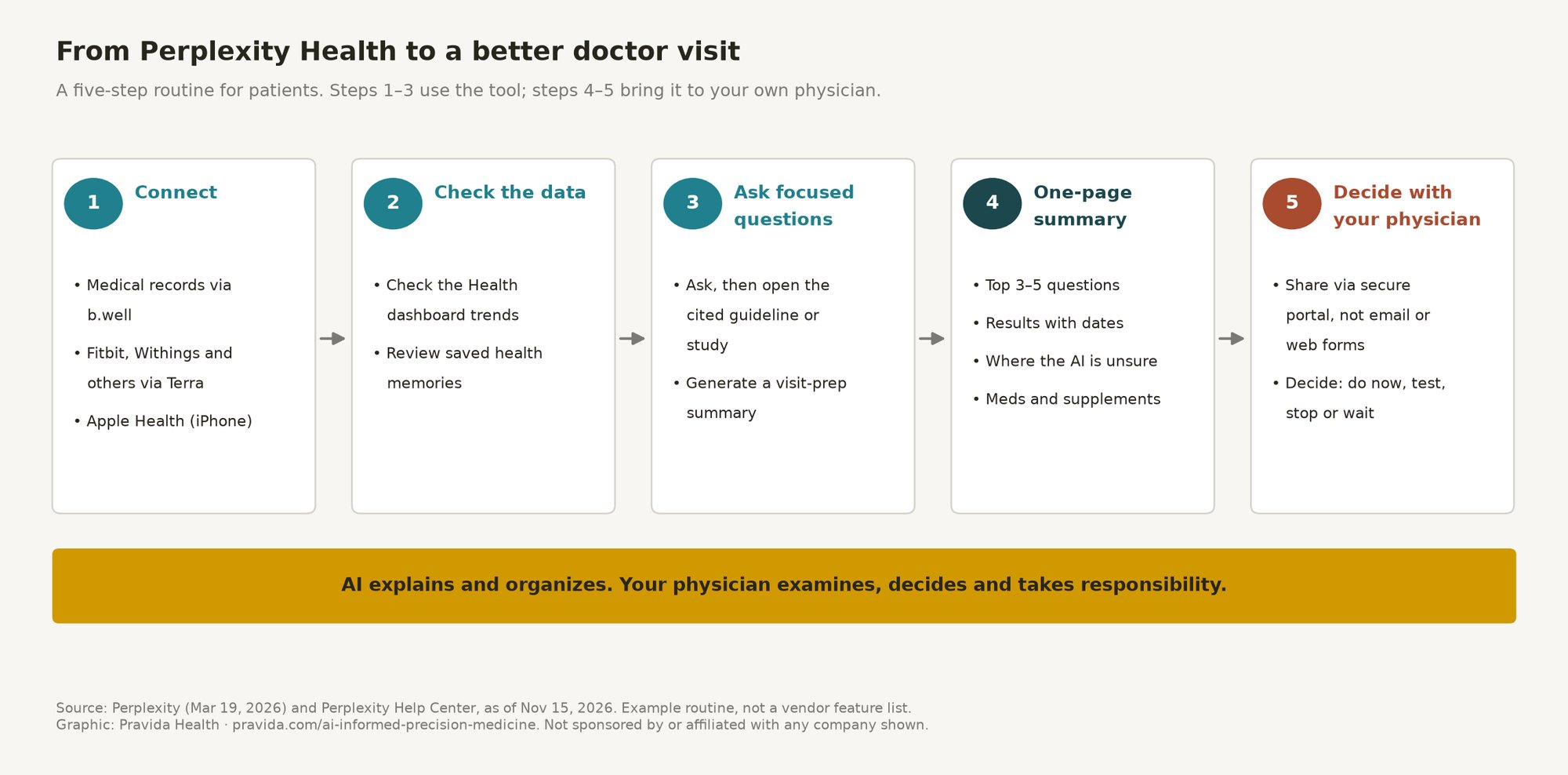
How to bring Perplexity Health work to your physician
The most useful thing you can bring to a visit is not a long chat transcript. It is a short, honest summary that separates what your records show from what the AI suggested. Here is the routine I recommend to my own patients:
- Check the data first. Before you ask anything, look at what the tool pulled in. Records can be incomplete or out of date, and a medication you stopped last year may still be listed.
- Ask your questions, then ask for the summary. Use the prompt below at the end of your conversation so the AI lists its own uncertainty.
- Add what the AI does not know. Symptoms you haven’t typed in, family history, supplements and anything that happened outside the records.
- Share it securely. Bring it to the visit or upload it through your physician’s patient portal. Don’t send health details by regular email or a website form.
- Let the visit decide. Your physician’s job is to decide which of the AI’s ideas apply to you, what to test, what to stop and what can wait.
One-page physician summary prompt (from our visit preparation guide; works in any of these tools)
“I’m preparing for a visit with my physician. Using only what we’ve discussed and the health information I’ve shared with you, write a one-page summary for my doctor with these sections: 1. My top 3–5 questions, in priority order. 2. Relevant results or data (with dates and units), and what changed over time. 3. What you suggested I consider, and how confident you are in each suggestion. 4. What you could not determine without an exam, testing, or my full history. 5. My current medications and supplements, as I’ve told you. Keep it under one page. Do not add diagnoses. Mark anything uncertain as uncertain.”
The AI health tools series
This post is part of a five-part series on what patients can do with consumer AI health tools to work better with their own physicians. The others:
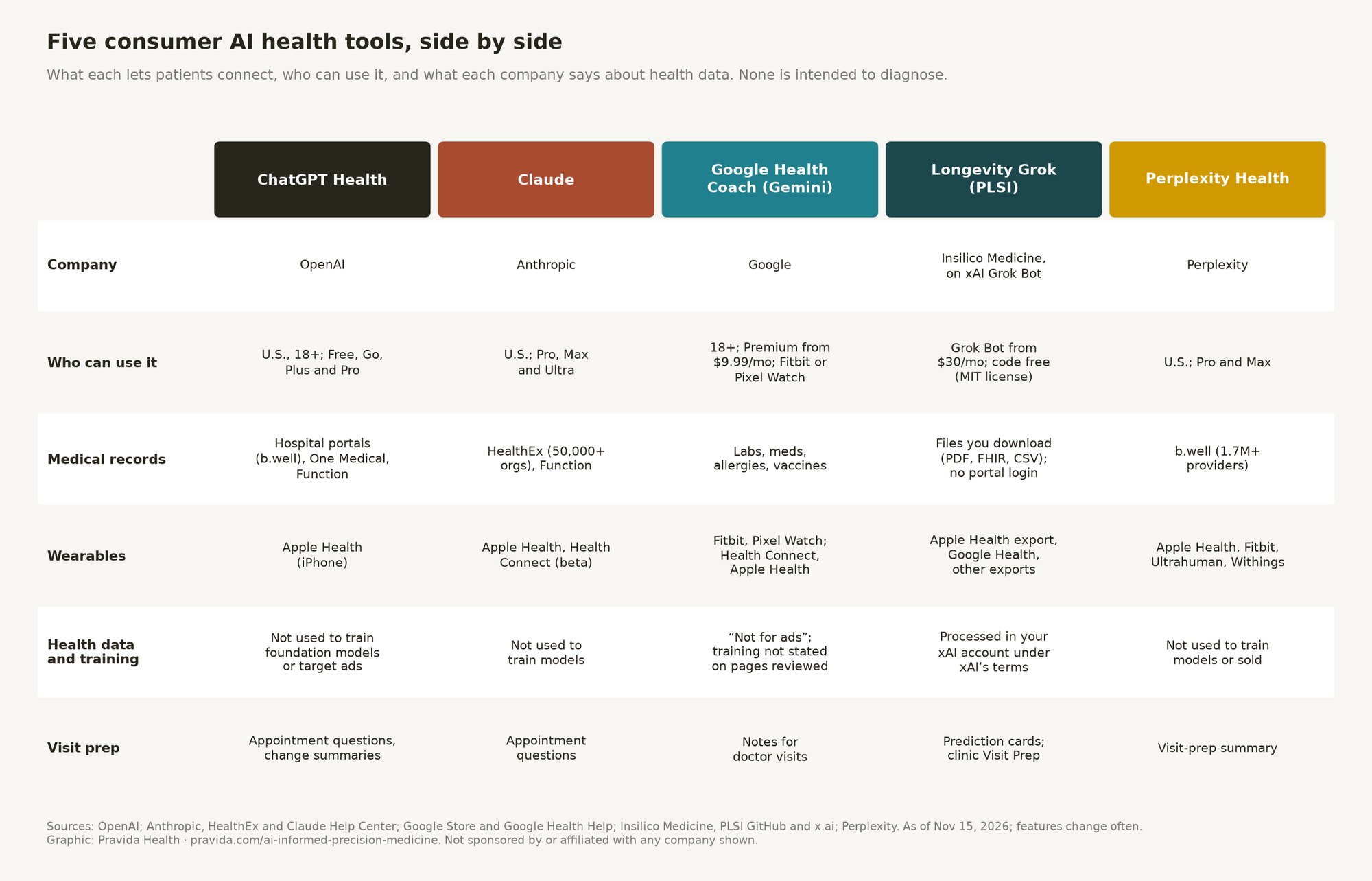
- ChatGPT Health
- Claude and your health records
- Gemini and the Google Health Coach
- Longevity Grok (PLSI)
For the health-system side, see Gemini for healthcare vs. OpenAI, Anthropic, Amazon and Microsoft. For how I work with patients who bring AI research to a visit, see AI-Informed Precision Medicine at Pravida.
Bring your AI research to a physician who uses these tools
Pravida’s AI-Informed Precision Medicine consultation is built for patients who have already done the research. You upload your one-page AI summary, recent labs and wearable exports through our secure patient portal. Dr. Turner reviews them before the visit, then works through them with you.
- Free 15-minute discovery call with our care coordinator
- Virtual consultation: 45 minutes, $295 (adults located in Georgia or Florida during the visit)
- In-person consultation in Midtown Atlanta: 60 minutes, $495
- You leave with prioritized recommendations: what to do now, what to test, what to stop and what can wait
Please don’t send health details through our website form or email; you’ll get a secure portal link after booking. Details and credit terms are on the consultation page.
Pravida Health, 1801 Peachtree St NE, Suite 150, Atlanta, GA 30309. Call 404-900-7371, email info@pravida.com or request an appointment.
Frequently asked questions
What is Perplexity Health?
Perplexity Health, launched March 19, 2026, lets U.S. Perplexity Pro and Max subscribers connect medical records, wearables and Apple Health data and ask health questions with cited answers. It includes a dashboard for biomarker and activity trends and can generate a visit-prep summary.
How does Perplexity Health connect to my medical records?
Through b.well, which Perplexity says reaches more than 1.7 million care providers in the U.S. What you see depends on what each provider makes available, such as lab results, visit summaries, medications and conditions.
Does Perplexity train on my health data?
Perplexity says health information is never used to train AI models or sold to third parties, and that you can disconnect sources and delete information at any time.
Is Perplexity Health free?
No. Perplexity says it is available to Pro and Max subscribers in the United States, rolling out in phases.
Can Perplexity Health diagnose me?
No. Perplexity says it is not intended to diagnose, treat or prevent diseases and is not a substitute for professional medical advice. Use it to understand your data and prepare questions for your physician.
References
- Introducing Perplexity Health. March 19, 2026. Perplexity.
- What is Perplexity Health? Perplexity Help Center.
- Perplexity can now access your Apple Health data to answer medical questions. March 19, 2026. MacRumors.
- Perplexity’s new AI health feature includes Apple Health integration nobody should use. March 19, 2026. AppleInsider.