
Key takeaways
- Copilot Health is a consumer product. Microsoft announced it in March 2026 and opened a U.S. preview on May 29, 2026 for adults with a Microsoft 365 Personal, Family or Premium subscription.
- It is temporarily unavailable. Microsoft’s support page, updated October 2026, says Copilot Health is paused during the move to a unified Copilot app, and that wearables and health records may return later than the rest.
- It connects records and wearables. Microsoft says records come from more than 50,000 U.S. provider organizations, with wearables starting with Apple Health.
- Microsoft makes strong privacy promises. It says Copilot Health data is not used to train AI, not used for ads and not sold, and is kept separate from the rest of Copilot.
- HIPAA does not apply. Microsoft says Copilot Health is a direct-to-consumer wellness product that is not intended to diagnose or treat.
Is Microsoft’s health AI for patients or for hospitals?
Both. Most physicians know Microsoft for Dragon Copilot, which drafts clinical notes in the exam room. That is a clinician tool, and I covered it in my comparison of Big Tech healthcare AI. Microsoft also has a consumer product, Copilot Health, aimed squarely at patients. It is a separate space inside Copilot where you can connect your medical records and wearable data and ask questions about them (Microsoft).
Microsoft says its consumer products, including Bing and Copilot, handle more than 50 million health questions a day (Microsoft AI). So even if you never open Copilot Health, there is a good chance you have asked Copilot a health question. This post covers what Copilot Health does, its unusual current status and how to use it well, as of November 15, 2026.
What Copilot Health is
Microsoft announced Copilot Health in March 2026 with a waitlist (Axios). On May 29, 2026, it opened a preview at copilot.microsoft.com/health for U.S. users 18 and older with a Microsoft 365 Personal, Family or Premium subscription. Work accounts are not eligible (Microsoft).
Microsoft says it built Copilot Health with its internal clinical team and an external panel of more than 250 physicians from more than 24 countries, and that it has ISO/IEC 42001 certification for how the AI is governed (Microsoft). Answers draw on health organizations selected using principles published by the National Academy of Medicine, plus a partnership with Harvard Health (Microsoft).
Its current status
This is the part most coverage misses. Microsoft’s support page, last updated October 2026, says that during the transition to the unified Copilot experience, Copilot Health will be temporarily unavailable. When it returns, some features, such as connecting wearables and accessing your electronic health record, may not be available immediately and will roll out over time (Microsoft Support). The same page also says previous users can continue to use it on the web, Windows and Edge, so access may vary by account. Microsoft has not said it is discontinued.
What it can connect
| Source | What it adds | Notes |
|---|---|---|
| Medical records | Visit summaries, medication lists, test results | More than 50,000 U.S. provider organizations through HealthEx; identity check with CLEAR; may return later than other features |
| Wearables | Activity, sleep, vital-sign trends | Preview started with Apple Health; Microsoft announced support for more than 50 devices, including Oura and Fitbit |
| Health Profile | Age, history, goals you ask it to save | Not a formal or complete health record; you can delete it |
| Provider search | Local clinicians | Search by specialty, language, gender, insurance and location |
Details are from Microsoft’s announcement, preview post and support page, and ZDNET’s hands-on review (Microsoft AI; Microsoft; Microsoft Support; ZDNET).
Five things patients can do with it
- Understand a lab result. Microsoft says early testers used Copilot Health to link records, understand lab results and prepare for appointments (Microsoft). Ask what a result means and what questions it raises.
- Spot trends across sources. Microsoft’s pitch is bringing sleep, activity and lab data together into one story (Microsoft AI). Ask for trends over months, with dates.
- Prepare questions. Microsoft describes the goal as arriving at your appointment with the right questions and context (Microsoft AI). Use the one-page prompt below.
- Find a clinician. Copilot Health can search local providers by specialty, language, gender, insurance and location (Microsoft). Always confirm network status with your insurer.
- Check it against your doctor. Microsoft’s own support page advises talking to a qualified clinician if an answer differs from what your provider told you (Microsoft Support). That is good advice for every tool in this series.
While it’s paused
You don’t need Copilot Health to prepare well. Download your records from your patient portal, export your wearable data, and use the one-page prompt below in any assistant you trust, or bring the files to your visit. If you used Copilot Health before, an answer on Microsoft Q&A says you need to sign in to the updated Copilot app by December 31, 2026 to keep eligible chats that haven’t migrated yet (Microsoft Q&A). That is a forum answer, not an official notice, so check your own account.
Privacy and control: what Microsoft says
- Training: Microsoft says information you share with Copilot Health is not used to train AI models (Microsoft Support).
- Ads and sale: Microsoft says it will not use Copilot Health information to build an ad profile, target ads or market to you, and does not sell it to insurers, employers or advertisers (Microsoft Support).
- Separation: Copilot Health conversations are kept separate from the rest of Copilot, and data is encrypted at rest and in transit (Microsoft).
- Storage: connected records and wearable data are accessed during conversations rather than stored in Copilot Health. By default it does store your conversations and Health Profile, and you can delete everything with “Delete my health data” (Microsoft Support).
- HIPAA: Microsoft says Copilot Health is a direct-to-consumer wellness product and that HIPAA does not apply to most such products (Microsoft Support). Microsoft’s Dr. Dominic King told The Verge that HIPAA is not required for a consumer experience using your own data (The Verge).
Where it falls short
The obvious limit right now is availability. A health tool that may lose its record and wearable connections for a period is hard to build a routine around. Microsoft has also set no public date for the return.
The deeper limits are the same as for the rest of this series. Microsoft says Copilot Health is not intended to diagnose, treat or prevent disease and is not a substitute for professional medical advice (Microsoft). A records pull can be incomplete, and a well-sourced general answer may not fit your situation. Microsoft’s privacy commitments are among the clearest of any company I reviewed, but they are company policies, not HIPAA protections.
How to bring Copilot Health work to your physician
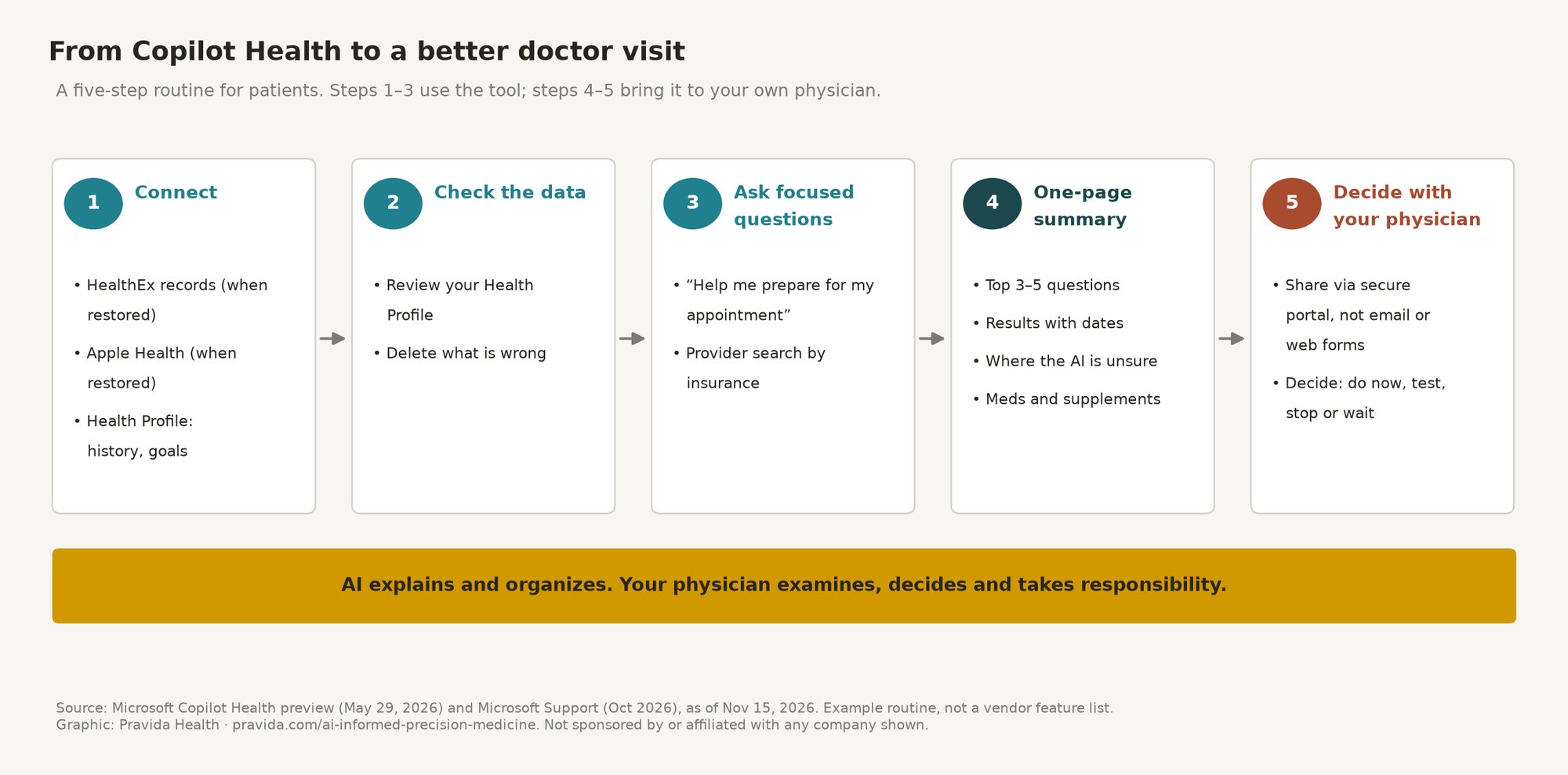
The most useful thing you can bring to a visit is not a long chat transcript. It is a short, honest summary that separates what your records show from what the AI suggested. Here is the routine I recommend to my own patients:
- Check the data first. Before you ask anything, look at what the tool pulled in. Records can be incomplete or out of date, and a medication you stopped last year may still be listed.
- Ask your questions, then ask for the summary. Use the prompt below at the end of your conversation so the AI lists its own uncertainty.
- Add what the AI does not know. Symptoms you haven’t typed in, family history, supplements and anything that happened outside the records.
- Share it securely. Bring it to the visit or upload it through your physician’s patient portal. Don’t send health details by regular email or a website form.
- Let the visit decide. Your physician’s job is to decide which of the AI’s ideas apply to you, what to test, what to stop and what can wait.
One-page physician summary prompt (from our visit preparation guide; works in any of these tools)
“I’m preparing for a visit with my physician. Using only what we’ve discussed and the health information I’ve shared with you, write a one-page summary for my doctor with these sections: 1. My top 3–5 questions, in priority order. 2. Relevant results or data (with dates and units), and what changed over time. 3. What you suggested I consider, and how confident you are in each suggestion. 4. What you could not determine without an exam, testing, or my full history. 5. My current medications and supplements, as I’ve told you. Keep it under one page. Do not add diagnoses. Mark anything uncertain as uncertain.”
The AI health tools series
This post is part of a seven-part series on what patients can do with consumer AI health tools to work better with their own physicians. The others:
- ChatGPT Health
- Claude and your health records
- Gemini and the Google Health Coach
- Longevity Grok (PLSI)
- Perplexity Health
- Meta’s Muse agent
For the health-system side, see Gemini for healthcare vs. OpenAI, Anthropic, Amazon and Microsoft. For how I work with patients who bring AI research to a visit, see AI-Informed Precision Medicine at Pravida.
Bring your AI research to a physician who uses these tools
Pravida’s AI-Informed Precision Medicine consultation is built for patients who have already done the research. You upload your one-page AI summary, recent labs and wearable exports through our secure patient portal. Dr. Turner reviews them before the visit, then works through them with you.
- Free 15-minute discovery call with our care coordinator
- Virtual consultation: 45 minutes, $295 (adults located in Georgia or Florida during the visit)
- In-person consultation in Midtown Atlanta: 60 minutes, $495
- You leave with prioritized recommendations: what to do now, what to test, what to stop and what can wait
Please don’t send health details through our website form or email; you’ll get a secure portal link after booking. Details and credit terms are on the consultation page.
Pravida Health, 1801 Peachtree St NE, Suite 150, Atlanta, GA 30309. Call 404-900-7371, email info@pravida.com or request an appointment.
Frequently asked questions
Is Microsoft Copilot Health available to consumers?
Yes, in preview. Since May 29, 2026, U.S. adults 18 and older with a Microsoft 365 Personal, Family or Premium subscription could use it at copilot.microsoft.com/health. Microsoft’s October 2026 support page says it is temporarily unavailable during the move to a unified Copilot app.
Is Copilot Health discontinued?
Microsoft has not said so. Its support page says Copilot Health is temporarily unavailable during the transition and that some features, such as wearables and health records, may return over time.
Does Microsoft train AI on my Copilot Health data?
Microsoft says information you share with Copilot Health is not used to train AI models, is not used for advertising and is not sold to third parties.
Is Copilot Health HIPAA compliant?
Microsoft says Copilot Health is a direct-to-consumer wellness product and that HIPAA does not apply to most such products. Its protections come from Microsoft’s own policies.
How is Copilot Health different from Dragon Copilot?
Dragon Copilot is a clinician tool that helps physicians and nurses document visits. Copilot Health is a consumer space where patients can connect their own records and wearables and ask questions.
References
- Introducing Copilot Health. March 2026. Microsoft AI.
- Copilot Health: now in preview. May 29, 2026. Microsoft.
- About Copilot Health. Last updated October 2026. Microsoft Support.
- Health check: how people use Copilot for health. Microsoft AI.
- Microsoft previews Copilot Health AI tool. March 12, 2026. Axios.
- Microsoft’s Copilot Health can connect to your medical records. The Verge.
- Copilot Health transition answer. Microsoft Q&A.
- I tested Microsoft Copilot Health with my real medical records. ZDNET.