

Why this diet, and why now
Almost every week a patient asks about the ProLon box. Sometimes they’ve already ordered it and want to know if I approve. Sometimes they’ve heard about it on a podcast and want to know if the science holds up. The Fasting Mimicking Diet, developed over roughly 25 years at the USC Longevity Institute by Valter Longo and colleagues and commercialized through L-Nutra as ProLon, is a five-day, plant-based, calorie- and protein-restricted eating pattern designed to place the body into a physiologic fasting state while still delivering measured food.
Unlike time-restricted eating protocols (16:8, one-meal-a-day), the FMD is not about when you eat. It is about sustaining a very specific low-protein, low-carbohydrate, moderate-healthy-fat nutrient signal for 120 continuous hours — long enough to suppress the growth-signaling pathways (mTOR, PKA, IGF-1) that time-restricted eating rarely reaches. That is the entire mechanistic point of the diet.
I read the FMD literature the way I read any longevity intervention: with a copy of the Wei, Brandhorst et al. 2017 Science Translational Medicine trial open on one screen and a running list of what I still do not know on the other. The headline results are real. The mechanism is well-mapped. And there are important caveats about who should not do this diet. This post walks through all three.
The mechanism, in plain physician terms
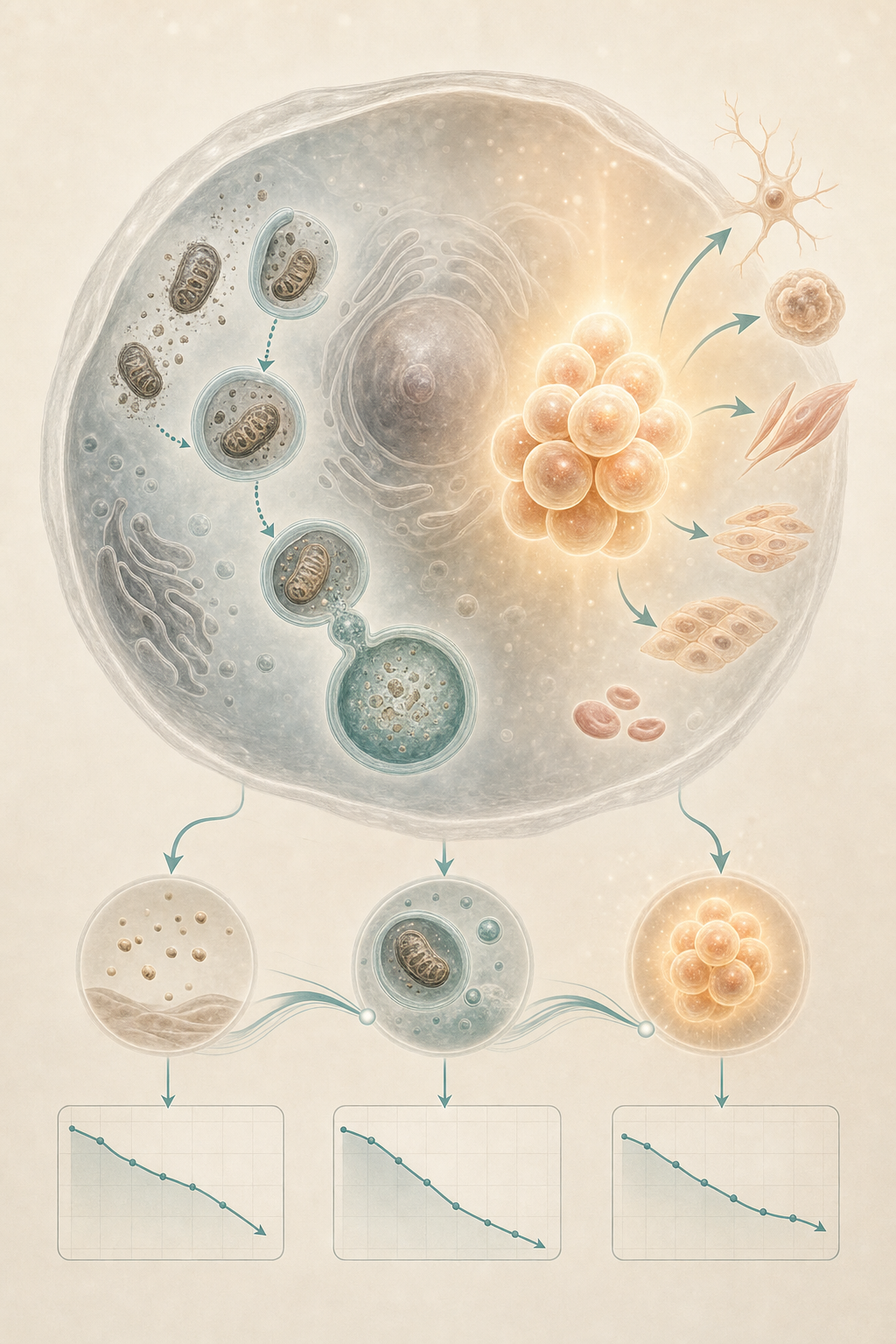
Every cell in the body runs an internal nutrient-sensing network that decides whether to grow or to recycle. Three pathways sit at the center of that network. mTOR (mechanistic target of rapamycin) responds to amino acid availability, especially branched-chain amino acids like leucine. PKA (protein kinase A) responds to glucose signaling. IGF-1 (insulin-like growth factor 1) responds to systemic protein intake. When any of these three is active, the cell is in growth mode. When all three are quiet at the same time, the cell shifts into repair mode — recycling damaged mitochondria and misfolded proteins through a process called autophagy.
The FMD is designed to hold all three of those signals quiet for long enough to matter. The original Brandhorst et al. 2015 Cell Metabolism paper mapped the exact composition: protein kept below roughly 25 grams per day, no animal protein, moderate healthy fats from nuts and olive oil, low glycemic carbohydrates, with total energy around 1100 kcal on day one dropping to roughly 725-800 kcal on days two through five. Those numbers matter. Higher protein — even plant protein — reactivates mTOR fast enough that you lose the autophagy window.
On refeeding, the picture flips. The pruning that happened during the fast is followed by a burst of stem-cell-mediated regeneration — hematopoietic, mesenchymal, and tissue-specific progenitors expanding to replace what was cleared. This coupled cycle — sustained autophagy during the fast, then regeneration on refeeding — is the reason a five-day intervention with recovery weeks in between produces effects that daily calorie restriction does not.
What the human trials actually show
The anchor human study is Wei, Brandhorst, and colleagues 2017 in Science Translational Medicine — a randomized controlled trial of 100 generally healthy US adults, of whom 71 completed three monthly 5-day FMD cycles either in the initial arm or after crossover. Weight fell by an average of about 5 lbs, primarily as abdominal fat, with lean mass preserved. Waist circumference dropped by more than an inch. Systolic blood pressure fell from 117.4 to 113.6 mmHg, diastolic from 75.7 to 72.8. Total cholesterol dropped roughly 10 mg/dL, LDL from 104.9 to 99.2. IGF-1 fell about 14%. C-reactive protein — a general marker of systemic inflammation — dropped from 1.5 to 1.0 mg/L. No serious adverse effects were reported.
The clinically important observation from that trial was not the averages. It was the post-hoc subgroup analysis. Participants who started with elevated baseline levels of a given risk factor (higher BMI, higher blood pressure, higher glucose, higher LDL, higher CRP) improved more than participants whose baseline values were already normal. In obese participants (BMI > 30), body weight decreased by approximately 9 lbs. In other words, the FMD didn’t push healthy people into a lower range. It pushed at-risk people toward a healthier one. That is the pattern I care about clinically.
The 2024 Nature Communications secondary analysis by Brandhorst, Levine, and colleagues went a step further and applied a validated biological-age biomarker to blood samples from that same trial and a second confirmation study. Three FMD cycles were associated with a median 2.5-year reduction in biological age, independent of weight loss. Insulin resistance improved. Hepatic fat measured by MRI went down. The lymphoid-to-myeloid ratio — an immune-system age indicator — rose. Two independent clinical cohorts, described further in the USC Longevity Institute’s summary of the findings, arrived at nearly identical results. That is the sentence that made this diet worth writing about.
The most recent evidence I have been watching is the 2025 Geroscience pilot randomized trial (NCT06115551) directly measuring autophagic flux in human peripheral blood mononuclear cells during FMD. In 30 participants averaging 49 years old, autophagy activation (LC3B-II/LC3B-I ratio with chloroquine treatment) rose significantly by day six of intervention, alongside significant changes in fasting glucose, ketones (β-hydroxybutyrate), and HOMA-IR. Small sample. Modest effect sizes. But the first direct in-human demonstration that the FMD does what the mechanistic story predicts it should do — a pattern also framed at the review level in a recent Longo-authored synthesis of FMD cycles, regeneration, biological age, and disease regression.
Where the evidence gets careful
I want to be honest about two things the marketing pages soften. First, most of the biomarker improvements measured in the pivotal trial were most pronounced in participants at elevated baseline risk. If your IGF-1, LDL, blood pressure, glucose, and CRP are already excellent, expect the ceiling of benefit to be lower. Second, the “$48 million invested, 32 clinical trials at 18 institutions” framing on the ProLon Science page is technically accurate but doesn’t distinguish between mechanism-oriented, small-sample, industry-sponsored, and independent trials. Most of the strongest data come from the Longo group at USC and its collaborators. Independent replication is happening — but slowly.
The oncology adjunct data are a separate category and deserve careful framing. The DIRECT phase 2 randomized trial (de Groot et al. 2020 Nature Communications) tested the FMD as an adjunct to neoadjuvant chemotherapy in HER2-negative breast cancer and found improved radiological and pathological response rates. A growing list of FMD-plus-chemotherapy adjunct studies continues to build on that finding. These data are genuinely encouraging, but they belong exclusively in a treatment plan that a patient’s oncologist owns. I will not prescribe FMD around chemotherapy at Pravida. That is a conversation for medical oncology.
Contraindications matter. The FMD should not be used in pregnancy or breastfeeding, in patients under 18, in people with BMI below approximately 18.5, in people with active eating disorders or a history of eating disorders, in people with insulin-dependent diabetes without close endocrinology oversight, in patients recovering from major surgery, or during acute infection or inflammatory flare. Anyone on antihypertensive or antihyperglycemic medication should coordinate a plan for dose adjustment before starting a cycle, because blood pressure and glucose both drop measurably during the five days.
What the FMD is not
The FMD is not intermittent fasting. Sixteen-eight, one-meal-a-day, and alternate-day approaches shift timing and can improve insulin sensitivity, but they rarely sustain the 48- to 72-hour nutrient-suppression window that autophagy and stem cell activation appear to require. Both approaches have a place. They are not interchangeable.
The FMD is also not a weight-loss program in the way a low-calorie diet is a weight-loss program. Yes, participants lose a few pounds. But the pounds return with normal eating between cycles and the physiologic effects — the biomarker improvements, the biological age reduction — are largely independent of weight loss in the published data. If sustained weight loss is the goal, this is not the right tool. If cellular rejuvenation and metabolic biomarker improvement are the goal, it is one of the best-supported tools we currently have.
How I think about the FMD in a longevity care plan
In the context of a longevity care plan at Pravida, I think about the FMD as one intervention in a stack that also includes structured strength and cardiovascular training, a Mediterranean-pattern baseline diet between cycles, screening-based cardiometabolic optimization, sleep and stress load management, and where appropriate targeted therapies like our DEXA-based bone health protocol or evidence-graded peptide protocols such as the BPC-157 and TB-500 approach we recently wrote about. Cellular rejuvenation stacks on top of a functional foundation, not on top of a fragile one.
The cadence I generally support — when a patient is a good candidate and there are no contraindications — tracks the ProLon protocol recommendation of three to six cycles per year. Most people start with three cycles roughly one month apart, then reassess biomarkers (IGF-1, hs-CRP, HbA1c, lipid panel, HOMA-IR, and where budget allows a validated biological-age panel) before deciding whether to continue at a maintenance cadence of one cycle per quarter.
The reason I want physicians involved in this decision, not just a consumer purchase page, is that the very same physiologic effects that make the FMD useful — hypotensive, hypoglycemic, and net-catabolic — are the effects that require dose adjustments in patients already on medication. The five days can be genuinely safe. They can also be dangerous if run on autopilot alongside an unmodified medication list. That is the piece I want in the room.
The pattern that keeps me interested in this diet is not the average biomarker improvement. It is the subgroup analysis: the people who started with the most to gain gained the most. That is what a real intervention looks like — not one that flattens everyone toward a lower number, but one that meets the physiology it finds.
Curious whether the Fasting Mimicking Diet fits your longevity plan?
Book a consultation and we’ll walk through your baseline biomarkers, medication list, and contraindications together — and design a cadence that fits your physiology rather than a generic schedule.
Book ConsultationCall 404.900.7371 · info@pravida.com
Key sources cited in this review
- Wei M, Brandhorst S, Shelehchi M, et al. Fasting-mimicking diet and markers/risk factors for aging, diabetes, cancer and cardiovascular disease. Sci Transl Med 2017;9(377):eaai8700. pmc.ncbi.nlm.nih.gov/articles/PMC6816332
- Brandhorst S, Choi IY, Wei M, et al. A periodic diet that mimics fasting promotes multi-system regeneration, enhanced cognitive performance and healthspan. Cell Metab 2015;22(1):86-99. pmc.ncbi.nlm.nih.gov/articles/PMC4509734
- Brandhorst S, Levine ME, Wei M, et al. Fasting-mimicking diet causes hepatic and blood markers changes indicating reduced biological age and disease risk. Nat Commun 2024;15:1309. nature.com/articles/s41467-024-45260-9
- Longo VD et al. Fasting Mimicking Diet Cycles, Regeneration, Biological Age and Disease Regression. PMC review 2025. pmc.ncbi.nlm.nih.gov/articles/PMC12763742
- Effect of fasting-mimicking diet on markers of autophagy and metabolic health in human subjects (NCT06115551). Geroscience 2025. pubmed.ncbi.nlm.nih.gov/41372565
- de Groot S et al. Fasting-mimicking diet as an adjunct to neoadjuvant chemotherapy for breast cancer in the multicentre randomized phase 2 DIRECT trial. Nat Commun 2020;11:3083. nature.com/articles/s41467-020-16138-3
- ProLon Science — USC Longevity Institute / L-Nutra research summary. prolonlife.com/pages/the-science
- USC Longevity Institute. 3 cycles of fasting-mimicking diet indicate a 2.5-year reduction in biological age. gero.usc.edu/longevity-institute