

The question I get more than any other in orthopedic longevity
The question shows up in almost every consultation from an active patient in their 40s or 50s: “Should I be taking BPC-157 and TB-500 for my tendon (or shoulder, or knee, or elbow)?” The honest answer is not what the peptide-selling internet wants to hear. Both peptides have a plausible molecular story and a substantial rodent literature. Neither has a completed peer-reviewed human randomized controlled trial for a tendon or ligament indication (McGuire et al. 2025, Current Reviews in Musculoskeletal Medicine; FDA BPC-157 briefing document, July 2026; FDA TB-500 briefing document, July 2026).
The evidence gap is the story. FDA’s own scientific staff, in briefing documents released ahead of the July 23-24, 2026 Pharmacy Compounding Advisory Committee meeting, recommended against adding either peptide to the 503A Bulks List, citing insufficient human safety and effectiveness data. The committee then voted 8-6 in favor of both, per press coverage — that vote is advisory, and covered in detail in our companion post on the PCAC session.
This post is the “what does the underlying science actually say” companion to that regulatory read. Below: what each peptide is, what the animal evidence shows, what the human evidence shows (very little), safety and regulatory status, and how we think about the risk-benefit conversation at Pravida.
What each peptide actually is
BPC-157: a synthetic 15-amino-acid pentadecapeptide (sequence GEPPPGKPADDAGLV, ~1419 Da), derived from a fragment of a human gastric juice protein and first described by Predrag Sikiric’s Zagreb group in the early 1990s. Also known in the literature as PL-10, PLD-116, PL14736, and Bepectin. Its defining pharmacological property is stability — it resists gastric-juice degradation for over 24 hours and retains bioactivity across oral, intraperitoneal, intramuscular, and intravenous routes despite a short circulating half-life (He et al. 2022, Frontiers in Pharmacology pharmacokinetics work referenced in the McGuire review). It was originally developed as an anti-ulcer / inflammatory bowel disease candidate, not as an orthopedic drug.
TB-500: the informal/commercial name for a synthetic acetylated 7-amino-acid fragment (Ac-LKKTETQ-OH) of the naturally occurring 43-residue protein thymosin β-4 (Tβ4). It corresponds to amino acids 17-23, the segment containing the G-actin binding domain. This distinction matters and gets muddled constantly in peptide marketing: TB-500 the small fragment is not the same molecule as full-length recombinant Tβ4 — and it is different again from the unrelated N-terminal tetrapeptide Ac-SDKP. Nearly all of the foundational human-facing efficacy data invoked for “TB-500” in wound-healing, cardiac, and corneal studies was generated with full-length recombinant Tβ4 (formulations like RegeneRx’s RGN-259, RGN-137, RGN-352), not the synthetic 7-mer sold as TB-500 (FDA TB-500 briefing document, 2026). FDA reviewers made a point of noting that there is no human clinical data specific to the TB-500 fragment itself.
What the animal evidence shows
BPC-157 — a real rodent tendon literature, largely from one group
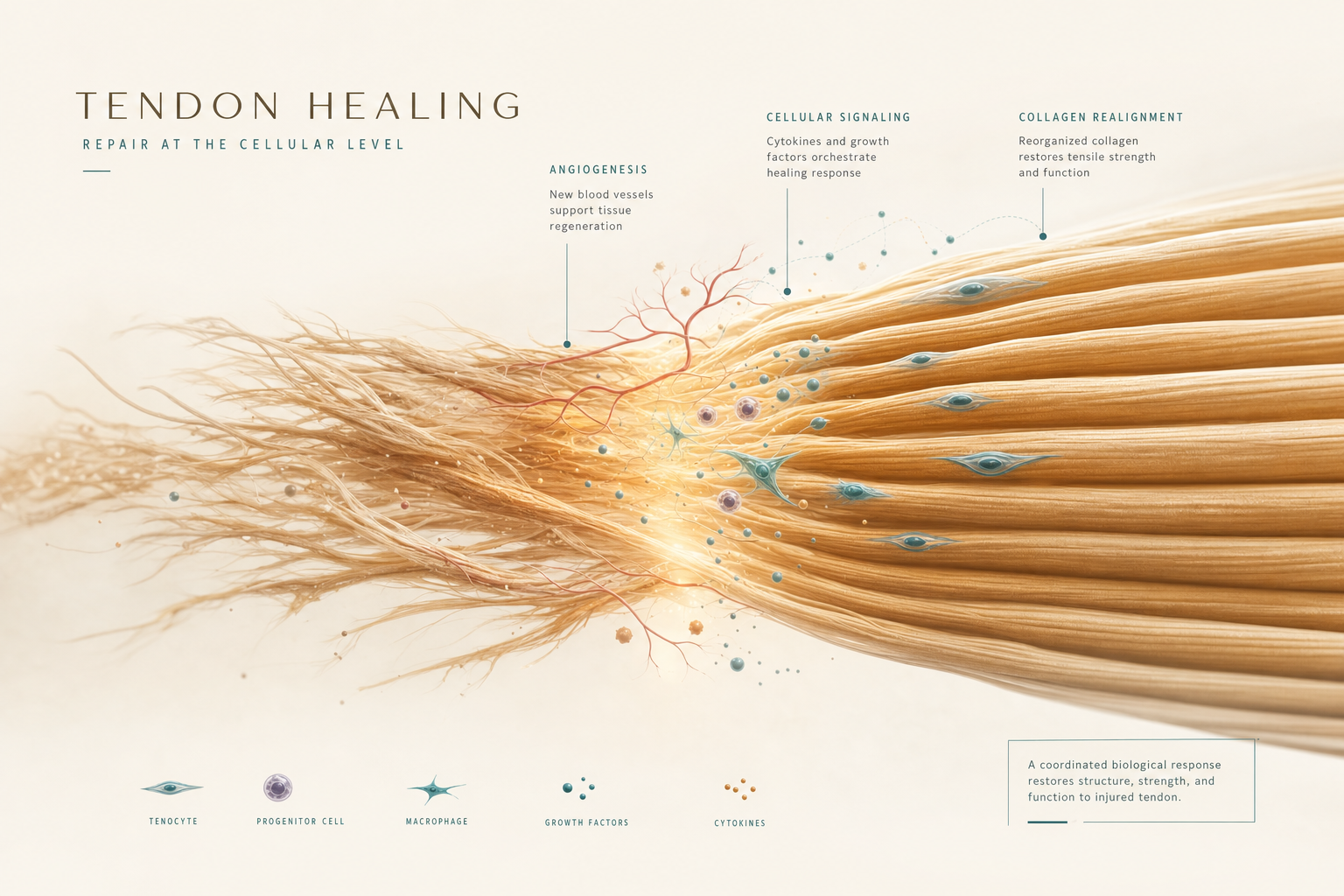
BPC-157 has consistently accelerated tendon-to-bone and tendon-to-tendon healing in rat models. The Achilles tendon transection model (Cerovecki 2010, Journal of Orthopaedic Research) and follow-up work show improved histologic organization, faster functional recovery, and increased biomechanical strength versus saline controls. Similar signals appear in MCL rat healing, muscle crush injury, and segmental bone defect models — all summarized in the 2025 McGuire review in Current Reviews in Musculoskeletal Medicine. Mechanistically the signal converges on VEGFR2 upregulation, NO/eNOS pathway activation, growth-hormone-receptor upregulation on tendon fibroblasts (Chang 2014, Molecules), and FAK-paxillin/ERK1/2 pro-migration signaling (McGuire 2025).
The honest structural caveat — a large share of the BPC-157 orthopedic literature comes from the Sikiric group in Zagreb or from labs collaborating with them. Independent replication outside that authorship cluster is limited. That does not invalidate the findings, but it is the kind of concentration a careful reader should flag before extrapolating from rat Achilles tendons to a human patient.
TB-500 — the tendon evidence is not what people think it is
The foundational rodent data for “TB-500”-style biology comes from full-length thymosin β-4 work — Bock-Marquette et al. 2004 in Nature on cardiac repair, subsequent corneal wound healing, and dermal wound healing studies. The mechanism is credible: G-actin sequestration, angiogenesis, laminin-5 upregulation, cell migration, macrophage recruitment.
There is essentially no tendon or ligament-specific rodent study of the TB-500 synthetic fragment. That gap is not a small footnote — it is the entire evidentiary basis for using TB-500 in an orthopedic soft-tissue context, and it does not exist in the peer-reviewed literature. The FDA TB-500 briefing document is explicit about this. What is marketed as “TB-500 for tendon healing” is mechanistic extrapolation from full-length Tβ4 data plus rat cardiac/dermal work, not tendon-specific evidence for the 7-mer fragment.
What the human evidence shows (very little)
BPC-157 in humans: the only human clinical work with meaningful published data was the PL-14736 oral formulation program for inflammatory bowel disease conditions — a gastrointestinal target, not a musculoskeletal one. As of July 2026 there is one registered ClinicalTrials.gov study for BPC-157 in a musculoskeletal indication (NCT07437547) that has not yet reported results. There is no completed peer-reviewed human RCT showing tendon, ligament, cartilage, or muscle benefit.
TB-500 in humans: none. FDA reviewers noted in July 2026 that they could identify no human clinical data specific to the TB-500 fragment. The human trials in the “thymosin beta-4” program — RGN-259 for dry eye, RGN-137 for venous stasis ulcers, RGN-352 for cardiac indications — used full-length recombinant Tβ4, not TB-500. Those trials had mixed results and none demonstrated a musculoskeletal orthopedic effect in humans.
The stack: the popular “BPC-157 + TB-500 stack” protocols circulating in the peptide community are not supported by any published RCT, preclinical combination study, or dosing pharmacokinetic work. The mechanistic argument for combining them is coherent on paper — different pathways, potentially additive — but that is a hypothesis, not evidence.
Safety and regulatory status
BPC-157 safety: rodent LD50 studies show a wide therapeutic index, and short-term rodent toxicology studies have not surfaced organ toxicity (McGuire 2025 review). Long-term human safety data does not exist. The theoretical concern that stands out for me as a physician: BPC-157 upregulates VEGFR2 and drives angiogenesis. Angiogenesis is what a healing tendon needs. It is also what a subclinical tumor needs. In a patient with a family history of certain malignancies, or an unknown occult lesion, that mechanism deserves a real conversation, not a shrug.
TB-500 safety: similarly limited human safety data. The FDA briefing document flagged the absence of human PK data, standardized manufacturing purity data, and adequate safety follow-up as reasons to recommend against inclusion on the 503A list.
WADA status matters more than most patients realize: both peptides are on the World Anti-Doping Agency Prohibited List at all times, in and out of competition — BPC-157 under S0 (non-approved substances) and TB-500 under S2.3 (growth factors and growth factor modulators). Any patient who is a competitive amateur or professional athlete, or who competes in any WADA-signatory sport (including masters-level and many recreational leagues), should treat that as a hard stop, not a footnote.
FDA and PCAC as of late July 2026: neither peptide is FDA-approved for any indication. Both had Category 2 restrictions removed in April 2026. Both were reviewed at the July 23-24, 2026 PCAC session, where FDA career staff recommended against inclusion and the committee voted 8-6 in favor. That vote is advisory, and the formal notice-and-comment rulemaking pathway toward Category 1 inclusion still has a 12-18 month horizon. Any use today — whether through a licensed 503A compounding pharmacy or through a research-use-only vendor — is off-label and outside the framework of an FDA-approved therapy. See our PCAC vote breakdown for the regulatory detail.
How we think about BPC-157 and TB-500 at Pravida Health
My clinical framework for these two peptides is the same framework I apply to any regenerative intervention where the mechanistic story is stronger than the human evidence. I ask three questions before the conversation goes any further:
- Is there a specific orthopedic indication with a real evidence signal — not just “my elbow hurts”?
- Is the peptide being sourced through a licensed 503A compounding pharmacy with USP quality standards, or from a research-use-only vendor with no purity or dosing guarantee?
- Is the patient a competitive athlete or WADA-tested? If yes, this conversation ends here.
For the patients who clear those three questions, the discussion I have next is honest: the mouse data on BPC-157 is meaningfully more developed than TB-500’s. The TB-500 tendon-healing narrative is largely mechanistic extrapolation from full-length thymosin β-4 work in cardiac and corneal tissue, not tendon-specific evidence for the actual 7-mer fragment being injected. That is not a reason to categorically refuse to prescribe it — it is a reason to be very clear with the patient about what the evidence is and is not.
At Pravida, we do not sell peptides. We do not use the six-peptide-stack marketing playbook that has become common in the aesthetic wellness space. When a peptide is prescribed for a specific patient with a specific indication, it is compounded through a licensed 503A pharmacy, prescribed at conservative published doses, and paired with the same rehabilitation, load management, and biomechanical work that would be prescribed with or without the peptide. The peptide is the smaller variable, not the larger one.
For our Foundation, Pinnacle, and Executive Health members interested in regenerative orthopedic care, BPC-157 and TB-500 come up in the context of a broader treatment plan — often alongside proven interventions like platelet-rich plasma (PRP), bone marrow aspirate concentrate, targeted physical therapy, and imaging-guided procedures. At our Atlanta clinic on 1801 Peachtree St NE, Ste 150, the framing I use most often is this: a peptide is a plausible catalyst, not a shortcut around the actual work of soft-tissue rehabilitation.
The mouse literature for BPC-157 is real. The human literature is essentially absent. The clinical question is not whether the biology could work — it is whether the evidence has yet earned an intervention.
Considering BPC-157 or TB-500 for a soft-tissue injury?
Book a consultation to walk through the evidence for your specific indication, review sourcing and safety, and decide whether either peptide belongs alongside the rest of your recovery plan.
Book ConsultationCall 404.900.7371 · info@pravida.com