
Why the pain scale is the wrong headline for a shoulder
Shoulder patients are, in my experience, uniquely disadvantaged by a subjective-only assessment. A painful shoulder is easy to compensate around — a small trunk rotation to substitute for external rotation, a shrug that offloads the deltoid, a shortened reach on the involved side — and after a few weeks those compensations become invisible to the patient. Their pain score drops. Their function does not actually return. And then a bag lift or a serve reproduces the same symptoms, and everyone is surprised.
Before I recommend a rehabilitation plan or a regenerative procedure like CartiNova for a shoulder, I want to know several specific things that no pain scale can tell me. How much external- and internal-rotation load does the involved shoulder actually tolerate compared to the uninvolved side? What does pulling capacity look like? What about horizontal pushing? And how much overhead loading can the shoulder accept — if any — without symptoms or loss of control? These are the questions that predict whether a shoulder holds up in a tennis match, a grocery lift, or a set of push-ups six months from now.
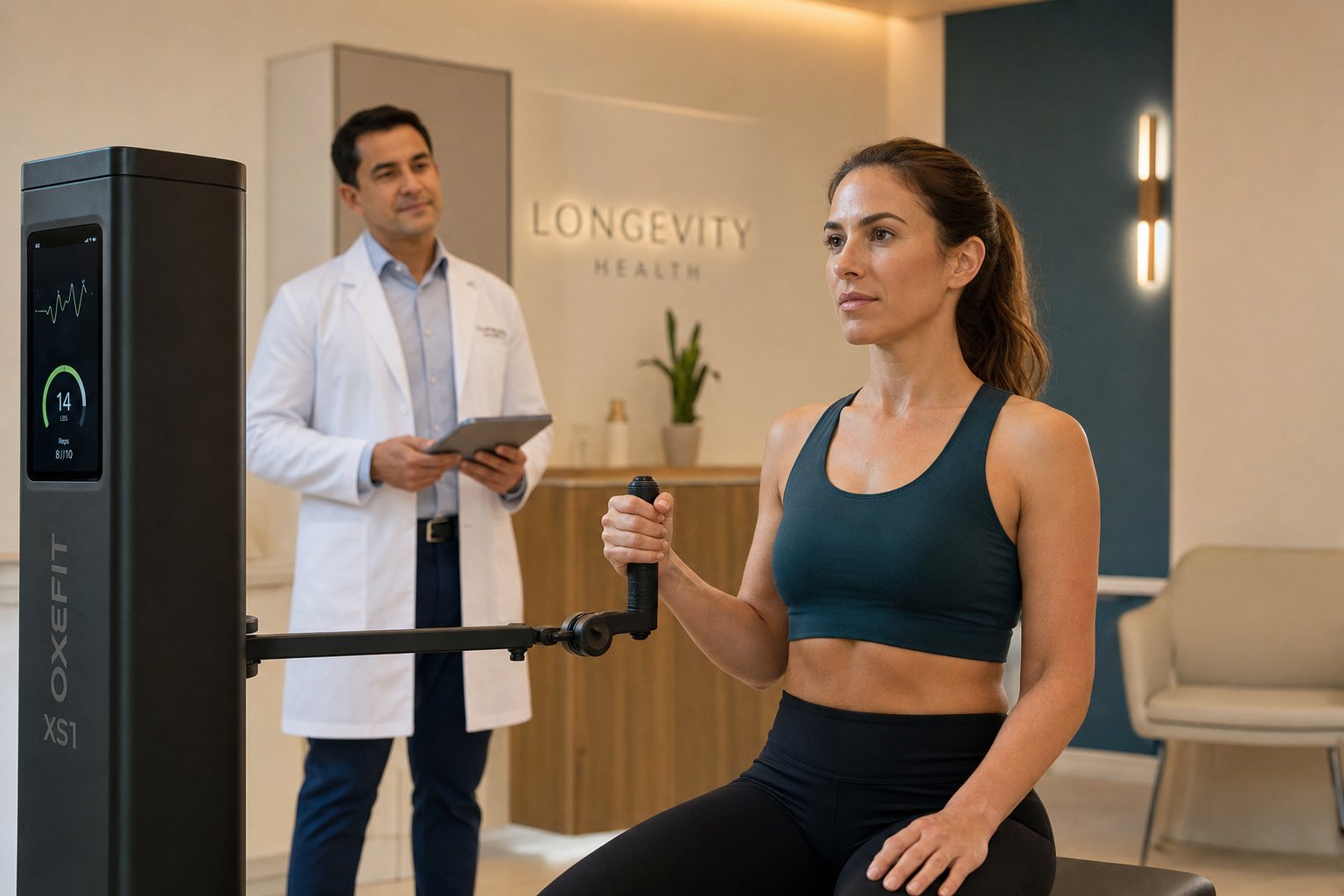
Every shoulder-focused patient at Pravida runs a structured five-movement battery on the OxeFit smart cable resistance system. It gives me the objective portrait of the involved shoulder that I need to plan around, and it gives us a repeatable measurement we can come back to at three months and every follow-up after that. Our companion posts describe the same approach for the knee and the spine; this is the shoulder version.
What OxeFit is (and honestly, what it isn’t)
The OxeFit XS1 is a floor-anchored, cable-based smart resistance platform. Resistance is delivered through motorized cables that can be programmed to hold a constant load, change dynamically within a rep, or respond to how quickly the patient is moving. Every rep captures the load moved, the tempo, and the completed range against the machine’s cable geometry. That objective, repeatable output is what makes it useful in a clinic.
One point of documentation matters, because it changes how we interpret results. OxeFit’s analytics guide describes the XS1’s on-board balance metric as lateral body position over the platform — not a direct measurement of left-versus-right limb strength — and pose-based motion tracking is an XP1 feature. In this shoulder battery I therefore document joint range of motion, scapular motion, and any compensations through examination and standardized video, and I do not interpret an XS1 balance score as a limb-symmetry ratio (OxeFit analytics guide).
What OxeFit is not: it is not a diagnostic device, it does not replace an ultrasound-guided exam or an MRI, and it does not decide whether a patient needs a procedure. Its analytics are clinically useful signals for a physician to discuss with a patient, not diagnoses. Interpretation is a physician job. But as a way of capturing an objective, high-resolution portrait of how a shoulder behaves under progressively realistic loads — and comparing that portrait to itself months later — it is exceptional.
The five-movement shoulder battery
Every shoulder-focused assessment at Pravida runs the same five patterns in the same order. The order is intentional: isolated rotation first (the safest way to establish rotator-cuff loading tolerance), then a functional pulling task, a horizontal pushing task, and finally overhead loading — the pattern most likely to reveal a painful arc or loss of control. These are my proposed clinical batteries; they are not validated OxeFit return-to-play tests.
1. Shoulder External Rotation — Handles
Purpose: external-rotation loading tolerance and endurance. Assesses: the posterior rotator cuff (infraspinatus and teres minor) under progressive resistance.
Elbow at the side, elbow support and cable height held constant between visits. What I look for: whether the trunk rotates to substitute for the shoulder, whether the elbow migrates away from the side, and whether the involved side matches the uninvolved side on the same load. A large asymmetry here in a patient with anterior shoulder pain often localizes to the posterior cuff and changes what the prehab plan needs to emphasize.
2. Shoulder Internal Rotation — Handles
Purpose: internal-rotation loading tolerance and endurance. Assesses: subscapularis and the anterior cuff under progressive resistance.
Same position discipline as the external rotation test — the moment the trunk starts to rotate to help, the test is contaminated. I record whether internal-rotation load reproduces anterior joint-line symptoms or a painful arc later in the arc of motion.
A note on interpretation: it is tempting to compute an ER-to-IR ratio and compare it to isokinetic norms from the sports-medicine literature. Do not. Those norms were established with different equipment, different lever arms, and different testing positions. Cable-based external-to-internal ratios are useful within a single patient over time, but they should not be interpreted against isokinetic reference values.
3. Seated Row — Handles + Bench
Purpose: functional pulling capacity. Assesses: posterior chain, scapular retractors, and the ability of the shoulder to accept load in a horizontal pulling pattern.
Bench position, grip, and reach are fixed between visits. I document shoulder elevation (the patient who has to shrug to complete the pull is telling me their scapular stabilizers are the limit), scapular motion, and any trunk assistance. Pulling capacity is one of the strongest correlates of practical arm function — carrying, lifting, opening doors — and it often recovers earlier than pressing capacity.
4. Bench Press — Handles + Bench
Purpose: horizontal pushing capacity. Assesses: the pectoralis and anterior deltoid, tricep long head, and shoulder tolerance to load in a horizontal push.
Bench position, elbow path, and the permitted depth of descent are fixed between visits — for a lot of shoulder patients the safe depth is not full range, and standardizing it matters more than maximizing it. I document pain and any loss of control on the eccentric phase. A patient with acceptable concentric pushing capacity but poor eccentric control is at higher risk for a re-aggravation once they leave the clinic.
5. Seated Shoulder Press — Handles + Bench
Purpose: overhead loading capacity. Assesses: deltoid, upper trapezius, and the shoulder’s tolerance to loaded overhead range.
Back support and elevation range are fixed. I watch for lumbar hyperextension (using the low back to substitute for the overhead range that the shoulder cannot provide), excessive shrugging, and a painful arc. If overhead loading is currently restricted, I defer this test or substitute a straight-arm pulldown, and I clearly record that overhead capacity was not tested this visit — that missing data point is itself clinically important.
Overhead-athlete variant. For throwing and racquet athletes, once clinically appropriate, I substitute Shoulder External Rotation at 90° abduction and Shoulder Internal Rotation at 90° abduction for the first two movements. This is treated as a separate protocol version with its own baseline; I do not compare loads across the two positions.
What the numbers actually mean in a clinical decision
On its own, a load number is just a number. What makes this battery useful is the shape of the profile across the five patterns and the reproducibility of the pain during specific loads. A rotator-cuff-dominant deficit looks different from a scapular-dyskinesis-dominant deficit, which looks different again from a stiff, painful-arc capsular pattern — and the five-movement profile helps me see which one I am dealing with before I recommend a plan.
The five questions I answer from a single shoulder assessment
- Where does the load fail? Which of the five movements reproduces the pain, and at what load relative to the uninvolved side?
- Is the deficit rotational, pulling, pushing, or overhead? Each answers a different clinical question and takes a different rehabilitation emphasis.
- Is overhead loading safe today? If yes, we test it. If no, we document why and re-test at the next visit.
- How large is the asymmetry? On the unilateral movements where a side-to-side comparison is meaningful, is the involved side within 10% of the uninvolved side or in the 20–30% deficit territory that needs a real plan?
- Is eccentric control the failure mode? A shoulder that loses control on the return phase of a press or a pull is at higher risk of re-aggravation.
How I program the assessment sets
Across the five movements, I keep the same three-set structure. This is a clinic operating rule, adjustable for diagnosis, irritability, and any postoperative restrictions.
The three-set structure
- Set 1 — Familiarization: 5–8 light repetitions. Confirm technique, permitted range, symptoms, and a suitable load.
- Set 2 — Reference test: 10 repetitions at a fixed load, approximately RPE 5–6/10 initially. Establishes the repeatable baseline; this load is re-used at follow-up so we are comparing like to like.
- Set 3 — Capacity test: Up to 10 repetitions at a hybrid clinician-and-AI-selected load targeting approximately RPE 7/10 without failure. This is what tracks the tolerated load at a similar effort over time.
I rest approximately 90–120 seconds between measured sets, longer when needed, and keep that rest consistent across visits. Movement tempo is fixed — roughly two seconds in each direction for the core battery — because a deliberately fixed speed limits how much we can interpret power as an independent outcome. If power is an explicit goal for a specific patient, we run a separately defined, cleared power test with consistent load and fast concentric intent.
A few implementation rules I do not deviate from between visits:
- Sides are tested separately only where the XS1 exercise supports safe unilateral execution. Bilateral results are reported as bilateral; I do not infer each limb’s contribution from a bilateral total.
- The reference set is held at constant resistance. Adaptive loading can be useful for exploring capacity, but a changing resistance complicates direct velocity comparison across visits. OxeFit describes adaptive loading as responding to concentric speed (Advanced Settings).
- Exercise order, attachments, cable geometry, seat and step height, footwear, range target, tempo, and use of support are all fixed between visits.
- We stop for sharp or escalating pain, instability, neurologic symptoms, or loss of controlled execution. The reason for stopping is documented.
- If a patient cannot safely perform a movement on assessment day, it is marked deferred, not zero. Its first safe completion becomes that movement’s baseline.
- Next-day symptoms are recorded to distinguish real performance gains from a load that caused an unacceptable flare.
What goes into the progress report
Every shoulder assessment produces the same seven-domain report so that visits can be compared directly.
- Reference performance — clean repetitions at the original load and range, with effort and symptoms noted.
- Capacity — the load completed for the prescribed repetitions at the target effort.
- Machine output — the available load, velocity, and power values captured under the same conditions.
- Movement quality — clinician-recorded range, compensations, balance losses, and support use.
- Side comparison — separate right/left results for the unilateral movements that support it.
- Patient function — a consistent regional questionnaire plus the patient’s specific activity goal.
- Recovery response — symptoms during, immediately after, and the day following the test.
For appropriate unilateral outcomes where higher is better, I calculate the Limb Symmetry Index as involved side ÷ uninvolved side × 100%. I interpret it alongside absolute capacity and the patient’s own baseline — two weak limbs can look symmetric, and dominant-limb adaptations are real. I do not treat ≥90% LSI as an automatic pass across these regions. Clearance decisions integrate tissue-specific recovery, clinical exam, sport demands, patient confidence, and actual training tolerance — an individualized approach consistent with the Bern shoulder consensus.
How this changes the plan around a CartiNova procedure
The primary reason we run this battery on regenerative orthopedic patients is that it turns a CartiNova procedure from an event into a program. Instead of “we did the injection, now go do PT,” we have a specific, quantitative starting point and a specific, quantitative target.
Prehab. If the assessment surfaces a large deficit in one of the five movements, a stability failure at a specific plane, or a persistent asymmetry, we do not schedule the procedure that week. We build a two-to-six-week prehab block focused on the specific deficits the assessment surfaced, then re-test. Patients who arrive at their regenerative procedure with cleaner mechanics generally tolerate the early post-procedure loading window better and progress faster. The biology of tissue response is real, but so is the mechanical environment that biology has to live in.
Post-procedure milestones. After a CartiNova procedure, the healing environment benefits from progressive, controlled loading — not from rest alone and not from a return to full activity too early. The OxeFit battery becomes our objective gate. Instead of “you feel ready, so go do it,” we can say “your reference load has returned, your capacity load is back within 10% of your uninvolved side, and your movement quality is holding — you are ready for the next phase.” Those are conversations patients can act on.
Follow-up testing. We repeat the same five-movement battery at defined intervals — typically at four, eight, and twelve weeks post-procedure, and quarterly thereafter. Because the movements, attachments, cable geometry, tempo, and scoring are held constant, small changes become visible and defensible. It gives patients something they rarely get in traditional orthopedic care: a graph that goes in the right direction.
How this battery translates to the things you actually do
Every movement in this battery was chosen because it maps onto a real-world task that a shoulder patient will do this week, not because it looked interesting on a screen.
- External rotation → reaching for a seat belt, opening a door outward, cocking phase of a throw or serve.
- Internal rotation → tucking a shirt in behind the back, reaching a back pocket, follow-through of a throw or swing.
- Seated row → pulling a heavy door open, lifting a bag off the floor, hauling a suitcase up a curb.
- Bench press → push-ups, pushing a stroller up a ramp, pushing off a bed rail to stand.
- Seated shoulder press → lifting a bag into an overhead bin, reaching a top shelf, hanging laundry.
When a patient sees a graph that shows their seated row load doubling and their overhead press finally clearing pain over twelve weeks, they do not have to imagine what it means. They know it means they can carry the suitcase again, and they can serve without pain this fall.
The honest limits, and where a good clinician still matters
A few things this assessment does not do, and does not pretend to do:
- Cable exercise loads are not equivalent to isokinetic torque. Do not apply isokinetic ER-to-IR ratio norms to these results.
- Overhead capacity may be untested for a real clinical reason. When that is the case, that missing data point is documented, not filled in.
- It does not diagnose specific pathology. That requires imaging, ultrasound-guided exam findings, and clinical reasoning.
- It does not tell you which regenerative procedure, if any, is right for you. That decision integrates imaging, exam, medical history, activity goals, and shared decision-making.
- There is no OxeFit number that automatically triggers a procedure or automatically clears a patient to return to sport. Interpretation still requires a physician who knows the patient.
- It cannot capture the fear, the sleep loss, and the meaning of pain that shape recovery just as much as the biomechanics do.
What it does do, better than almost anything else in our clinic, is remove ambiguity from the two questions shoulder patients ask most: “Am I actually better?” and “Am I ready to do the thing I love again?”
How I fit this into a Pravida care plan
For any regional orthopedic patient, the OxeFit battery is one of three tools I try to have in hand before I recommend a plan: a clinical exam (with ultrasound-guided joint assessment as needed), appropriate imaging, and an objective functional baseline. Together they answer the three questions a good plan has to answer: what is the structural problem, what is the movement problem, and what does “better” look like measurably? If we can answer all three, the CartiNova procedure — or a prehab-only plan, or a rehab-only plan — becomes a decision the patient can genuinely own. And when the numbers move in the right direction, the confidence to actually resume the activities they love comes back with them.
Companion posts cover the same functional-baseline approach for the knee and the spine. Patients who present with more than one region typically run the appropriate batteries in sequence.
Curious what your own functional shoulder baseline looks like?
We run this five-movement OxeFit shoulder assessment as part of the initial evaluation for regenerative orthopedic patients at Pravida Health in Buckhead, Atlanta. It takes about 30–40 minutes, produces a graph you actually understand, and gives us the starting line for whatever plan comes next.
Book a consultationKey sources referenced in this article
- OxeFit XS1 platform overview — OxeAI adaptive analysis, cable-based smart resistance, and real-time performance feedback. Available at oxefit.com.
- OxeFit. OxeLead Analytics Metrics Reporting Guide — describes the XS1 balance metric as lateral body position and confirms pose tracking is an XP1 feature. OxeFit support.
- OxeFit. Advanced Settings — documents that adaptive loading responds to concentric speed. OxeFit support.
- Schwank A, Blazey P, Asker M, et al. 2022 Bern Consensus Statement on Shoulder Injury Prevention, Rehabilitation, and Return to Sport. J Orthop Sports Phys Ther. 2022;52(1):11–28. PubMed 34972489.
- Ellenbecker TS, Davies GJ. The application of isokinetics in testing and rehabilitation of the shoulder complex. J Athl Train. 2000;35(3):338–350. PubMed 16558647. Establishes why isokinetic torque ratios should not be extrapolated to cable-based exercise loads.
- Cools AM, Borms D, Castelein B, Vanderstukken F, Johansson FR. Evidence-based rehabilitation of athletes with glenohumeral instability. Knee Surg Sports Traumatol Arthrosc. 2016;24(2):382–389. PubMed 26658564.