
Why “how much does it hurt?” is not enough
In most spine and back-pain clinics, the answer to “how are you doing?” is a number on a pain scale. That number is real. It is also, on its own, an inadequate way to decide whether a patient is ready to run, ready to lift a toddler off the floor, ready to return to golf, or ready for a regenerative procedure like CartiNova. Pain intensity fluctuates with sleep, mood, weather, and expectation. It does not tell me whether the hip hinge is safe, whether the deep spinal stabilizers are firing on time, or whether the left and right sides of the body are sharing load.
What I actually need to know before I plan a rehabilitation program or a regenerative procedure is different: Which planes of motion reproduce this patient’s pain? Where do they leak stability? Are the two sides of the body symmetric under load? Can they generate meaningful power without falling apart? These are movement questions, not questionnaire questions.
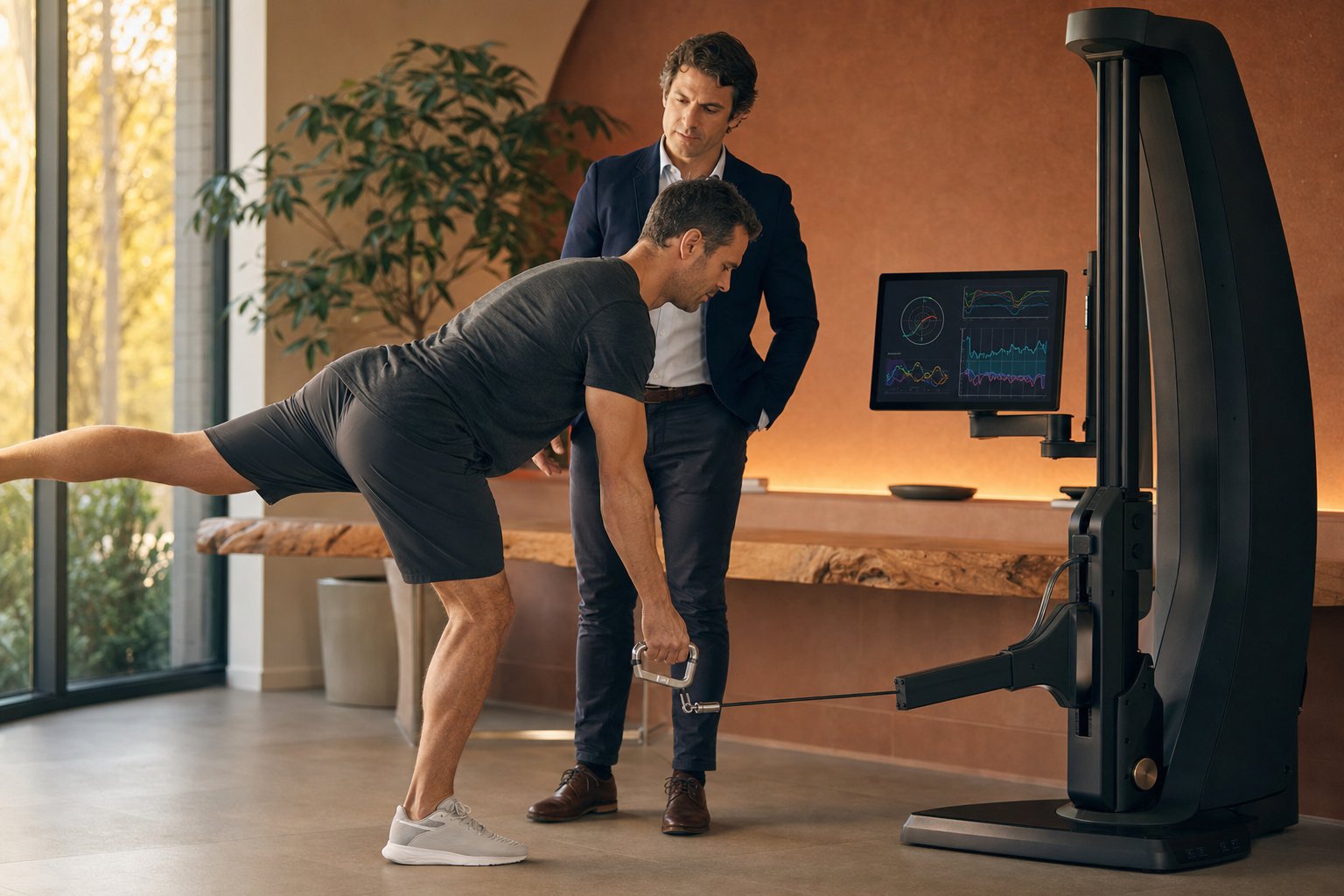
That is why every spine-focused patient at Pravida goes through a structured five-movement biomechanics battery on the OxeFit smart cable resistance system. It is not a workout. It is an assessment tool that gives me an objective, reproducible, physics-based portrait of how the spine and its supporting kinetic chain actually behave under load — and then lets me repeat the exact same test months later to see what changed.
What OxeFit is (and honestly, what it isn’t)
The OxeFit XS1 is a floor-anchored, cable-based smart resistance platform. Instead of stacked weight plates, resistance is delivered through motorized cables that can be programmed dynamically — heavier or lighter on the concentric versus the eccentric, adaptive to the tempo of the rep, or capped at a symmetry-matched load between limbs. Every rep is measured: peak force, rate of force development, range of motion, tempo, and left-to-right asymmetry.
Its adaptive mode is the piece that matters for a clinical assessment. Rather than the patient guessing at a starting weight, the machine begins conservatively and progressively increases cable resistance across sets in response to how well the patient controls the movement — measured by mobility (did you finish the range?), stability (did the trunk stay quiet?), symmetry (did the two sides do equal work?), and power (how quickly did you generate force?). The result is a load that is genuinely calibrated to the patient in front of me, not a guess and not a percentage of a one-rep max that we would never actually test in a fragile spine.
What OxeFit is not: it is not a diagnostic device, it does not replace a physical exam, and it does not decide whether a patient needs a regenerative procedure. As OxeFit itself states, its analysis models provide “clinically relevant insights” to discuss with a healthcare provider, not diagnoses. Interpretation is a physician job. What the platform does exceptionally well is capture a reproducible, high-resolution portrait of how a patient moves under load — and hold still while we compare that portrait to itself, months later.
The five-movement spine battery
Every spine-focused assessment at Pravida runs through the same five patterns, in the same order, at three sets of ten repetitions each. The order is intentional: we start with sagittal load (the safest, most familiar hinge), progress through transverse and diagonal rotational demands, then challenge axial compression, and finish with a motor-control task that ties everything together.
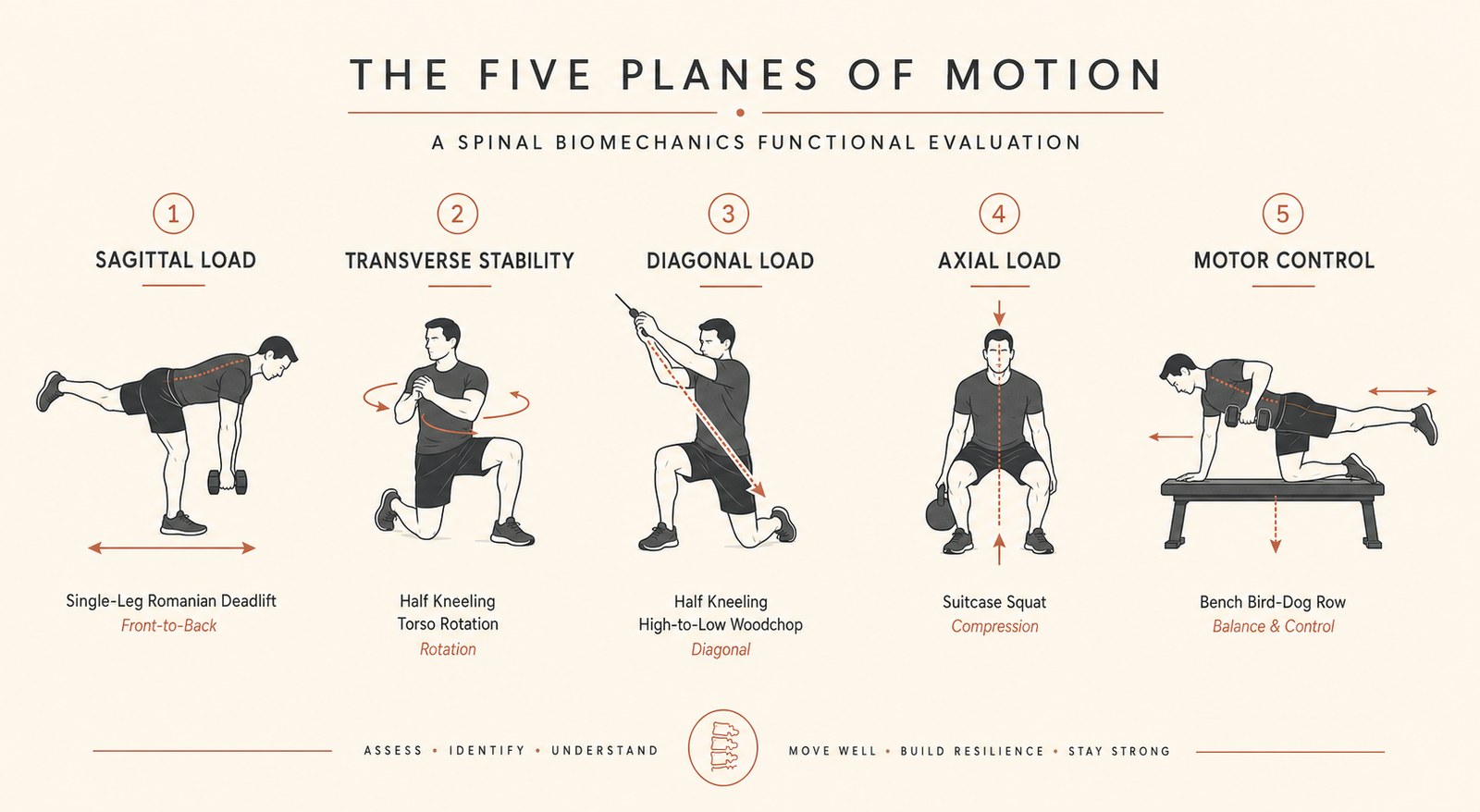
1. Sagittal Load — Single-Leg Romanian Deadlift (3 × 10)
The single-leg RDL is a hip-dominant hinge in the sagittal plane. Under load, the hamstrings and gluteus maximus contract eccentrically to control hip flexion, then concentrically to extend the hip on the return, while the entire posterior chain and the deep spinal stabilizers work isometrically to hold a neutral lumbar spine. Standing on one leg forces the frontal and transverse plane stabilizers — especially the gluteus medius and the multifidi — to prevent hip drop and unwanted trunk rotation.
What I am watching for on the OxeFit readout: symmetry between the left-stance and right-stance reps (a persistent difference of more than roughly 10–15% is meaningful and often lateralizes the pain pattern), stability as the load rises across sets (does the trunk stay quiet, or do we start to see rotational leak and lumbar flexion?), and mobility at the hip crease (does the hinge angle preserve across all three sets, or does the patient shorten the range as fatigue accumulates?).
Clinically, a poor sagittal load score with reproducible pain often points me toward a hip-dominant hinge deficit — weak posterior chain, poor lumbopelvic dissociation, or a pain-driven inhibition of the gluteals. That is a very different problem than a patient who scores well here but falls apart in the transverse plane.
2. Transverse Stability — Half-Kneeling Torso Rotation (3 × 10)
Half kneeling removes the hip and knee from the equation and forces the demand upward into the trunk. When the patient rotates the torso against cable resistance, the obliques and the deep rotators of the spine have to produce controlled rotation while the lumbar spine stays quiet. It is a pure test of rotational capacity and rotational control.
This is the pattern that most often exposes the classic modern desk-bound spine: adequate sagittal strength, catastrophic loss of rotational capacity. Patients who score poorly here typically report their pain not with bending but with reaching, turning to grab something from the back seat, or twisting under a golf swing. The adaptive mode captures both the power of the rotational drive and the stability of the return — how well the patient decelerates the movement, which is where the actual injury usually happens.
3. Diagonal Load — Half-Kneeling High-to-Low Woodchop (3 × 10)
The woodchop is a diagonal, cross-body chain that recruits the entire anterior oblique sling: the contralateral latissimus, the serratus, the internal and external obliques on opposite sides, and the hip adductors. It is the movement pattern that comes closest to real athletic loading — the swing of a tennis racket, the throw of a ball, the way we actually pick a heavy object up off a shelf and swing it down onto a counter.
This is where symmetry becomes especially informative. Very few humans are symmetric in the woodchop, but the size of the asymmetry matters. A dominant-side advantage of 5–10% is normal. A dominant-side advantage of 30% in a patient who chops on both sides equally in daily life often lateralizes an old, quiet spinal or hip pattern that will predict where they will get hurt next.
4. Axial Load — Suitcase Squat (3 × 10)
The suitcase squat — a squat with cable load in one hand at the side — puts the spine under asymmetric axial (vertical) compression. The quadratus lumborum, the obliques, and the deep spinal stabilizers on the loaded side have to produce a lateral counter-force to keep the spine vertical while the legs squat. This is the closest OxeFit analog to carrying a heavy grocery bag, a briefcase, or a toddler on one hip.
What I am watching for: stability under axial load (does the trunk stay vertical, or does the spine start to laterally flex toward the load?), and symmetry when we switch hands (does the same trunk position hold when the load is on the other side?). This test is one of my most reliable predictors of who is going to have trouble with everyday one-sided carrying tasks after they leave the clinic.
5. Motor Control — Bench Bird-Dog Row (3 × 10)
The final movement is deliberately the hardest to score well on. A bird-dog row on a bench asks the patient to hold a plank with three points of contact, extend the opposite leg, and row a cable handle with the opposite arm — all while keeping the pelvis and lumbar spine quiet. It is the ultimate integration task: proprioception, deep stabilizer timing, breathing coordination, and the ability to move an appendicular limb without disturbing the axial spine.
The motor control score here is often the clearest signal I get about the deep, un-glamorous work a patient needs to do before they should be loading heavy in any other plane. A patient who scores 90th percentile in sagittal power but 20th percentile in motor control is not ready to progress. They will get themselves hurt.
What the numbers actually mean in a clinical decision
The OxeFit adaptive mode produces a score for each pattern across the four metrics we care about. On its own, a score is a number. What makes it clinically useful is the shape of the profile across the five patterns and the reproducibility of the pain during specific loads.
The four questions I answer from a single spine assessment
- Where does the load fail? Which of the five planes reproduces the pain, and at what percentage of the adaptive load?
- Where is the asymmetry? Which side of the body under-produces, and by how much — and is that consistent with the imaging or the exam?
- What is limiting first — mobility, stability, or power? Because they take completely different training and treatment plans to fix.
- Is motor control the ceiling? If yes, no amount of strengthening the prime movers is going to help until we address the deep stabilizer timing.
How this changes the plan around a CartiNova procedure
The primary reason we run this battery on regenerative orthopedic patients is that it turns a CartiNova procedure from an event into a program. Instead of “we did the injection, now go do PT,” we have a specific, quantitative starting point and a specific, quantitative target.
Prehab. If the assessment shows a large sagittal-transverse imbalance, or a motor-control ceiling, or a persistent left-right asymmetry, we do not schedule the procedure that week. We build a two-to-six-week prehab block focused on the specific deficits the assessment surfaced, then re-test. Patients who arrive at their regenerative procedure with cleaner biomechanics generally tolerate the post-procedure loading window better and progress faster. The biology of tissue remodeling is real, but so is the mechanical environment that the biology has to live in.
Post-procedure milestones. After a CartiNova procedure, the healing tissue benefits from progressive loading, not from rest alone. The OxeFit battery becomes our objective gate. Instead of “you feel ready, so go run,” we can say “your sagittal load symmetry is now within 10%, your transverse stability score has returned to your baseline, and your motor control on the bird-dog row is back in the range where re-injury risk drops sharply — you are ready for the next phase.” Those are conversations that patients can act on.
Follow-up testing. We repeat the exact same battery at defined intervals — typically at four, eight, and twelve weeks post-procedure, and then quarterly. Because the movements, the tempo, and the adaptive scoring are held constant, small changes are visible and defensible. It also gives patients something they rarely get in traditional back-pain care: a graph that goes in the right direction.
How this battery translates to the things you actually do
Every movement in this battery was chosen because it maps onto a real-world task that a real patient will do this week, not because it looked interesting on a screen.
- Single-leg RDL → loading a suitcase into the trunk of a car, lifting a toddler off the floor, planting one foot and reaching for something on the ground.
- Half-kneeling torso rotation → turning to check a blind spot while driving, reaching for something behind you, the trunk rotation phase of a golf or tennis swing.
- Half-kneeling woodchop → unloading groceries from a cart to the counter, throwing anything, unloading a dishwasher, the full loaded swing of a golf club or racket.
- Suitcase squat → literally carrying a heavy grocery bag, a briefcase, a child on one hip, or one dumbbell up a flight of stairs.
- Bench bird-dog row → the underlying motor-control signature of every one-arm task you do all day, from vacuuming to reaching across a desk.
When a patient sees a graph that shows their suitcase squat symmetry improving from 74% to 92% over eight weeks post-procedure, they do not have to imagine what it means. They know it means they can carry the groceries in from the car again without paying for it that night.
The honest limits, and where a good clinician still matters
A few things this assessment does not do, and does not pretend to do:
- It does not diagnose a disc herniation, facet arthropathy, spondylolisthesis, or any specific spinal pathology. Those require imaging, exam, and clinical reasoning.
- It does not tell you which regenerative procedure, if any, is right for you. That decision integrates imaging, ultrasound-guided exam findings, medical history, and goals.
- Scores are not diagnostic thresholds. There is no OxeFit number that automatically triggers a procedure or automatically clears a patient to return to sport. Interpretation still requires a physician who knows the patient.
- It is best-in-class at objective, repeatable movement measurement — not at capturing the fear, the sleep loss, and the meaning of pain that shape recovery just as much as the biomechanics do.
What it does do, better than almost anything else in our clinic, is remove ambiguity from the two questions that patients ask most: “Am I actually better?” and “Am I ready to do the thing I love again?”
How I fit this into a Pravida care plan
For a spine-focused patient, the OxeFit battery is one of three tools I try to have in hand before I recommend a plan: a clinical exam, appropriate imaging or ultrasound assessment, and an objective functional baseline. Together they answer the three questions a good plan has to answer: what is the structural problem, what is the movement problem, and what does “better” look like measurably? If we can answer all three, the CartiNova procedure — or a prehab-only plan, or a rehab-only plan — becomes a decision the patient can genuinely own.
A companion post covers the knee-focused version of this battery — the six-movement lower-limb assessment we run for knee cartilage, meniscus, and post-procedure patients. If you are here for a knee, start there.
Curious what your own functional spine baseline looks like?
We run this five-movement OxeFit spine assessment as part of the initial evaluation for regenerative orthopedic patients at Pravida Health in Buckhead, Atlanta. It takes about 30 minutes, produces a graph you actually understand, and gives us the starting line for whatever plan comes next.
Book a consultationKey sources referenced in this article
- OxeFit XS1 platform overview — OxeAI adaptive analysis, cable-based smart resistance, and real-time performance feedback. Available at oxefit.com.
- McGill SM. Low Back Disorders: Evidence-Based Prevention and Rehabilitation. Human Kinetics, 3rd ed. — foundational biomechanics text on spinal stability, motor control, and the “big three” approach that informs the bird-dog and suitcase carry patterns used in this battery.
- Comerford MJ, Mottram SL. Kinetic Control: The Management of Uncontrolled Movement. Elsevier — reference for the framework of controlled versus uncontrolled movement across sagittal, frontal, and transverse planes.
- Cook G, Burton L, Hoogenboom BJ, Voight M. Functional Movement Screening: The use of fundamental movements as an assessment of function. Int J Sports Phys Ther. 2014;9(3):396–409. PubMed 24944858.
- Wilk KE, Macrina LC, Reinold MM. Non-operative rehabilitation for traumatic and atraumatic glenohumeral instability. N Am J Sports Phys Ther. 2006 (foundational reference for symmetry-based return-to-activity criteria in a rehab setting).