
Key takeaways
- Longevity Grok launched November 6, 2026. Insilico Medicine released it as open source with Harvard geneticist David Sinclair. Insilico calls it a Personal Longevity Superintelligence (PLSI). The GitHub project calls PLSI a Personal Longevity State Interface.
- The software is free, but the platform is not. It runs inside your own Grok Bot account, which xAI’s pricing page lists from $30 a month, with extra usage billed by token cost.
- Its best idea is keeping score. Each suggested intervention comes with a prediction card: a target biomarker, a confidence interval, a time horizon and an evidence grade. Code, not the bot, checks the result when your next labs arrive.
- It is not medical care. Insilico’s terms say no clinician reviews outputs and that you should consult a clinician before changing medications, supplements or treatment.
- It is the most hands-on tool in this series. It cannot log in to patient portals; you supply downloaded files. That suits technical self-trackers more than most patients.
A longevity AI that has to show its work
Most of the longevity advice my patients bring me has the same problem: it never gets checked. A supplement stack or diet change starts, the next labs come back months later, and nobody compares the result with what was expected. Longevity Grok is interesting because it tries to fix exactly that. Each suggestion is written as a prediction, and the prediction is scored.
You may see it called “PSLI” online. The correct abbreviation is PLSI. This post covers what it does as of November 15, 2026, what it asks of you, and how to bring it to your own physician.
What Insilico released
Insilico Medicine, a clinical-stage AI drug discovery company, announced Longevity Grok on November 6, 2026, together with David A. Sinclair, PhD, of Harvard Medical School (PR Newswire). It is a multi-agent system built for xAI’s Grok Bot platform that coordinates up to 30 specialized AI agents. It standardizes your records with clinical coding systems such as LOINC, RxNorm and UCUM and keeps a continuously updated record of your health (PR Newswire).
Insilico describes three roles: a personal longevity assistant, a physician’s assistant that gives clinicians structured context instead of scattered PDFs, and an opt-in partner for aging research (PR Newswire). Longevity.Technology reports that it derives measures such as PhenoAge and HOMA-IR from your data (Longevity.Technology).
Prediction cards and scoring
When PLSI proposes a lifestyle, nutrition or longevity intervention, it attaches a prediction card listing the target biomarker, a confidence interval, a time horizon and an evidence grade. The plan goes through an adversarial review by other agents. When follow-up results arrive, PLSI scores whether the outcome landed inside the predicted range and tracks how well calibrated it is over time (PR Newswire). The project says its deterministic tools do the calculating and scoring, and the bots provide judgment (GitHub).
What it can take in
| Data | How it gets in | Limits the project lists |
|---|---|---|
| Lab reports, discharge letters | PDF or photo, or values typed in chat | Shown on a record card for you to check first |
| Lab tables and FHIR records | CSV, spreadsheet or a FHIR file you download yourself | No direct patient-portal or insurer login |
| Methylation data | CSV of CpG values for aging clocks | Requires an add-on install |
| Apple Health | Third-party iPhone app (about 90 days) or full export ZIP | Live link omits weight, blood pressure and VO₂ max |
| Other wearables | Google Health, Open Wearables server or device exports | Some need a server you run yourself |
| Genome files | Not supported | No VCF or 23andMe-style import yet |
Source: the PLSI project documentation on GitHub (GitHub).
Five things patients can do with it before a visit
- Assemble a clean timeline. If you have years of labs from different companies, PLSI’s coding step can put them into one dated record with consistent units. That alone saves visit time.
- Bring the prediction card, not just the idea. “It suggested berberine” is hard to evaluate. “It predicted my fasting insulin would fall by a stated range in 12 weeks, with a stated evidence grade” is something your physician can check against your history.
- Ask your physician to set the safety rails. Medications, kidney and liver function, pregnancy and interactions are where a self-directed experiment can go wrong. Get those reviewed before you start.
- Agree on how you will measure it. Use the same lab, the same time of day and fasting state, and a realistic retest date. Otherwise the score means little.
- Share the scored result afterward. A missed prediction is useful information. It tells you and your physician that the intervention, the model or the measurement needs another look.
Insilico says the physician tier gives clinicians structured context and that formal diagnosis and prescriptions remain solely with licensed physicians (PR Newswire). The project lists clinic tools, including visit prep (GitHub). At Pravida, I would review a PLSI export the same way I review any AI summary: as a starting point, checked against your records and exam.
Privacy, cost and control
- Where your data lives: PLSI runs inside your own Grok Bot account. Insilico’s terms say xAI processes information in that account, including health information, under xAI’s own terms and privacy policy, and that Insilico cannot access the account (Insilico terms).
- Cost: the PLSI code is free and open source (PR Newswire). Grok Bot is listed at $30, $100 or $200 a month, with additional usage billed by token cost (x.ai). Always-on agents use tokens, so watch your usage.
- Research sharing is opt-in: you can contribute deidentified data to Insilico’s Longevity MotherShip research hub, with what Insilico calls an irrevocable kill switch to purge records (PR Newswire).
- Deidentification has limits: the project keeps event dates, birth year and sex, so its data are a limited data set, not HIPAA Safe Harbor deidentified (GitHub).
Where it falls short
Insilico’s own terms are the clearest statement of the limits. Longevity Grok is automated software, no clinician reviews outputs before you see them, and biological-age estimates and forecasts are estimates, not clinically validated findings unless a specific validation is identified. The terms also say not to use it to make clinical decisions, and to consult a clinician before starting, stopping or changing medications, supplements or treatment (Insilico terms).
I’d add two cautions from practice. First, an N-of-1 experiment on one biomarker can look like a success while something else gets worse, which is why the safety review matters. Second, Insilico, the companies behind the platform and the collaborators named in the launch all have interests in longevity science. That doesn’t make the tool wrong, but it is worth knowing. I found no independent evaluation of PLSI as of this writing.
How to bring Longevity Grok work to your physician
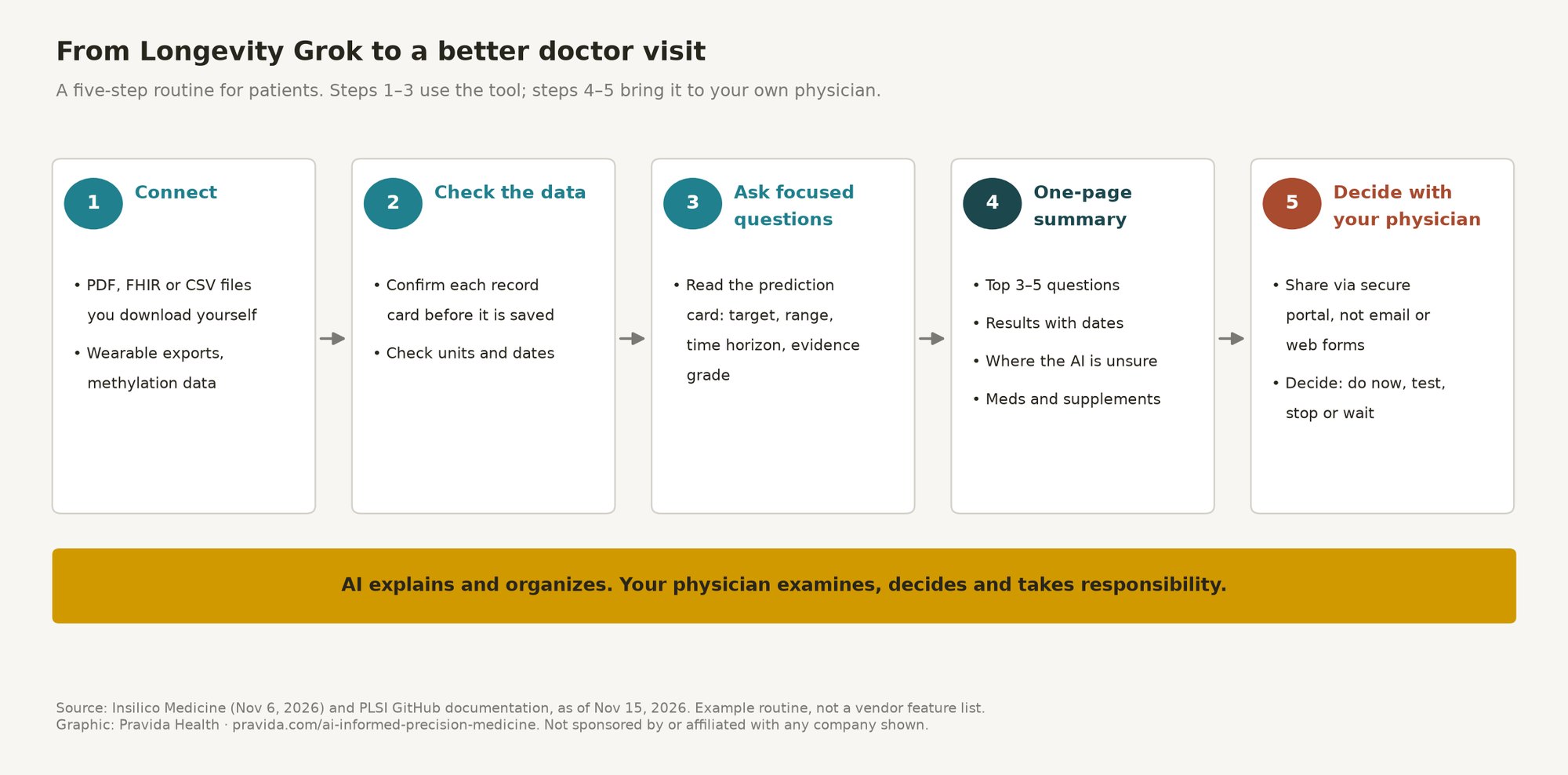
The most useful thing you can bring to a visit is not a long chat transcript. It is a short, honest summary that separates what your records show from what the AI suggested. Here is the routine I recommend to my own patients:
- Check the data first. Before you ask anything, look at what the tool pulled in. Records can be incomplete or out of date, and a medication you stopped last year may still be listed.
- Ask your questions, then ask for the summary. Use the prompt below at the end of your conversation so the AI lists its own uncertainty.
- Add what the AI does not know. Symptoms you haven’t typed in, family history, supplements and anything that happened outside the records.
- Share it securely. Bring it to the visit or upload it through your physician’s patient portal. Don’t send health details by regular email or a website form.
- Let the visit decide. Your physician’s job is to decide which of the AI’s ideas apply to you, what to test, what to stop and what can wait.
One-page physician summary prompt (from our visit preparation guide; works in any of these tools)
“I’m preparing for a visit with my physician. Using only what we’ve discussed and the health information I’ve shared with you, write a one-page summary for my doctor with these sections: 1. My top 3–5 questions, in priority order. 2. Relevant results or data (with dates and units), and what changed over time. 3. What you suggested I consider, and how confident you are in each suggestion. 4. What you could not determine without an exam, testing, or my full history. 5. My current medications and supplements, as I’ve told you. Keep it under one page. Do not add diagnoses. Mark anything uncertain as uncertain.”
The AI health tools series
This post is part of a five-part series on what patients can do with consumer AI health tools to work better with their own physicians. The others:
For the health-system side, see Gemini for healthcare vs. OpenAI, Anthropic, Amazon and Microsoft. For how I work with patients who bring AI research to a visit, see AI-Informed Precision Medicine at Pravida.
Bring your AI research to a physician who uses these tools
Pravida’s AI-Informed Precision Medicine consultation is built for patients who have already done the research. You upload your one-page AI summary, recent labs and wearable exports through our secure patient portal. Dr. Turner reviews them before the visit, then works through them with you.
- Free 15-minute discovery call with our care coordinator
- Virtual consultation: 45 minutes, $295 (adults located in Georgia or Florida during the visit)
- In-person consultation in Midtown Atlanta: 60 minutes, $495
- You leave with prioritized recommendations: what to do now, what to test, what to stop and what can wait
Please don’t send health details through our website form or email; you’ll get a secure portal link after booking. Details and credit terms are on the consultation page.
Pravida Health, 1801 Peachtree St NE, Suite 150, Atlanta, GA 30309. Call 404-900-7371, email info@pravida.com or request an appointment.
Frequently asked questions
What is Longevity Grok?
Longevity Grok is an open-source, multi-agent longevity AI released by Insilico Medicine with Harvard’s David Sinclair on November 6, 2026. Insilico calls it a Personal Longevity Superintelligence (PLSI). It runs on xAI’s Grok Bot and turns labs, wearable and methylation data into a continuous health record with scored predictions.
Is it PLSI or PSLI?
PLSI. Insilico’s announcement expands it as Personal Longevity Superintelligence, and the GitHub project describes PLSI as a Personal Longevity State Interface.
How much does Longevity Grok cost?
The PLSI software is free and open source. It runs in your own Grok Bot account, which xAI lists from $30 a month, with additional usage billed by token cost.
Who can see my health data in Longevity Grok?
Insilico’s terms say your data are processed in your Grok Bot account under xAI’s terms and privacy policy, and Insilico cannot access that account. Sharing with Insilico’s research hub is opt-in.
Should I start supplements or medications Longevity Grok suggests?
Not on its own. Insilico’s terms say outputs are not medical advice and that you should consult a clinician before starting, stopping or changing medications, supplements or treatment. Bring the prediction card to your physician first.
References
- Insilico open-sources 24/7 Personal Longevity Superintelligence. November 6, 2026. PR Newswire.
- PLSI project documentation. GitHub (Insilico-org/plsi).
- Longevity Grok terms of service. GitHub (Insilico-org/plsi).
- Insilico open-sources a longevity AI that keeps score. November 9, 2026. Longevity.Technology.
- Grok Bot pricing. x.ai.
- Longevity Grok website. longevitygrok.si.