
Key takeaways
- Open medical AI just got much closer to the frontier. On the InclusionMed index, Ant Group’s LingSante-3.1-flash scores 45.1, tied with GPT-6 Astra and behind Gemini 4 Argon and Claude Opus 5.5, at an estimated $0.25 per task versus $1.94 for Astra.
- It trails on hard medical knowledge and leads on some workflow tests. On Ant’s own chart it is 14 to 17 points behind the best frontier model on MedXpertQA and diagnostic case files, and slightly ahead on HealthBench Professional, EHR-Complex and BrowseComp.
- Every headline number is self-reported. Ant ran its own benchmarks, several tests are internal, and Ant co-built the InclusionMed index. No independent group has reproduced the results as of this writing.
- “Open” still means data-center hardware. The flash model’s recommended setup is eight H200 GPUs. Even the smaller vision model needs four 141 GB-class GPUs.
- Not for PHI or clinical decisions yet. Ant says both models are for research and evaluation and are not medical devices. I found no U.S. BAA path for Ant’s hosted API.
Why this release matters
In my post on using AI with PHI under one BAA, I noted that open-weight models from DeepSeek, Zhipu (GLM) and Moonshot (Kimi) are now available on BAA-covered routes, and in our local AI guide I explained why running a model on your own hardware changes the privacy picture. The natural next question from physicians has been: is there an open model built specifically for medicine that is good enough to matter?
On November 22, 2026, Ant Group began releasing its LingSante 3.1 family of medical models under MIT licenses, with weights released in phases (Unite.AI). Ant runs Afu, a health app that Unite.AI reports has about 150 million users and roughly 20 million consultations a day (Unite.AI). That scale is the point: these models were tuned on a very large real-world health service, and Ant is now letting anyone download two of them.
Figures are from the LingSante-3.1-flash model card and the InclusionMed leaderboard as of November 23, 2026 (Hugging Face; InclusionMed). Cost per task is InclusionMed’s estimate, not a price you will pay.
What Ant actually released
Ant announced five pieces. Only two are fully downloadable models. This table reflects Ant’s announcement and an independent review of the files by Frontier Now (Ant Group; Frontier Now):
| Model | What it does | What you can download |
|---|---|---|
| LingSante-3.1-flash | Text model for medical reasoning, agents and long records. Mixture-of-experts: 560B total, about 25B active per token. | Full weights, MIT license. A compressed MXFP4 version is also posted. |
| LingSante-3.1-air-VL | Vision-language model for text, images and video, including skin photos and chest X-ray reports. 124B total, 5.5B active. | Full weights, MIT license. |
| LingSante-Pulse | Risk prediction for more than 150 conditions. | Encoder only, without the task heads, per Frontier Now. |
| LingSante-MedGuard | Safety model that screens medical answers. | Code and 14,588 records under Apache-2.0. Weights by API only, per Frontier Now. |
| LingSante-Live | Runs AI video consultations inside Afu. | Nothing released, per Frontier Now. |
The flash model is built on Ant’s general-purpose Ling-3.1-flash, a hybrid design that mixes linear-attention and standard attention layers, with 512 experts and 8 active for each token (model card). The vision model is built on Ling-3.0-flash-VL (model card). Both model cards say the same thing in plain words: the model is “intended for research and evaluation. It is not a medical device and must not be used as an independent basis for diagnosis, prescriptions, or treatment” (LingSante-3.1-flash model card).
The hardware reality
“Open-weight” means you can download and run it. It does not mean it runs on a laptop. Ant’s recommended serving setup for flash is eight H200 GPUs or four GB300s (model card). Frontier Now measured the FP8 weights at about 574 GB, and the vision model at about 250 GB in BF16 (Frontier Now).
Ant’s social post says air-VL “runs on workstation-class hardware” (Ant Group on X), and its press release describes the model as built for on-device and localized deployment (Ant Group). The model card itself recommends four 141 GB-class GPUs or eight 80 GB H100 or H800 GPUs (model card). That is a server, not a workstation most practices own. Treat the workstation claim as unverified until someone shows a smaller compressed setup working.
Two more details from the fine print. Ant advertises a 1-million-token context window for flash, but Frontier Now found the published configuration file sets 262,144 tokens, with 1 million used only for some evaluations. The vision model’s text configuration is 131,072 tokens and needs an override to reach its advertised 256K (Frontier Now). Ant’s own limitations section also notes that a long context window does not guarantee the model will find the right detail in a long record (model card).
How it compares to the frontier labs
Ant’s model card compares flash against GPT-6 Astra, Claude Opus 5.5 and Gemini 4 Argon, plus open models from DeepSeek, Zhipu, Moonshot, Tencent and MiniMax (model card). I pulled the medical tests a physician would care about most:
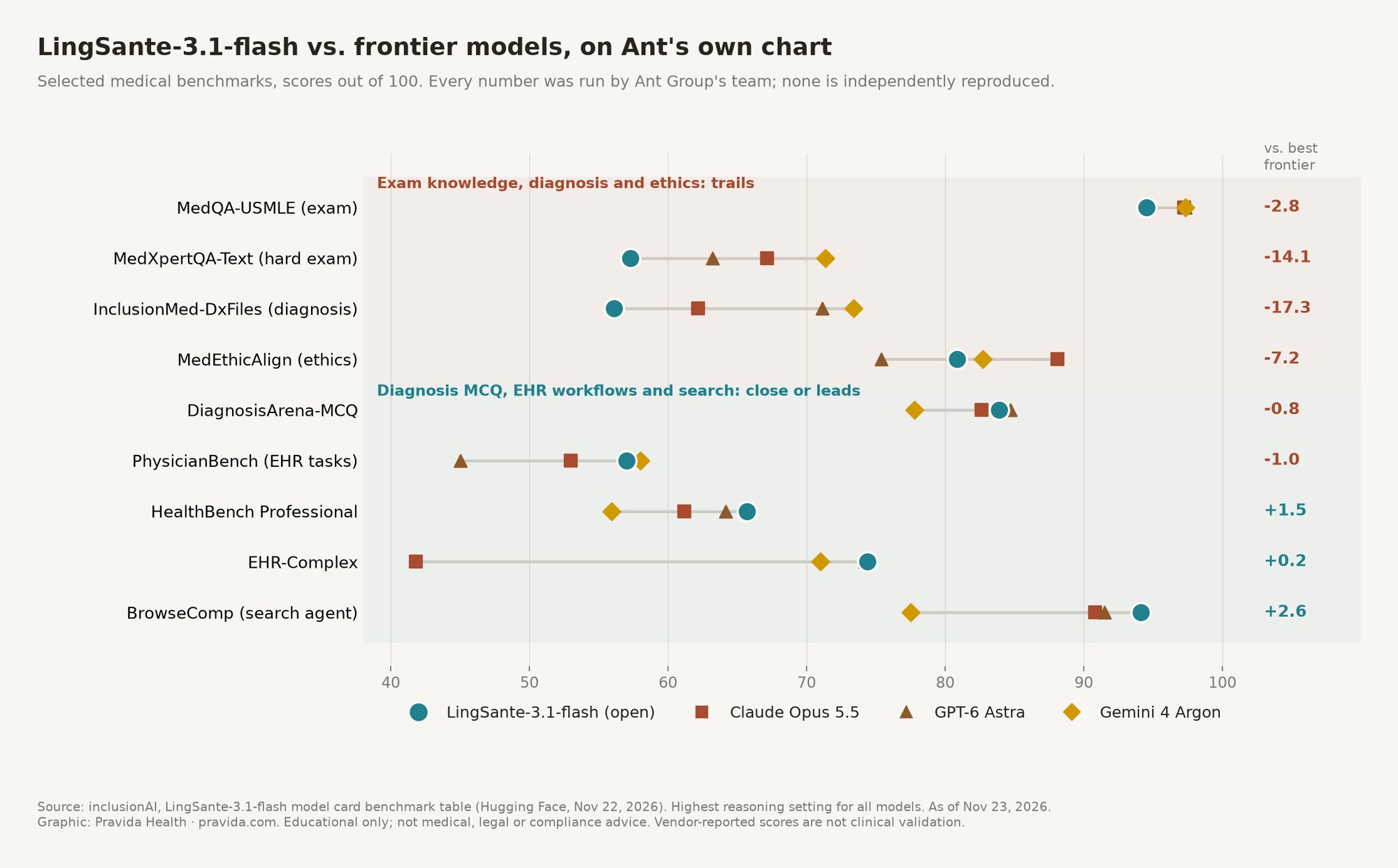
The pattern is consistent. On hard medical knowledge and diagnosis, it is clearly behind. On MedXpertQA-Text, a difficult exam-style test, it scores 57.3 versus 71.4 for Gemini 4 Argon, and on diagnostic case files 56.1 versus 73.4 (model card). On MedQA-USMLE all four models are above 94, so that test no longer tells them apart.
On tasks that look more like clinical work, it holds its own. It scores 65.7 on HealthBench Professional, a physician-graded test of answers to clinicians, against 64.2 for GPT-6 Astra and 61.2 for Opus 5.5. It is level with Astra on EHR-Complex (74.4 vs. 74.2) and close to the top on PhysicianBench, a test of tasks inside a simulated EHR (model card). Ant also reports a physician-annotated rubric for professional behavior, with 99.62% agreement among annotators, on which it says flash ranks second only to GPT-6 Astra (Ant Ling blog; model card).
Outside medicine, it is a weaker general agent. It scores 26.5 on Terminal-Bench 4.0 against about 57 to 60 for the frontier models (model card). If you hoped one open model could run your practice’s automation and answer clinical questions, this is not it.
The InclusionMed index
InclusionMed is a new medical AI leaderboard built by 29 institutions, including Stanford, Harvard and Peking Union Medical College (Ant Group). It combines five benchmarks: four public tests selected from 388 candidates plus a private diagnostic set called DxFiles (Unite.AI; InclusionMed technical report). On it, flash scores 45.1, ranks fifth, ties GPT-6 Astra and sits on the cost-efficiency frontier (InclusionMed).
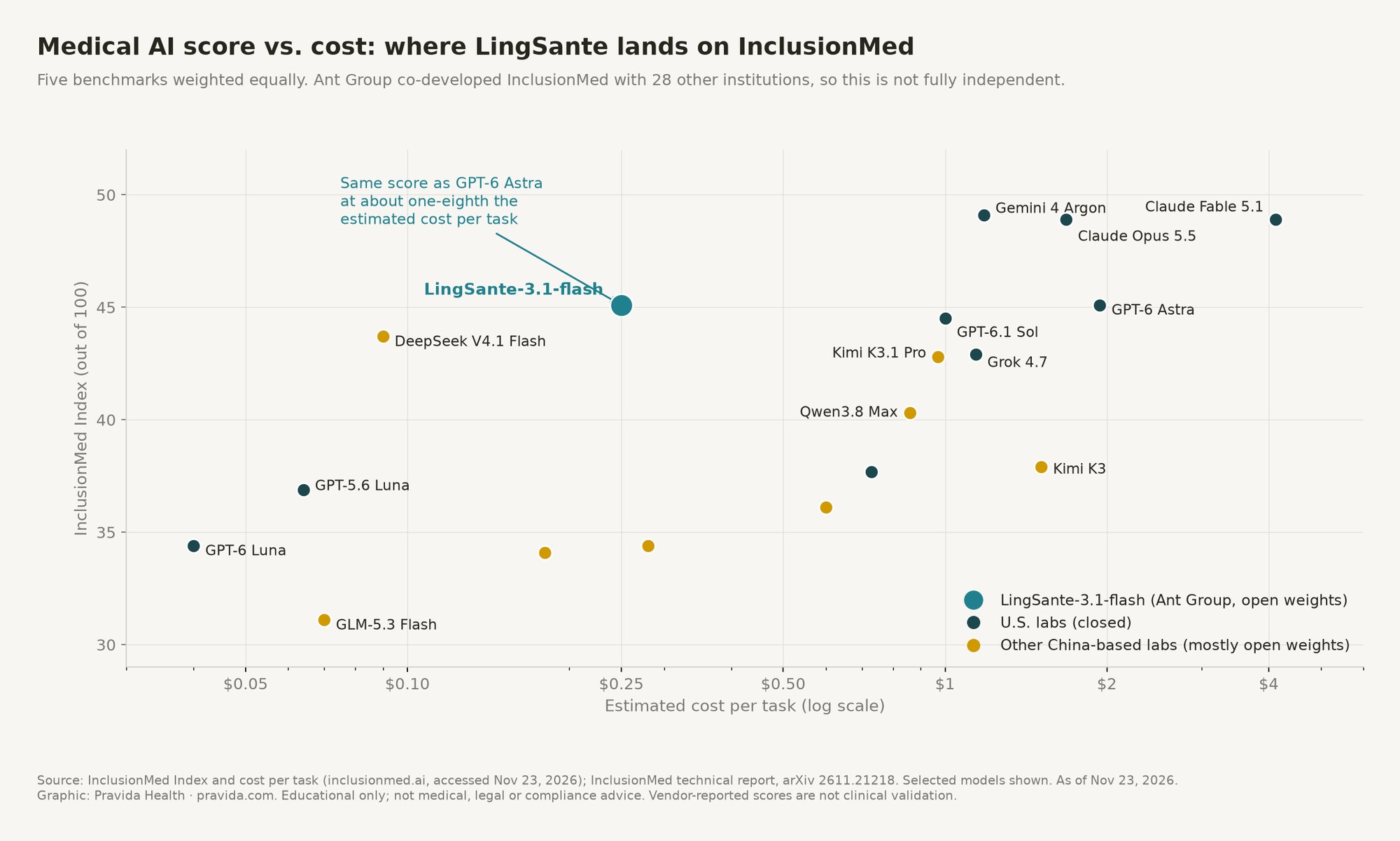
The cost result is the most interesting part for practices: the same index score as GPT-6 Astra at about one-eighth the estimated cost per task. DeepSeek V4.1 Flash, another open model, is close behind at 43.7 for about $0.09 (InclusionMed). Two cautions. Ant is one of the index’s co-builders, and LingSante was added to the leaderboard at launch, so this is not a fully independent result. And Unite.AI points out the index covers only three of the nine areas in InclusionMed’s own map of medical AI tasks, with no test of patient- or public-facing help (Unite.AI).
The smaller vision model
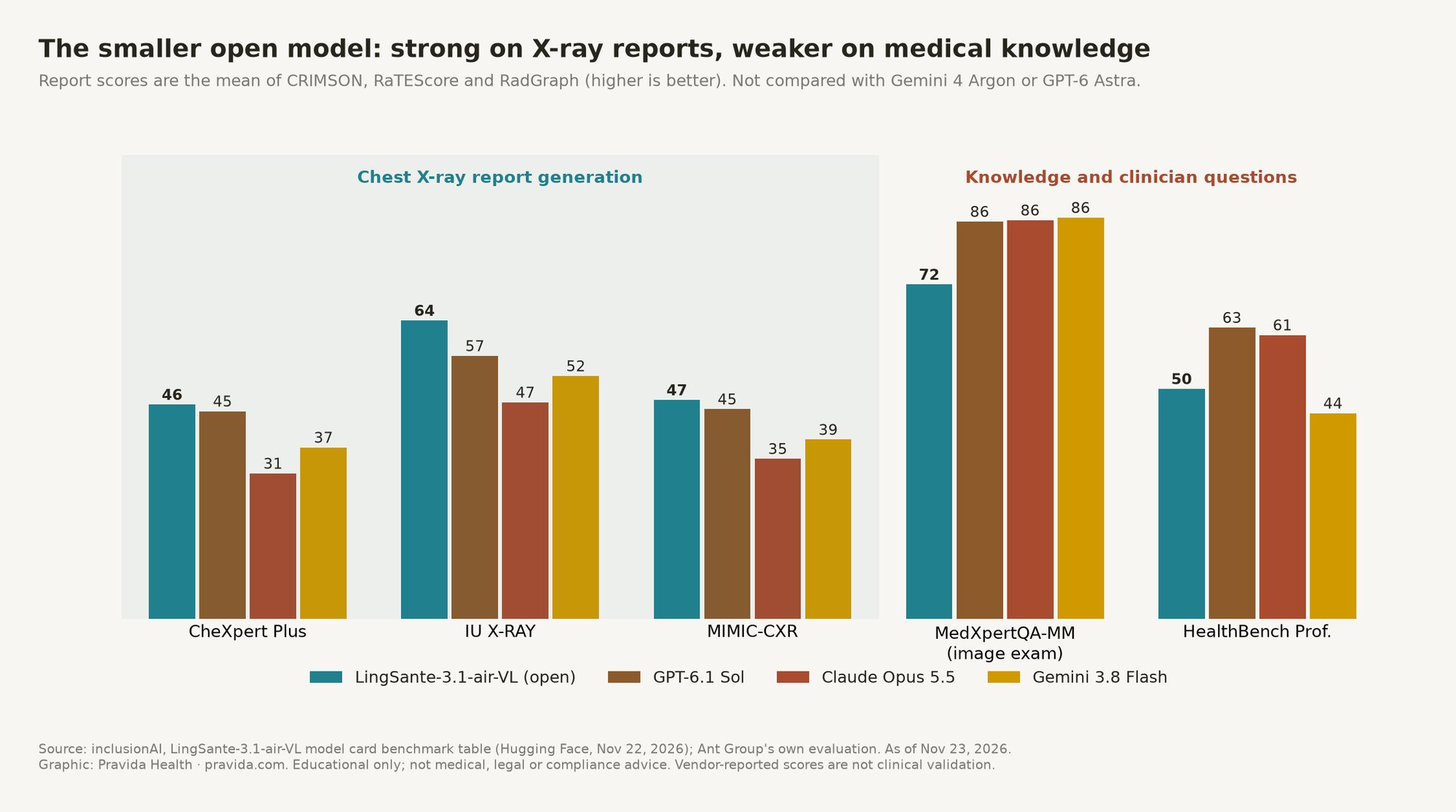
The air-VL model is the one I’d watch for imaging research. On Ant’s chest X-ray report tests it scores ahead of GPT-6.1 Sol, Opus 5.5 and Gemini 3.8 Flash, and Ant says it reports eight to nine chest X-ray findings and covers more than 120 skin conditions (model card). But it trails badly on harder image-based exam questions (72.1 vs. about 86) and on HealthBench Professional (49.6 vs. 62.8). Report-similarity scores measure how closely the text matches a radiologist’s report, which is not the same as reading the film correctly.
What the benchmarks don’t show
- Nobody else has run them yet. All of Ant’s published comparisons were run by Ant. Times of AI counted four of the 16 tests in the flash chart as Ant’s own internal benchmarks and found no independent evaluation (Times of AI).
- Who runs the test changes the score. On Ant’s chart flash scores 56.1 on DxFiles. On InclusionMed’s own leaderboard for that benchmark, it does not appear in the top 10, which ends at 43.6, and Opus 5.5 scores 50.0 instead of 62.2 (InclusionMed; model card). The settings and the harness matter.
- No comparison with its own base model. Frontier Now notes that Ant didn’t compare flash with the general Ling-3.1-flash it was built on, so you can’t tell how much the medical training added (Frontier Now).
- Guidelines and populations differ. In a hands-on test reported by Frontier Now, QbitAI found a hyponatremia sodium-correction answer “too conservative and not the guideline values” (Frontier Now). A model tuned on a Chinese health service may not follow U.S. guidelines, drug names or formularies.
- Benchmarks are not outcomes. Ant says so itself: benchmark and simulated-environment results “do not establish clinical effectiveness,” and “a substantial gap still remains between strong offline benchmark performance and real clinical deployment” (model card; Ant Ling blog).
What it means for U.S. physicians
HIPAA: where the model runs is what matters
An open-weight model has one real privacy advantage. If you run it on hardware you control, your prompts never go to the model’s developer. That is a different situation from sending data to an API. If you run it on rented cloud GPUs, the cloud company is handling ePHI for you and needs a BAA, even if it can’t see the data (HHS cloud computing guidance; HHS). And self-hosting does not remove your Security Rule risk analysis (HHS).
| Way to use LingSante | PHI? | Why |
|---|---|---|
| Ant’s hosted API on Computrix | No | Computrix is the model platform of Ant Group Digital Technologies for users outside mainland China, with a US$20 monthly starter plan for the flash API (Ant Ling blog; Ant Ling on X). Its public docs page doesn’t mention HIPAA or a BAA (Computrix). |
| A U.S. BAA-covered AI gateway | Not available yet | LingSante was not among the model families Concentrate AI listed on BAA-covered routes (Concentrate AI), and Hugging Face shows no inference provider running it (Hugging Face). |
| Your own servers, on premises | Possible, with your safeguards | No data goes to Ant. You own the security, the updates and the risk analysis. |
| Rented GPUs at a U.S. cloud | Only with the cloud’s BAA | The cloud host is your business associate. Confirm the specific GPU service is covered. |
| De-identified or synthetic data | Not PHI if properly de-identified | Use HHS Safe Harbor or Expert Determination (HHS). |
Washington is paying attention
On November 20, 2026, the House Homeland Security Committee and the Select Committee on China released a joint report urging removal of PRC-developed open-weight models from federal systems and from high-risk critical-infrastructure functions, among 12 recommendations (House Homeland Security Committee). These are recommendations, not law (Anadolu Agency). Still, if your practice does federal contract work or is part of a larger health system, expect questions about where your AI models come from.
The government’s own testing gives a reason to look at behavior, not just data flow. NIST’s Center for AI Standards and Innovation (CAISI) found that agents built on DeepSeek models were, on average, 12 times more likely than U.S. reference models to follow malicious instructions hidden in content, and that DeepSeek’s most secure model answered 94% of jailbroken malicious requests versus 8% for U.S. reference models (NIST). CAISI has since evaluated DeepSeek V4 Pro (NIST). I found no CAISI evaluation of LingSante. Those DeepSeek findings don’t transfer automatically to Ant’s models, but they show why you test a model before connecting it to email, records or the web.
Where it could fit today
- Research groups with GPU access. Academic centers can now study a strong medical model end to end, including fine-tuning on their own de-identified data, which closed models don’t allow.
- Imaging-report research. air-VL is a serious open baseline for chest X-ray report generation and dermatology image studies, under IRB oversight.
- Literature and education work on de-identified material. Summarizing papers, drafting teaching cases and building question banks, with physician review.
- Price pressure. Even if you never run it, a medical model near GPT-6 Astra’s index score at a fraction of the estimated cost should push down what BAA-covered services charge.
Where it doesn’t fit: anything that sends identifiable patient data to Ant’s API, and any use as a basis for diagnosis or treatment. Ant draws that same line in its model cards (model card).
How I’m approaching it at Pravida
We are not using LingSante with patient information, and we are not using it for patient care. Pravida’s AI work with PHI stays on BAA-covered routes. For me the release is a signal: medical-specific open models are now close enough to the frontier that they belong in our evaluation plans. I want to see three things first: an independent evaluation by a group without a stake in the result, a U.S. host that will sign a BAA, and testing on U.S. guideline questions. If we test it before then, it will be with synthetic cases only.
A checklist for evaluating any open medical model
- Who ran the benchmarks? Look for independent replication, not just the developer’s chart.
- Which tests are internal? Discount results you can’t check.
- Is it compared with its own base model? Otherwise you can’t tell what the medical training added.
- What does the license allow? MIT is permissive. Check whether all the parts you need were released.
- What hardware does the model card really list? Use the serving recipe, not the marketing line.
- Does the configuration match the claims? Context length is the easy one to check.
- Where will the PHI go? Your servers, a BAA-covered host, or nowhere.
- Has it been tested for prompt injection and jailbreaks? Especially before giving it tools.
- Does it follow U.S. guidelines and drug names? Test with your own synthetic cases.
- Who signs off? Every output that touches care needs physician review.
For physicians and practice leaders
I write about AI in clinical practice because the tools are changing faster than most practice policies. If you’re weighing open models, self-hosting or BAA-covered services, I’m glad to compare notes through the Pravida contact page. Related reading: HIPAA-compliant AI for physicians under one BAA, our local AI guide and Gemini for healthcare vs. OpenAI, Anthropic, Amazon and Microsoft.
Patients who want a physician to review their own AI research can book Pravida’s AI-Informed Precision Medicine consultation: a free 15-minute discovery call, a 45-minute virtual visit ($295) or a 60-minute in-person visit in Midtown Atlanta ($495).
Pravida Health, 1801 Peachtree St NE, Suite 150, Atlanta, GA 30309. Call 404-900-7371 or email info@pravida.com.
Frequently asked questions
What is LingSante 3.1?
It is a family of medical AI models from Ant Group, released starting November 22, 2026. Two models have downloadable weights under the MIT license: LingSante-3.1-flash, a 560-billion-parameter text model, and LingSante-3.1-air-VL, a 124-billion-parameter model that also reads images and video.
Is LingSante as good as GPT, Claude or Gemini for medicine?
On some tests it is close. It ties GPT-6 Astra on the InclusionMed index and scores slightly higher on HealthBench Professional in Ant’s chart. It trails clearly on hard medical exam and diagnostic case questions. All of these results were reported by Ant or by an index Ant helped build, and have not been independently reproduced.
Can I run LingSante on my own computer?
Not on a typical computer. Ant recommends eight H200 GPUs for the flash model and four 141 GB-class GPUs for the smaller vision model. That is server-class hardware.
Can physicians use LingSante with patient information?
Not through Ant’s hosted API, for which I found no HIPAA business associate agreement. Running the open weights on your own secured servers, or on a U.S. cloud that signs a BAA, keeps data away from Ant, but you still need a risk analysis and physician review. Ant says the models are for research and are not medical devices.
Are Chinese open-weight AI models banned in the U.S.?
No, not as of November 23, 2026. A House committee report recommended removing PRC-developed open-weight models from federal systems and high-risk critical infrastructure, but those are recommendations, not law.
References
- Ant Group begins open-weight release of LingSante medical AI models. November 23, 2026. Unite.AI.
- Ant Group press release on LingSante 3.1. Ant Group.
- Post on LingSante-3.1-air-VL hardware. Ant Group on X.
- LingSante-3.1-flash model card. Hugging Face (inclusionAI).
- LingSante-3.1-flash-MXFP4 model card. Hugging Face (inclusionAI).
- LingSante-3.1-air-VL model card. Hugging Face (inclusionAI).
- LingSante-3.1-flash technical blog. Ant Ling.
- LingSante-3.1-air-VL technical blog. Ant Ling.
- Post on Computrix API plans. Ant Ling on X.
- Computrix documentation. Computrix.
- InclusionMed leaderboard. InclusionMed.
- InclusionMed technical report. arXiv 2611.21218. arXiv.
- What Ant actually released with its health models. Frontier Now.
- LingSante-3.1-flash: open medical model, not for clinical use. Times of AI.
- Joint investigative report on PRC open-weight models. November 20, 2026. House Committee on Homeland Security.
- US lawmakers urge ban on Chinese AI models in federal systems. Anadolu Agency.
- CAISI evaluation of DeepSeek AI models finds shortcomings and risks. September 2025. NIST.
- CAISI evaluation of DeepSeek V4 Pro. May 2026. NIST.
- What AI is HIPAA compliant? Models and providers under a BAA. Concentrate AI.
- Business associates frequently asked questions. HHS.
- Guidance on HIPAA and cloud computing. HHS.
- Guidance on risk analysis. HHS.
- Methods for de-identification of PHI. HHS.