
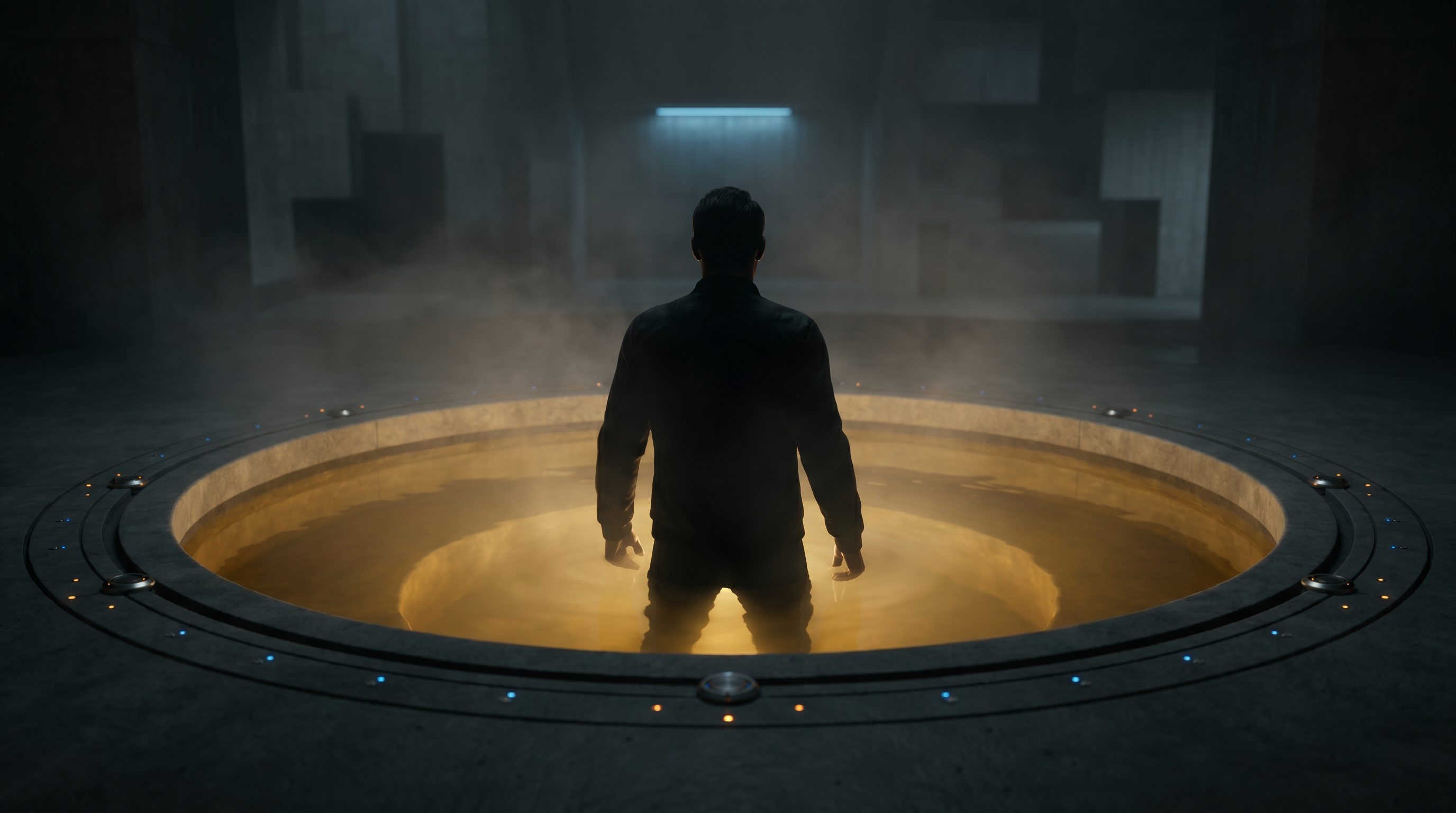
The image that made me stop scrolling
A person steps into a shallow pool of golden light. They lower themselves under the surface. A ring of roughly 500,000 tiny ultrasonic transducers pings the body from every angle, millions of times per second. Sixty seconds later, an AI reconstruction produces a three-dimensional map of the interior of that human being — down to a fraction of a millimeter.
This is not the opening of a science fiction novel. It is the pitch for Midjourney Medical, the new healthcare division announced by the AI image lab, with a first location — the Midjourney Spa — planned for San Francisco in 2027.
As a physician who spends most of his week thinking about musculoskeletal imaging, regenerative injections, and how to bring longevity medicine to real patients, I read the announcement three times before I let myself react. I want to walk through what I think is genuinely exciting about this, what I think is genuinely worrying, and where I land on it as a clinician.
The short version: the technology is more interesting than the branding suggests, and the branding is more dangerous than the technology suggests.
What Midjourney is actually building
Strip away the language about spas and hot tubs and cold plunges for a moment. What Midjourney is describing is an ultrasound tomography system — a full-body acoustic scanner that uses water immersion to eliminate the air-tissue impedance mismatch that has always limited conventional ultrasound.
Water immersion tomography is not new. It has been studied in breast imaging for two decades. What is new is the scale: a ring of half a million transducer elements, a 60-second acquisition, and an AI segmentation pipeline that assigns tissue types to each slice. Midjourney’s stated roadmap runs about 12 months of algorithm and hardware refinement, a first commercial location in late 2027, and a Gen3 scanner they claim will reach “MRI-comparable resolution at roughly 100 times the speed” (Midjourney).
According to Business Insider’s coverage, prototypes have produced 3D maps in the promised 60 seconds. A demo unit was available in person at the announcement, and multiple people have publicly reported putting a hand or arm into it and seeing internal structures rendered on a screen. This is a real device, not a rendering.
The business model is worth noting too. Midjourney has always operated without outside investors — funded, as they put it, by everyday users of their image tools. They are extending that model into medicine, positioning themselves as a “community-driven research lab” (Midjourney). That framing matters, and I’ll come back to it.
What I love about this, as a doctor
Let me start with the parts that made the physician in me lean forward.
It is radiation-free, magnet-free, and roughly an order of magnitude cheaper per acquisition than MRI. The reason we don’t use it for whole-body screening is not physics. It is operator dependence, air artifact, and the fact that a conventional ultrasound probe sees only a small window at a time. Water immersion plus a 360-degree transducer array plausibly solves both problems at once. That is a real engineering insight.
I have patients who need imaging and can’t get it. Not because the machine doesn’t exist, but because their high-deductible plan won’t cover a $2,400 MRI, or the nearest facility has a six-week backlog, or they are claustrophobic and cannot tolerate a bore. If Midjourney’s cost claims — “10x cheaper, 60x faster” (Frank Houbre) — hold up in a clinical validation, that is a genuine shift in access. Not because it replaces MRI, but because it lowers the price and friction of a first look.
In regenerative medicine we spend a lot of time reasoning backwards from a single symptomatic scan. Was that Baker’s cyst there five years ago? Was that muscle asymmetry gradual or acute? A cheap, quick, radiation-free baseline scan at age 35 that becomes a comparison for age 45 is scientifically useful in a way that no single scan ever is. I think longitudinal imaging is the most underdeveloped concept in preventive medicine, and this hardware could unlock it.
Most of the healthcare technology I evaluate in my inbox is trying to sell me a service. Midjourney has said they are not raising traditional venture capital and are answering to their community of users (Midjourney). Whether that survives contact with FDA process and clinical validation is another question. But the incentive structure at the outset is unusual, and it is not automatically worse than the alternative.
Where the branding runs ahead of the biology
Now the harder part.
Midjourney’s tagline is that the scanner will be “as powerful as MRI, and as casual as a trip to the spa” (Midjourney). I understand why they wrote that sentence. I also think it is the sentence that will get people hurt if it is not walked back.
Ultrasound is not MRI. It is not CT. It is not a colonoscopy. These modalities are not interchangeable, and pretending they are is exactly the kind of oversimplification that erodes trust in medicine over the long run. Hank Green made this point more concisely than I could: different scans do different things, and adding a new full-body scan does not replace any of the ones we already use. It might add. It does not substitute.
More importantly, we have a name for what happens when you do whole-body imaging in asymptomatic people: incidentalomas. These are findings that would never have caused a symptom if you had never looked. And they are not rare. In whole-body MRI studies, meaningful incidental findings show up in 15 to 40 percent of asymptomatic adults, depending on how you define meaningful. Most of them are not cancer. Most of them are not anything at all. But once you see the shadow, someone has to explain it, someone has to biopsy it, someone has to bill for the follow-up, and the patient has to lie awake at night wondering if they are dying.
The US Preventive Services Task Force does not recommend against whole-body imaging because they are hostile to prevention. They recommend against it because when you subtract the harms of workup and anxiety from the benefits of early detection, the math frequently comes out negative or neutral. Finding more things in the body is not the same as helping the patient.
I fully expect the radiology response to Midjourney Medical — which has already been publicly negative — to be dismissed as protectionism. Some of it will be. Most of it will not. The people worrying about incidentalomas have watched what happens downstream of a fuzzy shadow on a screen. They are correct to worry.
“A scan without a plan for its findings is not preventive medicine. It is anxiety generation.”
The questions I would want answered before I refer a patient
If a Midjourney Spa opened in Atlanta tomorrow and a patient asked me whether they should book a scan, here are the questions I would want answered first.
Who is reading the scan?
A 3D volumetric acquisition is not a diagnosis. It is data. If the AI segmentation flags something, does a licensed radiologist review it? If it does not flag something, does a radiologist ever look at all? The difference between “the AI didn’t see anything” and “a board-certified radiologist reviewed the study and saw no acute findings” is not a marketing distinction. It is the difference between a medical device and a novelty.
What is the follow-up pathway?
When the scan finds a 6mm hepatic lesion — and it will, in a meaningful fraction of scans — what happens next? Does the spa hand the patient a PDF? Do they refer to a specific hepatologist? Is there any structured plan for the second scan in three months that the standard of care would require? A scan without a plan for its findings is not preventive medicine. It is anxiety generation.
What is the false positive rate in asymptomatic adults?
This is the number I most want to see, and it is the number Midjourney has not published. Twenty prototype scans is not a validation study. If the false positive rate in a healthy 40-year-old is 30 percent per scan, that is a very different product than if it is three percent.
What does the FDA path look like?
Ultrasound devices generally clear through 510(k), which is a relatively fast pathway. But an AI-assisted diagnostic system claiming MRI-comparable performance is a different regulatory animal. I would want to see a clear articulation of what the intended use language will say, and whether the marketing language matches it. In my experience, when the marketing runs ahead of the intended use, the FDA notices.
Is the operator trained?
Water immersion tomography is technique-dependent. Positioning, breath hold, motion artifact — these matter. A spa attendant is not a sonographer. If Midjourney intends to solve this with hardware and AI reconstruction alone, that claim needs data.
The regenerative medicine angle nobody is talking about
Most of the public conversation about Midjourney Medical has focused on cancer screening and the incidentaloma problem, which is the right first-order question. But I want to flag a second-order use case that is closer to what I do every day.
In regenerative medicine, we live and die by musculoskeletal imaging. We image before we inject PRP into a partial rotator cuff tear. We image after to track healing. We use DEXA to track body composition longitudinally. We use ultrasound to guide bone marrow aspirations. Every one of these is a specific, targeted acquisition.
A 60-second full-body ultrasound tomography scan is not a replacement for any of those. But it is potentially a substrate for something my field has never had: a routine, cheap, longitudinal baseline of the entire musculoskeletal system. Tendon thickness. Joint effusion. Muscle cross-sectional area. Subcutaneous versus visceral fat distribution. Vascular calcification. Bone cortex signal.
If a Midjourney Gen3 scanner in 2028 can generate that dataset for a few hundred dollars, and a physician can layer targeted diagnostic ultrasound on top when clinically indicated, that changes what preventive orthopedic and longevity medicine looks like. It becomes possible to model an individual patient’s trajectory instead of comparing them to a population norm.
That is exciting. It is also completely dependent on the questions in the previous section actually being answered.
My physician recommendation, today
I am not going to tell a patient to fly to San Francisco in 2027 to be scanned in a hot tub. Not because I think the technology is fake, but because a scan without a clinician in the loop is not medicine. It is data.
I will tell a patient — I am telling them, actually — to pay attention to this. Because if Midjourney executes even 60 percent of what they have described, and if the validation data holds up, this is one of the most interesting entrants in the diagnostic imaging space in a decade. Not because it beats MRI. It won’t. But because it might make a first look at your own body cheap enough, fast enough, and pleasant enough that a whole generation of people who currently avoid imaging entirely will actually engage with their own health.
That is a genuinely different world. It is also a world that requires the medical community to build the interpretive scaffolding around it, or it will hurt more people than it helps.
If you are reading this and you work in radiology, oncology, or preventive medicine, my ask is simple: engage with this technology now. Don’t wait for the spa to open. The interpretive framework — who reads it, who acts on it, what constitutes a meaningful finding at population scale — is going to be built by whoever shows up early. It should be built by physicians, not by marketing teams.
If you are reading this as a patient or a consumer: be genuinely curious, and be genuinely cautious. Curiosity is what makes prevention work. Caution is what protects you from a healthcare system that has been known to bill you into a corner over a shadow that meant nothing.
I will be watching Midjourney Medical closely. If the Gen3 scanner ships in 2028 with published validation data and a real clinician-in-the-loop workflow, I will consider integrating it into how we practice at Pravida Health. Until then, I will keep doing what I have always done: image with intent, treat the patient in front of me, and stay skeptical of any technology that promises to replace judgment with volume.
A pool of golden light is a beautiful image. It is not, by itself, a diagnosis.
Have questions about imaging, prevention, or where new technology fits your care?
Dr. Turner reviews your history and goals, explains honestly what current imaging and regenerative options can and cannot do, and helps you separate genuine innovation from marketing language.
Book a ConsultationCall 404.900.7371 · info@pravida.com
Frequently Asked Questions
Is Midjourney Medical a replacement for MRI?
No, and Midjourney has not claimed that it is, despite tagline language comparing the scanner to MRI. Ultrasound and MRI are different modalities that see different things in the body, and one does not substitute for the other. A cheap, fast, radiation-free ultrasound tomography scan may add a useful first look, particularly as a longitudinal baseline, but it does not replace an MRI when a physician needs MRI-specific detail to diagnose or stage a specific problem.
When can I actually get scanned in one of these?
Midjourney has announced a first Midjourney Spa location planned for San Francisco in 2027, with roughly 12 months of hardware and algorithm refinement ahead of that opening. A Gen3 scanner claiming MRI-comparable resolution at higher speed is described further out, around 2028. As of today, there is no commercial location open and no published clinical validation data, so the honest answer is: not yet, and not without watching for that validation first.
What is an “incidentaloma” and why does it matter?
An incidentaloma is a finding on imaging that would never have caused a symptom if nobody had looked for it. In whole-body MRI studies of asymptomatic adults, meaningful incidental findings show up in 15 to 40 percent of scans depending on how meaningful is defined. Most are not cancer and most are not anything at all, but each one triggers a workup, a bill, and often real anxiety for the patient — which is exactly why the USPSTF weighs those harms against the benefit of early detection.
Is water-immersion ultrasound tomography a real technology?
Yes. Water immersion eliminates the air-tissue impedance mismatch that limits conventional ultrasound, and it has been studied in breast imaging for two decades. What is new in Midjourney’s approach is the scale — a ring of roughly 500,000 transducer elements, a 60-second acquisition, and an AI segmentation pipeline. Business Insider has reported that prototype units have produced 3D maps in the promised 60 seconds and that a working demo unit was available in person, so this is a real device, not a rendering.
Will Pravida Health use this if it ships?
We are watching closely rather than committing either way. If the Gen3 scanner ships with published validation data and a real clinician-in-the-loop workflow — a licensed radiologist reviewing findings, a defined follow-up pathway, and a transparent false positive rate — we would consider integrating it into how we practice, particularly as a longitudinal musculoskeletal baseline. Until those questions are answered with data rather than marketing language, we are not referring patients to book a scan. Questions about imaging strategy today can be discussed in a consultation.
References
- Midjourney Medical announcement, “A New Era of Midjourney.” Available at: Midjourney Medical announcement
- Business Insider — Midjourney Unveils a Full-Body Ultrasound Scanner and Spa Concept, June 18, 2026. Available at: Business Insider — Midjourney Unveils a Full-Body Ultrasound Scanner and Spa Concept
- Frank Houbre — Midjourney launches an ultrasonic medical scanner, June 21, 2026. Available at: Frank Houbre analysis
- AI News (smol.ai) — Midjourney Medical: scan your organs like you step on a scale, June 17, 2026. Available at: AI News (smol.ai) coverage
- US Preventive Services Task Force — Recommendations. Available at: US Preventive Services Task Force
- Incidental findings in whole-body imaging of asymptomatic adults, systematic review. Available at: PubMed 32275354 — incidental findings systematic review