
Key takeaways
- Consumer chatbots are not a place for PHI. Free, Plus, Pro and Team-style plans generally come without a business associate agreement (BAA). Anthropic, for example, says its BAA does not cover Free, Pro, Max or Team plans.
- Any AI service that handles PHI for you is a business associate. HHS says a cloud provider that creates, receives, maintains or transmits ePHI for a covered entity needs a BAA, even if it can’t view the data.
- One BAA can cover many models. AI gateways such as Concentrate AI sign one BAA with you and hold their own BAAs with the model providers. HHS says you don’t need a BAA directly with a business associate’s subcontractor.
- A BAA is not compliance. You still need a risk analysis, the minimum-necessary standard, secure devices and a policy for which tools staff may use.
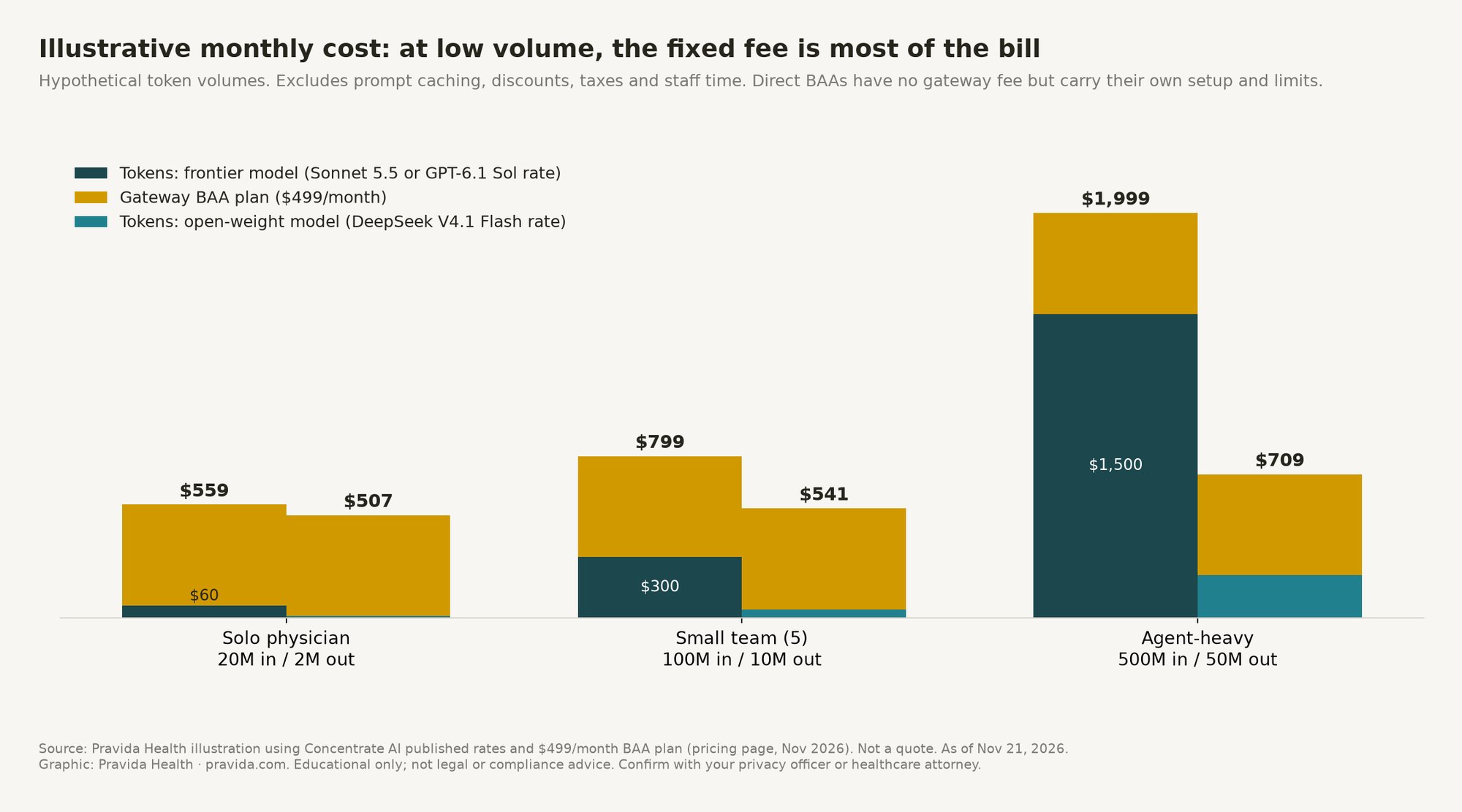
- For a small practice, convenience is the main benefit, not cheaper tokens. At low volume the $499 monthly plan is most of the bill. At high volume, the model you choose matters far more than the fee.
Why this matters now
Most physicians I talk with have tried a large language model (LLM) for something clinical: a prior authorization letter, a summary of 80 pages of outside records, a patient-friendly explanation of an MRI. Many did it in a consumer chat app, and many pasted in names, dates or record numbers. That is where the risk is.
Under HIPAA, a company that creates, receives, maintains or transmits electronic protected health information (ePHI) on your behalf is a business associate, and you need a BAA with it. HHS applies this to cloud services directly: lacking an encryption key “does not exempt a CSP from business associate status” (HHS cloud computing guidance). An LLM provider that processes your prompts is in the same position.
The major AI companies do offer BAAs, but only for specific products and configurations. OpenAI lists its HIPAA-eligible products, including ChatGPT for Healthcare and the API with modified retention (OpenAI). Anthropic says its BAA covers eligible products such as Claude Enterprise chat and its own API, and does not cover Free, Pro, Max or Team plans (Anthropic Trust Center). If you want several models, you end up negotiating several agreements.
Figures are Concentrate AI’s published numbers as of November 2026: one BAA, 69 to 71 models depending on the page and date, seven BAA-eligible serving providers and a $499 monthly plan, with inference billed separately (Concentrate; Concentrate pricing).
What a BAA-covered AI gateway is
An AI gateway sits between your software and the model companies. Your app or desktop tool calls one address with one key, and the gateway forwards each request to the model you choose. Concentrate AI, a New York company, describes itself as a managed AI gateway and model router that sells the inference itself, so you don’t open an account with each AI lab (Concentrate).
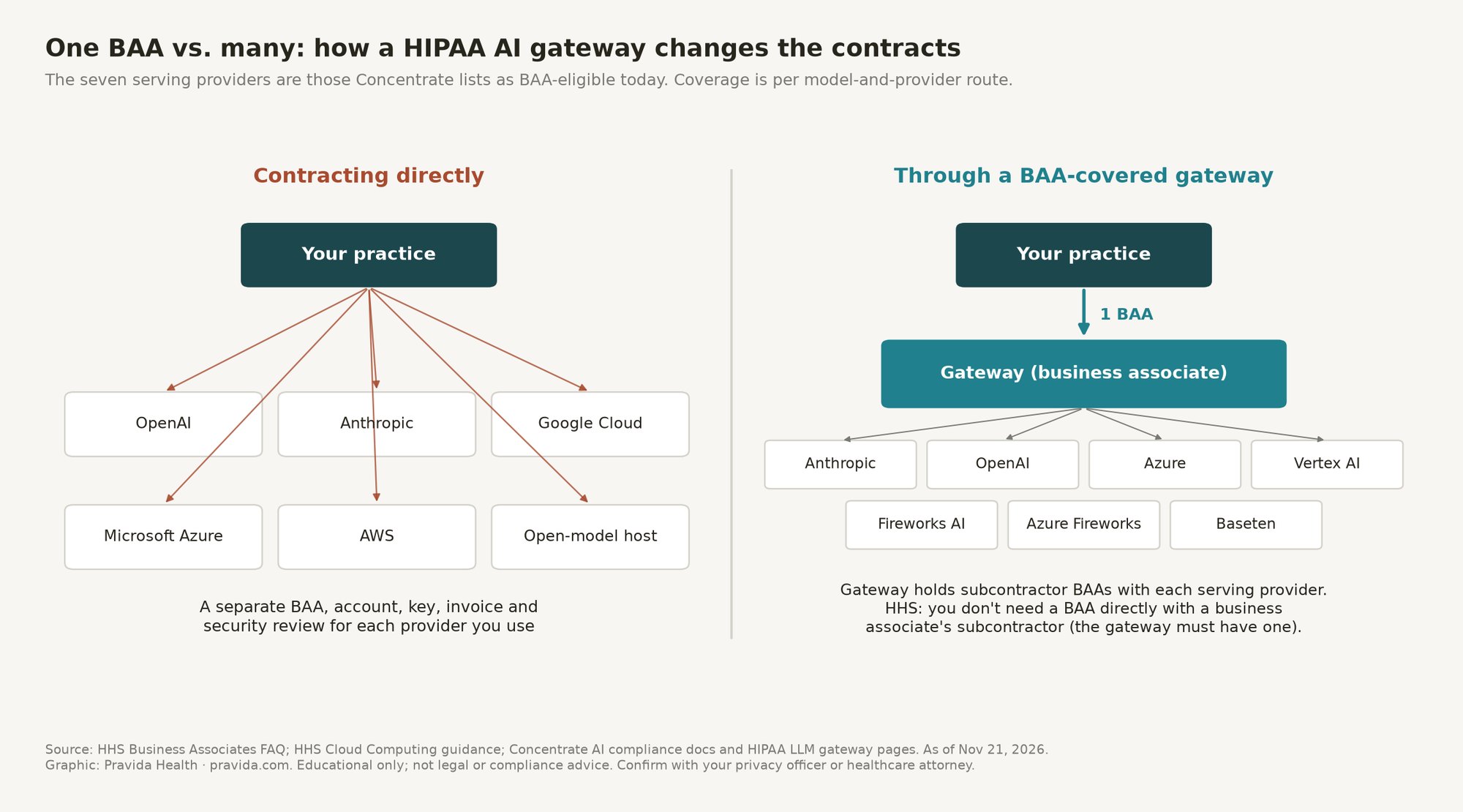
For healthcare, Concentrate launched what it calls a HIPAA AI gateway on November 12, 2026, announced in a press release distributed through Reuters (Reuters press release). The model is simple: you sign one BAA with Concentrate, and Concentrate holds the BAAs with the providers that serve covered routes (Concentrate compliance docs). Its listed BAA-eligible serving providers are Anthropic, OpenAI, Microsoft Azure, Google Vertex AI, Fireworks AI, Azure Fireworks and Baseten, covering models from OpenAI, Anthropic, Google, xAI, DeepSeek, Zhipu (GLM), Moonshot (Kimi), Qwen, MiniMax and NVIDIA (Concentrate).
A note on counting: I had the number as eight or nine vendors after my first conversation with the company. The published count is seven serving providers, the companies that actually run the models, carrying about ten model families. Both numbers are useful, but the seven providers are the ones with BAAs in the chain.
Is “one BAA” legally sound?
The structure matches how HIPAA already handles subcontractors. HHS says a business associate “must establish a BAA with its subcontractor before disclosing PHI to the subcontractor,” and that “a covered entity is not required to establish a BAA directly with a subcontractor of its business associate” (HHS business associate FAQ). The same arrangement already covers your EHR vendor’s hosting company.
What that means in practice: your protection depends on the gateway’s BAA with you, and on the gateway’s BAAs with each provider actually being in place for the route your request uses. Concentrate says those provider BAAs are available to customers on its plan (Concentrate). Ask to see them, and have your attorney read the one you sign.
What “HIPAA mode” locks down
The part I found most useful for a practice is that the safety settings are enforced at the organization level, not left to each user. According to Concentrate’s documentation, once its staff turn on HIPAA mode:
| Setting | In a HIPAA-enabled organization (per Concentrate) |
|---|---|
| Zero data retention | Locked on. A route must support it to be used. |
| Prompt and response logging | Locked off. Prompt and response bodies are not stored; metadata such as model, token count and cost is still recorded. |
| Routing and fallbacks | Only BAA-covered routes. If none can serve the request, it fails with an error instead of falling back to an uncovered provider. |
| Bring your own key | Unavailable, because the BAAs don’t cover your own provider accounts. |
| Cost optimizer | Not available for HIPAA organizations. |
| Anthropic server tools | Files API, code execution, web fetch, computer use and external MCP servers are blocked as outside Anthropic’s BAA. |
| Web search | Depends on which engine runs it. Confirm your setup before sending PHI. |
Sources: Concentrate compliance docs; Concentrate HIPAA LLM API; Concentrate. HIPAA mode is not self-service: you sign the BAA, Concentrate turns the mode on and confirms before you send PHI, and it recommends testing with synthetic data first (Concentrate).
What a gateway does not cover
Concentrate says it directly: “HIPAA does not certify AI gateways” and “you remain responsible for your own HIPAA obligations” (Concentrate). OpenAI says the same about its own BAA (OpenAI). Here is what stays on your side:
- Your risk analysis. The Security Rule requires “an accurate and thorough assessment of the potential risks and vulnerabilities” to ePHI (HHS). Add the AI workflow to it.
- The software on your computer. The gateway covers the trip to the model. The desktop app you use, such as OpenWork, OpenCode or Claude Code, may keep conversation history on your laptop. That device needs disk encryption, a password and your normal endpoint controls. Concentrate’s own Claude Code guide notes that the coding app, local session storage and connected tools must fit your approved setup (Concentrate).
- Tools that reach outside. Plugins, connectors and web tools can send data to third parties that aren’t in the BAA chain. Anthropic, for instance, says data sent to third parties through external MCP servers isn’t covered by its BAA (Anthropic).
- Minimum necessary. The Privacy Rule asks you to limit PHI to what the task needs (HHS). For literature questions or drafting templates, strip identifiers. HHS describes the two de-identification methods, Safe Harbor and Expert Determination (HHS).
- Clinical accuracy. A BAA says nothing about whether the answer is right. Every output that touches care needs physician review.
- Model availability. Coverage is per model-and-provider route, not per model (Concentrate). Some newer models may not be available on covered routes. Anthropic, for example, says certain “Covered Models” require 30-day retention and can’t be used with zero data retention unless it authorizes it (Anthropic). Ask which models you can actually use.
What it costs, honestly
Concentrate’s plan is $499 a month for access to its BAAs, with inference billed separately at provider rates and, it says, no markup on tokens (Concentrate pricing). Its general site also says pooled usage across customers improves rates as spend grows (Concentrate). I have not seen published numbers for those volume rates, so I treat them as a possible bonus, not a reason to buy.
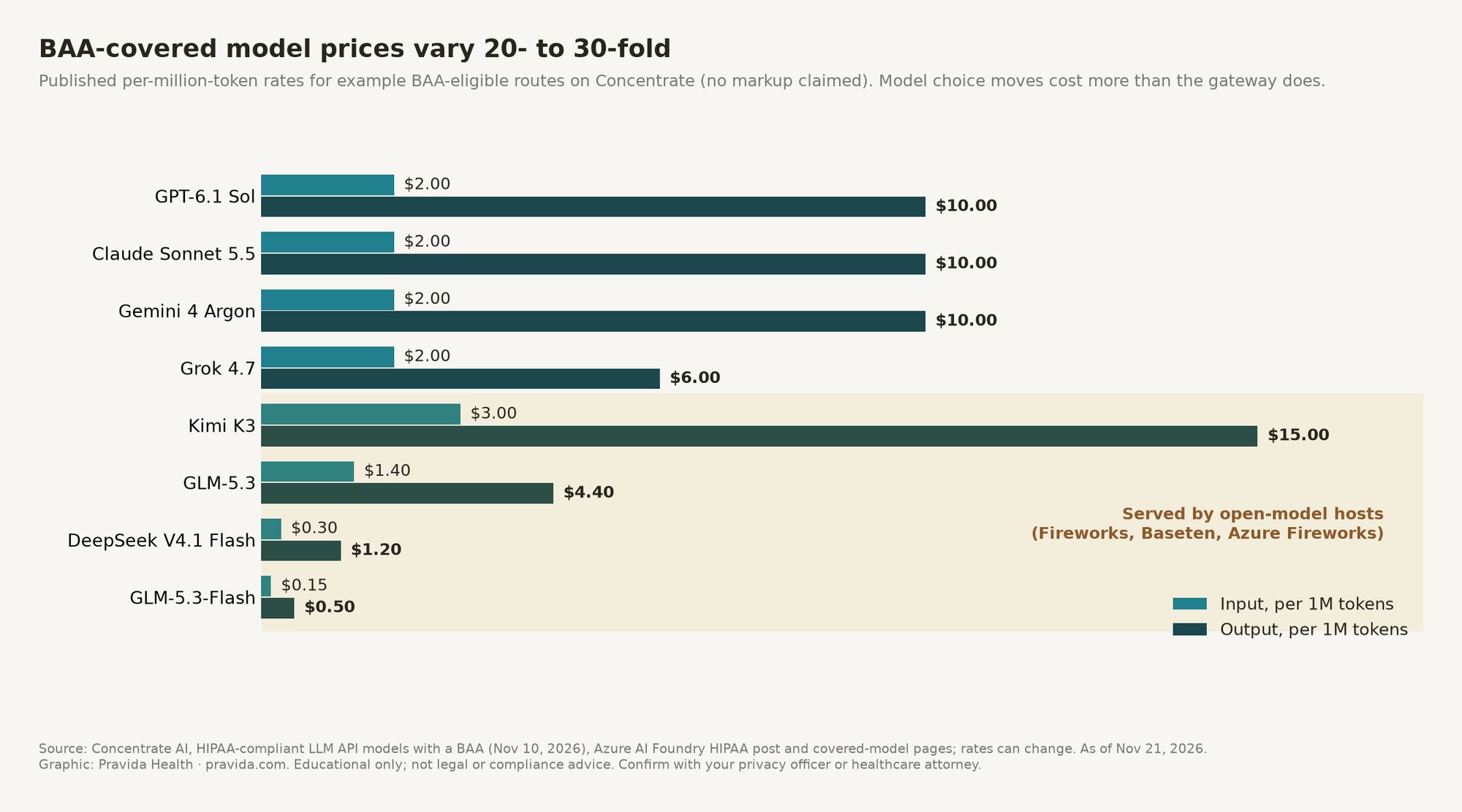
Two things drive what a practice actually pays. First, the model. Published prices on covered routes vary 20- to 30-fold. Input runs from $0.15 per million tokens for GLM-5.3-Flash to $3 for Kimi K3, and output from $0.50 to $15 (Concentrate).
Second, volume. For a solo physician using AI a few times a day, token costs are small and the fixed fee is most of the bill. The value then is consolidation: one contract, one invoice, several model families and covered failover. For agent-heavy work, model choice matters more than the gateway fee.
The alternative is to contract directly. OpenAI offers a self-serve API BAA, but self-serve enrollment requires an established history of API usage (OpenAI). Anthropic’s API BAA requires your organization to sign and then have its team turn HIPAA support on (Anthropic). AWS offers a self-service BAA covering HIPAA-eligible services, including Amazon Bedrock (AWS; AWS eligible services), and Google’s Cloud BAA covers listed products, including generative AI on Vertex AI (Google Cloud). Direct contracts have no gateway fee. They do mean one agreement, account and configuration per company, and each covers only its own models.
How I’m approaching it at Pravida
Pravida is completing onboarding with Concentrate as of this writing. The steps the company gave us match its documentation: subscribe, sign the BAA, receive a HIPAA organization login from its team, then connect a desktop client with the API key. The instruction I appreciated most was plain: don’t create your own organization or send any PHI until the HIPAA organization is active.
Our ground rules, which I’d suggest to any practice:
- No PHI until activation is confirmed in writing. Test every workflow with synthetic records first.
- Start with low-risk tasks. Drafting letters, summarizing outside records for physician review and organizing literature, not autonomous decisions.
- De-identify when the task allows it. Most literature and template work doesn’t need a name or date of birth.
- One approved tool list. Staff use the HIPAA organization and approved desktop clients only, with consumer chat apps off-limits for patient information.
- Encrypted devices only. Local conversation history is still PHI.
- Physician sign-off. Anything that reaches a chart, a patient or a payer gets reviewed and owned by a clinician.
Ten questions to ask any HIPAA AI vendor
- Who signs the BAA with us, and may we review your BAAs with each provider?
- Which exact model-and-provider routes are covered today, and how will we hear about changes?
- Is zero data retention enforced, and are prompts or responses logged anywhere?
- What happens when a covered route is down? Does the request fail or fall back?
- Which features are excluded: web search, file uploads, code execution, plugins?
- Does coverage extend to the desktop or coding client we plan to use?
- What metadata do you keep, and for how long?
- Can we get your SOC 2 Type II report and your provider list?
- What are the breach notification terms and timelines in your BAA?
- What is the total monthly cost at our expected volume, including fees and any minimums?
For physicians and practice leaders
I write about AI in clinical practice because physicians are adopting these tools faster than most practices are writing policies for them. If you’re working through the same questions, I’m glad to compare notes through the Pravida contact page. For the patient side of AI, see the Claude, ChatGPT Health and local AI guides in our AI health tools series, and our comparison of Gemini for healthcare vs. OpenAI, Anthropic, Amazon and Microsoft.
Patients who want a physician to review their own AI research can book Pravida’s AI-Informed Precision Medicine consultation: a free 15-minute discovery call, a 45-minute virtual visit ($295) or a 60-minute in-person visit in Midtown Atlanta ($495).
Pravida Health, 1801 Peachtree St NE, Suite 150, Atlanta, GA 30309. Call 404-900-7371 or email info@pravida.com.
Frequently asked questions
Can physicians use ChatGPT or Claude with patient information?
Only through products and configurations covered by a business associate agreement. Consumer and individual plans generally are not covered. OpenAI and Anthropic offer BAAs for specific enterprise and API products, and gateways such as Concentrate AI offer one BAA covering several providers’ models.
What is a HIPAA AI gateway?
It is a service between your software and the AI model companies. You sign one BAA with the gateway, which holds BAAs with the providers that run the models and restricts your requests to covered routes.
Do I need a separate BAA with OpenAI, Anthropic and Google if I use a gateway?
Not for requests that go through the gateway’s covered routes, according to Concentrate. HHS says a covered entity doesn’t need a BAA directly with its business associate’s subcontractor, but the business associate must have one with each subcontractor.
Does signing a BAA make my AI use HIPAA compliant?
No. A BAA is one requirement. You still need a Security Rule risk analysis, minimum-necessary use of PHI, secure devices, staff policies and physician review of outputs. Both OpenAI and Concentrate say a BAA alone doesn’t make you compliant.
How much does Concentrate AI cost for a practice?
Concentrate publishes a $499 monthly plan for access to its BAAs, with inference billed separately at provider rates and no stated markup. Total cost depends mostly on which models you use and how much.
References
- Business associates frequently asked questions. HHS.
- Guidance on HIPAA and cloud computing. HHS.
- Guidance on risk analysis. HHS.
- Minimum necessary requirement. HHS.
- Methods for de-identification of PHI. HHS.
- Managed AI gateway and model router. Concentrate AI.
- HIPAA LLM API with a BAA. Concentrate AI.
- HIPAA LLM gateway with enforced route restrictions. Concentrate AI.
- Compliance documentation. Last modified November 12, 2026. Concentrate AI.
- Pricing. Concentrate AI.
- HIPAA-compliant LLM API: models with a BAA. November 10, 2026. Concentrate AI.
- What AI is HIPAA compliant? Models and providers under a BAA. Concentrate AI.
- Concentrate AI launches HIPAA AI gateway with one BAA. Concentrate AI.
- HIPAA-compliant inference in Claude Code with Concentrate. Concentrate AI.
- Concentrate AI launches HIPAA-compliant AI gateway (press release via EZ Newswire). November 12, 2026. Reuters.
- Getting a business associate agreement for the OpenAI API. OpenAI Help Center.
- HIPAA eligible products and functionality. OpenAI Help Center.
- Business associate agreements (BAA) for commercial customers. Anthropic.
- Covered Models under a business associate agreement. Anthropic.
- Trust Center FAQ. Anthropic.
- HIPAA compliance. Amazon Web Services.
- HIPAA eligible services reference. Amazon Web Services.
- HIPAA compliance on Google Cloud. Google Cloud.