Key takeaways
- Health in ChatGPT launched to U.S. adults on July 23, 2026. It is on web and iOS for Free, Go, Plus and Pro users who are 18 or older, and lets you connect Apple Health, supported hospital records, One Medical and Function Health.
- It is built to help you prepare, not to diagnose. OpenAI says Health is designed to support, not replace, medical care and is not intended for diagnosis or treatment.
- The best patient uses are organizing and explaining. Comparing labs over time, summarizing changes since your last visit and drafting questions are where it helps most.
- You control the connections. Connected records and Apple Health data are not used to train OpenAI’s foundation models, and data from a disconnected source is deleted within 30 days, according to OpenAI.
- Bring a one-page summary, not the chat. A short summary that marks what is uncertain makes visit time go to decisions.
Why I’m glad my patients use it
More of my patients now arrive having already asked ChatGPT about their labs. That is usually a good sign. Patients who come in with organized questions tend to have better visits, and the ones who have read their own results are quicker to spot what changed. What they need from me is the part an AI cannot do: decide which of those possibilities actually applies to them, examine them, and take responsibility for the plan.
This post covers what Health in ChatGPT does as of November 15, 2026, what it is good at, and the routine I recommend for turning it into a better visit with your own physician. It is the first in a five-part series on consumer AI health tools.
What Health in ChatGPT is
OpenAI first introduced ChatGPT Health in January 2026 as a separate space inside ChatGPT for a small group of early users (OpenAI). On July 23, 2026, it launched to logged-in U.S. users 18 and older on web and iOS across the Free, Go, Plus and Pro plans (OpenAI). OpenAI says that in early testing more than 70% of health-related conversations happened outside the separate Health space, so ChatGPT can now draw on your connected health information in any conversation, with your permission (OpenAI).
Health still has its own place in the sidebar, where you connect and manage accounts, see recent data and trends, browse synced records and return to past health conversations (OpenAI Help Center). You can type @Health in a message to tell ChatGPT to use your health data.
What you can connect
| Source | What it adds | Notes |
|---|---|---|
| Medical records | Lab results, visit summaries, medications, clinical history | Supported U.S. hospital systems and provider portals; OpenAI partners with b.well; availability varies by provider |
| Apple Health | Sleep, activity, movement and other synced metrics | Requires an iPhone; apps like Oura, WHOOP and Garmin can flow in through Apple Health if they share data with it |
| One Medical | Records from One Medical care | Listed as a supported source |
| Function Health | Lab test results and insights | Listed as a supported source |
| Your own files | Photos and documents you upload | Useful for outside reports that are not in a connected portal |
These details come from OpenAI’s announcement and help center (OpenAI; OpenAI Help Center). OpenAI notes that some proprietary wearable scores may not transfer through Apple Health, and that connected information can be incomplete or out of date (OpenAI).
Six things patients can do with it before a visit
- See what changed since your last visit. Ask: “Summarize what changed in my records and labs since my visit on [date].” OpenAI lists summarizing changes since an appointment as a core use (OpenAI Help Center).
- Trend a lab over time. “How has my LDL cholesterol trended over the last three years, with dates and units?” Trends are often more useful to me than a single value.
- Translate the jargon. Ask what a term in your imaging report or visit note means. Then ask what it does not tell you.
- Connect sleep and activity to symptoms. If you track sleep with a wearable, ask whether your fatigue lines up with shorter sleep or lower activity. Treat what it finds as a pattern to discuss, not a diagnosis.
- Clean up your medication list. OpenAI lets you review conditions and medications, remove what is out of date and add family history (OpenAI). An accurate list is one of the most valuable things you can bring.
- Draft your top questions. Ask it to rank your questions by importance so the most important one comes first in the visit.
Privacy and control: what OpenAI says
- Training: connected medical records and Apple Health information, and conversations that use them, are not used to train OpenAI’s foundation models or to target ads, regardless of your model-training setting (OpenAI).
- Permission prompts: by default ChatGPT asks before using connected records or Apple Health data in a response. You can switch to always allow in Settings (OpenAI).
- Disconnecting: you can disconnect accounts at any time, and data synced from a disconnected source is deleted from OpenAI’s systems within 30 days. Information already in your chat history stays there unless you delete it (OpenAI).
- Other people’s records: the connected experience is meant for your own records. For a parent or child, OpenAI suggests a separate account or project (OpenAI Help Center).
One point patients often miss: a consumer AI app is generally not your healthcare provider, so HIPAA usually does not apply to it the way it applies to a medical practice. That doesn’t make the app unsafe, but it does mean the company’s own privacy terms are what protect you. Read them before connecting.
Where it falls short
OpenAI says it worked with more than 260 physicians in 60 countries over two years and evaluates the model with physician-written rubrics (OpenAI). That is meaningful work, but it is not the same as evidence that patients who use it have better health outcomes. No such data have been published.
In practice, the limits I see are predictable. It can’t examine you. It only knows what is in the connected records and what you type, and portals often leave out outside imaging, older records and supplements. It can sound confident when it shouldn’t. A PCWorld reviewer who connected their own records found it useful for understanding medical terms and adding context, but described it as mirroring, not replacing, a doctor’s advice (PCWorld). That matches what I see.
For any new chest pain, trouble breathing, stroke symptoms or other emergency, skip the chatbot and call 911.
How to bring ChatGPT Health work to your physician
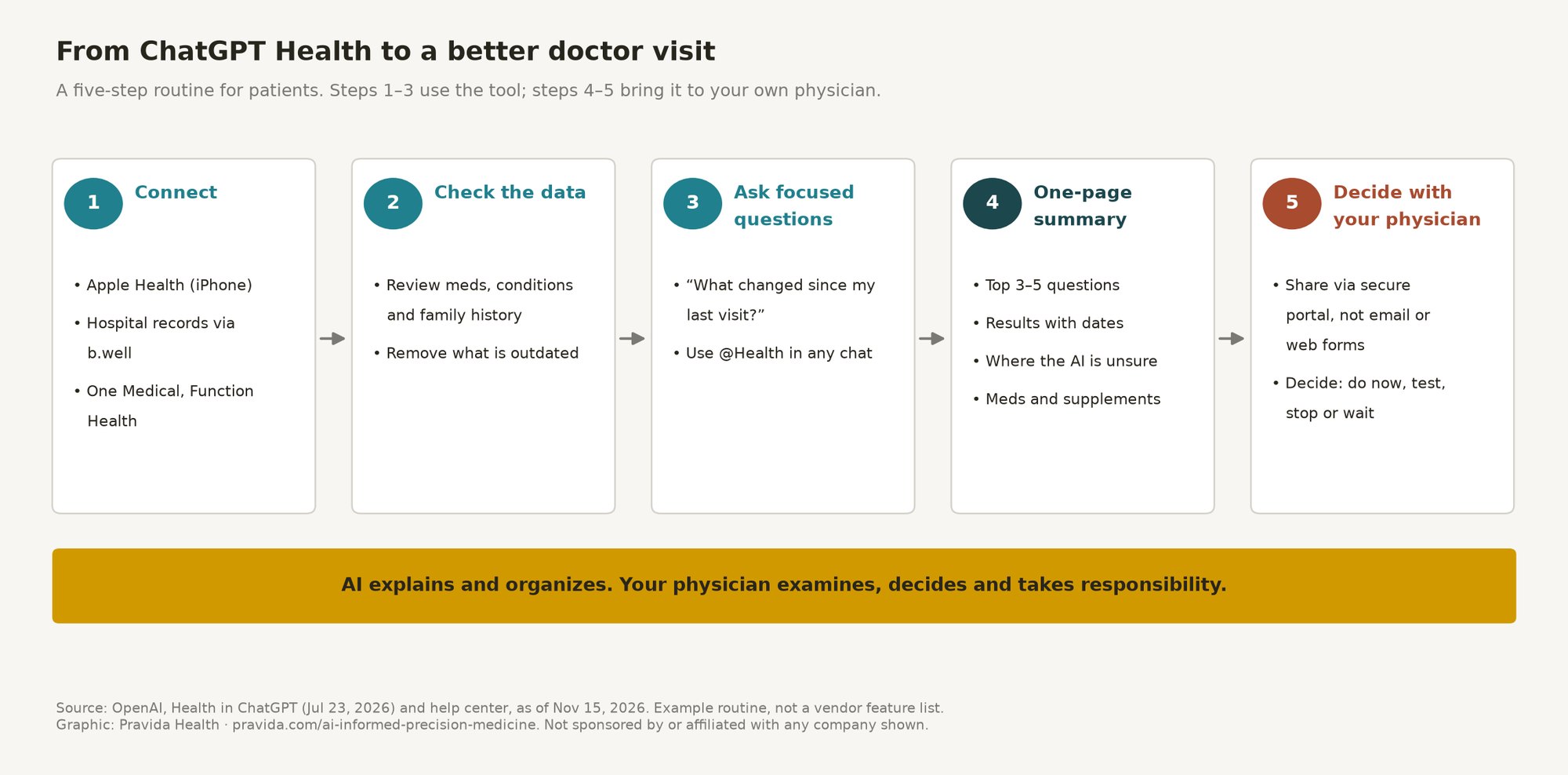
The most useful thing you can bring to a visit is not a long chat transcript. It is a short, honest summary that separates what your records show from what the AI suggested. Here is the routine I recommend to my own patients:
- Check the data first. Before you ask anything, look at what the tool pulled in. Records can be incomplete or out of date, and a medication you stopped last year may still be listed.
- Ask your questions, then ask for the summary. Use the prompt below at the end of your conversation so the AI lists its own uncertainty.
- Add what the AI does not know. Symptoms you haven’t typed in, family history, supplements and anything that happened outside the records.
- Share it securely. Bring it to the visit or upload it through your physician’s patient portal. Don’t send health details by regular email or a website form.
- Let the visit decide. Your physician’s job is to decide which of the AI’s ideas apply to you, what to test, what to stop and what can wait.
One-page physician summary prompt (from our visit preparation guide; works in any of these tools)
“I’m preparing for a visit with my physician. Using only what we’ve discussed and the health information I’ve shared with you, write a one-page summary for my doctor with these sections: 1. My top 3–5 questions, in priority order. 2. Relevant results or data (with dates and units), and what changed over time. 3. What you suggested I consider, and how confident you are in each suggestion. 4. What you could not determine without an exam, testing, or my full history. 5. My current medications and supplements, as I’ve told you. Keep it under one page. Do not add diagnoses. Mark anything uncertain as uncertain.”
The AI health tools series
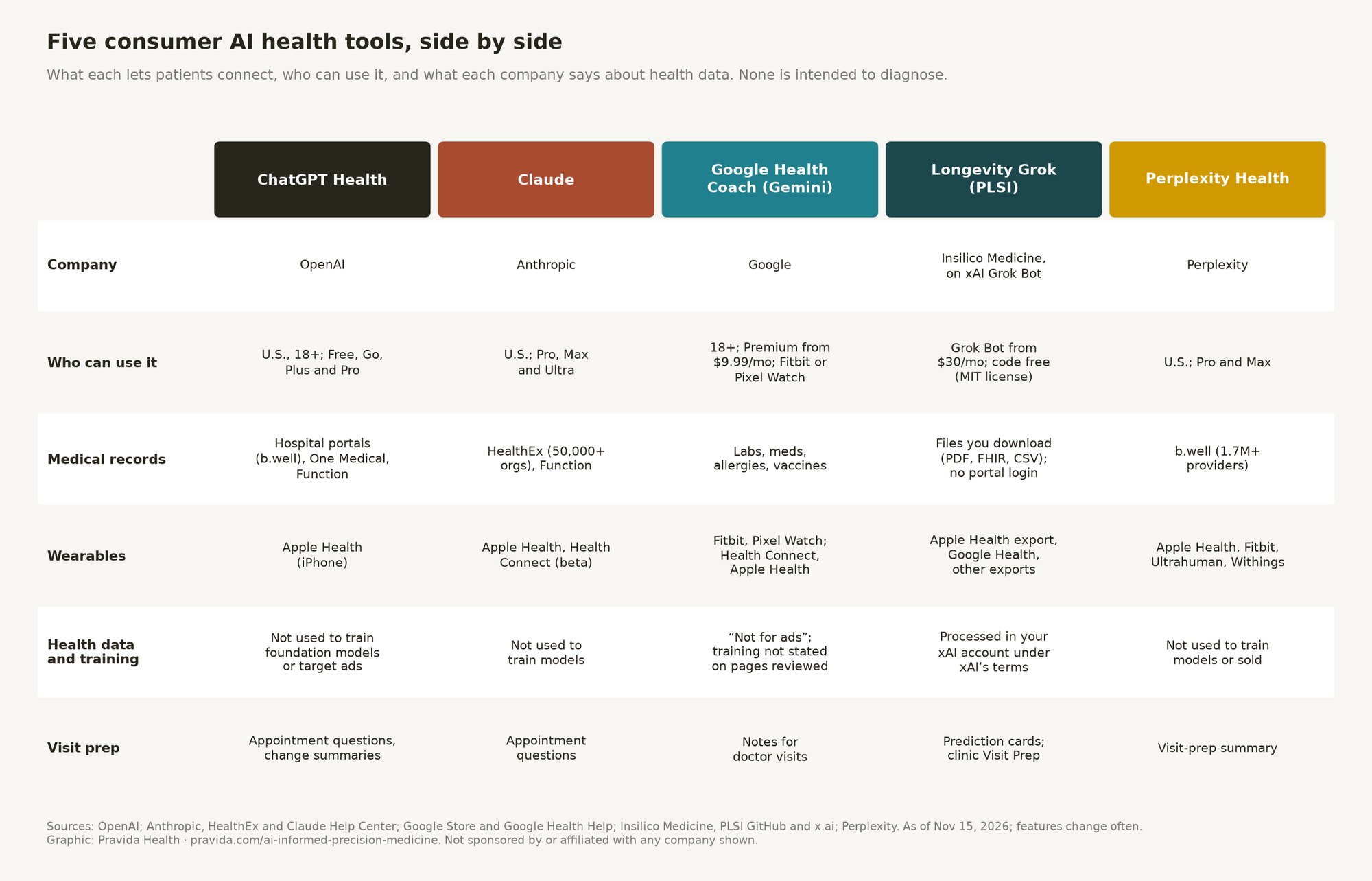
This post is part of a five-part series on what patients can do with consumer AI health tools to work better with their own physicians. The others:
- Claude and your health records
- Gemini and the Google Health Coach
- Longevity Grok (PLSI)
- Perplexity Health
For the health-system side, see Gemini for healthcare vs. OpenAI, Anthropic, Amazon and Microsoft. For how I work with patients who bring AI research to a visit, see AI-Informed Precision Medicine at Pravida.
Bring your AI research to a physician who uses these tools
Pravida’s AI-Informed Precision Medicine consultation is built for patients who have already done the research. You upload your one-page AI summary, recent labs and wearable exports through our secure patient portal. Dr. Turner reviews them before the visit, then works through them with you.
- Free 15-minute discovery call with our care coordinator
- Virtual consultation: 45 minutes, $295 (adults located in Georgia or Florida during the visit)
- In-person consultation in Midtown Atlanta: 60 minutes, $495
- You leave with prioritized recommendations: what to do now, what to test, what to stop and what can wait
Please don’t send health details through our website form or email; you’ll get a secure portal link after booking. Details and credit terms are on the consultation page.
Pravida Health, 1801 Peachtree St NE, Suite 150, Atlanta, GA 30309. Call 404-900-7371, email info@pravida.com or request an appointment.
Frequently asked questions
What is ChatGPT Health?
Health in ChatGPT is OpenAI’s health experience inside ChatGPT. Since July 23, 2026, U.S. users 18 and older on web and iOS can connect Apple Health, supported medical records, One Medical and Function Health so ChatGPT can explain results in context, track changes and help prepare for appointments.
Is ChatGPT Health free?
OpenAI says Health is rolling out across the Free, Go, Plus and Pro plans in the U.S. Connecting Apple Health requires an iPhone, and medical-record availability varies by provider.
Does OpenAI train on my medical records?
OpenAI says connected medical records and Apple Health information, and conversations that use them, are not used to train its foundation models or to target ads. Data from a disconnected source is deleted within 30 days.
Can ChatGPT Health diagnose me?
No. OpenAI says Health is designed to support, not replace, medical care and is not intended for diagnosis or treatment. Use it to prepare questions and understand your records, then make decisions with a physician.
What should I bring to my doctor from ChatGPT Health?
A one-page summary with your top three to five questions, relevant results with dates, what the AI suggested and how confident it was, what it could not determine, and your current medications and supplements. Share it securely, not by regular email.
References
- Launching Health in ChatGPT. July 23, 2026. OpenAI.
- Introducing ChatGPT Health. January 2026, updated July 23, 2026. OpenAI.
- Health in ChatGPT (help article). OpenAI Help Center.
- I gave ChatGPT my medical records. It was less scary, and more useful, than expected. November 2026. PCWorld.