
Shoulder pain is one of the most common musculoskeletal complaints seen in primary care, sports medicine, and physical medicine and rehabilitation. Rotator cuff pathology — the continuum from tendinopathy through partial- and full-thickness tears — accounts for the majority of that burden, affecting an estimated 20–30% of adults and rising steeply with age. For decades, the clinical decision tree was relatively simple: conservative care, then subacromial injection, then surgery. Two biological interventions — platelet-rich plasma (PRP) and bone marrow aspirate concentrate (BMAC) — have entered the conversation in a meaningful way, and the evidence base for them has matured enough that a physician can have a defensible, evidence-graded discussion with patients.
This article is that discussion. It covers what PRP and BMAC do, where the evidence is strongest, where it is still incomplete, and how we think about patient selection at Pravida Health. Two papers in particular — Hernigou et al. 2014 and Centeno et al. 2024 — anchor the evidence review, because they represent the best available data on BMAC at the shoulder and deserve a careful read rather than a dismissive or uncritical summary.
The Shoulder Problem Most Adults Eventually Face
Rotator cuff pathology exists on a spectrum, and that spectrum matters enormously when evaluating biologic interventions. At one end is tendinopathy: intrinsic degeneration of the supraspinatus, infraspinatus, subscapularis, or teres minor tendons without a discrete tear on imaging. It presents as activity-related shoulder pain, impingement signs, and often responds to structured physical therapy, load management, and postural correction. At the next stage are partial-thickness rotator cuff tears (PTRCTs), which involve disruption of some but not all layers of the tendon and are further classified by location (bursal-side, articular-side, intratendinous) and depth. Most PTRCTs — particularly those less than 50% of tendon thickness — can be managed conservatively with reasonable success rates.
The picture changes with full-thickness tears. A small full-thickness tear in a younger, active patient without fatty infiltration of the rotator cuff musculature is a fundamentally different problem than a massive, retracted full-thickness tear with fatty infiltration in a 70-year-old. The former may respond to biologics or structured PT with meaningful functional recovery; the latter almost certainly requires surgical reconstruction if functional goals are to be met. Massive, retracted tears with significant fatty infiltration or pseudoparalysis represent the far end of the spectrum where biologics alone are unlikely to restore meaningful anatomy and function, and frank discussion about surgery is the appropriate starting point.
The reason this spectrum matters for regenerative medicine is simple: not all of these conditions respond the same way to PRP or BMAC. The evidence that exists — and it is better than many physicians assume — is primarily in tendinopathy, partial-thickness tears, and BMAC augmentation of surgical repair. Applying findings from those populations to massive retracted tears would be a clinical error.
What “Regenerative Orthopedics” Actually Means for the Shoulder
The phrase “regenerative orthopedics” covers a range of interventions with different mechanisms, preparation methods, and evidence profiles. For shoulder pathology, the two most relevant and most studied are PRP and BMAC.
PRP (Platelet-Rich Plasma)
PRP is produced by centrifuging a small volume of the patient’s blood to concentrate platelets above baseline levels. The concentrate is then delivered under ultrasound guidance into the subacromial space, directly into the intra-tendinous lesion, or into the acromioclavicular joint depending on the clinical target. The mechanism is growth-factor mediated: platelets release PDGF (platelet-derived growth factor), TGF-β (transforming growth factor beta), VEGF (vascular endothelial growth factor), and other cytokines that modulate the local inflammatory environment, recruit mesenchymal progenitor cells, and stimulate tissue remodeling. Preparation methods vary significantly across studies and providers — leukocyte-rich vs. leukocyte-poor formulations, platelet concentration multiples, and activation method all influence the biologic product delivered. This variability is a meaningful limitation when interpreting the literature.
BMAC (Bone Marrow Aspirate Concentrate)
BMAC is produced by aspirating bone marrow from the iliac crest or, in some protocols, the proximal humerus, and concentrating the mononuclear cell fraction. The resulting product contains mesenchymal stem/stromal cells (MSCs), hematopoietic progenitor cells, platelets, and a rich growth factor environment. BMAC is a more complex biologic than PRP — both in preparation and in what it delivers to the target tissue. For surgical augmentation, BMAC is typically injected into the tendon-bone footprint and the repair site during or immediately after arthroscopic rotator cuff repair. For percutaneous non-surgical use, it is delivered under ultrasound guidance to the tendon lesion. MSC concentration in the harvest correlates with healing outcomes in Hernigou’s work, which underscores that preparation method and harvest quality matter.
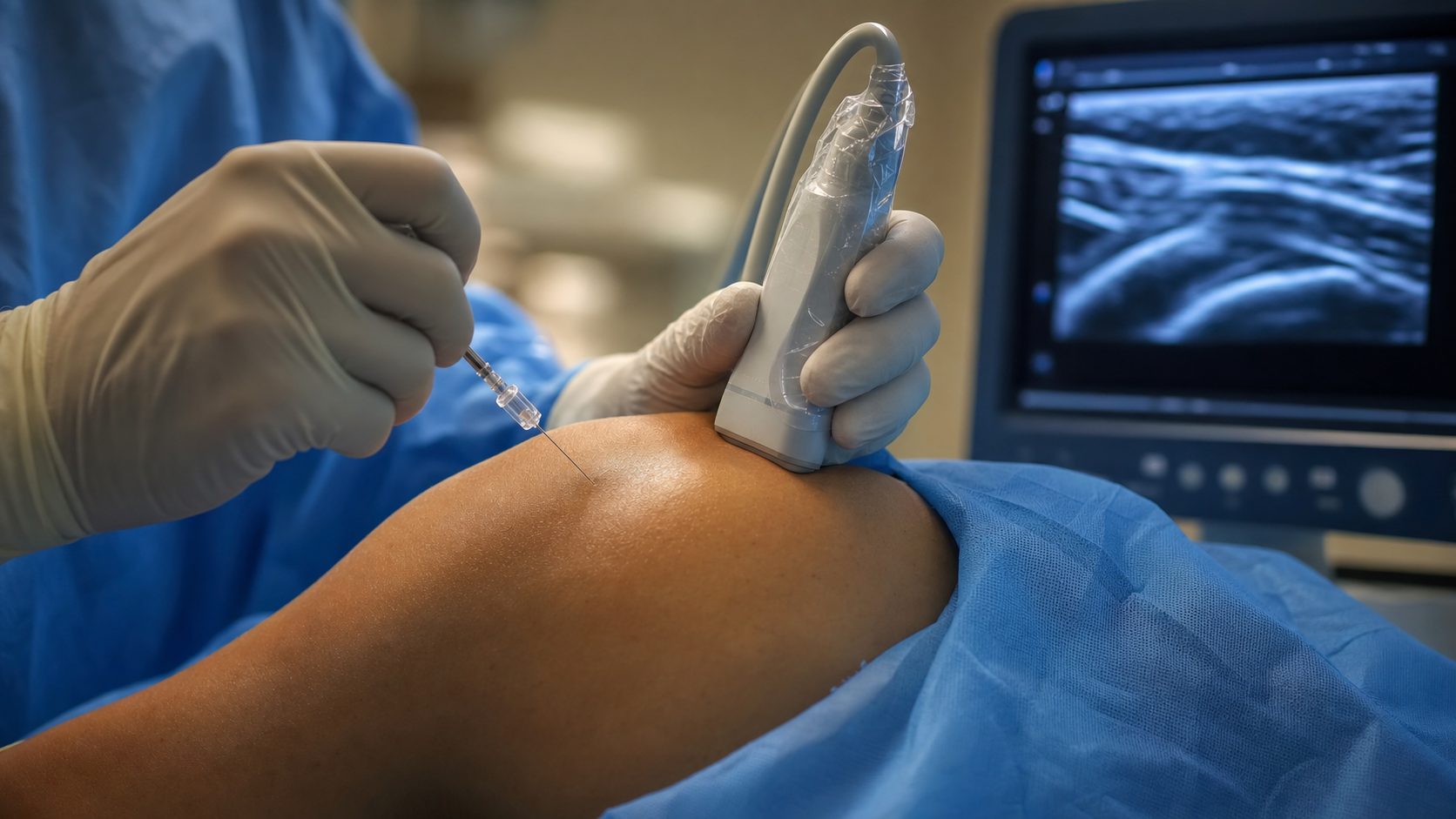
One technical point that applies to both PRP and BMAC: ultrasound guidance is non-negotiable for accurate shoulder delivery. Blind subacromial injections miss the intended target in a clinically meaningful percentage of cases. Image guidance improves accuracy of subacromial, intra-tendinous, and footprint targeting, and accuracy is a prerequisite for any meaningful biologic effect.
The Evidence That Matters Most: Two Papers Worth Reading Closely
A large and heterogeneous PRP and biologic literature exists for shoulder pathology. Two papers stand above the rest in the BMAC category because they offer the strongest clinical signal available — one for surgical augmentation with unusually long follow-up, one for percutaneous non-surgical treatment at the highest evidence level currently available for this indication.
Hernigou et al. 2014 — BMAC Augmentation of Arthroscopic Rotator Cuff Repair
Hernigou P, Flouzat Lachaniette CH, Delambre J, Zilber S, Duffiet P, Chevallier N, Rouard H. Biologic augmentation of rotator cuff repair with mesenchymal stem cells during arthroscopy improves healing and prevents further tears: a case-controlled study. Int Orthop. 2014;38(9):1811–1818. DOI: 10.1007/s00264-014-2391-1 | PubMed 24913770
Design: Case-controlled study (level III). Forty-five patients who received BMAC augmentation of single-row arthroscopic rotator cuff repair were compared with 45 matched controls who received repair without BMAC. BMAC was aspirated from the anterior iliac crest under local anesthesia and concentrated to 12 mL. Four mL were injected at the tendon-bone junction; 8 mL were injected at the footprint during surgery. MSC concentration in each graft was quantified. Both groups received the same rehabilitation protocol.
Key results: At 6-month MRI follow-up, 100% (45/45) of BMAC-augmented repairs had healed vs. 67% (30/45) of controls. At 10-year follow-up — the longest published follow-up for any biologic augmentation of rotator cuff repair — intact rotator cuffs on MRI were documented in 87% (39/45) of the BMAC group vs. 44% (20/45) of controls. Among patients with healed repairs at 6 months, retear rates at 10 years were substantially lower in the BMAC group. MSC concentration in the graft correlated positively with healing outcomes, suggesting a dose-response relationship.
Honest read: This is a striking durability signal. A 43-percentage-point difference in intact rotator cuffs at 10 years is not a marginal finding — it is the largest clinical benefit reported in the biologic augmentation literature for the shoulder. However, level III evidence has important limitations. This is case-controlled, not randomized. It is single-surgeon, conducted at a specialized center with proprietary MSC quantification methods not available at most hospitals or outpatient practices. The control group selection process could introduce selection bias. No sham-controlled blinding was possible. These limitations do not erase the signal, but they do mean the result requires replication in a multi-center randomized trial before it can be considered definitive evidence of efficacy.
Centeno et al. 2024 — Percutaneous BMC + Platelet Products vs. Exercise for Rotator Cuff Tears (RCT)
Centeno CJ, Fausel Z, Dodson E, et al. Percutaneous bone marrow concentrate and platelet products versus exercise therapy for the treatment of rotator cuff tears: a randomized controlled, crossover trial with 2-year follow-up. BMC Musculoskelet Disord. 2024;25:392. DOI: 10.1186/s12891-024-07519-6 | PMC11102209
Design: Randomized controlled crossover trial with 2-year follow-up. Participants with confirmed supraspinatus tears on MRI were randomized to either (a) percutaneous autologous BMC plus platelet products (PRP and platelet lysate delivered under image guidance to the tendon lesion) or (b) a structured home exercise therapy program. Patients in the exercise arm could cross over to BMC treatment after 3 months. Primary outcomes were validated patient-reported measures: DASH (Disabilities of the Arm, Shoulder and Hand), Numeric Pain Scale (NPS), and Single Assessment Numeric Evaluation (SANE).
Key results at 3 months: Significantly greater improvement in DASH (Δ −11.7 vs. −3.8, P = 0.01), Numeric Pain Scale (Δ −2.0 vs. +0.5, P = 0.004), and SANE (50.0 vs. 0.0, P < 0.001) in the BMC arm compared with the exercise arm. Patient-reported outcomes continued to improve through 24 months in the BMC group, with no serious adverse events reported. Among patients with both pre- and post-treatment MRIs, 73% showed imaging evidence of healing after BMC treatment.
Honest read: This is the strongest randomized, non-surgical evidence we currently have for biologic treatment of rotator cuff tears. The crossover design is a practical and ethical choice when the comparator arm (exercise) can be offered to everyone eventually, but it limits long-term between-group comparison after month 3 because exercise-arm patients could cross over and receive BMC. The robustness of the 3-month outcomes — significant improvements across three independent validated instruments — and the 2-year durability data for BMC patients are clinically meaningful. Single-center design, the combination product (BMC plus two platelet products) that differs from PRP-only protocols, and the absence of a sham injection control remain important limitations.
What these two papers don’t yet tell us: No multi-center, sham-controlled RCT of BMAC at the shoulder has been published. Durability of pain and function benefit beyond 2 years has not been established for percutaneous non-surgical BMAC outside of Hernigou’s surgical augmentation context. Biologic preparation methods vary substantially across studies — MSC quantification, platelet concentration, activation method, and delivery technique differ enough that cross-study comparison is limited. MRI-detected healing does not always equal patient-perceived symptom improvement, and the relationship between structural change and functional outcome is imperfect. These are not reasons to dismiss the evidence; they are reasons to communicate it with precision rather than overselling it.
“BMAC and PRP at the shoulder are no longer at the fringe. Two papers in particular — Hernigou 2014 and Centeno 2024 — give physicians defensible language to discuss these treatments with patients who are weighing options before, instead of, or alongside surgery.”
Where PRP Fits — and Where It Doesn’t (Beyond These Two Papers)
The broader PRP literature for shoulder pathology is large but heterogeneous. Preparation method, platelet concentration, leukocyte content, injection target, number of injections, and comparator arm differ dramatically across studies, which complicates any attempt at a clean summary. Several patterns have emerged from recent systematic reviews that are clinically useful even with that noise.
Partial-Thickness Rotator Cuff Tears (PTRCTs)
Recent systematic reviews of PRP for PTRCTs — including a 2024 systematic review (PubMed 38641254) and a Cureus 2024 review (PMC11499309) — generally find short-term pain benefit (3–6 months) over placebo or corticosteroid, with effect sizes that are clinically meaningful for pain reduction. Durable functional improvement at 12+ months is less consistently demonstrated, and head-to-head comparisons with structured physical therapy are limited. The honest summary: PRP is a reasonable option for partial-thickness tears that have not responded to a real PT trial, with short-term pain benefit supported by multiple studies and longer-term benefit that requires more data to confirm.
Subacromial Impingement and Tendinopathy
For subacromial impingement syndrome and rotator cuff tendinopathy, results are mixed but modestly encouraging. Some RCTs favor PRP over corticosteroid at 6–12 months — a 2024 RCT (PubMed 39098382) found greater improvement with subacromial PRP than corticosteroid at 12 months — while other RCTs find exercise therapy equally effective at 6 months. The lack of benefit difference at 6 months in some exercise-comparison trials does not necessarily mean PRP is ineffective; it may mean that exercise itself is an active intervention rather than a passive control. Corticosteroid injections, by contrast, carry known risks of tendon weakening with repeated use, which makes PRP an increasingly reasonable alternative for patients who would otherwise receive repeated steroid injections.
PRP Intraoperative Augmentation of Rotator Cuff Repair
Meta-analyses suggest that PRP augmentation of surgical rotator cuff repair may reduce retear rates in large and massive tears, where the biology of healing is most challenged and where growth-factor delivery to the repair site may make the largest incremental difference. Results in small and medium tears are inconsistent across studies (Wang 2015, Flury 2016, and subsequent meta-analyses). The advances in biologic augmentation review (PMC5221413) provides a useful synthesis of where the surgical PRP literature stands and where heterogeneity in preparation and application limits conclusions.
How We Approach This at Pravida Health
Pravida Health is located at 1801 Peachtree St NE, Ste 150, Atlanta, GA 30309. Our approach to shoulder biologics is structured around patient selection, diagnosis-first thinking, and honest outcomes communication.
Patient selection logic for shoulder regenerative procedures:
- Confirmed rotator cuff pathology on physical examination supported by ultrasound or MRI — not symptoms alone. Imaging defines tear morphology (partial vs. full vs. massive/retracted), which determines which intervention makes sense.
- Symptoms refractory to a real trial of conservative care: structured physical therapy (4–6 weeks minimum with documented protocol), postural retraining, and activity modification. Biologics are not a shortcut past conservative care — they are an option when conservative care has genuinely been tried and has not achieved acceptable outcomes.
- Tear morphology, patient age, and goals inform the PRP vs. BMAC vs. surgical referral decision. A partial-thickness bursal-side tear in a 45-year-old is a very different clinical situation than a full-thickness supraspinatus tear in a 60-year-old with occupational demands. We discuss both paths openly.
- All injections are performed under ultrasound guidance. Accuracy at the target tissue is not optional.
- Outcomes are tracked using validated instruments: DASH or QuickDASH, VAS for pain, range-of-motion metrics, return-to-activity benchmarks, and MRI when clinically indicated.
- Frank conversation when surgery is the better answer. Large retracted tears, fatty infiltration of the rotator cuff musculature, significant pseudoparalysis, and instability are findings that warrant surgical referral rather than a biologic injection as the primary intervention. We do not oversell biologics when surgery is the right answer.
- Surgical-augmentation conversation when patients are headed for rotator cuff repair: BMAC adjunct can be discussed as an evidence-supported option consistent with the surgeon’s protocol, particularly in larger tears where retear risk is elevated.
If you are considering a regenerative approach for shoulder pathology and would like an evaluation, contact us at Pravida Health to discuss your specific situation with a board-certified physician.
Risks, Limitations & What the Evidence Doesn’t Yet Show
Any discussion of shoulder biologics requires honest accounting of what the evidence cannot yet tell us and what the procedures themselves entail.
- Procedure risks: Ultrasound-guided shoulder injections — whether PRP or BMAC — carry risks of local bleeding, post-injection pain flare (common in the first 48–72 hours), infection, and rare nerve irritation or anesthetic reaction. BMAC involves a bone marrow aspiration from the iliac crest, which adds harvest-site soreness, bleeding risk, and the small risk of infection at the aspiration site. These risks are manageable in experienced hands but require informed discussion before the procedure.
- No multi-center sham-controlled RCT for BMAC at the shoulder. Hernigou 2014 is the cornerstone dataset, but it is level III. The multi-center, blinded trial that would fully establish BMAC as a standard-of-care surgical adjunct has not been done.
- Variability in PRP and BMAC preparation methods is a genuine problem for comparing study results. The product described in Centeno 2024 (BMC plus PRP plus platelet lysate) is not the same as a standard single-spin PRP injection; conclusions from one preparation should not be applied indiscriminately to another.
- MRI improvement does not always equal patient-reported symptom durability. Imaging-based healing metrics and patient-perceived function can diverge, and both should be measured in outcomes tracking.
- Not a substitute for surgery when surgery is the right answer. Full-thickness retracted tears in young active patients, instability, significant pseudoparalysis, and fatty infiltration of the rotator cuff musculature are situations where surgery is the appropriate primary intervention, not a biologic injection.
- Cost is typically not covered by insurance. PRP and BMAC injections for rotator cuff pathology are classified as investigational or experimental by most commercial payors and Medicare. Patients should receive transparent cost information — including any follow-up imaging or visits — before scheduling.
What You Can Do Today
- Confirm the diagnosis with a clinician who examines you — not from imaging alone. Physical examination, activity history, and imaging together define tear morphology and guide treatment selection. A report that says “partial thickness tear” without clinical context is not sufficient to plan a biologic injection.
- Optimize a real PT program first. Four to six weeks of structured physical therapy with documented exercises, progressions, and goals is the baseline before considering injection therapy. If PT has not been tried, it should be.
- If you’ve already had surgery and are facing a re-tear conversation, ask the surgeon specifically about evidence-based biologic adjuncts at the time of revision. Hernigou’s 10-year data is a reasonable basis for that conversation.
- When evaluating a regenerative provider, ask: Does this practice use ultrasound guidance for all injections? Can they describe the preparation method and what is actually in the product? Do they track outcomes with validated instruments? Can they cite the specific evidence for what they are recommending? Providers who cannot answer those questions clearly are worth scrutinizing.
- Bring questions about specific evidence. The two papers reviewed above — Hernigou 2014 and Centeno 2024 — are reasonable starting points. Ask your provider how their approach relates to those specific protocols. Contact Pravida Health if you would like an evidence-grounded consultation before making a treatment decision.
Frequently Asked Questions
Does PRP or BMAC actually heal a torn rotator cuff?
The evidence for partial-thickness tears and tendinopathy is more encouraging than for large full-thickness tears. Centeno et al. 2024 — a randomized controlled crossover trial — found that percutaneous BMC plus platelet products produced significantly greater short-term improvement in pain, function, and MRI-based healing signals compared with exercise alone, with 73% of patients showing imaging evidence of healing after BMC. For large, retracted full-thickness tears with fatty infiltration, biologics alone are unlikely to substitute for surgical repair. The answer depends on tear morphology, chronicity, and individual patient factors, which is why imaging and an experienced clinician’s assessment are essential before any treatment decision.
How is the Centeno 2024 trial different from earlier PRP studies?
Most prior PRP studies for rotator cuff pathology are observational or have small sample sizes, short follow-ups, and variable preparation methods. Centeno et al. 2024 (BMC Musculoskelet Disord) is a randomized controlled crossover design — level I/II evidence — with 2-year follow-up. It used a combination product (BMC plus platelet products, not PRP alone) and measured outcomes with validated instruments: DASH, Numeric Pain Scale, and SANE. The 2-year durability signal without serious adverse events is particularly noteworthy. It remains a single-center trial with crossover design limitations, but it is the strongest non-surgical biologic evidence currently available for rotator cuff tears.
Is BMAC augmentation a good idea before rotator cuff surgery?
The Hernigou 2014 case-controlled study — the largest long-term biologic augmentation dataset at the shoulder — found that BMAC augmentation of single-row arthroscopic rotator cuff repair was associated with 100% healing at 6 months vs. 67% in controls, and 87% vs. 44% intact rotator cuffs on MRI at 10-year follow-up. That is a striking durability signal. However, Hernigou 2014 is level III evidence (case-controlled, single surgeon), not a blinded RCT. A frank conversation with both the operating surgeon and a regenerative medicine physician about the available evidence is the right first step for patients planning rotator cuff repair.
Will insurance cover PRP or BMAC for my shoulder?
In nearly all cases, no. PRP and BMAC injections for rotator cuff pathology are considered experimental or investigational by most commercial insurers and Medicare, and they are not covered as standalone outpatient procedures. Costs should be discussed openly before scheduling, and patients should confirm the full fee structure — including any post-procedure imaging or follow-up visits — in advance. At Pravida Health, we provide transparent cost information upfront. Contact us to discuss current pricing for your situation.
Is this offered at Pravida Health?
Yes. Pravida Health offers ultrasound-guided PRP and BMAC injections for appropriately selected shoulder patients at our Atlanta clinic at 1801 Peachtree St NE, Ste 150, Atlanta, GA 30309. Patient selection follows a structured evaluation: confirmed diagnosis on physical exam and imaging, a documented trial of conservative care, and a frank discussion of tear morphology, patient goals, and the surgical alternative when indicated. We track outcomes with validated instruments and refer for surgical consultation when surgery is the right answer. To discuss your specific situation, contact us to schedule a consultation.
Ready to discuss your shoulder with an evidence-grounded physician?
At Pravida Health, we start with your diagnosis, your imaging, and your goals — not a preferred procedure. If PRP or BMAC makes sense for your shoulder, we will explain exactly why and what the evidence says. If surgery or PT is the better answer, we will tell you that too.
Book a Consultation