
Hip pain is one of the most common reasons adults over 50 limit activity — and one of the most consequential, because the natural history of hip osteoarthritis ends at a decision point that most patients want to defer as long as possible: total hip arthroplasty (THA). For the first time, a 15-year matched-cohort dataset now gives us meaningful evidence about whether a biologic intervention can move that decision point. The Hernigou, Centeno, Berger, Dodson & Murphy 2026 study — published in International Orthopaedics and indexed as PMID 42301272 — is the centerpiece of this article and the most important real-world joint-preservation evidence for the hip published to date.
This post covers four hip pathologies that behave very differently with regenerative therapies: hip osteoarthritis, greater trochanteric pain syndrome (GTPS) and gluteal tendinopathy, proximal hamstring tendinopathy, and femoroacetabular impingement (FAI) with labral pathology. The evidence quality differs sharply by condition — and the honest framing of that variation is the point of this article.
The Hip Problems Most Adults Eventually Face
The hip is a ball-and-socket joint designed for load transfer across a lifetime of walking, climbing, and sport. The four largest categories of adult hip pain follow distinct anatomic pathways, each with different implications for biologic therapy.
Hip osteoarthritis progresses along a one-way path. Kellgren-Lawrence grading on weight-bearing X-rays defines severity, but the clinical experience of a patient with KL 2–3 hip OA — loss of internal rotation, groin pain with prolonged walking, morning stiffness — tells a story that plain films can understate. THA is one of the most successful operations in modern surgery; the point is not to avoid it indefinitely, but to defer it by 5–15 years in an active 50- or 60-year-old. That is precisely where the new 15-year intraosseous BMC data lands.
Greater trochanteric pain syndrome / gluteal tendinopathy is the most prevalent chronic hip tendinopathy in adults, particularly perimenopausal women. The pain over the lateral hip with side-lying, single-leg stance, and stair-climbing is caused by tendinosis and compressive load at the gluteus medius and minimus insertion on the greater trochanter — not trochanteric bursitis, as it was historically mislabeled. This distinction matters because treatment is tendon-directed, not bursa-directed.
Proximal hamstring tendinopathy presents as deep ischial pain that worsens with sitting, sprinting, and deep hip flexion. It is the tendinopathy that derails cyclists, rowers, and runners — and it is notoriously slow to respond to conservative management. The biologic evidence here is moderate but clinically meaningful for truly recalcitrant cases.
FAI and labral pathology represent a separate category where, at present, the biologic evidence does not support PRP as a useful adjunct — a point this article addresses directly and honestly.
What “Regenerative Orthopedics” Actually Means at the Hip
The language of regenerative medicine can obscure meaningful differences between interventions — and at the hip, the procedural details matter more than at almost any other joint.
PRP (Platelet-Rich Plasma)
PRP is produced by centrifuging a small volume of the patient’s autologous blood to concentrate platelets above baseline. At the hip, the delivery site and formulation vary significantly by indication: intra-articular under ultrasound or fluoroscopic guidance for OA (the deep hip joint capsule makes blind injection clinically unacceptable — published blind injection accuracy rates are 50–80%); peritendinous around the gluteus medius/minimus footprint at the greater trochanter for gluteal tendinopathy; and peritendinous at the ischial tuberosity for proximal hamstring origin pain. Leukocyte-poor PRP (LP-PRP) is favored for intra-articular OA applications based on the available data; leukocyte-rich PRP (LR-PRP) is used in most positive GTPS trials, including Fitzpatrick 2018.
BMAC (Bone Marrow Aspirate Concentrate)
BMAC is concentrated autologous bone marrow aspirated from the iliac crest. The intra-articular form delivers concentrated marrow elements into the hip joint space. The intraosseous (IO) form — the technique in the landmark Hernigou/Centeno 2026 study — injects BMC directly into the subchondral bone of the femoral head under fluoroscopy, targeting bone marrow lesions and the subchondral bone plate. This is meaningfully different from an intra-articular injection: the procedural complexity, delivery target, and biological rationale are distinct. Cell dose matters: the landmark study demonstrated a CFU-F (colony forming unit fibroblast) dose-response — patients with higher mesenchymal stem cell yield had better outcomes. Preparation quality is not a procedural detail; it is the variable that determines whether an intraosseous BMC procedure does anything.
Image Guidance Is Non-Negotiable at the Hip
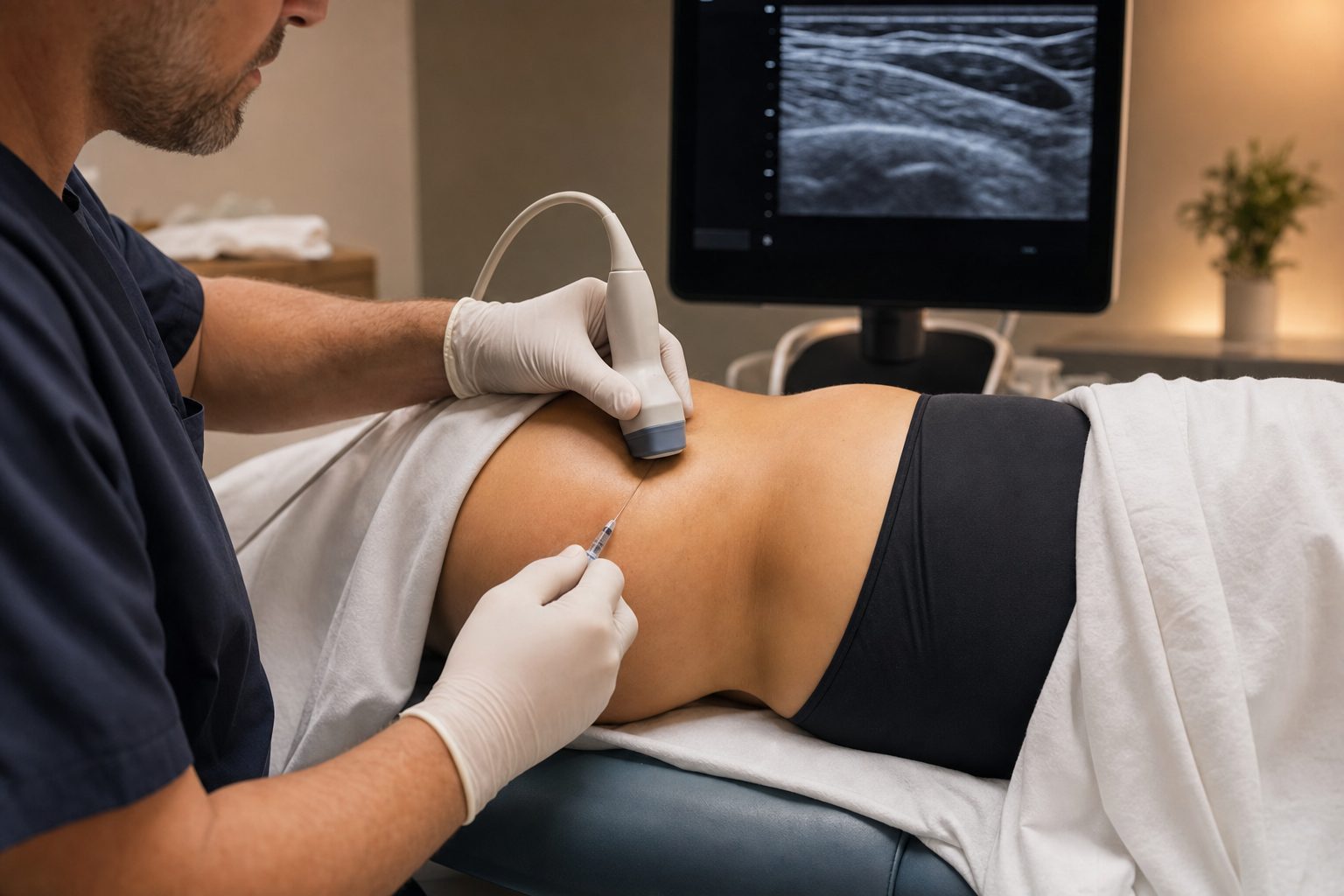
Every meaningful biologic procedure at the hip requires image guidance. Blind intra-articular hip injections have published accuracy rates as low as 50%. Ultrasound is standard for peritendinous injections at the trochanter and ischium; ultrasound or fluoroscopy for intra-articular injections; and fluoroscopy for intraosseous BMC delivery into the femoral head. Practices that perform hip biologics without image guidance are not delivering the procedure that produced positive outcomes in the published literature.
The Evidence That Matters Most: Hip OA, Gluteal Tendinopathy, and Hamstring Origin Pain
This is the section where the hip evidence varies most sharply by indication. Reading the literature as a single category — “PRP for the hip” — produces a blurred and misleading picture. The three conditions below each have their own evidence base, their own effect sizes, and their own honest caveats.
6a. Hip Osteoarthritis — and the Landmark 15-Year IO BMC Data
The most important new signal in hip joint-preservation medicine is the Hernigou/Centeno 2026 intraosseous BMC matched-cohort study. This is not incremental evidence — it is a 15-year dataset that changes how we should frame conversations about biologic options in mild-to-moderate hip OA.
Hernigou P, Centeno CJ, Berger DR, Dodson E, Murphy MB. Intraosseous bone marrow concentrate for hip osteoarthritis: a 15-year matched-cohort study of 217 treated versus 217 conservative-care hips. Int Orthop. 2026 Jun 16. PubMed 42301272 | DOI 10.1007/s00264-026-06908-x
Hernigou, Centeno, Berger, Dodson & Murphy 2026 is a monocentric matched-cohort study of 434 hips: 217 hips treated with intraosseous BMC injected into the femoral head subchondral bone under fluoroscopy, matched 1:1 to 217 hips managed with conservative care. Follow-up extended to 15 years with Kaplan-Meier THA-free survival analysis. The headline result: progression to total hip arthroplasty at 15 years was 16.1% (35/217) in the IO BMC arm versus 40.1% (87/217) in matched conservative controls — more than a halving of progression risk. The dose-response with CFU-F yield was significant: patients in the highest tertile of mesenchymal stem cell concentration had meaningfully better THA-free survival than those in the lowest tertile, strengthening the case for a biological mechanism rather than a procedural placebo effect.
The safety data from the Hernigou/Centeno 2026 study is equally striking. There were zero adverse events in the IO BMC arm across the entire 15-year observation period. Among the patients who eventually did progress to THA, zero of the 35 BMC patients required revision surgery compared with 7 of the 87 control patients who progressed to THA (8.0% revision rate). This secondary endpoint — 0 vs 7 revision surgeries — suggests that IO BMC may also improve the biomechanical or biological conditions that make subsequent THA more durable, though that mechanism requires further study. Cite: PMID 42301272, DOI 10.1007/s00264-026-06908-x.
Honest framing: this is a matched cohort, not a randomized controlled trial. It is monocentric — a single team with significant expertise in IO BMC delivery. Replication in multi-center settings with independent operators is needed. But a true double-blind RCT with 15-year follow-up of joint-preserving biologics in hip OA is not practically feasible to run — and the dose-response relationship, the consistent safety record, and the magnitude of the THA-free survival difference provide more causal inference support than most matched cohort studies. This is the strongest real-world joint-preservation evidence we have for the hip, and it belongs in every patient conversation about biologic options in mild-to-moderate OA.
Intra-articular (non-intraosseous) PRP for hip OA tells a more modest story. Lim et al. 2023 in AJSM — 8 studies, 331 patients — found PRP significantly reduced pain versus baseline with peak effect at 1–2 months, with leukocyte-poor and single-injection formulations outperforming leukocyte-rich and multi-injection protocols. Cite: PubMed 35971803. A 2024 systematic review of 5 RCTs of intra-articular PRP for hip OA found significant pain and function improvement in all 5 studies with a favorable safety profile and outcomes comparable to hyaluronic acid. Cite: PubMed 39569300.
A negative head-to-head finding worth knowing: A 2025 Frontiers in Bioengineering and Biotechnology SR/MA found that combining PRP with hyaluronic acid (PRP+HA) was actually worse for pain than PRP alone at both 3 and 12 months in hip OA — the opposite of what is observed in knee OA. Cite: Frontiers 2025 PRP+HA SR/MA. This is a practically important negative finding: if you are receiving intra-articular treatment for hip OA, combining PRP and HA does not appear to be additive and may be counterproductive.
The honest clinical synthesis for hip OA: intra-articular PRP is a reasonable bridge intervention with modest-to-moderate evidence, best at 1–3 months, using leukocyte-poor single-injection protocols. Do not combine with HA based on current data. Intraosseous BMC, in experienced hands with verified high CFU-F yield, now has the strongest long-term joint-preservation evidence of any non-surgical hip OA intervention — by a substantial margin.
6b. Greater Trochanteric Pain Syndrome / Gluteal Tendinopathy
This is the area where PRP at the hip has the strongest, most consistent positive signal in the published literature. Multiple RCTs and systematic reviews favor PRP over corticosteroid in the medium-to-long term, with a durable 2-year advantage documented in the only head-to-head RCT with that follow-up window.
Fitzpatrick J, Bulsara MK, O’Donnell J, McCrory PR, Zheng MH. Analysis of platelet-rich plasma extraction: variations in platelet and blood components between 4 common commercial kits. Am J Sports Med. 2018;46(1):166–174. PubMed 29293361
Fitzpatrick 2018 is the foundational RCT for PRP in gluteal tendinopathy — 80 patients (39 PRP, 37 corticosteroid), single ultrasound-guided injection, clinical and imaging diagnosis of chronic gluteal tendinopathy confirmed. At 12 weeks, modified Harris Hip Score (mHHS) was 74.1 in the PRP group versus 67.1 in the CS group (P=.048). MCID achievement (≥8 point mHHS improvement): 82% PRP versus 56.7% CS (P=.016). These are clinically meaningful differences in a well-designed comparative trial. The 2-year follow-up showed sustained PRP benefit while the CS effect had largely faded by 6 months; 27 of 40 cortisone patients crossed over to PRP at 3 months and also did well — providing rare durable RCT evidence at the hip. Cite: PubMed 29293361.
Atilano L, et al. Ultrasound-guided subfascial platelet-rich plasma versus dry needling for greater trochanteric pain syndrome. Orthop J Sports Med. 2024;12(4). Sage DOI 10.1177/23259671241249123
Atilano 2024 is a more recent RCT of 92 patients randomized to ultrasound-guided subfascial PRP versus enthesis needling for GTPS. At 3 months, 60% of the PRP group versus 33.3% of the needling group had a >20% VAS reduction (P=.040). The HOS-Sports Subscore difference also favored PRP at 3 months (P=.048). This study is important because it compares PRP against a procedure control — needling itself stimulates a healing response — and PRP still outperformed. Cite: Sage 2024.
The Cureus 2024 SR (Allameen et al.) synthesized 9 studies with 508 patients receiving PRP for lateral hip pain: improvement and sustained relief in 8 of 9 studies; PRP often more effective than CS. Cite: PMC11604237. The January 2026 Arthroscopy SR — 11 RCTs, 581 hips across hamstring, GTPS, and piriformis pathology — showed a statistically significant meta-analytic treatment effect for mHHS favoring PRP in GTPS (P=.005). All 11 RCTs found improvements versus control at at least one time point. Cite: PubMed 41838530.
Honest clinical read: for chronic gluteal tendinopathy that has failed conservative care (PT, activity modification, NSAIDs, side-sleeping modification), PRP is now arguably the injectable of choice. CS may still have a role for acute flares or as a diagnostic injection, but it lacks the durability that PRP has demonstrated out to 2 years in head-to-head trials. Hip abductor strengthening (clamshells, banded walks, side-lying leg raises), gait/cadence work to reduce hip adduction, and side-sleeping position modification remain foundational alongside any injection.
6c. Proximal Hamstring Tendinopathy
Proximal hamstring tendinopathy — pain at the ischial tuberosity with sitting, sprinting, and deep hip flexion loading — is among the most refractory hip tendinopathies. The biologic evidence here is moderate: positive case series and retrospective cohorts in chronic recalcitrant presentations, with a more equivocal picture for acute hamstring muscle injuries.
Davenport 2015 (Muscles, Ligaments and Tendons Journal) described a case series of ultrasound-guided PRP at the ischial tuberosity for chronic recalcitrant hamstring tendinopathy: effective and reliable when traditional conservative treatment failed. Cite: PMC4327356. The Wetzel 2013/2018 retrospective cohort showed ultrasound-guided PRP at the proximal hamstring origin produced significant improvement in pain and function in athletic populations who had failed PT. Cite: BJSM 2019 supplementary review.
The January 2026 Arthroscopy SR (PMID 41838530) included 5 hamstring studies (4 acute muscular injury, 1 chronic proximal tendinopathy): meta-analysis showed a significant 8-day shorter return to sport favoring PRP in acute hamstring injuries (P=.005) with low heterogeneity (I²=.65). Cite: PubMed 41838530. However, Reurink et al. (NEJM 2014) found that a single PRP injection did NOT outperform intensive rehabilitation alone in acute MRI-positive hamstring injuries — the most important negative trial in this area. The picture for acute hamstring muscle injury is therefore more mixed than for chronic proximal tendinopathy at the ischial tuberosity.
Honest clinical read: for chronic proximal hamstring tendinopathy that has failed 12+ weeks of structured eccentric and isometric loading, ultrasound-guided PRP at the ischial tuberosity is a reasonable next step. For acute hamstring muscle strains, PRP may modestly shorten return to sport but is not a substitute for structured rehabilitation. Modifying sitting position (donut cushion, sit-stand desk) and avoiding deep-flexion stretching that compresses the tendon at the ischium are practical adjuncts.
“At 15 years, intraosseous bone marrow concentrate cut the rate of total hip replacement by more than half. That’s not just a positive trial — that’s the most consequential joint-preservation signal we’ve seen for the hip.”
Where Biologics Probably Don’t Help Yet at the Hip
Honest evidence-graded medicine requires naming where the data says no — and the hip has one clear category where it does.
FAI / Labral Tears
The 2021 systematic review in the Journal of Hip Preservation Surgery (PMC8460156) reviewed the evidence for intraoperative PRP during hip arthroscopy for FAI and labral pathology. The conclusion was clear: PRP as an intraoperative adjunct during hip arthroscopy for FAI/labral repair does NOT provide clinical improvement. Outcomes in PRP-augmented arthroscopy were not meaningfully better than arthroscopy without PRP augmentation. PRP is not currently recommended as a biologic adjunct for arthroscopic labral repair outside of clinical trials. Conservative-management trials of PRP for symptomatic labral tears without surgery are very limited. If you have mechanical symptoms — locking, catching, significant activity limitation — a referral to a hip arthroscopist for diagnosis and surgical discussion is the appropriate next step.
Acute Hamstring Muscle Strains
As noted above, the evidence for acute hamstring muscle injury is mixed. The NEJM 2014 Reurink trial was negative; the 2026 meta-analysis favors PRP by approximately 8 days return to sport. Best framed as: may modestly shorten return to sport, not curative, and not a substitute for structured rehabilitation. Prescribing PRP instead of rehab for an acute hamstring tear is not supported by evidence.
Adductor and Iliopsoas Tendinopathy
Published evidence for biologic injection at the adductor origin and iliopsoas tendon is limited to small case series and case reports. These are not established indications for PRP based on current evidence. If you have groin or anterior hip pain attributed to adductor or iliopsoas tendinopathy, an evidence-based discussion should begin with structured rehabilitation, not injection.
How We Approach This at Pravida Health
Pravida Health is located at 1801 Peachtree St NE, Ste 150, Atlanta, GA 30309. Our approach to hip biologics is structured around a confirmed diagnosis, a genuine trial of conservative care, honest communication about what the evidence shows for the specific pathology, and image guidance on every procedure.
- Hip OA: diagnosis confirmed by physical exam (FABER, FADIR, loss of internal rotation) and weight-bearing radiographs (Kellgren-Lawrence grading). Best candidates for biologics are mild-to-moderate OA (KL grade 2–3) with intact joint preservation parameters, symptoms refractory to ≥3 months of structured PT, weight management, and oral therapy. Intra-articular LP-PRP for symptom management; intraosseous BMC — in carefully selected patients with verified high CFU-F yield and experienced fluoroscopic delivery — for joint preservation. Contact us to discuss whether you are a candidate.
- GTPS / gluteal tendinopathy: diagnosis confirmed by clinical exam (single-leg stance, FADER-resisted), ultrasound or MRI showing tendinosis or partial-thickness tear, refractory to PT, side-sleeping modification, and activity adjustment for ≥6 weeks. LR-PRP peritendinous under ultrasound guidance.
- Proximal hamstring tendinopathy: confirmed by ischial pain with sitting/sprint loading, palpation, and imaging, refractory to 12+ weeks of structured eccentric and isometric loading. Ultrasound-guided PRP at the ischial tuberosity.
- Outcomes tracked: VAS, mHHS, HOOS, return-to-activity metrics for athletes.
- Surgical referral when it is the better answer: advanced OA (KL 4, joint space obliteration, mechanical symptoms); full-thickness gluteal tendon tears with significant retraction; proximal hamstring tendon rupture with >2 cm retraction in active patients (early surgical repair); symptomatic labral tears with mechanical locking/catching (hip arthroscopist referral). Contact Pravida Health if you are unsure which category applies to your situation.
- Physical therapy is foundational before and after every hip biologic procedure. Hip biologics fail when conservative care is skipped or abbreviated.
If you are considering a regenerative approach for hip pain and want an evidence-grounded evaluation, contact us at Pravida Health to discuss your specific clinical picture with a board-certified physician.
Risks, Limitations & What the Evidence Doesn’t Yet Show
- Post-injection flare: common and expected after intra-articular hip injection (3–7 days); longer and more variable after intraosseous BMC procedures. Patients must be counseled to anticipate it and plan accordingly.
- Iliac crest soreness and bruising after BMC harvest — expected, usually resolves in 5–10 days. Rare hematoma or infection at harvest site.
- Infection, bleeding, transient nerve irritation — standard procedural risks of any percutaneous injection, minimized with sterile image-guided technique but not eliminated.
- Intraosseous BMC requires fluoroscopic guidance, specialized operator training, and patient counseling about a procedure substantially more involved than a standard intra-articular injection. Not all practices offering “BMC hip injection” are delivering the intraosseous technique studied by Hernigou and Centeno.
- PRP preparation variability: concentration, leukocyte content, volume, and single vs multiple injection protocols differ substantially across studies and providers. The formulation determines whether the biology works; asking about preparation methodology is appropriate.
- The landmark IO BMC data is matched cohort, not RCT, monocentric. Replication in multi-center settings is needed. Intra-articular PRP has not been shown to delay THA in the manner demonstrated by the IO BMC study.
- For GTPS: strong PRP signal over CS at 12 weeks to 2 years, but most trials are small (n=40–92). The signal is consistent; the effect sizes warrant larger replication studies.
- For FAI/labral tears: PRP does NOT currently improve outcomes compared with arthroscopy alone (PMC8460156).
- Cost: PRP and BMAC for hip conditions are not covered by most commercial insurers. Full cost information provided upfront before any procedure is scheduled.
- Not a substitute for surgery when surgery is the right answer: advanced OA, full-thickness tendon rupture with retraction, mechanical labral pathology with locking/catching.
What You Can Do Today
- For hip OA: commit to a structured hip-strengthening program (glutes, deep external rotators, core) and weight management — every 10 lb of weight loss meaningfully reduces hip joint load. Low-impact aerobic conditioning (cycling, pool, elliptical) maintains cartilage nutrition without impact loading. If symptoms persist after 8–12 weeks of consistent effort, ask about image-guided intra-articular LP-PRP for symptom control, and ask whether you might be a candidate for intraosseous BMC if you have mild-to-moderate disease and high CFU-F yield. Contact Pravida Health to discuss your KL grade, symptom trajectory, and candidacy.
- For GTPS / gluteal tendinopathy: start with side-sleeping modification (pillow between knees, avoid sleeping directly on the symptomatic side), hip abductor strengthening (clamshells, side-lying leg raises, banded walks), and gait adjustments to reduce hip adduction. If you have had a CS injection that helped briefly and then rebounded — which is exactly the pattern documented in head-to-head RCTs — PRP is the better-evidenced next step.
- For proximal hamstring tendinopathy: eccentric and isometric loading for at least 12 weeks before considering any injection. Modify sitting (donut cushion, sit-stand desk), avoid deep-flexion hamstring stretching that compresses the tendon at the ischium. Most cases improve with structured rehabilitation alone when given adequate time.
- When evaluating a regenerative provider for the hip: image guidance is non-negotiable for every injection at this joint; ask about preparation system and platelet concentration for PRP; confirm whether “BMC” means intra-articular or intraosseous delivery for OA; ask about outcome tracking instruments (VAS, mHHS, HOOS); and ask for the specific evidence the provider can cite for your pathology. Providers who can articulate both the positive and negative evidence — and who refer to surgery when surgery is the better answer — are the ones worth trusting.
Frequently Asked Questions
Can a biologic injection actually delay total hip replacement?
Yes — with an important caveat about what kind of biologic and how it is delivered. The landmark evidence comes from Hernigou, Centeno, Berger, Dodson & Murphy 2026 (PMID 42301272), a monocentric matched-cohort study of 434 hips with up to 15-year follow-up. Patients receiving intraosseous BMC had a 16.1% rate of THA progression at 15 years versus 40.1% in matched conservative controls. The dose-response with CFU-F yield strengthens causal inference. For intra-articular PRP in hip OA, the evidence supports symptom reduction but has not demonstrated THA delay at the same magnitude. The Hernigou/Centeno study is matched cohort and monocentric — replication is needed — but it represents the strongest real-world joint-preservation data available for the hip. Contact us to discuss whether you might be a candidate.
Should I get a cortisone shot or PRP for outer hip pain (greater trochanteric pain / gluteal tendinopathy)?
The evidence now favors PRP for medium-to-long-term outcomes. Fitzpatrick 2018 (PMID 29293361) found PRP significantly better than CS at 12 weeks (mHHS 74.1 vs 67.1, P=.048), and the 2-year follow-up showed the CS effect had largely worn off while PRP benefit was sustained. The 2026 Arthroscopy SR (PMID 41838530) confirmed the meta-analytic signal favoring PRP in GTPS (P=.005). CS still has a role for acute flares, but if you have had a cortisone injection that helped briefly and then rebounded, PRP is the better-evidenced next step.
What’s the difference between intra-articular and intraosseous bone marrow concentrate (BMC) for hip arthritis?
Intra-articular BMC is injected into the hip joint space. Intraosseous (IO) BMC — the technique in the Hernigou/Centeno 2026 study — delivers concentrated marrow directly into the subchondral bone of the femoral head under fluoroscopy, targeting bone marrow lesions and the subchondral bone plate. IO BMC is more procedurally involved and requires specialized operator expertise. The landmark study’s results (16.1% vs 40.1% THA progression at 15 years; 0 vs 7 revision surgeries; zero adverse events) were achieved with the intraosseous technique specifically. These findings cannot be assumed to extrapolate to intra-articular injection without separate evidence.
Will PRP help my labral tear or FAI?
Based on current evidence, PRP is not recommended as a biologic adjunct for arthroscopic labral repair or FAI outside of clinical trials. The 2021 systematic review in Journal of Hip Preservation Surgery (PMC8460156) found intraoperative PRP during hip arthroscopy for FAI/labral repair does NOT improve outcomes over arthroscopy alone. Conservative-management trials of PRP for symptomatic labral tears without surgery are very limited. If you have mechanical hip symptoms (locking, catching, significant activity limitation), a referral to a hip arthroscopist for diagnosis and surgical discussion is the appropriate next step.
Is this offered at Pravida Health?
Yes. Pravida Health offers image-guided PRP and BMC injections for appropriately selected hip patients at our Atlanta clinic at 1801 Peachtree St NE, Ste 150, Atlanta, GA 30309. Our approach begins with diagnosis confirmation on physical exam and imaging, a genuine trial of conservative care, and a frank discussion of what the evidence shows for your specific pathology. We track outcomes using validated instruments (VAS, mHHS, HOOS) and refer for surgical consultation when surgery is the better answer. To discuss your situation with a board-certified physician, contact us to schedule a consultation.
Ready to discuss your hip with an evidence-grounded physician?
At Pravida Health, we start with your diagnosis, your imaging, and your goals — not a preferred procedure. If intraosseous BMC or PRP makes sense for your hip OA, gluteal tendinopathy, or hamstring origin pain, we will explain exactly why and what the evidence says. If surgery or PT is the better answer, we will tell you that too.
Book a Consultation