
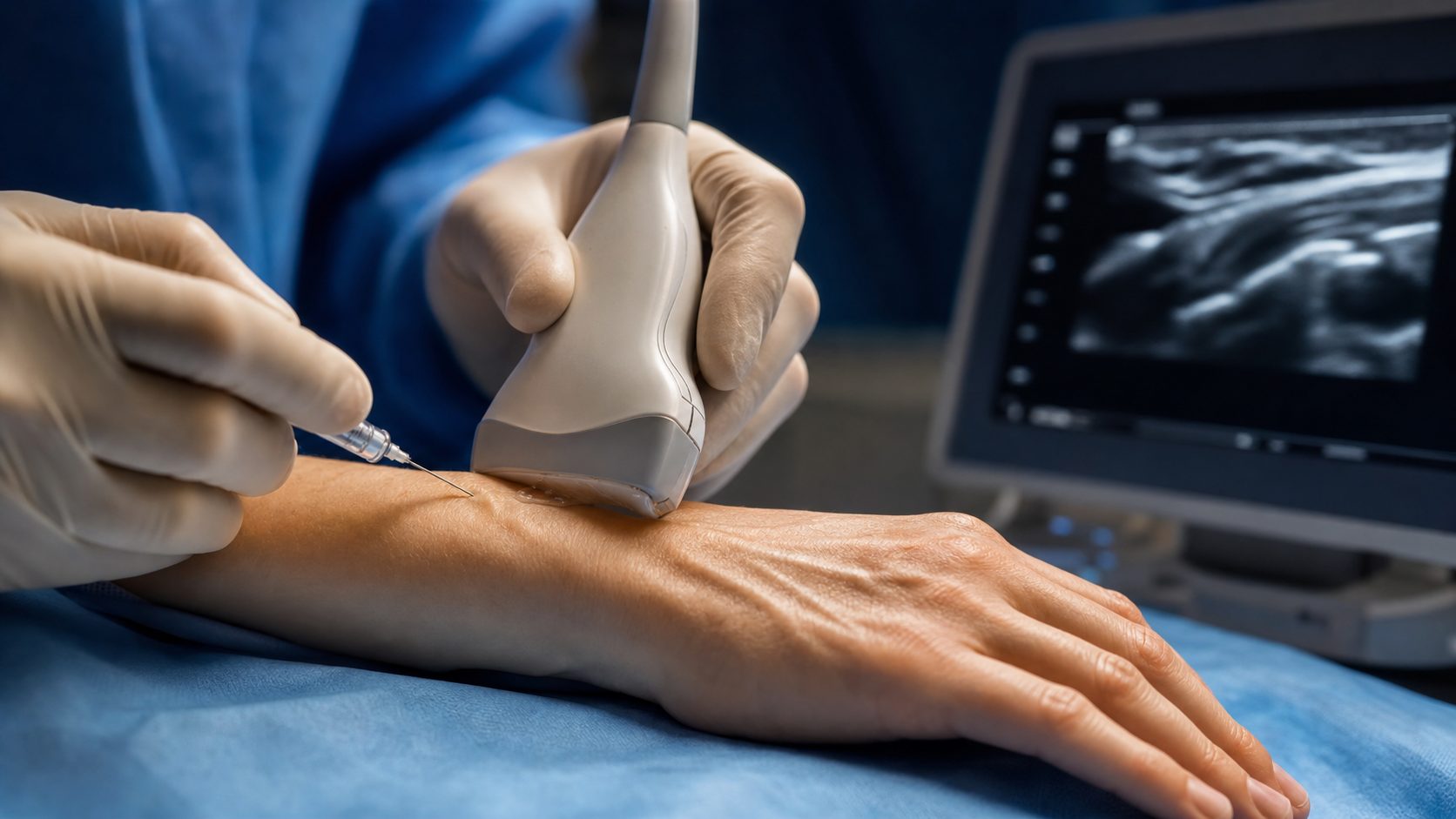
Hand and wrist pain is among the most functionally limiting musculoskeletal conditions — these structures mediate almost every act of daily life. Thumb carpometacarpal (CMC) osteoarthritis, De Quervain’s tenosynovitis, trigger finger, and triangular fibrocartilage complex (TFCC) tears together account for a large share of what sports medicine and physical medicine physicians see in middle-aged and active adults. Where in this spectrum does platelet-rich plasma (PRP) have a defensible evidence base, and where does the honest answer remain “not yet”?
The answer is not uniformly positive — which is the most clinically useful thing to know. The evidence for thumb CMC OA and De Quervain’s is meaningfully positive across multiple RCTs and systematic reviews, with important preparation-quality caveats. The evidence for trigger finger and TFCC tears is insufficient to recommend PRP as a primary intervention. Honest engagement with the critical placebo-controlled RCT that was negative for thumb CMC OA is part of that discussion.
The Hand and Wrist Problems Most Adults Eventually Face
Before evaluating any biologic intervention, understanding the pathologic spectrum matters — PRP behaves very differently across these four conditions, and evidence quality also differs substantially by condition.
Thumb Carpometacarpal (Basal Thumb) Osteoarthritis
Thumb CMC osteoarthritis is among the most common hand pathologies in adults over 40, affecting up to 1 in 3 women over 50 radiographically, and disproportionately affecting post-menopausal women due to ligamentous laxity changes. The CMC joint — a saddle joint at the base of the thumb — is under constant load during pinch, grip, and key/pen tasks. Radiographic staging follows the Eaton-Glickel system: early-to-moderate stages (I–III) with preserved ligamentous support are the best candidates for non-surgical management, including biologics. Advanced stage IV disease with subluxation and joint destruction is typically a surgical conversation.
De Quervain’s Tenosynovitis
De Quervain’s tenosynovitis is a stenosing tenosynovitis of the first dorsal compartment of the wrist, involving the abductor pollicis longus (APL) and extensor pollicis brevis (EPB) tendons as they pass through a fibro-osseous tunnel over the radial styloid. It is classically associated with new parents (particularly those lifting infants with wrist in ulnar deviation), lactating women, and repetitive-use workers. The Finkelstein test (and Eichhoff modification) is the standard clinical diagnostic maneuver. The anatomic location — subcutaneous over the thin radial styloid — makes it particularly prone to corticosteroid-related fat atrophy and skin depigmentation, which partly explains why the safety profile of PRP is clinically relevant here.
Trigger Finger (Stenosing Flexor Tenosynovitis)
Trigger finger is one of the most common hand conditions presenting to primary care and orthopedics. It results from stenosing tenosynovitis at the A1 pulley — the proximal annular pulley at the base of the digit — causing painful clicking, locking, or triggering of the flexor tendon during digit motion. Corticosteroid injection remains first-line with 60–90% success rates in the short term, and recurrence occurs in up to 33% of cases; A1 pulley release (percutaneous or open) is the surgical standard for refractory cases.
TFCC (Triangular Fibrocartilage Complex) Tears
TFCC tears cause ulnar-sided wrist pain and are common in racket sport athletes, gymnasts, and following falls on an outstretched hand. The TFCC is a complex fibrocartilaginous structure that stabilizes the distal radioulnar joint and cushions the ulnar wrist. Central tears (Palmer class 1A) are often degenerative and managed conservatively; peripheral tears with instability may require surgical repair.
The fundamental point this spectrum illustrates: biologics behave very differently across these four pathologies. The evidence driving the strongest clinical signal is specific to thumb CMC OA and De Quervain’s. Extrapolating those findings to trigger finger or TFCC tears would be a clinical error.
What “Regenerative Orthopedics” Actually Means at the Hand and Wrist
For hand and wrist pathology, the primary biologic of clinical interest is PRP — and how it is prepared matters as much as the decision to use it at all.
PRP (Platelet-Rich Plasma)
PRP is produced by centrifuging a small volume of the patient’s autologous blood to concentrate platelets above baseline. For thumb CMC OA, the concentrate is delivered under ultrasound guidance as an intra-articular injection into the CMC joint. For De Quervain’s, it is delivered peritendinously around the APL and EPB within the first dorsal compartment. Platelets release PDGF, TGF-β, VEGF, and other growth factors that modulate local inflammation, recruit mesenchymal progenitor cells, and stimulate collagen remodeling.
Concentration matters profoundly. The positive RCTs for thumb CMC OA — including Malahias 2018 — typically used 5–10× baseline platelet concentration. The negative JBJS Open Access 2025 placebo-controlled RCT used only approximately 1.3× baseline concentration — a preparation that is barely above whole blood by definition. This is a central reason why head-to-head trials disagree, and it is the most important technical variable to clarify when considering any regenerative provider.
Ultrasound Guidance — Non-Negotiable at the Hand and Wrist
At the wrist and hand, ultrasound guidance is a prerequisite for safe and accurate biologic delivery. These are millimeter-scale targets with adjacent neurovascular structures of significant consequence: the radial artery and superficial radial nerve branches run immediately adjacent to the first dorsal compartment and thumb CMC joint. Blind or landmark-guided injections carry meaningful risk at these sites. Real-time ultrasound guidance is standard of care.
BMAC at the Hand and Wrist
BMAC is rarely used in routine hand and wrist practice outside surgical adjunct for scaphoid nonunion — it is not a standard office-based indication, and there is essentially no dedicated evidence base for BMAC in thumb CMC OA or De Quervain’s.
The Evidence That Matters Most: Thumb CMC OA and De Quervain’s Tenosynovitis
The hand and wrist PRP literature is anchored by two pathologies where the data is informative: thumb CMC osteoarthritis and De Quervain’s tenosynovitis. The evidence quality and honest read differ between the two — itself a clinically important distinction.
6a. Thumb Carpometacarpal (Basal Thumb) Osteoarthritis
The honest summary: across multiple positive RCTs and systematic reviews, PRP outperforms corticosteroid at 12 months for pain and function in thumb CMC OA. But the most recent placebo-controlled RCT was negative — and the reason matters. Preparation quality and platelet concentration are not footnotes; they are the central variable that explains why the literature diverges.
Malahias MA, et al. Platelet-rich plasma versus corticosteroid intra-articular injections for the treatment of trapeziometacarpal arthritis: a prospective randomized controlled study. Cartilage. 2018. PubMed 30343590 | Sage PDF
Malahias 2018 is the foundational RCT comparing two ultrasound-guided PRP injections versus two methylprednisolone injections (n=33) in thumb CMC osteoarthritis. At 12 months, PRP was significantly superior on VAS (P=0.015), Q-DASH (P=0.025), and patient satisfaction (P=0.002). Both groups improved from baseline, but the durability of PRP benefit substantially exceeded that of corticosteroid at one year. This is a level I RCT and the most widely cited evidence for PRP in thumb CMC OA.
Rowan University Stratford Research Day 2025. Systematic review of PRP for thumb CMC osteoarthritis. Rowan 2025 SR
Rowan 2025 systematic review of 4 studies (including 2 RCTs) documented a striking functional divergence at 12 months: VAS improved from 75 to 20 in the PRP group versus 70 to 65 in the CS group; DASH scores were 20.4 versus 43 (P=0.025) favoring PRP at long-term follow-up. This pattern — early CS equivalence followed by substantial PRP superiority at 12 months — is consistent across the independent evidence base.
El Sewify O, et al. Platelet-rich plasma injection for trapeziometacarpal osteoarthritis: a systematic review and meta-analysis. Hand Surg Rehabil. 2025. ScienceDirect
El Sewify 2025 is the most recent systematic review and meta-analysis of PRP for thumb CMC OA — 7 studies, 115 patients, mean follow-up 14.1 months. Results: significant pain reduction, significant pinch strength improvement, 73.7% patient satisfaction, and no major adverse events across any included study. This is the broadest pooled analysis of CMC PRP data available and reflects a consistent positive signal across multiple independent research groups.
Evans A, et al. Platelet-rich plasma for thumb carpometacarpal joint osteoarthritis: a meta-analysis of randomized controlled trials. J Orthop. 2020. PMC7015825
Evans 2020 meta-analysis of 4 RCTs in the Journal of Orthopaedics found PRP superior to control at long-term follow-up for both pain (P<0.01) and function (P=0.0004). The long-term functional advantage was statistically robust across independent RCTs, adding further weight to the Malahias 2018 and Rowan 2025 findings.
JBJS Open Access 2025 (NCT04218591). Single intra-articular PRP vs saline placebo for thumb CMC OA: PRP not superior at 6 months. Key caveat: trial used ~1.3× baseline platelet concentration. JBJS Open Access 2025 PDF
JBJS Open Access 2025 (NCT04218591) is the most methodologically rigorous trial in this literature: a placebo-controlled RCT (n=90) comparing single intra-articular PRP versus saline placebo for thumb CMC OA. Result: PRP was NOT superior to placebo at 6 months on any primary outcome. This is the cleanest blinded placebo-controlled evidence currently available in this space — and it is genuinely negative. The critical methodological caveat that cannot be dismissed: the trial used approximately 1.3× baseline platelet concentration, far below the 5–10× concentrations used in the Malahias 2018 and Evans 2020 positive trials. A preparation barely above whole blood is not the same biologic as a properly concentrated PRP. Honest read: this trial is both the best-designed study in the literature AND a reinforcement that preparation quality is the central variable. Low-concentration PRP behaves no better than saline.
Loibl M, et al. Radiologically-guided PRP injections for thumb CMC OA: no significant effect on pain, PRWHE, or grip strength. Arch Orthop Trauma Surg. 2022. PubMed 35259167
Loibl 2022 retrospective study of 29 patients receiving two radiologically-guided PRP injections found no significant effect on pain, PRWHE, or grip strength. This is a negative retrospective study with additional methodological limitations (radiologic rather than ultrasound guidance, retrospective design) but adds to the picture of a literature where preparation method, guidance technique, and study design substantially influence outcomes.
Honest synthesis for thumb CMC OA: PRP provides modest but durable benefit at 12 months when concentration is adequate (5–10× baseline) and ultrasound guidance is used. The placebo-RCT signal strongly suggests low-concentration PRP behaves no better than saline. Early Eaton-Glickel stage with intact ligamentous support is the best candidate profile.
6b. De Quervain’s Tenosynovitis
The De Quervain’s evidence is more uniformly positive: PRP is at minimum equivalent to corticosteroid, with significantly better safety, and at longer follow-up outperforms CS on QuickDASH and VAS across multiple independent trials.
Kumar A, et al. A prospective randomized comparative study of PRP versus methylprednisolone injection in De Quervain’s tenosynovitis. J Hand Microsurg. 2022. PubMed 36926208
Kumar 2022 is the most rigorous RCT of PRP versus corticosteroid for De Quervain’s tenosynovitis: n=60, single injection of PRP versus methylprednisolone, 1-year follow-up. Both groups were equally effective at 1 year on VAS, DASH, and Mayo Wrist Score — but the PRP group had a complication rate of 0% versus 26.67% in the corticosteroid group. Complications in the CS group included subcutaneous fat atrophy and skin depigmentation over the radial styloid — which are not cosmetically trivial findings given the visibility of the site and the patient demographics most commonly affected. For a radial-side injection in the first dorsal compartment, this safety differential is clinically meaningful and should be part of every informed consent discussion.
Egyptian RCT 2024. PRP vs corticosteroid for De Quervain’s tenosynovitis: CS faster at 2 weeks, PRP superior at 6 months on QuickDASH-9 and VAS. Cureus 2024. PMC11215342
Egyptian RCT 2024 (Cureus) — n=40, single PRP versus CS injection. CS provided faster relief at 2 weeks (consistent with the known pattern of early CS superiority across the biologic literature), but PRP was significantly superior at 6 months on QuickDASH-9 (P<0.05) and VAS. This time-dependent pattern — CS faster early, PRP more durable — mirrors the elbow lateral epicondylitis literature and represents an emerging consistent theme across multiple tendinopathic conditions.
Naidu 2024. PRP vs corticosteroid for De Quervain’s tenosynovitis: both effective on VAS; no DASH difference. Cureus 2024. PMC11398726
World J Orthop 2024 systematic review. All 7 included studies concluded PRP outperformed CS at long-term follow-up for De Quervain’s tenosynovitis. PMC11417631
The World J Orthop 2024 systematic review of 7 studies is notable for its consistency: all 7 included studies concluded PRP outperformed corticosteroid at long-term follow-up for De Quervain’s — unanimity across independent research groups that is a stronger signal than any single trial.
Cureus 2024 systematic review. 8 studies, 3 RCTs: PRP equal or superior to CS with excellent safety profile; “promising alternative.” PMC11663418
The Cureus 2024 systematic review (8 studies, 3 RCTs) concluded PRP equal or superior to corticosteroid with an excellent safety profile, characterizing PRP as a “promising alternative” for De Quervain’s. The convergence across two independent 2024 systematic reviews substantially strengthens the evidence base.
Honest synthesis: CS still wins the first 2–4 weeks; PRP is more durable AND carries a meaningfully better safety profile. For patients with prior CS complications (fat atrophy, depigmentation at the radial styloid) or those seeking durable benefit, PRP is a strong evidence-supported choice — not an experimental one.
“At the hand and wrist, biologics shine brightest where the data is best — early-to-moderate thumb CMC arthritis and refractory De Quervain’s tenosynovitis. Preparation quality, ultrasound guidance, and patient selection matter more than enthusiasm.”
Where PRP Probably Doesn’t Help Yet at the Hand and Wrist
Trigger Finger (Stenosing Flexor Tenosynovitis)
Corticosteroid injection remains first-line for trigger finger, with 60–90% success rates across multiple sources and a well-established mechanism targeting the A1 pulley tenosynovial inflammatory process. Recurrence occurs in up to 33% of cases, and for refractory trigger finger, percutaneous or open A1 pulley release is the surgical standard of care. The PRP evidence for trigger finger consists of isolated case reports only — there are no published RCTs, no systematic reviews, and no meaningful case series supporting PRP for this indication. PRP is not recommended as first-line treatment for trigger finger based on current evidence. Patients should not choose PRP over a corticosteroid injection for trigger finger on the basis of any existing evidence.
TFCC (Triangular Fibrocartilage Complex) Tears
The TFCC evidence base for PRP is very limited and, critically, the best available retrospective data is negative. A 2024 retrospective study using PRP as an adjunct to arthroscopic TFCC repair found no improvement in QuickDASH — the non-PRP group actually performed better. PMC11466133. A small ultrasound-guided PRP case series (n=6, Yu 2025) showed VAS reduction from 5.67 to 0.83, with 3 of 6 patients reporting greater than 80% pain relief — encouraging but not generalizable from 6 patients. Active RCTs are underway (NCT03805698). Honest read: there is not enough data to recommend PRP routinely for TFCC tears, and the existing comparative data trends negative.
Other Hand Conditions
Scaphoid nonunion is primarily a surgical condition — PRP is occasionally used as a surgical adjunct, not a standalone office injection. DIP/PIP osteoarthritis has essentially no high-quality PRP evidence and is not a current recommended indication.
How We Approach This at Pravida Health
Pravida Health is located at 1801 Peachtree St NE, Ste 150, Atlanta, GA 30309. Our approach is structured around confirmed diagnosis, patient selection, preparation quality, and honest evidence communication. Patient selection criteria:
- Thumb CMC OA: Diagnosis confirmed by physical examination (positive grind test, CMC joint-line tenderness, pain with opposition) and radiographs (Eaton-Glickel staging); best candidates are early-to-moderate stage (I–III) with intact ligamentous support. Symptoms must be refractory to at least 6 weeks of conservative care: custom or pre-fabricated thumb spica splint, NSAIDs, and structured hand therapy. Stage IV disease with subluxation and intractable pain is a surgical referral, not a biologic candidate.
- De Quervain’s tenosynovitis: Diagnosis confirmed by Finkelstein/Eichhoff test and ultrasound (thickened first dorsal compartment retinaculum, tenosynovial hyperemia on power Doppler); symptoms refractory to thumb spica splinting and activity modification (minimum 4–6 weeks). Patients with prior CS-related complications (fat atrophy, depigmentation) are strong candidates for PRP given the safety data.
- PRP preparation: LR-PRP or LP-PRP at 5–10× baseline platelet concentration — not the low-concentration preparations that produced the negative JBJS 2025 placebo-controlled trial. Concentration specification is a non-negotiable part of our protocol.
- Ultrasound guidance on every injection. Non-negotiable at the wrist and hand given proximity to the radial artery and superficial radial nerve branches at the injection sites for both thumb CMC OA and De Quervain’s. Contact us to discuss whether your clinical picture is appropriate.
- Outcomes tracked: VAS, QuickDASH, PRWHE (Patient-Rated Wrist/Hand Evaluation), grip strength dynamometry, pinch strength dynamometry — at baseline and at 6 and 12 months.
- Hand therapy: Before, during, and after injection. Biologics work alongside structured rehabilitation, not in place of it. Patients who skip hand therapy have substantially lower rates of durable improvement.
- Surgical referral criteria: High-grade thumb CMC OA with subluxation (Eaton-Glickel stage IV) and intractable pain; refractory De Quervain’s after multiple injections; trigger finger that fails CS (A1 pulley release); TFCC tears with mechanical instability symptoms requiring arthroscopic evaluation.
To discuss your hand or wrist with a board-certified physician, contact us at Pravida Health.
Risks, Limitations & What the Evidence Doesn’t Yet Show
- Post-injection flare: Intra-articular CMC PRP reliably produces a post-injection pain flare that can last 3–7 days. This is expected — not a sign of treatment failure. Patients should plan to avoid pinch-loaded activities during this window.
- Transient sensory disturbance: Radial-side injections at the first dorsal compartment or thumb CMC joint are immediately adjacent to superficial radial nerve branches. Transient sensory changes are possible even with proper technique. Meticulous ultrasound-guided needle placement substantially reduces but does not entirely eliminate this risk.
- Infection and bleeding: Standard procedural risks of any percutaneous injection. Ultrasound guidance and sterile technique minimize these risks. The radial artery is at particular risk without ultrasound guidance for radial-wrist injections.
- PRP preparation variability: Concentration methods vary substantially across providers. The central variable explaining why the CMC literature diverges — the JBJS 2025 negative placebo-RCT used ~1.3× versus the positive trials’ 5–10× — is directly attributable to preparation quality. Asking your provider about platelet concentration multiple is not an unreasonable question; it is the right question.
- For thumb CMC OA: Multiple positive RCTs and SRs favor PRP at 12 months — but the best-designed placebo-controlled trial was negative (likely due to low concentration). Evidence is encouraging but not uniformly positive across all study designs.
- For De Quervain’s: Evidence is consistently encouraging and the safety data is compelling. Most trials are small (n=40–60) and larger confirmatory RCTs would further strengthen the evidence base.
- Trigger finger and TFCC: Insufficient evidence to recommend PRP as a primary intervention. Do not substitute PRP for corticosteroid for trigger finger based on current data.
- Cost: PRP for hand and wrist conditions is typically not covered by insurance. Full cost information should be provided upfront before any treatment decision.
- Not a substitute for surgery when surgery is the right answer: Advanced stage IV thumb CMC OA with subluxation, refractory trigger finger, and mechanically symptomatic TFCC tears are situations where surgical consultation should precede any further biologic consideration.
What You Can Do Today
- For thumb CMC OA: Commit to a full course of conservative care — custom or pre-fabricated thumb spica splint, NSAIDs, and structured hand therapy for at least 6 weeks — before considering any injection. Many early-to-moderate cases stabilize with conservative care alone given adequate time and compliance. This is not a consolation prize; it is the evidence-supported first step.
- Optimize ergonomics: Reduce pinch-loaded activities — heavy key turning, opening jars, prolonged smartphone use (especially with side-pinch grip patterns) — and consider adaptive tools. Jar openers, key turners, and ergonomic pens reduce CMC joint load meaningfully during the recovery phase.
- For De Quervain’s: Thumb spica splint, ice, and activity modification for 4–6 weeks before considering injection. For new parents, this often means re-evaluating infant lifting mechanics — using full wrist extension rather than ulnar deviation lift technique reduces first dorsal compartment stress substantially.
- If you have had a corticosteroid injection that left a depigmented or atrophic skin patch over the radial styloid, or that provided brief relief and rebounded, discuss PRP as an evidence-supported alternative with a meaningfully better safety profile at that injection site. Contact us to schedule a conversation.
- When evaluating a regenerative provider for the hand: Ultrasound guidance is non-negotiable. Ask about platelet concentration (target 5–10× baseline). Confirm outcome tracking with validated instruments (VAS, QuickDASH, PRWHE, grip and pinch strength). Confirm the provider can cite the specific evidence for and against — including the JBJS 2025 placebo-controlled trial. Providers who understand why the negative trials were negative — and who can explain how their preparation protocol differs — are the ones worth trusting. Contact Pravida Health if you want an evidence-grounded evaluation.
Frequently Asked Questions
Does PRP actually work for thumb (basal thumb / CMC) arthritis?
The honest answer depends on preparation quality and follow-up time horizon. Multiple positive RCTs and systematic reviews — including Malahias 2018 (VAS P=0.015 at 12 months), Rowan 2025 SR, and El Sewify 2025 meta-analysis (73.7% patient satisfaction across 7 studies) — show PRP outperforms corticosteroid at 12 months for thumb CMC OA. The most recent placebo-controlled RCT (JBJS Open Access 2025, n=90) was negative — but it used only ~1.3× baseline platelet concentration, far below the 5–10× used in positive trials. Honest read: PRP provides modest but durable benefit for early-to-moderate thumb CMC OA when concentration is adequate and ultrasound guidance is used. Preparation quality is the central variable that explains why the literature diverges.
Should I get a cortisone shot or PRP for De Quervain’s tenosynovitis?
Corticosteroid provides faster relief in the first 2–4 weeks, but PRP is more durable at 6–12 months and carries a far better safety profile. The Kumar 2022 RCT documented 0% complications with PRP versus 26.67% with corticosteroid (fat atrophy and depigmentation at the radial styloid). If you have had prior CS complications at the radial styloid — or need durable relief rather than short-term control — PRP is a serious evidence-supported alternative. For entirely new presentations, a structured trial of splinting and activity modification should precede either injection. Contact us to discuss your individual situation.
Will PRP help my trigger finger?
No — not as a first-line or recommended treatment. Corticosteroid injection for trigger finger remains standard of care with 60–90% success rates. The PRP evidence for trigger finger consists of isolated case reports only — no RCTs, no systematic reviews. PRP is not recommended as a primary intervention for trigger finger based on current evidence. If corticosteroid injections have failed, A1 pulley release (a minor surgical procedure) is the appropriate next step, not PRP. Honest answer: trigger finger is not a current indication for biologic injection therapy.
How long does PRP for the hand and wrist take to work?
For thumb CMC OA, the evidence (Malahias 2018) shows significant advantages emerging at 6 months and maximizing at 12 months — PRP is a longer-arc benefit, not an acute fix. Expect a post-injection flare of 3–7 days. For De Quervain’s tenosynovitis, the Kumar 2022 RCT showed equivalent outcomes at 1 year, while the Egyptian Cureus 2024 RCT showed PRP superiority by 6 months. In both conditions, structured hand therapy and activity modification run in parallel with the biologic response; skipping rehabilitation substantially reduces the probability of durable improvement.
Is this offered at Pravida Health?
Yes. Pravida Health offers ultrasound-guided PRP injections for appropriately selected hand and wrist patients at our Atlanta clinic at 1801 Peachtree St NE, Ste 150, Atlanta, GA 30309. Our protocol uses 5–10× baseline platelet concentration — not the low-concentration preparations that produced negative trials. We confirm diagnosis with physical examination and imaging, require a genuine trial of conservative care, track outcomes with VAS, QuickDASH, PRWHE, and grip/pinch strength, and refer for surgical consultation when surgery is the better answer. To discuss your specific situation with a board-certified physician, contact us to schedule a consultation.
Ready to discuss your hand or wrist with an evidence-grounded physician?
At Pravida Health, we start with your diagnosis, your imaging, and your goals — not a preferred procedure. If PRP makes sense for your thumb CMC arthritis or De Quervain’s tenosynovitis, we will explain exactly why and what the evidence says. If conservative care, hand therapy, or surgery is the better answer, we will tell you that too.
Book a Consultation