
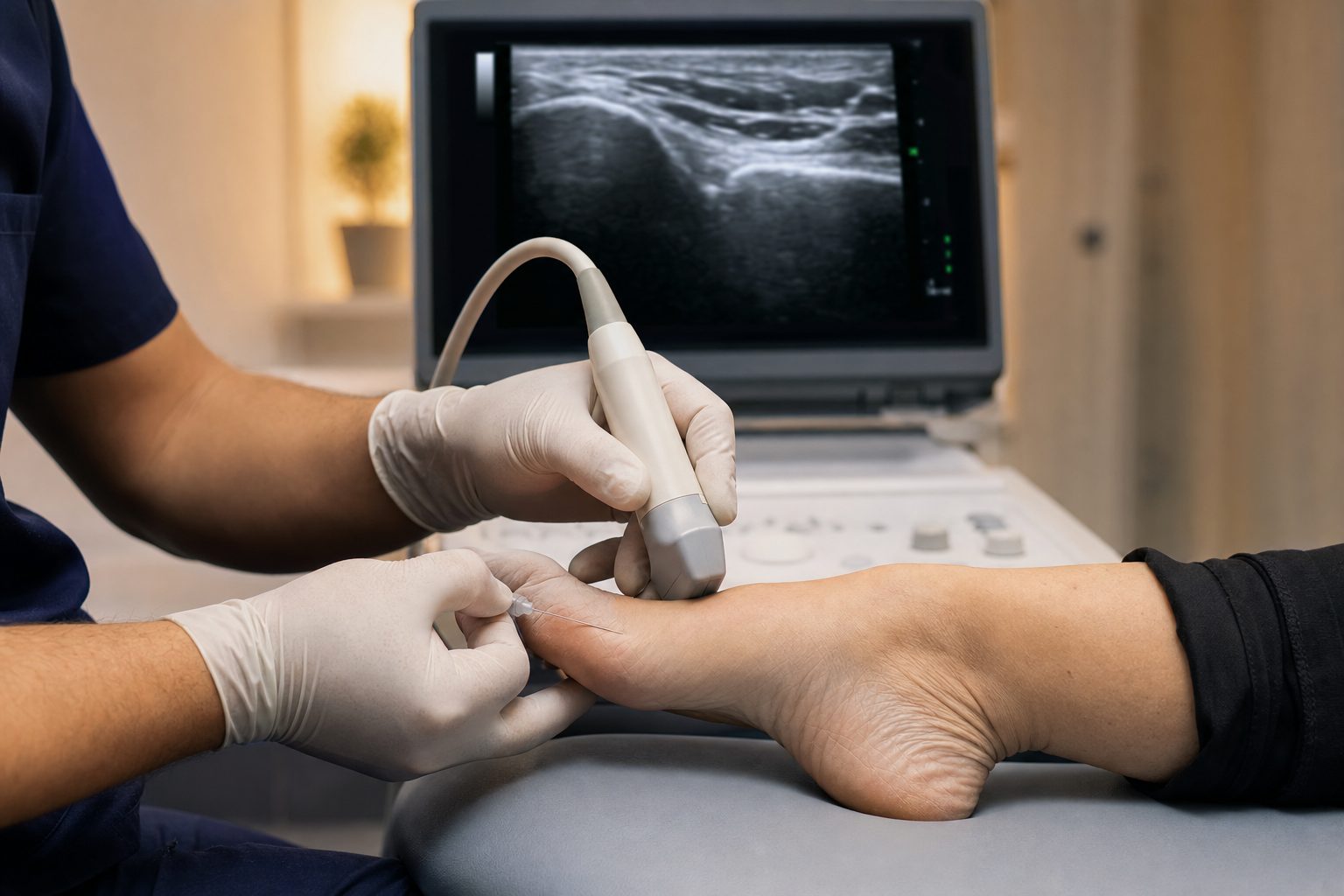
Foot and ankle problems account for an enormous share of adult orthopedic complaints — and they are among the most consequential, because untreated heel pain, Achilles tendinopathy, and ankle arthritis erode the foundation of every activity in daily life. This article takes a joint-by-joint evidence review approach to one of the most instructive questions in regenerative orthopedics: does PRP (or BMAC) actually help at the foot and ankle — and for which conditions specifically?
The short answer is that the evidence varies sharply by diagnosis. For chronic plantar fasciitis, multiple large meta-analyses now give PRP a Grade A recommendation — a rare level of support for a biologic injection. For midportion Achilles tendinopathy, the best meta-analytic data shows PRP does not outperform structured eccentric loading or placebo. For osteochondral lesions of the talus, BMAC used as a surgical adjunct has the strongest long-term cartilage repair signal at the ankle. These contrasts are not minor differences in effect size — they define the whole clinical picture, and they are the reason an honest evidence review for the foot and ankle is worth the reader’s time.
The Foot and Ankle Problems That Define Adult Pain Visits
Heel pain (plantar fasciitis), Achilles tendinopathy, ankle arthritis, peroneal and posterior tibial tendinopathy, and first metatarsophalangeal osteoarthritis (hallux rigidus) together account for the vast majority of adult hindfoot complaints presenting to orthopedic and physical medicine practices. Each has a different natural history, a different tissue target, and a different response to biologic therapy.
The case for distinguishing carefully across these conditions is not academic. Biologics behave very differently across the foot and ankle — and the stakes of getting the framing right are real. Corticosteroid alternatives matter here because corticosteroid injections at the foot carry documented downside risks that PRP avoids: plantar fascia rupture (rare but documented after medial heel CS injection), plantar fat-pad atrophy, skin depigmentation, and tendon softening preceding rupture at the Achilles (which is why most clinicians avoid CS injection at the Achilles entirely). When PRP genuinely outperforms CS over the long term — as it does in chronic plantar fasciitis — the safer-and-more-effective conclusion matters for patients making real decisions.
Conservative care remains foundational regardless of biologic status: structured heel-pain rehabilitation, eccentric loading for Achilles tendinopathy, controlled ankle motion (CAM) boot for partial tears, orthoses for foot biomechanics, and weight management for hindfoot and ankle osteoarthritis. Biologics work alongside these interventions, not instead of them.
What “Regenerative Orthopedics” Actually Means at the Foot and Ankle
The language of regenerative medicine is used loosely, and the foot and ankle is a joint region where the procedural details define whether a biologic has any chance of working. Three interventions are relevant at this joint level.
PRP (Platelet-Rich Plasma)
PRP is produced by centrifuging a small volume of the patient’s autologous blood to concentrate platelets above baseline. At the plantar fascia, the target is the medial calcaneal tubercle at the proximal fascial origin, using an ultrasound-guided peppering technique to disrupt degenerative fascia and deliver growth factors (PDGF, TGF-β, VEGF) directly into the zone of chronic degeneration. At the Achilles, the appropriate delivery is peritendinous — not intratendinous, which carries an unacceptable theoretical rupture risk. At the ankle joint, intra-articular ultrasound-guided injection for ankle osteoarthritis or talar cartilage pathology. Leukocyte-rich PRP (LR-PRP) at concentrations of 5–7× baseline is the formulation used in most positive plantar fasciitis trials.
BMAC (Bone Marrow Aspirate Concentrate)
BMAC is concentrated autologous bone marrow aspirated from the iliac crest. At the foot and ankle, the strongest evidence supports BMAC as a surgical adjunct — delivered arthroscopically into the prepared bone bed during microfracture or cartilage extracellular matrix repair for osteochondral lesions of the talus (OLT). Office-based intra-articular BMAC for primary ankle osteoarthritis is much less well-studied and should be distinguished from the higher-evidence surgical-adjunct indication.
Image Guidance Is Non-Negotiable
Blind plantar fascia and Achilles injections have variable accuracy; the target structures are small, and you need to confirm you are at the medial calcaneal tubercle (plantar fascia) or peritendinous space (Achilles) rather than in the fat pad or intratendinous. Ultrasound is the standard at Pravida Health for every foot and ankle biologic injection. Preparation quality — platelet concentration, leukocyte content, volume, and injection technique — influences outcomes, and these variables differ enough across providers to make them worth asking about. Contact us if you have questions about our preparation methodology.
The Evidence That Matters Most: Three Contrasting Pictures
The foot and ankle literature provides one of the clearest illustrations in all of regenerative orthopedics that biologics are not one thing. The three subsections below each have their own evidence base, their own direction of effect, and their own honest clinical bottom line.
6a. Chronic Plantar Fasciitis — PRP’s Strongest Foot/Ankle Signal
Chronic plantar fasciitis is the condition where PRP has the most consistently positive evidence in the foot. The honest summary: at least three large meta-analyses now favor PRP over corticosteroid for plantar fasciitis at 3, 6, and 12 months. Corticosteroid is faster at 1 month; PRP is more durable beyond 3 months; and PRP has a markedly safer profile with no documented cases of plantar fascia rupture or fat-pad atrophy in the published PRP literature.
Zuo J, et al. PRP vs corticosteroid for plantar fasciitis: systematic review and meta-analysis of 24 RCTs, 1,653 patients. Am J Phys Med Rehabil. 2025. Review discussed at jeffreypengmd.com (Zuo 2025 SR/MA review)
Zuo 2025 SR/MA (24 RCTs, 1,653 patients, American Journal of Physical Medicine & Rehabilitation) is the largest pooled analysis of PRP versus corticosteroid for plantar fasciitis to date. PRP injections yielded significantly better pain scores than CS at 3 months and 6 months, with no significant difference at 1 month. PRP was also superior on AOFAS functional scores at 3, 6, and 12 months — a durable and consistent advantage that reflects the biological mechanism rather than a short-term anti-inflammatory effect. Cited via the Jeffrey Peng MD plantar fasciitis review.
Hurley ET, et al. Platelet-rich plasma versus corticosteroids for plantar fasciitis: a systematic review of randomized controlled trials. Orthopedics. 2020;43(2):e80–e86. PubMed 32109160
Hurley 2020 (9 RCTs, n=479) found statistically significant VAS improvements favoring PRP at every time point through 12 months, with AOFAS scores significantly favoring PRP at 6 and 12 months. The authors assigned PRP a Grade A recommendation for chronic plantar fasciitis — a rare strength of recommendation for a biologic injection at any joint. Cite: PubMed 32109160.
Hohmann E, et al. Platelet-rich plasma versus corticosteroid injections for plantar fasciitis: a systematic review and meta-analysis. Am J Sports Med. 2021;49(5):1381–1393. Sage AJSM doi:10.1177/0363546520937293
Hohmann 2021 (American Journal of Sports Medicine) found PRP and CS produced comparable AOFAS and VAS scores at 1, 3, and 6 months, but PRP was superior at 12 months — consistent with the diverging durability pattern seen across all three meta-analyses. Cite: Sage AJSM.
Singh 2024 RCT (n=70, chronic plantar fasciitis, Foot and Ankle Surgery) found PRP significantly superior to CS on VAS at 1, 3, and 6 months (6-month VAS: 3.71 PRP vs 5.40 CS, p<0.0001); AOFAS significantly better at 3 and 6 months; zero adverse events in the PRP arm. Cite: ScienceDirect 2024. Singla 2024 (n=70 RCT, recalcitrant plantar fasciitis) confirmed PRP superior to CS at 1, 3, and 6 months. Cite: PubMed 40092568.
Safety contrast that matters: corticosteroid injections at the medial heel carry a documented — rare but real — risk of plantar fascia rupture and plantar fat-pad atrophy, particularly with repeat injections. PRP carries only transient post-injection soreness in the published literature. When a biologic is both more durable and safer than the comparator, that is a meaningful clinical signal.
Honest read for chronic plantar fasciitis: for chronic refractory disease that has failed 6+ weeks of structured conservative care (stretching, night splinting, orthoses, weight management, NSAIDs), ultrasound-guided PRP is now arguably the injectable of choice. CS may still have a role for an isolated time-pressured flare, but it is not the right default for chronic disease. Contact us to discuss whether you are a candidate.
6b. Achilles Tendinopathy — The Negative Case for PRP
This is the most important “biologics don’t always work” finding in foot and ankle regenerative orthopedics — and it needs to be framed honestly, not buried. For midportion Achilles tendinopathy (the chronic, degenerative, mid-tendon form 2–6 cm above the insertion, which is the most common presentation), the best meta-analytic evidence shows PRP does not outperform structured eccentric loading or placebo. This is not a weak signal — it is a consistent finding across multiple well-designed trials.
Ling SKK, et al. Platelet-rich plasma injection for chronic midportion Achilles tendinopathy: a systematic review and meta-analysis. Orthop J Sports Med. 2024;12(11). Sage doi:10.1177/23259671241296508
Ling 2024 (Orthopaedic Journal of Sports Medicine, Sage) is the most comprehensive meta-analysis of PRP for midportion Achilles tendinopathy to date: 6 RCTs, 422 patients, PRP injection versus sham/saline/eccentric loading. The result was unambiguous: NO significant difference between PRP and control at short term (3 months: p=.29), intermediate term (6 months: p=.42), or long term (12 months: p=.57) on VISA-A score. No significant difference on maximal Achilles tendon thickness on ultrasound either. This is not an ambiguous or borderline finding — it is a consistent null result across three time horizons in a well-pooled meta-analysis. Cite: Sage doi:10.1177/23259671241296508.
The Ling 2024 finding is consistent with the prior literature. The de Vos 2010 landmark NEJM-era double-blind RCT (54 patients) found single PRP injection NOT superior to saline at 6, 12, or 24 weeks — the original signal that midportion Achilles tendinopathy responded differently to PRP than other tendons. The Krogh 2016 BMJ Open SR/MA (4 RCTs, 170 patients) confirmed no difference between PRP and placebo for midportion Achilles tendinopathy. Cite: PMC7044811. Ling 2024 updates and extends this consistent picture with two more years of RCT data — and the answer has not changed.
Why is midportion Achilles tendinopathy different? The prevailing hypothesis is that chronic midportion Achilles tendinopathy involves a degenerative, hypovascular tissue environment with neovascularization and neoneuralization that may limit platelet growth factor uptake. The biology of tendinosis at the mid-Achilles is meaningfully different from the reactive-degenerative tissue at the plantar fascia origin — same molecule, different tissue environment, different response.
For insertional Achilles tendinopathy (at the calcaneal insertion, often involving Haglund’s deformity and retrocalcaneal bursa) and for chronic recalcitrant midportion cases that have failed structured eccentric loading: the evidence base is thinner and more mixed. Some smaller positive trials exist, but there are no large RCTs. PRP may have a role in carefully selected refractory insertional cases.
Honest read for midportion Achilles tendinopathy: structured 12-week progressive eccentric loading (Alfredson protocol — heel-drop exercises off a step) is the proven first-line intervention. Shockwave therapy is a reasonable adjunct. PRP is not a default for this condition and should be reserved for carefully selected refractory cases where the patient has been told the meta-analytic data does not support a strong benefit. Referring a patient for PRP as a first or second-line treatment for midportion Achilles tendinopathy, without completing structured eccentric loading, is not evidence-based. Contact us if you would like to discuss your specific situation.
6c. Osteochondral Lesions of the Talus and Ankle Osteoarthritis
The biologic role at the ankle joint splits clearly into two situations: BMAC as a surgical adjunct for osteochondral lesions of the talus (OLT) — where there is a real and sustained evidence signal — and intra-articular PRP for primary ankle osteoarthritis, where the benefit is modest and likely similar to placebo on functional scores.
For OLT — BMAC as surgical adjunct:
Buda R, et al. Osteochondral lesions of the talus: long-term clinical and radiographic outcomes with bone marrow-derived cell transplantation at 10 years. Am J Sports Med. 2021. PubMed 33606047
Buda 2021 reported sustained pain relief and clinical improvement at 10 years with BMAC plus collagen scaffold for osteochondral lesions of the talus in ankle osteoarthritis — a long-term outcome dataset that is rare in the cartilage repair literature. Cite: PubMed 33606047.
Murawski CD, Kennedy JG. Operative treatment of osteochondral lesions of the talus. J Bone Joint Surg Am. 2013. Cartilage ECM-BMAC study: Sports Foot & Ankle PDF
The Murawski/Kennedy ECM-BMAC vs microfracture study showed that OLT patients treated with cartilage extracellular matrix plus BMAC had significantly higher MOCART cartilage repair scores than microfracture-only patients (73 ± 11.5 vs 54.0 ± 24.1; p=.0015), with significantly better Infill, Integration, and Signal subscores. Revision surgery rate was higher in the microfracture-only group. Cite: Sports Foot & Ankle PDF. Hannon 2015 systematic review found BMAC for chondral defects of the talus showed varying degrees of beneficial outcomes across studies with no major complications. The 2025 Pagliazzi study showed functional and radiographic improvement with combined biologic-augmented OLT repair. Cite: PubMed 40266311.
For primary ankle OA — intra-articular PRP: Paget 2023 SR/MA (3 RCTs and 2 cohort studies; 184 ankle OAs, 132 PRP) found that at 12 weeks PRP significantly reduced VAS and functional scores vs baseline — but the magnitude of improvement was similar to the placebo effect from prior RCTs. Cite: PubMed 37208754. The 2024 Frontiers SR/MA (10 studies, including 6 RCTs) found PRP significantly better than control for talar cartilage injuries (AOFAS MD 8.66, p<0.00001; VAS SMD -1.24, p<0.00001) but NOT for ankle osteoarthritis alone, and microfracture + PRP combination significantly better than PRP injection alone.
Honest read for OLT: when ankle arthroscopy with microfracture or cartilage matrix repair is indicated, BMAC augmentation is well-supported by the literature and is approaching standard of care at high-volume foot and ankle centers. For office-based intra-articular PRP for primary ankle OA, the benefit is modest and likely placebo-similar on functional scores — a reasonable discussion for mild-to-moderate OA refractory to conservative care, but with calibrated expectations.
“The honest news from the foot and ankle literature is that biologics are not one thing. Plantar fasciitis gets a Grade-A recommendation for PRP. Midportion Achilles does not. Same molecule, same physician, very different evidence.”
Where Biologics Probably Don’t Help Yet at the Foot and Ankle
An evidence-graded approach requires naming the conditions where the data says no — or says not yet. The foot and ankle has several.
- Midportion Achilles tendinopathy as a primary indication: meta-analyses through 2024 show no benefit over eccentric loading or placebo (Ling 2024, Krogh 2016). Structured eccentric loading first, always.
- Acute Achilles tendon ruptures: no evidence that PRP improves outcomes over standard rehabilitation or surgical repair. This is not an indication for biologic injection.
- First MTP joint osteoarthritis (hallux rigidus): very limited evidence, mostly case reports and small cohorts. Conservative care, carbon-fiber footwear, and surgical cheilectomy or fusion remain standard for advanced disease.
- Peroneal tendinopathy and posterior tibial tendinopathy: small case series; reasonable to consider in carefully selected refractory cases that have failed bracing and structured PT, but the evidence base is thin. Not a default indication.
- Acute lateral ankle sprains: PRP has not been shown to outperform structured rehabilitation in well-designed trials. Structured rehab and proprioceptive training remain the first-line interventions.
How We Approach This at Pravida Health
Pravida Health is located at 1801 Peachtree St NE, Ste 150, Atlanta, GA 30309. Our approach to foot and ankle biologics is structured around a confirmed diagnosis, a genuine trial of conservative care, honest communication about what the evidence shows for each specific pathology, and ultrasound guidance on every injection procedure.
- Chronic plantar fasciitis: diagnosis by clinical exam (medial heel tenderness, first-step morning pain, positive windlass test) and ultrasound (plantar fascia thickness ≥4 mm at calcaneal origin, hypoechoic degeneration). Best candidates have symptoms >3 months despite 6+ weeks of stretching, night splinting, OTC orthoses, and footwear modification. LR-PRP at 5–7× baseline concentration, ultrasound-guided peppering technique at the medial calcaneal tubercle. Contact us to discuss candidacy.
- Achilles tendinopathy: structured 12-week eccentric loading (Alfredson protocol) is the first conversation. Shockwave is a reasonable adjunct for midportion disease. PRP only for carefully selected patients who have completed structured rehab and remain symptomatic — with full informed consent that the meta-analytic evidence for midportion disease is consistently null. Insertional cases are a different discussion.
- Osteochondral lesion of the talus: evaluation typically requires MRI staging. If symptomatic with appropriate lesion characteristics, surgical referral for arthroscopic microfracture or ECM-BMAC repair is the higher-evidence pathway. We coordinate carefully with the operative team to time biologic delivery to the procedure.
- Primary ankle OA: image-guided intra-articular PRP can be considered in select mild-to-moderate cases refractory to PT, bracing, and oral therapy — discussed honestly as likely modest benefit on a short-term basis. Not the same as OLT-directed BMAC-augmented surgery.
- Image guidance for every foot/ankle biologic procedure. Outcomes tracked: VAS, FAAM, AOFAS, FFI, and return-to-activity metrics.
- When surgical referral is the better answer: large unstable OLT (arthroscopic repair with BMAC adjunct); end-stage ankle OA (total ankle arthroplasty vs arthrodesis discussion); plantar fascia rupture; full-thickness Achilles rupture; Stage III/IV posterior tibial tendon dysfunction. Contact Pravida Health if you are unsure which category applies.
Podiatric biomechanical evaluation, orthoses, and footwear coaching are foundational alongside any biologic intervention. We do not offer injections as a shortcut around conservative care.
Risks, Limitations & What the Evidence Doesn’t Yet Show
- Post-injection flare: common and expected after plantar fascia PRP (3–7 days); can be longer and more intense after Achilles peritendinous PRP. Patients must plan around this.
- Infection and bleeding: rare with sterile ultrasound-guided technique but not zero. Standard procedural risk applies.
- Iliac crest soreness and bruising after BMAC harvest — expected, resolves in 5–10 days. Rare hematoma or infection at harvest site.
- Achilles PRP: rare reports of tendon irritation after peritendinous injection; no published cases of Achilles rupture from PRP — in stark contrast to corticosteroid injection at the Achilles, which is generally avoided because of rupture risk.
- PRP preparation variability: concentration, leukocyte content, volume, and single-vs-multiple injection protocols differ substantially across studies and providers. The formulation determines whether the biology works. Ask about preparation methodology.
- For plantar fasciitis: strong and consistent PRP signal, but most individual trials are small-to-moderate (n=40–180). The meta-analytic pool is now large enough (1,653 patients in Zuo 2025) that the direction of effect is well-established.
- For midportion Achilles tendinopathy: meta-analytic evidence is consistent across three time horizons — PRP does NOT outperform standard care.
- For ankle OA: PRP benefit appears modest and short-term. Not equivalent to the OLT surgical-adjunct evidence.
- Cost: PRP and BMAC for foot and ankle conditions are not covered by most commercial insurers. Full cost information provided before any procedure is scheduled.
- Not a substitute for surgery when surgery is the right answer: large unstable OLT, end-stage ankle OA, full tendon ruptures.
What You Can Do Today
- For plantar fasciitis: structured stretching (gastrocnemius, soleus, and plantar fascia stretches 3×/day), night splinting for at least 6 weeks, OTC arch supports, footwear with adequate heel cushioning, weight management, NSAIDs short-term if appropriate. If symptoms persist beyond 6 weeks of consistent effort, ultrasound-guided PRP is now arguably the next-best injectable rather than a corticosteroid.
- For midportion Achilles tendinopathy: commit to a structured 12-week eccentric loading program (Alfredson protocol — heel-drop exercises off a step) before considering any injection. Modify training volume, address calf flexibility, optimize footwear. Most cases improve with structured rehab when given adequate time.
- For insertional Achilles tendinopathy: avoid deep dorsiflexion stretching that compresses the tendon against the calcaneus; use a small heel lift; eccentric loading from a flat surface (not a step, which compresses the insertion).
- For ankle OA: hindfoot/ankle bracing or carbon-fiber insert, low-impact conditioning (cycling, pool), weight management, oral therapy. Image-guided intra-articular PRP is a reasonable discussion for mild-to-moderate disease refractory to conservative care, with calibrated expectations.
- For OLT: obtain MRI staging and a foot/ankle surgical consultation. BMAC-augmented repair has the best long-term cartilage repair signal. Do not defer imaging if you have persistent ankle pain with activity that has not responded to conservative care.
- When evaluating a regenerative provider for the foot and ankle: ultrasound guidance is non-negotiable; ask about platelet concentration and preparation system; ask what evidence the provider can cite for your specific diagnosis; confirm whether they will tell you when PRP is not the right answer (as it isn’t for midportion Achilles disease). Contact Pravida Health to have that conversation.
Frequently Asked Questions
Does PRP actually work better than a cortisone shot for plantar fasciitis?
Yes — for chronic plantar fasciitis that has failed conservative care, multiple large meta-analyses now favor PRP over corticosteroid at 3, 6, and 12 months. Hurley 2020 (PubMed 32109160) gave PRP a Grade A recommendation (9 RCTs, n=479). Hohmann 2021 (AJSM) found PRP superior at 12 months. The Zuo 2025 SR/MA (24 RCTs, 1,653 patients) confirmed PRP superior on pain and functional scores at 3 and 6 months. Corticosteroid may be faster at 1 month, but its effect fades and it carries risks of plantar fascia rupture and fat-pad atrophy with repeat use that PRP does not share. Contact us to discuss whether you are a candidate.
Why are you cautious about PRP for Achilles tendinopathy?
Because the best available meta-analytic evidence does not support PRP for midportion Achilles tendinopathy. Ling et al. 2024 (6 RCTs, 422 patients, Orthopaedic Journal of Sports Medicine) found NO significant difference between PRP and sham/saline/eccentric loading at short, intermediate, or long term on VISA-A score. This is a consistent null result across multiple time horizons — not a weak or borderline finding. Structured 12-week eccentric loading remains the proven first-line intervention. PRP is reserved for carefully selected refractory cases with full informed consent.
What’s BMAC, and when does it actually help at the ankle?
BMAC (bone marrow aspirate concentrate) is concentrated autologous bone marrow from the iliac crest. At the ankle, the strongest evidence supports BMAC as a surgical adjunct for osteochondral lesions of the talus (OLT). Buda 2021 (PubMed 33606047) showed sustained improvement at 10 years. The Murawski/Kennedy ECM-BMAC study showed MOCART scores of 73 vs 54 versus microfracture alone (p=.0015). For primary ankle osteoarthritis in the office, evidence is much thinner and benefit modest.
Will PRP help my ankle arthritis or chronic ankle sprains?
For primary ankle osteoarthritis, intra-articular PRP shows modest short-term pain reduction but the improvement is similar in magnitude to placebo on functional scores (Paget 2023 SR/MA, PubMed 37208754). For acute lateral ankle sprains, PRP has not been shown to outperform structured rehabilitation. These are not conditions where we expect a strong biologic response. PRP for mild-to-moderate ankle OA refractory to conservative care is a reasonable discussion with calibrated expectations — not a high-confidence indication. Contact us to discuss your clinical picture.
Is this offered at Pravida Health?
Yes. Pravida Health offers ultrasound-guided PRP injections for appropriately selected foot and ankle patients at our Atlanta clinic at 1801 Peachtree St NE, Ste 150, Atlanta, GA 30309. For osteochondral lesions of the talus, we coordinate with operative teams for BMAC-augmented arthroscopic repair. Our approach begins with diagnosis confirmation, a genuine trial of conservative care, and a frank discussion of what the evidence shows for your specific pathology — including the honest distinction between plantar fasciitis (strong PRP signal) and midportion Achilles tendinopathy (weak PRP signal). We track outcomes with VAS, FAAM, AOFAS, and FFI scores and refer for surgery when surgery is the better answer. Contact us to schedule a consultation.
Ready to discuss your foot or ankle with an evidence-grounded physician?
At Pravida Health, we start with your diagnosis, your imaging, and your goals — not a preferred procedure. If PRP makes sense for your chronic plantar fasciitis or BMAC-augmented surgery is right for your osteochondral lesion of the talus, we will explain exactly why and what the evidence says. If eccentric loading or surgical referral is the better answer, we will tell you that too.
Book a Consultation