
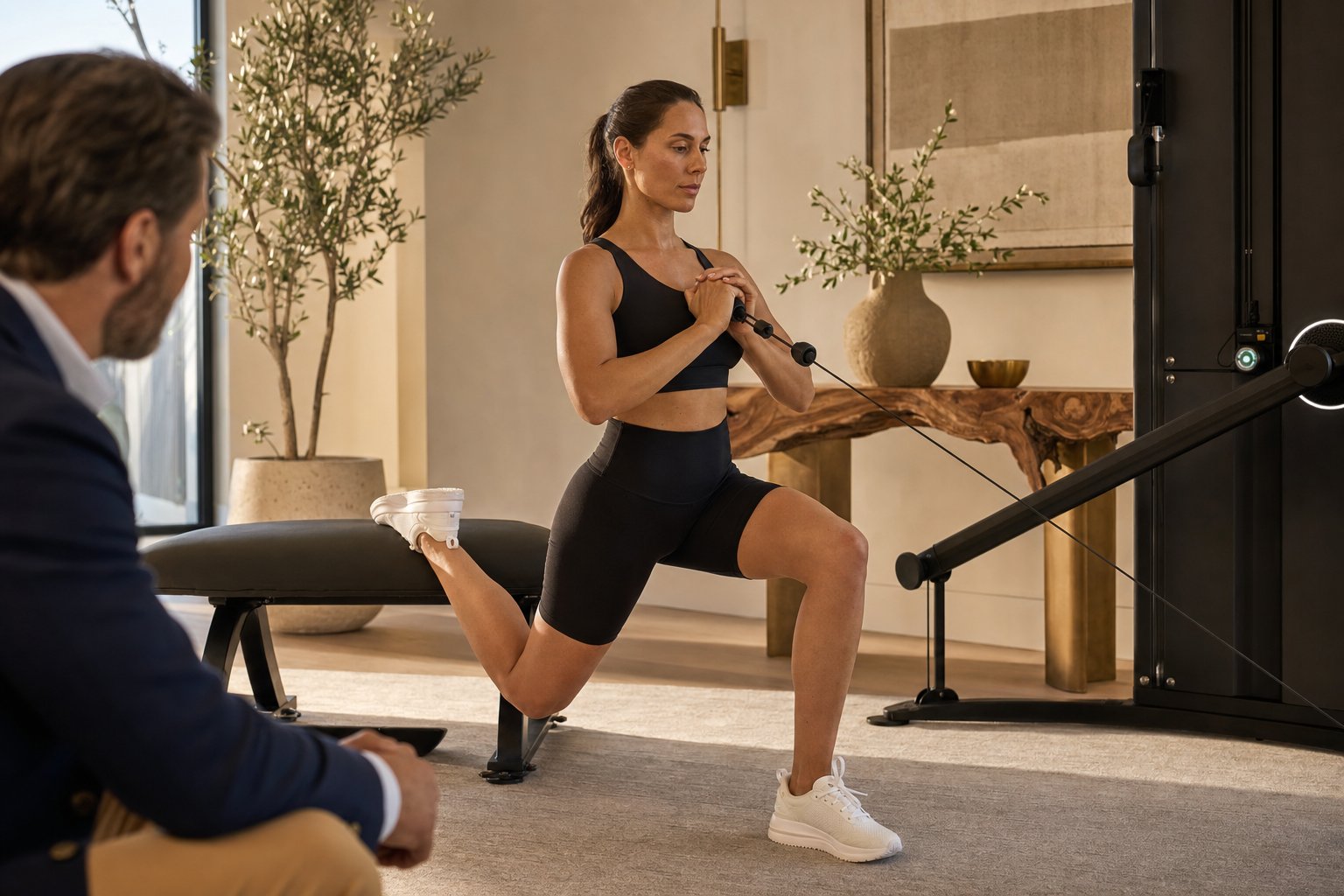
Why the pain scale is the wrong headline for a knee
Knee patients are, in my experience, uniquely disadvantaged by a subjective-only assessment. Pain in a knee is easy to compensate away — a small shift in stance width, a subtle unloading of the involved side, a slightly bent trunk over the affected leg — and after a few weeks the compensations become invisible to the patient. Their pain score drops. Their function does not actually return. And then they twist an ankle, or the other knee starts to hurt, and everyone is surprised.
Before I recommend a rehabilitation plan or a regenerative procedure like CartiNova for a knee, I want to know several specific things that no pain scale can tell me. How much force is the involved knee actually producing compared to the uninvolved side? At what depth does the knee lose control? Which plane of motion — sagittal, frontal, or hip-dominant — reproduces the pain? Is the deficit primarily a strength problem, a stability problem, or a symmetry problem? These are the questions that predict whether a knee is going to hold up in a hike, a tennis match, or a flight of stairs six months from now.
Every knee-focused patient at Pravida goes through a structured six-movement biomechanics battery on the OxeFit smart cable resistance system. It gives me the objective portrait of the involved knee that I need to plan around, and it gives us a repeatable measurement we can come back to at 4, 8, and 12 weeks after a procedure — and every quarter after that.
What OxeFit is (and honestly, what it isn’t)
The OxeFit XS1 is a floor-anchored, cable-based smart resistance platform. Resistance is delivered through motorized cables that can be programmed to change load dynamically within a single rep — concentric versus eccentric, tempo-matched, or capped at a symmetry-matched load between limbs. Every rep captures peak force, rate of force development, range of motion, tempo, and the left-versus-right work distribution.
Its adaptive mode is the part that matters clinically. Rather than the patient guessing at a starting weight — and knee patients especially tend to guess low, protecting the involved side — the machine begins conservatively and progressively increases cable resistance across the three sets based on how well the patient controls the movement. Control is scored on four axes: mobility (did the knee reach the target depth?), stability (did the knee track the toes, or did it drift into valgus?), symmetry (is the involved side sharing the work?), and power (how quickly is force being generated?). The load that emerges is calibrated to the patient in front of me, not to a percentage of a one-rep max we would never actually test in an arthritic knee.
What OxeFit is not: it is not a diagnostic device, it does not replace an ultrasound-guided exam or an MRI, and it does not decide whether a patient needs a procedure. As OxeFit itself states, its analysis models provide “clinically relevant insights” to discuss with a healthcare provider, not diagnoses. Interpretation is a physician job. But as a way of capturing an objective, high-resolution portrait of how a knee behaves under progressively realistic loads — and comparing that portrait to itself months later — it is exceptional.
The six-movement knee battery
Every knee-focused assessment at Pravida runs the same six patterns in the same order, at three sets of ten repetitions each. The order is intentional and progressive: bilateral first (safest, most familiar), then a demanding unilateral loading pattern, a real-world stair-climbing analog, a frontal-plane lunge that stresses medial and lateral stability, a hip-dominant hinge that tests the posterior chain, and an optional backward-shuffle add-on for patients who need to demonstrate deceleration control before returning to sport or hiking.
1. Baseline Bilateral — Squat (3 × 10)
The bilateral squat is our safest opening because both knees share the load. It answers a simple question first: Can this patient produce coordinated, symmetric extension force out of the floor at all? The adaptive mode captures peak force, the tempo of the descent versus the ascent, and, crucially, whether one leg is contributing more work than the other — something you can rarely see with the naked eye because a small pelvic shift or trunk lean hides it.
What I look for: symmetry is the headline — a large left-right work imbalance under bilateral loading is one of the earliest signs of a knee that is being protected. Mobility in the descent (does the patient reach parallel or a self-selected functional depth on both sides?), and stability as the load progresses across sets (does knee tracking stay clean, or do we start to see valgus drift or an early rise of the heels?).
2. Primary Unilateral — Bulgarian Split Squat (3 × 10)
The Bulgarian split squat is the pattern that separates strong knees from knees that only look strong. With the rear foot elevated behind the patient, the front leg has to produce essentially all of the extension force while the trunk and pelvis stay stacked. It is a demanding sagittal-plane, unilateral loading test that also punishes any lateral hip weakness on the standing side.
This is where symmetry stops being subtle. When we run the involved side and then the uninvolved side, the difference in peak force and rate of force development is often dramatic — and often much larger than the pain score would predict. It is not uncommon to see a patient reporting 2/10 pain on the involved knee show a 25–30% deficit in force production compared to their uninvolved side. That is a knee that will not tolerate a return to hiking, tennis, or heavy stairs without a targeted plan.
The Bulgarian split squat is a well-studied unilateral loading pattern, and it maps onto real-world tasks — getting up out of a low chair, climbing a step with a bag in the opposite hand, standing up from a kneeling position — more directly than most bilateral movements.
3. Real-World Loading — Step Up (3 × 10)
The step-up is included because stairs are the number-one activity that patients with a compromised knee tell me they are losing confidence in. A cable-loaded step-up progressively loads the involved knee through the exact concentric-then-eccentric arc that a real staircase requires. The adaptive mode captures whether the patient can produce peak force cleanly at the top of the step and, critically, whether they can decelerate the step down without a hip drop, a knee wobble, or a trunk lean.
I pay particular attention to stability here because the eccentric (stepping-down) phase of stair descent is where most knees actually fail in real life — not on the way up. A patient with adequate concentric strength but poor eccentric control on step-down is at high risk for a fall or a re-aggravation once they leave the clinic.
4. Frontal Plane — Lateral Lunge (3 × 10)
The lateral lunge takes the knee out of the sagittal plane and into the frontal plane — sideways loading. This is where we test the medial and lateral stabilizers of the knee and hip: the gluteus medius, the adductors, the medial and lateral hamstrings, and the ability of the knee to accept load without collapsing inward (dynamic valgus) or drifting outward.
A lot of knee pathology, especially medial-compartment osteoarthritis and old meniscal injuries, is exquisitely sensitive to frontal-plane loading. When the lateral lunge reproduces a patient’s specific pain pattern at a load the sagittal-plane movements did not, that is a clinical signal I take seriously. It also tells me exactly what part of the rehab plan needs the most volume: frontal-plane control cannot be trained in the sagittal plane alone.
5. Hip Dominant — Single-Leg Romanian Deadlift (3 × 10)
The single-leg RDL closes the loop on the posterior chain. Even in a knee-focused evaluation, we need a portrait of hip and hamstring capacity, because a knee is only as stable as the hip and hamstring that support it. A patient with weak or asymmetric posterior chain function will inevitably shift load anteriorly and load the involved knee harder than they should.
Under load, the hamstrings and gluteus maximus contract eccentrically to control hip flexion, then concentrically to extend the hip on the return, while the deep spinal stabilizers hold a neutral lumbar spine and the standing-leg gluteus medius fights hip drop. Watching the single-leg RDL scores on both sides usually tells me exactly how much posterior chain work needs to go into the plan, and it is often a bigger deficit than the patient expects.
6. Optional Add-On — Backward Shuffle (3 × 10)
For patients aiming to return to hiking, running, tennis, court sports, or trail activities, we add a backward shuffle. It looks simple, but it is one of the most demanding neuromuscular tasks in the battery: it forces the knee to accept load in a novel direction while the patient is decelerating and generating power in a reversed movement pattern. Poor performance on the backward shuffle correlates with the kind of unexpected knee failures that happen when a patient plants and pivots on uneven ground.
I only add this test once the earlier five patterns are clean enough that the risk of doing it is acceptable. It is often the final gate before I clear a patient to return to sport.
What the numbers actually mean in a clinical decision
The OxeFit adaptive mode produces a score for each pattern across the four metrics we care about. On its own, a score is just a number. What makes it useful is the shape of the profile across the six patterns and the reproducibility of the pain during specific loads.
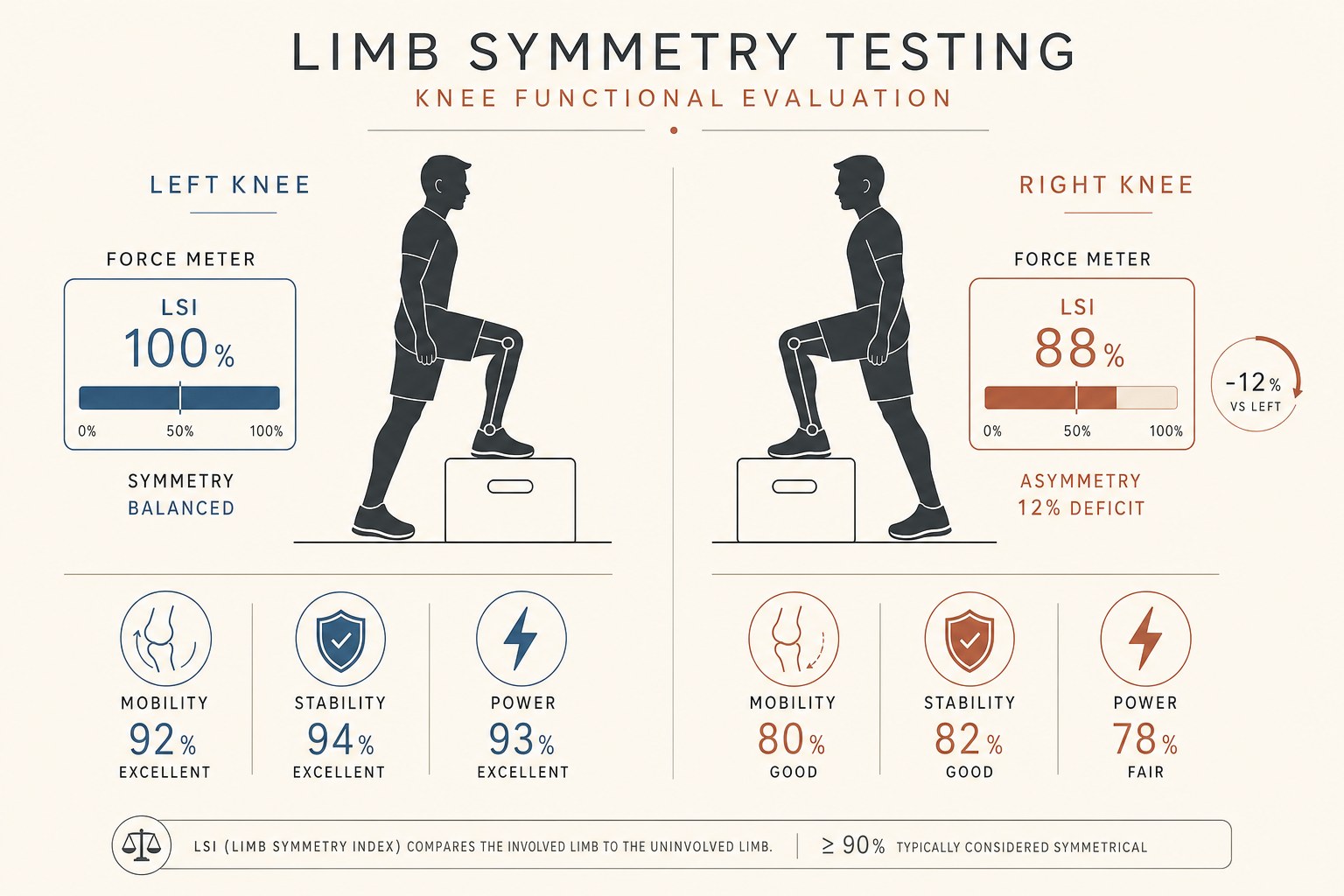
The metric that carries the most weight in knee work is the Limb Symmetry Index (LSI) — the involved side’s output as a percentage of the uninvolved side. In orthopedic rehabilitation literature, an LSI of at least 90% is commonly used as a functional readiness benchmark before returning to demanding activity, and evidence suggests that lower LSI values at the time of return correlate with higher rates of re-injury and contralateral injury (see, for example, Grindem et al., BJSM 2016 in ACL populations). We use LSI as one clinical input, not as an automatic threshold, and always alongside pain behavior, imaging, and patient goals.
The four questions I answer from a single knee assessment
- Where does the load fail? Which of the six planes reproduces the pain, and at what percentage of the adaptive load?
- How large is the LSI deficit? Is the involved side within 10% of the uninvolved side, or are we in the 20–30% deficit territory that needs a real plan?
- What is limiting first — mobility, stability, or power? Because each takes a different training and treatment plan to fix.
- Is eccentric control (step-down) the failure mode? If yes, that changes both the prehab program and the return-to-activity gates.
How this changes the plan around a CartiNova procedure
The primary reason we run this battery on regenerative orthopedic patients is that it turns a CartiNova procedure from an event into a program. Instead of “we did the injection, now go do PT,” we have a specific, quantitative starting point and a specific, quantitative target.
Prehab. If the assessment shows a large LSI deficit, a stability failure at the step-down or the lateral lunge, or a persistent hip-dominant asymmetry, we do not schedule the procedure that week. We build a two-to-six-week prehab block focused on the specific deficits the assessment surfaced, then re-test. Patients who arrive at their regenerative procedure with cleaner knee mechanics generally tolerate the early post-procedure loading window better and progress faster. The biology of cartilage response is real, but so is the mechanical environment that the biology has to live in.
Post-procedure milestones. After a CartiNova knee procedure, the healing environment benefits from progressive, controlled loading — not from rest alone and not from a return to full activity too early. The OxeFit battery becomes our objective gate. Instead of “you feel ready, so go hike,” we can say “your bilateral squat LSI is now within 10%, your Bulgarian split squat force production is back to 85% of the uninvolved side, and your step-down stability score has returned to baseline — you are ready for the next phase.” Those are conversations patients can act on.
Follow-up testing. We repeat the same six-movement battery at defined intervals — typically at four, eight, and twelve weeks post-procedure, and then quarterly. Because the movements, the tempo, and the adaptive scoring are held constant, small changes are visible and defensible. It gives patients something they rarely get in traditional knee care: a graph that goes in the right direction.
How this battery translates to the things you actually do
Every movement in this battery was chosen because it maps onto a real-world task that a real patient will do this week, not because it looked interesting on a screen.
- Bilateral squat → standing up out of a low chair, getting off the couch, sitting down onto a toilet, picking up a laundry basket from the floor.
- Bulgarian split squat → getting up from kneeling in the garden, standing up out of a low car, climbing a steep step, single-leg loading during any change-of-direction movement.
- Step-up → literally stairs, hikes, curbs, and every step up onto a stool or a step ladder.
- Lateral lunge → reaching to the side for a heavy grocery bag, catching yourself when you stumble sideways, the plant leg of any sport with lateral movement (tennis, pickleball, basketball, skiing).
- Single-leg RDL → loading a bag into the trunk of a car, lifting a toddler off the floor, planting one foot and reaching for something on the ground.
- Backward shuffle → decelerating on a downhill hike, backing up in tennis or pickleball, catching your balance when you step backward off a curb.
When a patient sees a graph that shows their Bulgarian split squat symmetry improving from 72% to 91% over eight weeks post-procedure, they do not have to imagine what it means. They know it means they can carry the groceries up the stairs, and they can hike Kennesaw again this fall.
The honest limits, and where a good clinician still matters
A few things this assessment does not do, and does not pretend to do:
- It does not diagnose meniscal tears, cartilage lesions, or specific knee pathology. Those require imaging, ultrasound-guided exam findings, and clinical reasoning.
- It does not tell you which regenerative procedure, if any, is right for you. That decision integrates imaging, exam, medical history, activity goals, and shared decision-making.
- An LSI score is not a diagnostic threshold. There is no OxeFit number that automatically triggers a procedure or automatically clears a patient to return to sport. Interpretation still requires a physician who knows the patient.
- It cannot capture the fear, the sleep loss, and the meaning of pain that shape recovery just as much as the biomechanics do.
What it does do, better than almost anything else in our clinic, is remove ambiguity from the two questions that patients ask most: “Am I actually better?” and “Am I ready to do the thing I love again?”
How I fit this into a Pravida knee care plan
For a knee-focused patient, the OxeFit battery is one of three tools I try to have in hand before I recommend a plan: a clinical exam (with ultrasound-guided joint assessment as needed), appropriate imaging, and an objective functional baseline. Together they answer the three questions a good plan has to answer: what is the structural problem, what is the movement problem, and what does “better” look like measurably? If we can answer all three, the CartiNova procedure — or a prehab-only plan, or a rehab-only plan — becomes a decision the patient can genuinely own. And when the numbers move in the right direction, the confidence to actually resume the activities they love comes back with them.
A companion post covers the spine-focused version of this battery — the five-movement trunk assessment we run for back-pain and post-procedure spinal patients. If you are here for both a knee and a back, most patients end up running both.
Curious what your own functional knee baseline looks like?
We run this six-movement OxeFit knee assessment as part of the initial evaluation for regenerative orthopedic patients at Pravida Health in Buckhead, Atlanta. It takes about 30–40 minutes, produces a graph you actually understand, and gives us the starting line for whatever plan comes next.
Book a consultationKey sources referenced in this article
- OxeFit XS1 platform overview — OxeAI adaptive analysis, cable-based smart resistance, and real-time performance feedback. Available at oxefit.com.
- Grindem H, Snyder-Mackler L, Moksnes H, Engebretsen L, Risberg MA. Simple decision rules can reduce reinjury risk by 84% after ACL reconstruction: the Delaware-Oslo ACL cohort study. Br J Sports Med. 2016;50(13):804–808. PubMed 27162233. Establishes Limb Symmetry Index ≥90% as one of the strongest predictors of safe return-to-activity in the ACL population.
- Kyritsis P, Bahr R, Landreau P, Miladi R, Witvrouw E. Likelihood of ACL graft rupture: not meeting six clinical discharge criteria before return to sport is associated with a four times greater risk of rupture. Br J Sports Med. 2016;50(15):946–951. PubMed 27215935.
- Cook G, Burton L, Hoogenboom BJ, Voight M. Functional Movement Screening: The use of fundamental movements as an assessment of function. Int J Sports Phys Ther. 2014;9(3):396–409. PubMed 24944858.
- Wilk KE, Arrigo CA. Rehabilitation principles of the anterior cruciate ligament reconstructed knee: twelve steps for successful progression and return to play. Clin Sports Med. 2017. Foundational reference for phased, criterion-based post-procedure knee rehabilitation.