
Prefer to watch? The video version of this article is also on YouTube.
Why I am writing about this
I spend a lot of my time these days thinking about artificial intelligence in medicine: building tools for my own practice, teaching physicians and future physicians to work alongside these systems, and reading the new studies as they come out. And I keep coming back to one conviction that I want to state plainly, because I think it will shape how the next decade of healthcare goes.
The best healthcare will not be delivered by AI instead of humans. It will be delivered by humans augmented by AI.
That sounds like a slogan, so let me show you why I believe it is an evidence-based position rather than a sentimental one. The argument runs through a surprising place: the science of nonverbal communication, one of the most misquoted statistics in all of the social sciences, and a quiet limitation built into nearly every study showing that chatbots are “more empathetic” than doctors.
The 93% myth, and what was actually tested
You have almost certainly heard that 93% of communication is nonverbal: 7% words, 38% tone of voice, 55% facial expression and body language. It shows up in leadership seminars, sales trainings, and, unfortunately, in medical education.
It is not true in the way it is usually quoted. The figures come from two 1967 experiments by the psychologist Albert Mehrabian and colleagues. As communication scholar David Lapakko documented in his review of how the claim spread, those studies asked listeners to judge a speaker’s attitude from single words such as “maybe,” in situations where the tone or facial expression was deliberately made to conflict with the word, and neither study actually compared words, voice, and face together in one design (Lapakko, CTAMJ). Mehrabian himself has cautioned against applying the numbers to communication in general.
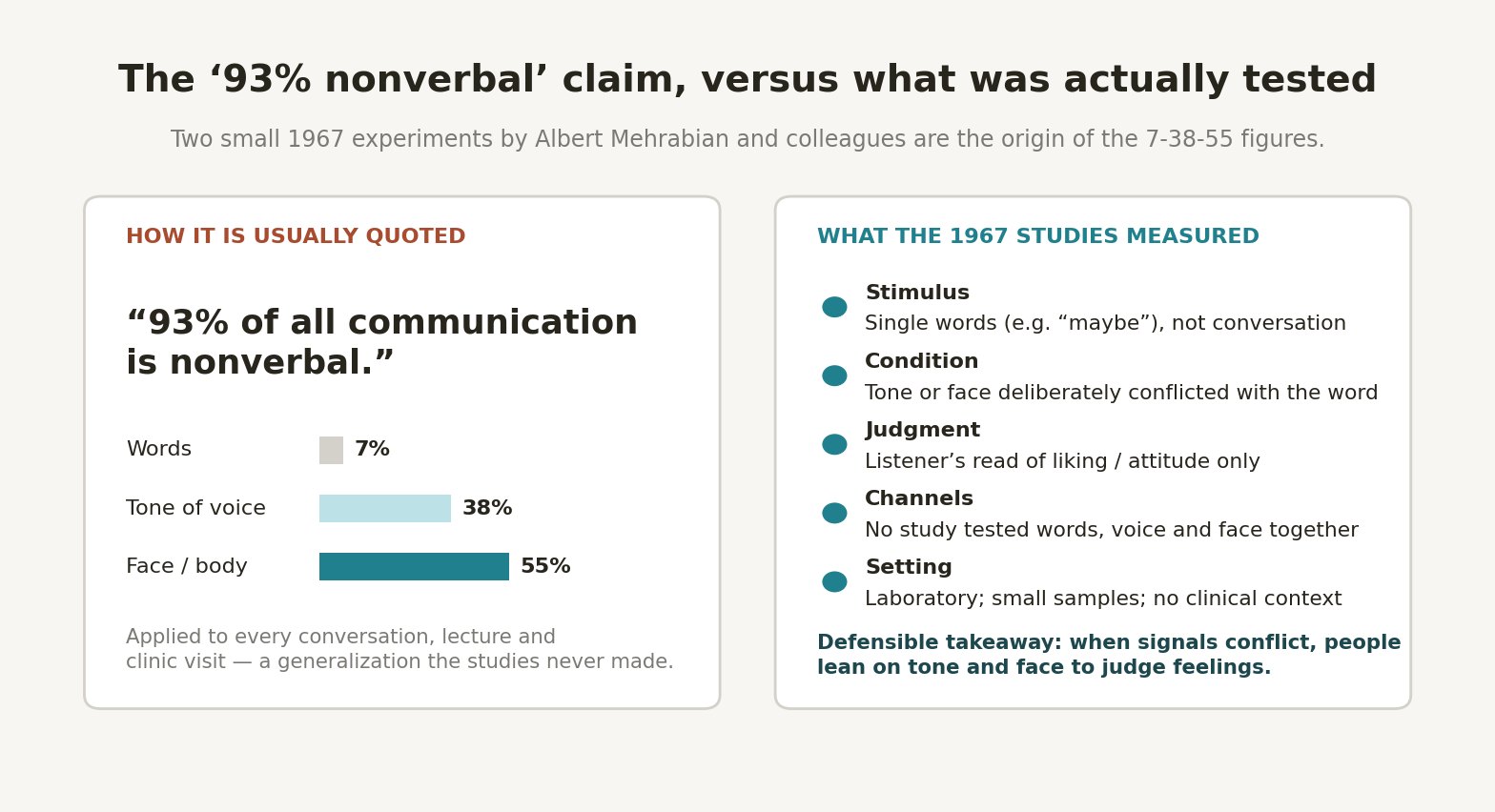
The defensible takeaway is narrower and still important: when what someone says and how they say it do not match, listeners tend to lean on tone and face to decide what the person really feels. In a clinical encounter, where a patient says “I’m fine” while staring at the floor, that is not trivia. It is the whole game.
So I would replace the 93% claim with a statement I can defend:
A transcript captures much of what was said, but not necessarily how it was said or how two people responded to one another. A clinical encounter is a multimodal interaction involving language, voice, timing, facial expression, gaze, posture, gesture, proximity and interpersonal synchrony.
What the clinical evidence shows
Once you drop the myth, what does the actual medical literature say about the nonverbal side of care? The honest answer is: consistent direction, modest effects, and messy methods.
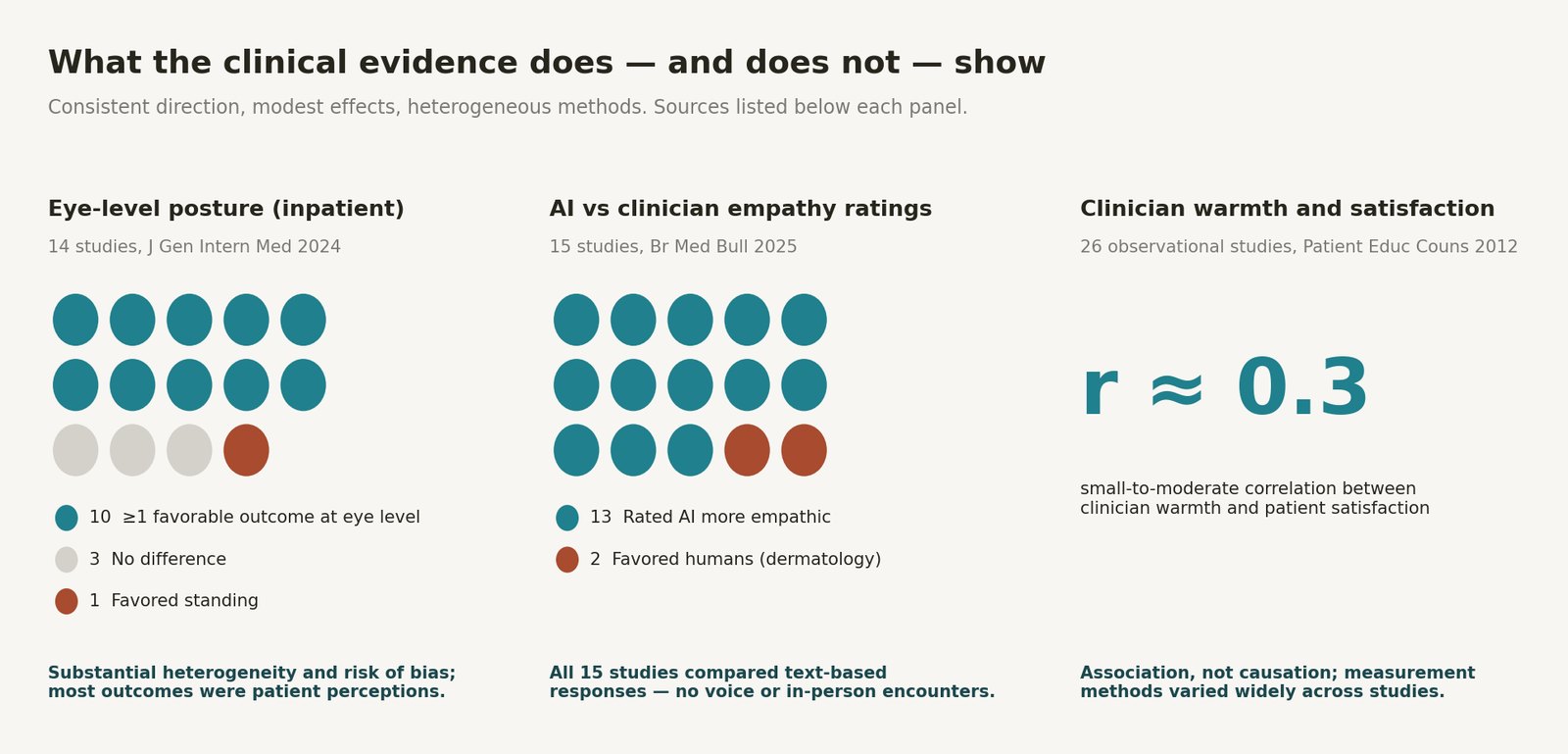
Warmth and listening. A 2012 systematic review and meta-analysis in Patient Education and Counseling pooled 26 observational studies, most in U.S. primary care. Clinician warmth and attentiveness were associated with higher patient satisfaction, with a small-to-moderate correlation of about 0.3, and the relationship held across studies that assessed vocal tone, general affect, and body language. The authors also noted significant variation in study design and in how nonverbal behavior was measured (Henry et al., Patient Educ Couns 2012). The UK’s NICE evidence update summarized the finding simply: listening, warmth, and avoiding negativity are associated with improved satisfaction (NICE evidence update).
Body language in the primary care office. An earlier systematic review of physician-patient communication in primary care identified 8 nonverbal studies and found head nodding, forward lean, direct body orientation, and uncrossed arms and legs among the behaviors positively associated with outcomes. It also found, somewhat counterintuitively, that less mutual gaze was associated with better outcomes in some studies, and the authors emphasized a lack of consensus on what to measure and conflicting findings (Beck et al., J Am Board Fam Pract 2002). I find that gaze result useful precisely because it is inconvenient. Nonverbal communication is not a checklist where more eye contact is always better. Context matters.
Sitting down. A 2024 systematic review in the Journal of General Internal Medicine looked at clinician posture at the hospital bedside across 14 studies, including 6 randomized trials. Ten of the 14 reported at least one favorable outcome when clinicians communicated at the patient’s eye level; three found no difference; one favored standing. The authors flagged substantial heterogeneity and risk of bias (Houchens et al., J Gen Intern Med 2024; Michigan Medicine).
Professional guidance. The American College of Obstetricians and Gynecologists’ December 2025 committee statement on effective patient-physician communication includes a mnemonic for nonverbal cues that demonstrate empathy: Eye contact, Muscles of facial expression, Posture, Affect, Tone of voice, Hearing the whole patient, and Your response (ACOG Committee Statement, 2025). Notice how few of those seven letters live in the words themselves.
Where language models fit, and what they cannot see
Now the AI side. You may have seen the headlines that chatbots are rated as more empathic than physicians. Those findings are real. A 2025 systematic review and meta-analysis in the British Medical Bulletin found that in 13 of 15 studies, AI chatbot responses were rated more empathic than those of human clinicians (Howcroft et al., Br Med Bull 2025). A 2026 systematic review and meta-analysis in JMIR included 10 studies and concluded that LLM-based tools can produce more empathetic, detailed, and understandable responses, while noting that the evidence was predominantly cross-sectional and that no randomized trials specifically testing effects on communication outcomes were found (Richter et al., JMIR 2026).
Here is the detail that rarely makes the headline. In the empathy meta-analysis, the authors point out that all of the included studies analyzed text-based interactions, and that this is a problem because empathy in consultations often relies on both verbal and nonverbal cues such as nodding and leaning forward (Howcroft et al., preprint). These studies measure the quality of a written reply. They do not measure the relationship between two people in a room.
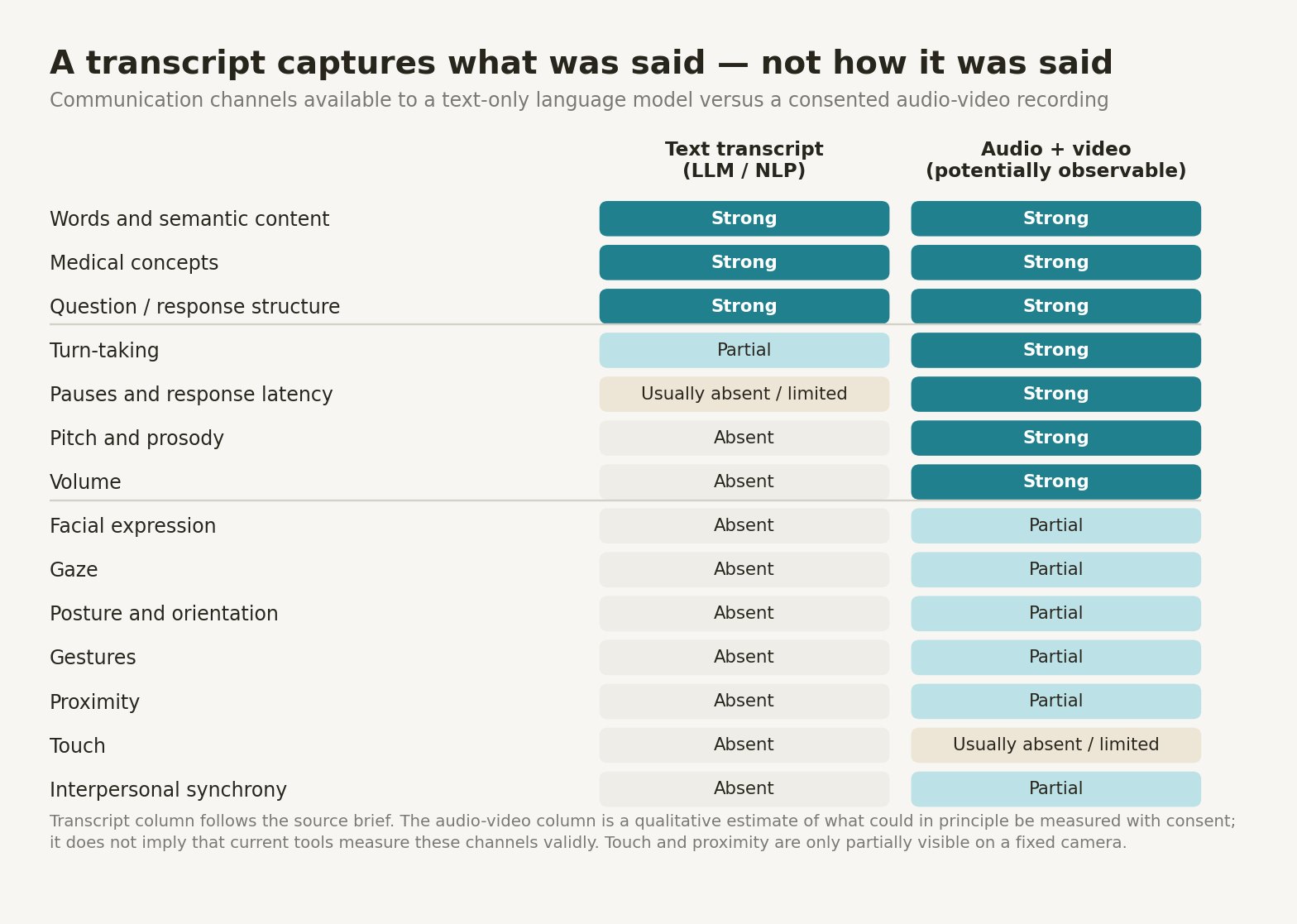
That is why I draw a distinction between linguistic empathy and embodied empathy. They are not necessarily the same phenomenon. A model can write a beautifully compassionate paragraph. It cannot, from text, notice that the patient went quiet for four seconds after hearing the word “recurrence,” or that the clinician answered while looking at the monitor. A 2026 commentary in npj Digital Medicine puts the risk well: promoting automated empathy risks fostering “empty empathy talk” — language devoid of relational depth and embodied meaning — and uncritical reliance on it may weaken clinicians’ own empathic skills (npj Digital Medicine 2026).
I do not read any of this as an argument against AI. I read it as a map of where AI is strong (language, structure, drafting, recall) and where the human in the room is still irreplaceable (presence, attention, and the moment-to-moment reading of another person). Put those together deliberately and you get something better than either alone.
The wrong way to add cameras and microphones
The obvious next step is multimodal AI: models that listen to voice and watch video, not just read transcripts. That is where the opportunity is, and it is also where it would be easy to build something harmful.
The worst version is a dashboard that tells a physician, “Your empathy score is 73.” A single number gives no time, no context, and nothing to practice. Worse, it pretends to read emotions from faces, which the science does not support well. A major review in Psychological Science in the Public Interest concluded that people do not reliably express specific emotions through a fixed set of facial movements, so inferring someone’s emotional state from their face alone is far less straightforward than many technologies assume (Barrett et al., 2019). Regulators have noticed: the European Union’s AI Act prohibits AI systems that infer emotions of people in workplaces and educational institutions, except for medical or safety reasons (EU AI Act, Article 5). A clinician training tool is both a workplace and an educational tool, so this matters for anyone designing one.
The better version describes observable behaviors at specific moments, and leaves the interpretation to a human coach.
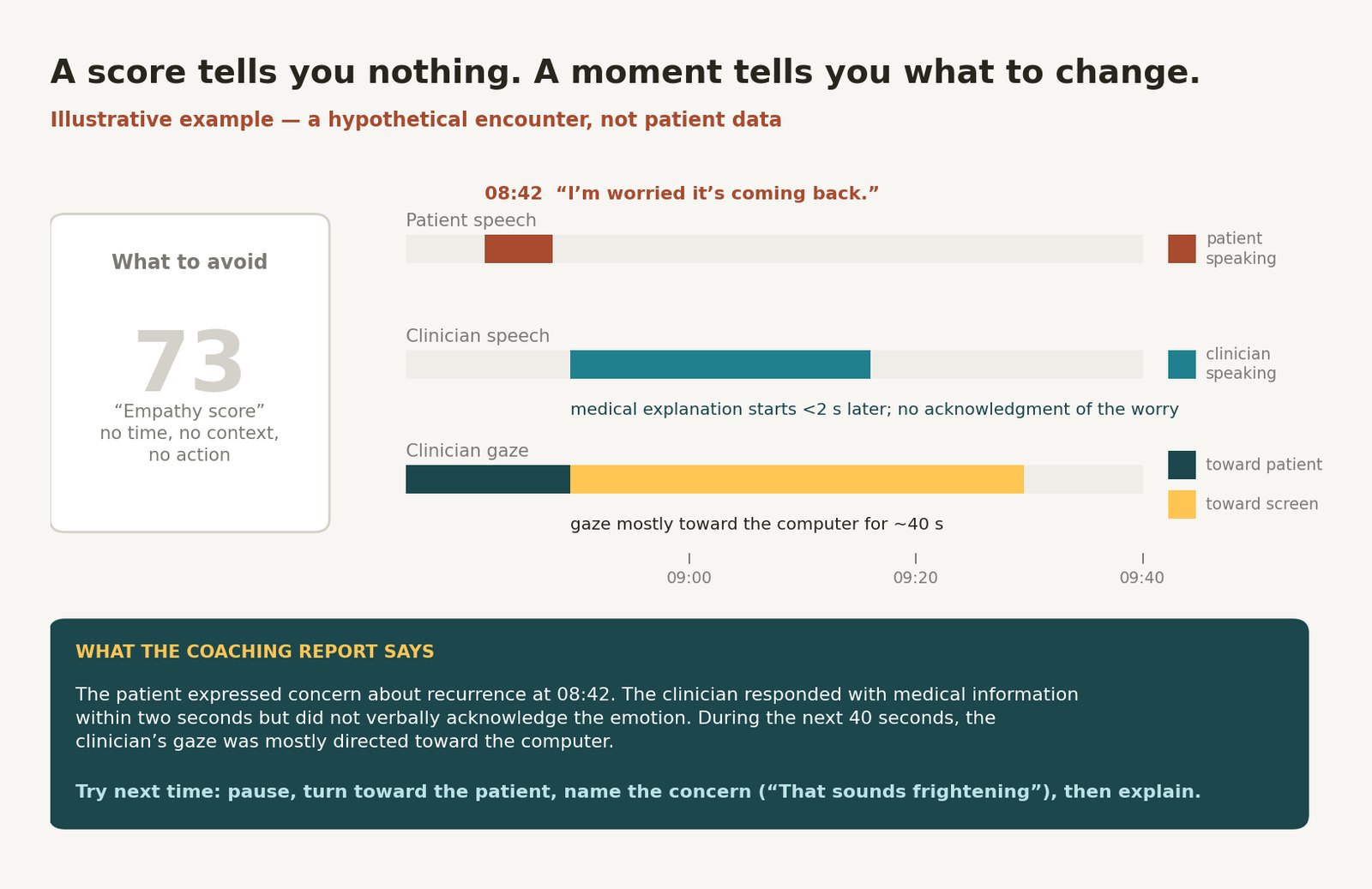
Compare “your empathy score is 73” with this: The patient expressed concern about recurrence at 08:42. The clinician responded with medical information within two seconds but did not verbally acknowledge the emotion. During the subsequent 40 seconds, the clinician’s gaze was predominantly directed toward the computer. Every physician I know could do something with that sentence tomorrow morning.
A coaching loop, not a judge
Here is the framework I think the field should build toward. Human communication feeds consented multimodal sensing; AI analysis surfaces specific moments; a clinician coach reviews them with the learner; and the learner brings better habits into the next real encounter.
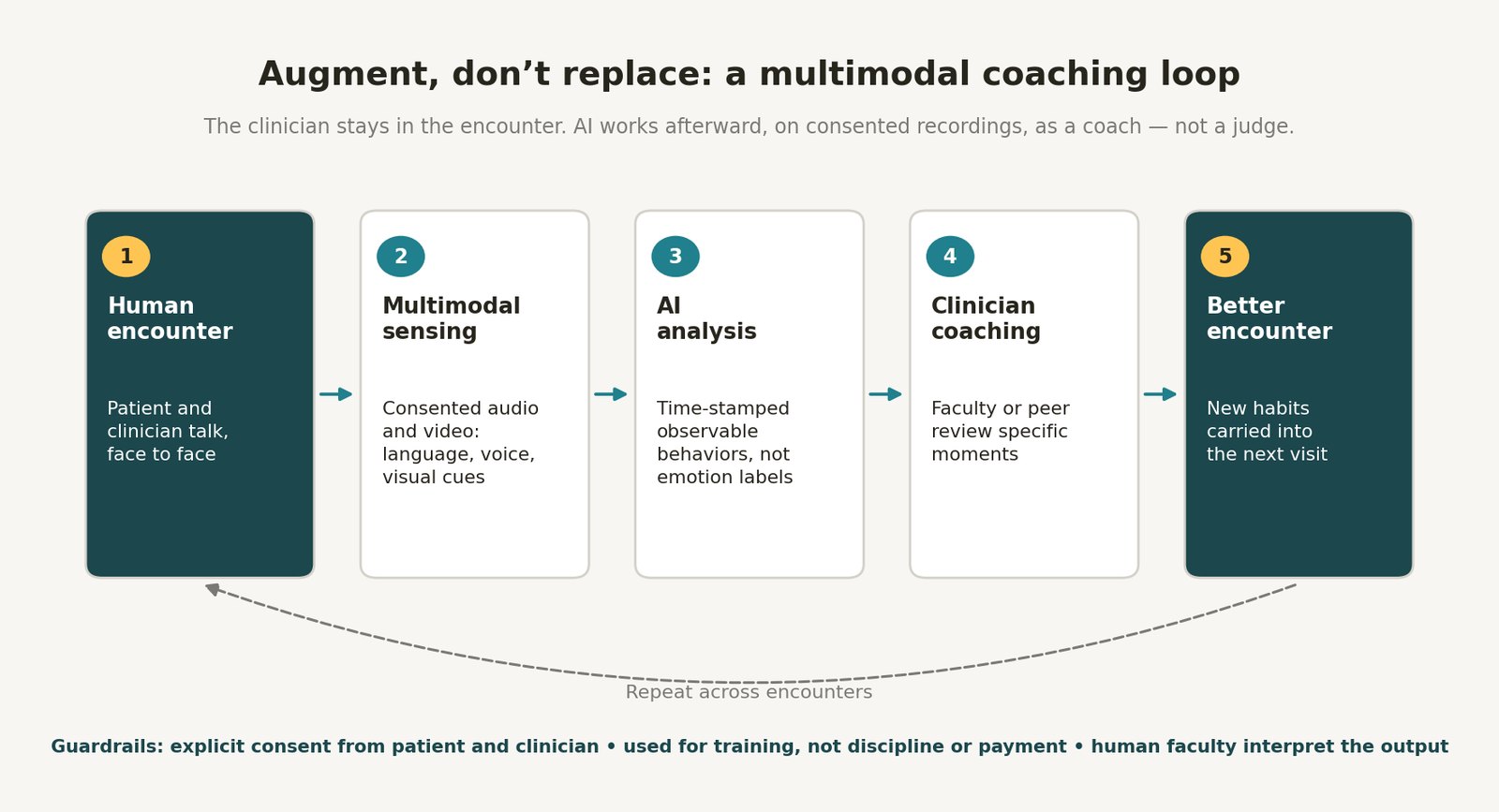
The analysis layer would look across four domains:
- Language: empathy statements, open-ended questions, clarity of explanations, teach-back, interruptions, and shared decision-making.
- Voice: speaking rate, pauses, conversational dominance, prosody, and vocal affect.
- Visual: gaze direction, facial movement, posture, body orientation, and gesture.
- Interaction dynamics: speaking-time ratio, response latency, interruptions, synchrony, and what happens immediately after a patient makes an emotional statement.
None of those require the machine to decide whether a clinician “cares.” They require it to notice, with timestamps, what happened, so that a human teacher can ask the question that actually changes behavior: what were you thinking at 08:42, and what would you do differently?
Guardrails I would insist on
- Consent from everyone in the room. Recording a clinical encounter involves protected health information. Patients and clinicians must opt in explicitly, with clear data-retention and privacy terms.
- Training, not discipline or pay. The moment coaching data is used to rank, punish, or compensate clinicians, people will perform for the camera instead of the patient.
- Behaviors, not emotion labels. Report gaze direction and response latency; do not claim to detect sadness, anger, or “empathy.”
- Validate across people. Norms for eye contact, touch, and personal space vary by culture, age, and disability. Tools must be tested for accuracy and bias across diverse patients and clinicians before anyone trusts their output.
- A human interprets. Faculty and peer coaches decide what a moment means. The AI points; the human teaches.
- The evidence is still early. We do not yet have trials showing that AI-assisted multimodal coaching improves patient outcomes. This is a design proposal to be tested, not a proven intervention.
What this means for patients, and for how we train physicians
For patients, the practical takeaway is reassuring. The parts of a visit that make you feel heard — someone sitting at your eye level, turning toward you, pausing when you say something frightening — are not soft extras. They are part of the care, and there is reasonable evidence that they matter to how patients experience it. When I use AI in my own practice, the goal is to take clerical work off the clinician so more of the visit can be spent on exactly those things, not to put a screen between us.
For medical education, this is the problem I care about most. Through Future Physician Academy, I am working on how to prepare the next generation of physicians to practice alongside AI: to let the machine handle what it does well, and to get deliberately better at the human skills it cannot replace. Organizations such as the Healthcare Experience Foundation, which works with more than 700 healthcare organizations on patient experience and provider-patient relationships (Business Wire), already understand that communication is a trainable clinical skill. Multimodal AI, used carefully, could give that kind of coaching far more specific moments to work with.
Where I land
Clinical communication is inherently multimodal. Language models are increasingly capable of understanding and generating the verbal component, but text alone eliminates several channels through which patients and clinicians communicate attention, emotion, empathy, and engagement.
The next generation of healthcare communication AI should therefore augment, not reduce, the human encounter by helping clinicians recognize and improve these multimodal behaviors. The goal is clinician training, not automated judgment. That is what I mean when I say the best healthcare will be delivered by humans augmented by AI.
If you want care built around that kind of attention, or you are a clinician or educator interested in this work, you can reach out and book a consultation here.
Key sources referenced in this article
- Lapakko D. Communication is 93% nonverbal: an urban legend proliferates. Communication and Theater Association of Minnesota Journal. Summer 2007:8–19. Full text. Original studies: Mehrabian A, Wiener M. J Pers Soc Psychol. 1967;6:109–114; Mehrabian A, Ferris SR. J Consult Psychol. 1967;31:248–252.
- Henry SG, Fuhrel-Forbis A, Rogers MAM, Eggly S. Association between nonverbal communication during clinical interactions and outcomes: a systematic review and meta-analysis. Patient Educ Couns. 2012;86(3):297–315. ScienceDirect.
- National Institute for Health and Care Excellence. Patient experience in adult NHS services: evidence update. NICE.
- Beck RS, Daughtridge R, Sloane PD. Physician-patient communication in the primary care office: a systematic review. J Am Board Fam Pract. 2002;15(1):25–38. JABFM.
- Houchens N, Engle JM, Palanjian R, et al. Effect of clinician posture on patient perceptions of communication in the inpatient setting: a systematic review. J Gen Intern Med. 2024;39(16):3290–3298. doi:10.1007/s11606-024-08906-4. PMC11618274.
- American College of Obstetricians and Gynecologists. Effective patient-physician communication. Committee Statement, December 2025. ACOG.
- Howcroft A, Bennett-Weston A, Khan A, Griffiths J, Gay S, Howick J. AI chatbots versus human healthcare professionals: a systematic review and meta-analysis of empathy in patient care. Br Med Bull. 2025;156(1):ldaf017. doi:10.1093/bmb/ldaf017; preprint arXiv 2602.05628.
- Richter S, Buszello CH, Prem M, et al. Impact of large language model–based AI tools on physician-patient communication: systematic review and meta-analysis. J Med Internet Res. 2026;28:e77307. JMIR.
- The risk of empty empathy talk and challenges of automated empathy in healthcare communication. npj Digit Med. 2026. Nature.
- Barrett LF, Adolphs R, Marsella S, Martinez AM, Pollak SD. Emotional expressions reconsidered: challenges to inferring emotion from human facial movements. Psychol Sci Public Interest. 2019;20(1):1–68. PubMed 31313636.
- Regulation (EU) 2024/1689 (Artificial Intelligence Act), Article 5: prohibited AI practices, including emotion inference in workplaces and education institutions. EU AI Act, Article 5.
- Healthcare Experience Foundation. healthcareexperience.com; NRC Health and Healthcare Experience Foundation partnership announcement, June 2026, Business Wire.