A brief, controlled, low-oxygen “workout”
Every few months a patient asks me about a hypoxia chamber, an altitude mask, or a clinic offering “intermittent hypoxia therapy” for longevity or performance. My honest answer used to be a hedge. It no longer is, because the human evidence base has actually caught up enough to say something specific: intermittent hypoxia therapy, done at the right dose, in the right patient, for the right duration, produces measurable and in some cases fairly convincing benefits in aerobic capacity, cognitive function, and possibly metabolic health.
That sentence has a lot of qualifiers in it, and I mean every one of them. Intermittent hypoxia therapy (IHT), sometimes delivered as intermittent hypoxic-hyperoxic training (IHHT), is not a wellness fad dressed up in physiology language. It is a real, testable clinical intervention with a real, testable dose-response relationship — and, uncomfortably, it shares a root mechanism with one of the more damaging processes in medicine: the chronic intermittent hypoxia of untreated obstructive sleep apnea (OSA).
That overlap is the reason I am writing this piece the way I am. Before I walk through what the training and cognitive data show, I want to be explicit about what IHT is not, because getting that distinction wrong is how a physiologically sound intervention becomes a dangerous one.
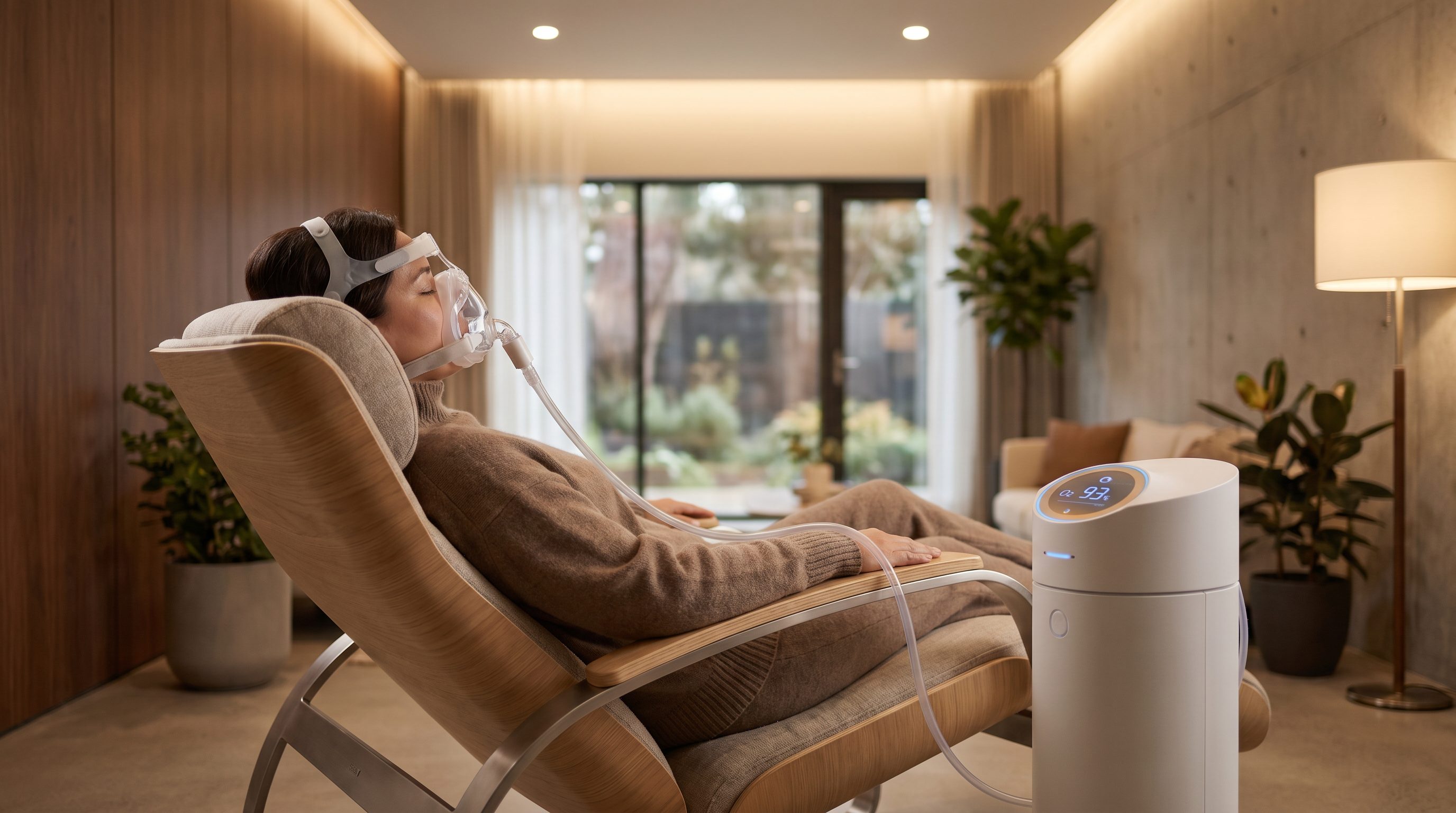
Here is the plain description first. IHT alternates brief bouts — typically three to seven minutes — of breathing air with a reduced oxygen fraction (roughly 10–15% FiO₂, equivalent to an altitude of about 5,000–6,500 meters) with recovery bouts of room air or oxygen-enriched air (around 33% FiO₂). A full session runs three to five cycles, delivered three to five times a week for three to eight weeks, through a fitted mask connected to an air-blending device, in a clinic, at sea level, while the patient is awake and monitored.
Why the dose is the whole story
This is the section I want every reader to sit with, because it is the safety-defining point of this entire article.
Therapeutic IHT is minutes long, delivered while the patient is awake, at a controlled and verified FiO₂, with a physiological recovery period built into every cycle, a handful of times a week, for a handful of weeks. Chronic intermittent hypoxia (CIH) from untreated obstructive sleep apnea is hundreds of desaturation-reoxygenation events per night, every night, for years, occurring while the patient is unconscious and unable to protect their own physiology. The molecular pathway both processes touch — HIF-1α signaling, sympathetic activation, oxidative stress — is the same. The dose, duration, frequency, and context are opposite, and in pharmacology and physiology alike, dose is what turns a stimulus into either an adaptation or an injury.
The chronic intermittent hypoxia literature from sleep medicine is unambiguous: years of nocturnal desaturation drive sympathetic overactivation, endothelial dysfunction, and HIF-1α-mediated systemic inflammation, and that chronic intermittent hypoxia burden is a well-established contributor to the cardiovascular morbidity seen in untreated OSA (2023 review on OSA-related cardiovascular harm; cardiovascular implications of intermittent hypoxia). That is real harm, well documented, and it is exactly why I lead with this distinction rather than bury it in a methods paragraph.
Here is the principle in one sentence, borrowed directly from pharmacology: the same molecule can be the poison and the medicine, and the only variable that decides which one you get is dose. A brief, awake, monitored, controlled hypoxic exposure with a built-in recovery interval is a physiological training stimulus. Hundreds of unmonitored, unconscious desaturations a night is a disease process. Because of this, patients with untreated or unaddressed OSA should not be enrolled in an IHT program — full stop, no exceptions, until the sleep-disordered breathing itself is diagnosed and treated.
What the human evidence actually shows
With the dose distinction on the table, here is what the published human data actually demonstrates — graded honestly by study type, because a randomized trial and a pilot signal are not the same tier of evidence.
Aerobic capacity and performance
A 2023 meta-analysis pooling controlled trials of intermittent hypoxic training found a weighted mean difference in VO₂max of +3.20 mL/kg/min (95% CI 1.33–5.08) versus control, alongside a modest hemoglobin increase of about +0.25 g/dL. That effect held across both trained and untrained adults, and the magnitude is roughly comparable to what you would expect from adding a moderate additional endurance training block — a meaningful, if not extraordinary, physiological gain.
Cognitive function in older adults
This is where the signal gets more interesting to me clinically. A 2024 systematic literature review found that IHT and IHHT improved cognitive function in both healthy and cognitively impaired older adults across seven published studies plus five registered trials — twelve out of twelve studies pointing the same direction is a consistent signal, though systematic reviews of heterogeneous small trials still call for caution before generalizing.
The strongest single study is a 2017 randomized controlled trial by Bayer and colleagues in 34 geriatric patients aged 64–92, comparing multimodal training plus IHHT against multimodal training plus sham. The IHHT group improved on the DemTect cognitive screen by +16.7% versus −0.39% in the sham group (P<0.001), with additional gains on clock-drawing and the six-minute walk test. That is a real RCT with a real control arm, which is why I weight it heavily.
In mild cognitive impairment specifically, a 2019 trial by Serebrovska and colleagues used a three-week IHHT protocol (five minutes at 12% O₂ alternating with three minutes at 33% O₂, four cycles per session, fifteen sessions total) and found an 11% improvement in MoCA score, along with reductions in amyloid-beta expression and neutrophil extracellular traps. Effects persisted at one-month follow-up, which is a meaningfully longer durability window than most short-course interventions manage to demonstrate.
A smaller 2020 pilot study by Wang and colleagues in amnestic MCI, using 10% O₂ alternating with room air across eight cycles, three sessions a week for eight weeks, found improved cerebral oxygenation and vasodilation alongside short-term memory and attention gains. I want to be precise about what this is: a pilot study, not a powered RCT, and I am treating it as a supportive signal rather than confirmatory evidence.
Metabolic effects
The metabolic data is the thinnest of the four domains, and I want to say that plainly rather than oversell it. A 2025 crossover trial in type 2 diabetes found that a single session of acute intermittent hypoxia improved insulin sensitivity relative to sham during an oral glucose tolerance test. That is a physiological signal from an acute exposure — it is not a chronic outcome trial, and it says nothing yet about whether repeated sessions produce a durable change in HbA1c or long-term glycemic control. The 2024 systematic review referenced above also cites reduced fasting glucose in some prediabetes cohorts, but I would not counsel a patient to expect a metabolic-syndrome-altering effect from IHT alone based on what exists today.
Cardiovascular and cerebrovascular effects
A 2022 systematic review of IHNT/IHHT programs in elderly patients with existing cardiovascular disease found the interventions were safe and produced favorable effects on heart rate and blood pressure, with no consistent adverse hematologic or lipid signal — reassuring, though it should be read as a safety-and-feasibility signal in a screened population, not a cardiovascular outcomes trial. Separately, a 2024 study found that IHT improved cerebral blood flow in healthy participants with no measurable cognitive decrement during or after the protocol.
“Twelve out of twelve cognitive studies pointing the same direction is a real signal. It is not yet a chronic outcomes trial, and I say so to every patient who asks.”
What the mechanisms suggest — and where to be careful
The proposed biology behind IHT runs through a small number of overlapping pathways: HIF-1α stabilization, vascular endothelial growth factor (VEGF) upregulation, erythropoietin release, mitochondrial biogenesis, angiogenesis, and a broader redox-conditioning effect on cellular stress-response systems. A 2019 review in Experimental & Molecular Medicine on hypoxia and aging lays this out clearly: mild, intermittent hypoxic exposure activates adaptive, protective pathways, while sustained or severe hypoxia depletes and overwhelms those same pathways rather than reinforcing them.
That is the mechanistic mirror of the clinical dose distinction I opened with. The chronic intermittent hypoxia literature from OSA documents genuine cardiovascular harm from years of severe, unmonitored, nocturnal desaturation — and I want to be unambiguous that this literature is not evidence against short-course, supervised, clinical IHT. It is evidence for exactly the opposite conclusion: keep the protocol short, keep it supervised, and screen out the patients for whom the exposure would land on the harmful end of that dose curve rather than the adaptive end.
Where I currently stand for our patients
Given the evidence above, here is how I currently think about candidacy, screening, and protocol design for patients asking about IHT at Pravida Health.
Reasonable candidates include patients with a defined aerobic performance goal, mild cognitive complaints without a dementia diagnosis, prediabetes or metabolic-syndrome-focused longevity patients, and athletes returning from injury who want a supervised aerobic-conditioning adjunct.
- Untreated obstructive sleep apnea
- Uncontrolled hypertension
- Unstable angina
- Recent myocardial infarction or stroke
- Active pulmonary disease
- Pregnancy
- Uncontrolled arrhythmias
- Hemoglobinopathies
Before anyone starts, our screening includes a sleep study if there is any history of snoring, witnessed apnea, or elevated BMI risk, a resting ECG, a blood pressure check, a hemoglobin level, and a symptom-limited exercise assessment when clinically indicated. This is not an optional formality — it is the mechanism by which we keep a patient on the adaptive side of the dose curve rather than the harmful side.
The protocol I lean toward clinically is intermittent hypoxic-hyperoxic training: hypoxic intervals at 10–12% FiO₂ alternating with hyperoxic recovery, thirty to forty minutes per session, three times a week for four to six weeks, followed by re-evaluation against the patient’s baseline goal — VO₂max, a cognitive screen, or a metabolic marker, depending on why they started.
What we don’t yet know
I think it is just as important to be honest about the open questions as it is to summarize the positive findings. We do not yet have a clear optimal dose-response curve separating what is ideal for cognitive endpoints versus cardiovascular endpoints versus metabolic endpoints — the protocols in the literature vary meaningfully in FiO₂, cycle length, and total session count. We do not know whether benefits persist beyond three to twelve months without some maintenance dosing schedule; most trials simply did not follow patients that long. We do not know how IHT interacts with resistance training, GLP-1 receptor agonists, or other longevity interventions patients are commonly combining it with. And we do not have a long-term safety signal in healthy patients without underlying disease, because the existing trials are short and the populations are relatively small.
The practical framework we use in Atlanta
In practice, our approach follows five steps: a screening intake covering sleep, cardiac, pulmonary status, hemoglobin, and current medications; a baseline VO₂max or six-minute walk test, plus a cognitive baseline if that is the target outcome; supervised sessions with continuous SpO₂, heart rate, and blood pressure monitoring throughout; re-testing at four to six weeks to decide whether the intervention is producing a measurable effect for that specific patient; and, if an effect is present, maintenance sessions roughly every three to four months rather than indefinite continuous dosing.
I also tell every patient the same thing before they start: IHT is never a substitute for the fundamentals. Sleep, resistance training, adequate protein intake, and a cardiorespiratory base built through conventional training remain the foundation. IHT is, at best, a supervised adjunct on top of those fundamentals — not a replacement for any of them.
Curious whether intermittent hypoxia therapy fits your goals?
Dr. Turner reviews your cardiopulmonary history, sleep status, and performance or cognitive goals, and explains honestly whether a supervised IHT/IHHT protocol makes sense for you — and screens for the conditions that would make it inappropriate.
Book a ConsultationCall 404.900.7371 · info@pravida.com
Frequently Asked Questions
Is intermittent hypoxia the same thing as sleep apnea?
No, and this distinction is the most important thing in this entire article. Obstructive sleep apnea produces chronic intermittent hypoxia: hundreds of unconscious desaturation events per night, for years, with no supervision and no recovery dose control. Therapeutic IHT is a brief, awake, monitored, dose-controlled exposure delivered a few times a week for a few weeks. Same physiological stimulus in name only — the dose, duration, and context are opposite, and that is exactly why untreated OSA is a contraindication to IHT rather than a reason to try it.
Can I do this at home with an altitude mask?
I would not recommend it without medical screening and supervision first. The protocols in the published trials use calibrated air-blending devices that deliver a precise, verified FiO₂ with continuous pulse oximetry, and most excluded people with unscreened cardiopulmonary disease or sleep-disordered breathing. A consumer altitude mask with no gas monitoring and no screening removes the safety margin that makes the clinical data look good in the first place. If you want to try IHT, start with a screening visit, not a mail-order mask.
Will it make me anemic or hurt my heart?
The published short-course protocols have generally not shown harmful hematologic or cardiovascular effects; a 2023 meta-analysis actually found a small hemoglobin increase (about +0.25 g/dL) alongside the VO₂max gain, and a 2022 systematic review in elderly cardiovascular disease patients found IHNT/IHHT programs were safe on heart rate and blood pressure with no consistent adverse lipid or hematologic signal. That is reassuring for short, supervised, screened courses. It is not permission to run hypoxic sessions indefinitely or unsupervised, and it says nothing about people with unscreened cardiopulmonary disease, which is precisely the population these studies excluded.
How long before I know if it's working?
Most positive trials used protocols lasting three to eight weeks, three to five sessions per week, with outcomes measured at the end of that block. Cognitive gains in the Serebrovska et al. 2019 trial were measurable at three weeks and persisted at one month; the Bayer et al. 2017 geriatric RCT saw significant DemTect and walk-test gains over a defined multi-week course. My practical answer: plan on a four-to-six-week course with a baseline and a re-test, not a single session, before drawing any conclusion about whether it is doing anything for you specifically.
Do you offer intermittent hypoxia therapy at Pravida Health?
We evaluate candidacy for IHT/IHHT as part of our longevity and performance programs, with screening for sleep-disordered breathing, cardiac and pulmonary status, and hemoglobin before anyone starts. If you are a reasonable candidate — an aerobic performance goal, mild cognitive complaints without dementia, or a metabolic-longevity focus — we can discuss a supervised, monitored protocol and what re-testing at four to six weeks would look like for your goals. Questions about candidacy can be discussed in a consultation.
References
- Intermittent hypoxic training meta-analysis on VO₂max and hemoglobin, 2023. Available at: 2023 IHT VO₂max meta-analysis
- Boulares and colleagues, systematic literature review of IHT/IHHT cognitive outcomes in older adults, 2024. Available at: 2024 systematic review, IHT/IHHT cognitive outcomes in older adults
- Bayer et al., randomized controlled trial of multimodal training plus IHHT in geriatric patients, 2017. Available at: Bayer et al. 2017 geriatric IHHT RCT
- Serebrovska et al., three-week IHHT protocol in mild cognitive impairment, 2019. Available at: Serebrovska et al. 2019 IHHT in mild cognitive impairment
- Wang et al., pilot study of IHT in amnestic mild cognitive impairment, 2020. Available at: Wang et al. 2020 IHT pilot study in amnestic MCI
- Newsom et al., crossover trial of acute intermittent hypoxia and insulin sensitivity in type 2 diabetes, 2025. Available at: 2025 crossover trial, acute intermittent hypoxia and insulin sensitivity in T2D
- Behrendt et al., systematic review of IHNT/IHHT safety in elderly cardiovascular disease patients, 2022. Available at: Behrendt et al. 2022 elderly CVD IHHT safety review
- Review of hypoxia signaling and aging biology, Experimental & Molecular Medicine, 2019. Available at: 2019 Nature Exp Mol Med review, hypoxia and aging
- Study of IHT effects on cerebral blood flow in healthy participants, 2024. Available at: 2024 IHT cerebral blood flow study
- Review of cardiovascular harm from OSA-related chronic intermittent hypoxia, 2023. Available at: OSA / chronic intermittent hypoxia cardiovascular harm review
- Review of the cardiovascular implications of intermittent hypoxia. Available at: Cardiovascular implications of intermittent hypoxia