
A new category of medicine
When patients walk into my practice with chronic low back pain, the treatment conversation has historically had three tiers: pharmacologic (NSAIDs, muscle relaxants, occasionally short-course opioids), procedural (image-guided injections, orthobiologic interventions like PRP or BMAC, sometimes surgery), and rehabilitative (physical therapy, movement retraining, cognitive behavioral therapy). What I did not expect five years ago is that a fourth tier — a prescription-use, self-administered, in-home digital therapeutic delivered through a virtual reality headset — would earn an FDA De Novo authorization and produce two-year durable pain reductions in sham-controlled trials. But that is exactly what happened.
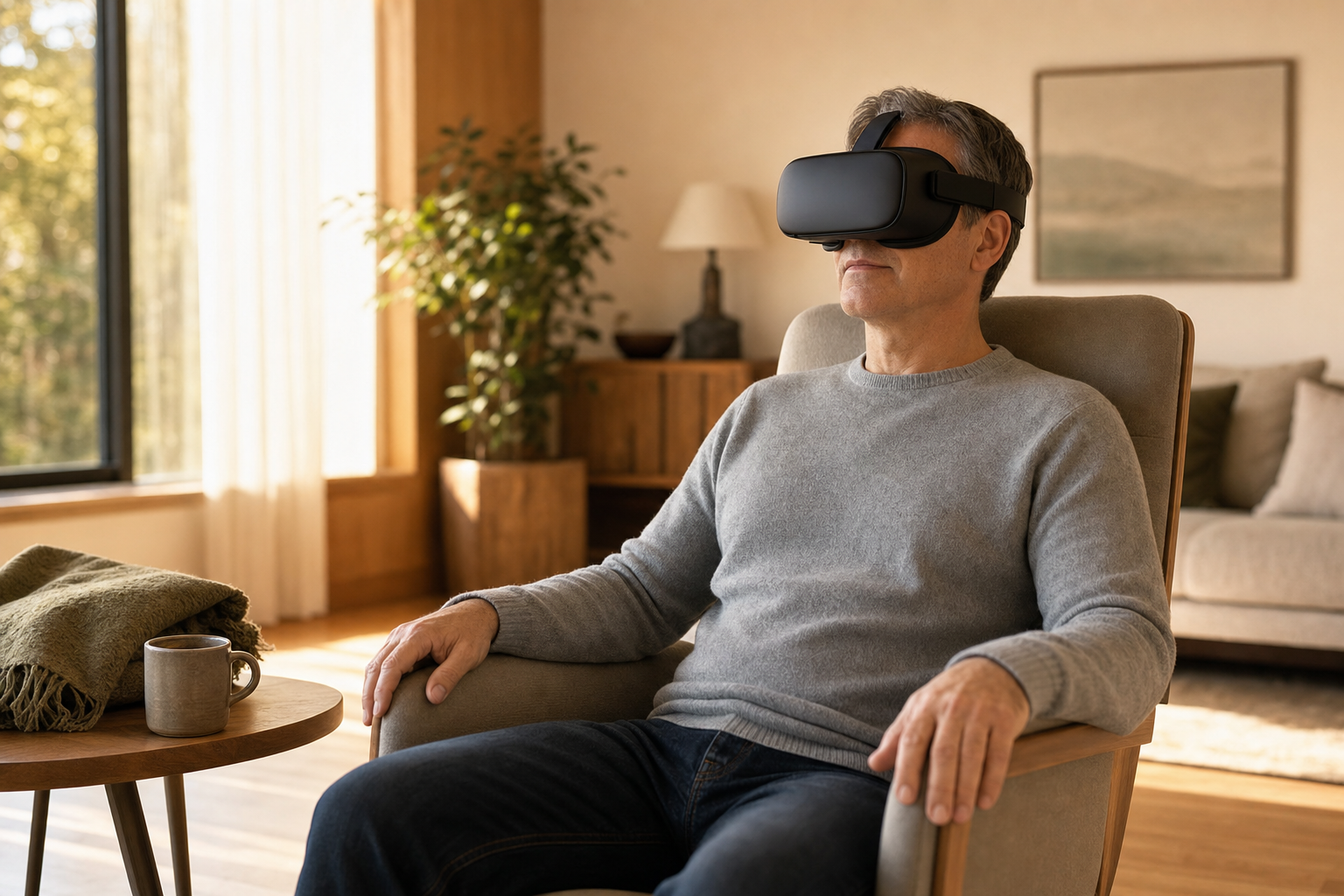
The product is RelieVRx, developed by AppliedVR, authorized by the FDA in November 2021 as the first in-home immersive virtual reality treatment for chronic lower back pain in adults. It is not a distraction game. It is a structured 56-session, eight-week behavioral skills program delivering cognitive behavioral therapy, diaphragmatic breathing, interoceptive biofeedback, mindfulness, and pain-neuroscience education inside an immersive VR environment. Each session runs about six minutes. It is prescription-only. It is self-administered at home.
I read the RelieVRx literature the way I read any new intervention that could plausibly reduce opioid exposure in my patients: with the pivotal trial protocol on one screen and a running list of questions on the other. This post walks through the mechanism, the two large randomized sham-controlled trials that support the FDA authorization and the real-world effectiveness claim, the honest limitations, and how I think about immersive therapeutics inside a regenerative and physical medicine care plan.
The pain-neuroscience mechanism
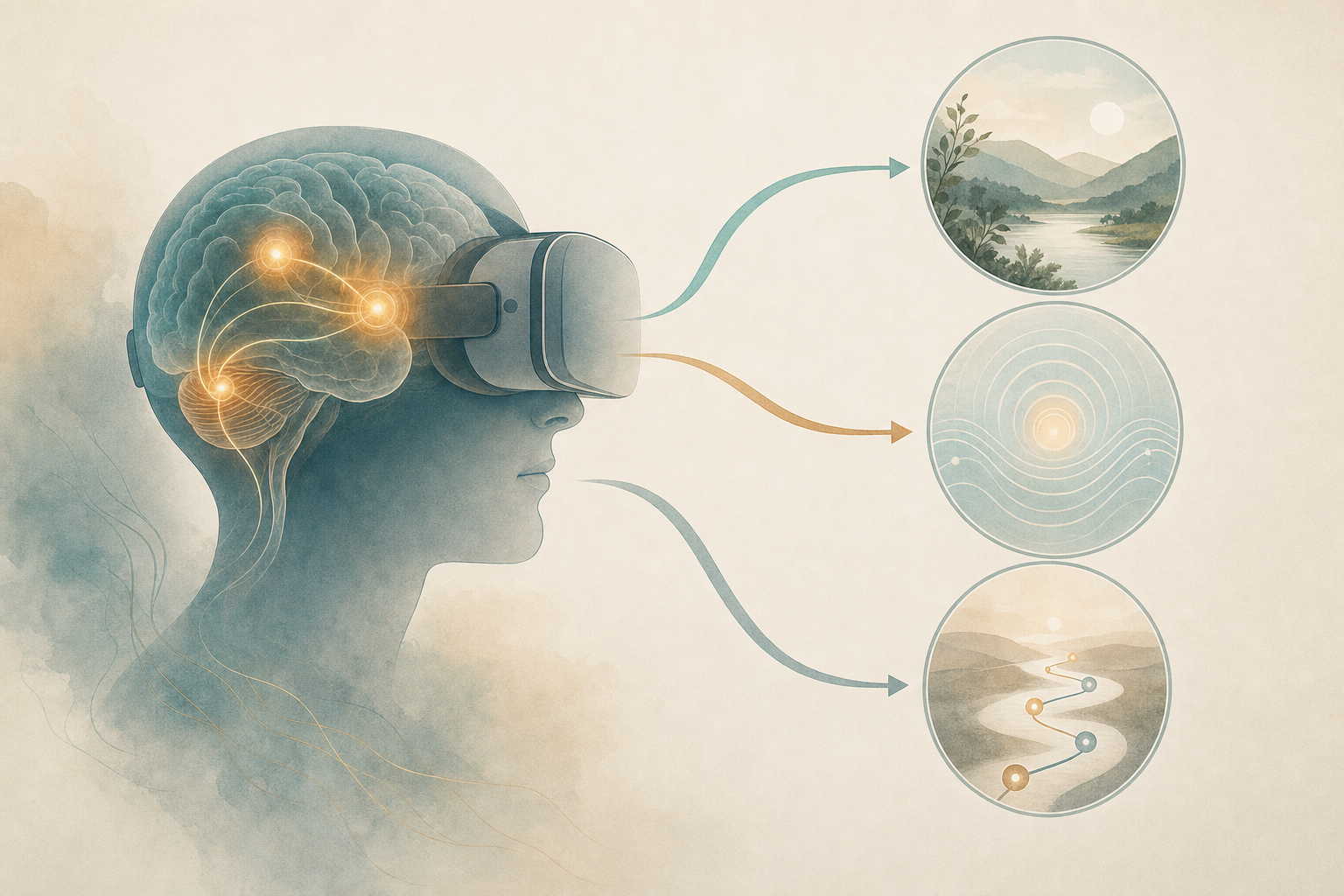
Chronic pain is not simply a longer version of acute pain. It is a rewired signaling state in which the same nociceptive inputs get amplified through central sensitization — changes in the thalamus, insula, anterior cingulate cortex, prefrontal cortex, and their descending modulatory circuits. Once that rewiring is in place, treatment strategies aimed only at peripheral tissue often plateau. The strongest chronic-pain interventions we have historically had — cognitive behavioral therapy, pain-neuroscience education, graded exposure, and mindfulness-based stress reduction — all work by re-engaging those central circuits. The problem has never been that they do not work. The problem has been that most patients cannot get consistent, daily access to them.
That is the specific gap the RelieVRx protocol is engineered to fill. The 56-session program compresses the therapeutic components of a multi-week outpatient CBT-for-pain protocol into six-minute daily immersive experiences delivered at home. Immersion serves three coupled functions: it competes for attentional bandwidth in a way a phone app or workbook cannot, it delivers paced breathing and biofeedback in a sensory-rich environment that raises engagement, and it repeats skills across enough sessions to actually build the behavioral habits that predict durable improvement. This is the “why VR, not just an app” answer.
The mechanism is not only theoretical. In a separate but conceptually adjacent randomized trial, Ashar and colleagues 2024 in Pain tested a neuroscience-based VR therapy against a waitlist control in 61 participants with chronic back pain and included pre- and post-treatment MRI. They found reduced pain intensity (Hedges’ g = 0.63) and pain interference (g = 0.84) at post-treatment and two-week follow-up, partially mediated by reduced kinesiophobia and pain catastrophizing. And they found measurable brain-network changes — increased dorsomedial prefrontal functional connectivity with somatomotor, anterior prefrontal, and visual cortices, and decreased white matter fractional anisotropy in the corpus callosum near the anterior cingulate. Small trial, preliminary imaging findings, but the direction of the biology matches the direction of the clinical benefit.
What the human trials actually show
The pivotal trial supporting the FDA De Novo authorization is Garcia, Birckhead, Krishnamurthy, and colleagues 2021 in the Journal of Medical Internet Research (JMIR) — a double-blind, remote, randomized, placebo-controlled trial of 188 community-based US adults with self-reported non-malignant low back pain of six or more months duration and average pain intensity of 4 or more out of 10. Participants were randomized 1:1 to the 56-day RelieVRx (then called EaseVRx) program or to a sham VR condition delivering 2D nature content through the same headset. The primary outcomes were between-group differences in pain intensity and pain-related interference with activity, mood, stress, and sleep from baseline to day 56.
RelieVRx was statistically superior to sham on every primary outcome (highest P = .009), with between-group Cohen d effect sizes of 0.40 to 0.49 — moderately clinically meaningful superiority over an active sham. The within-group pre-post effect sizes in the RelieVRx arm were large, 1.17 to 1.30, meeting moderate-to-substantial clinical importance for reduced pain intensity and reduced pain interference with activity, mood, and stress. Between-group superiority was also seen for physical function (P = .022) and sleep disturbance (P = .013). Sham-arm participants improved too — expectancy effects with VR are real — but the active treatment arm improved more.
The larger and more clinically relevant dataset is the 1,067-participant real-world effectiveness trial by Maddox and colleagues published in Mayo Clinic Proceedings: Digital Health in 2023 (NCT05263037). This was a decentralized, double-blind, sham-controlled trial in a nationally representative, demographically diverse, clinically severe sample — mean age 50.8 ± 13.2 years, over 70% women, with baseline pain intensity averaging 4.5 to 5.3 on a 0-10 scale. RelieVRx was again superior to a strong active sham. At day 56, the RelieVRx arm showed a clinically meaningful 2.0-point average reduction in pain intensity (95% CI 1.73-2.06) and a 2.3-point average reduction in pain interference (95% CI 1.99-2.33). The between-group differences over sham were smaller in absolute terms (0.406 for pain intensity, 0.523 for pain interference) but statistically robust, and the confidence intervals excluded zero for all primary endpoints.
The durability question is answered separately. In a 24-month follow-up published in Pain Medicine, Maddox and colleagues reported that RelieVRx pain reductions were sustained two years after the eight-week program ended. Two years of durability from an eight-week behavioral intervention is the specific finding that turned my read of this technology from “interesting distraction tool” into “prescribable therapy.” It is also the finding that makes the ~$100 billion annual US economic burden of chronic low back pain feel finally negotiable.
Where the evidence gets careful
I want to be honest about three things the marketing framing softens. First, the between-group differences over an active sham in the real-world trial were modest in absolute terms — a 0.4-point pain-intensity advantage on a 10-point scale is statistically significant and clinically defensible, but it is not the same story as the 2.0-point within-arm reduction that appears in the headline number. Both numbers are true. They answer different questions. The 2.0-point number is how much the RelieVRx arm improved. The 0.4-point number is how much of that improvement is attributable to the active therapy above and beyond the strong, immersive, sham-VR condition. Both matter clinically. Only one is the causal effect.
Second, the broader immersive VR chronic-pain literature is more heterogeneous than the RelieVRx trials suggest in isolation. A 2024 scoping review by Astek and colleagues concluded that immersive VR shows moderate effect on chronic pain versus no intervention, but effects roughly equivalent to standard rehabilitation in head-to-head comparisons in several trials. The RelieVRx sham-controlled evidence is unusually strong for the field — but the field as a whole is not yet uniformly positive, and long-term head-to-head comparisons with structured outpatient CBT-for-pain do not yet exist.
Third, RelieVRx is authorized for adults 18+ with chronic lower back pain lasting longer than three months. It is not authorized for acute low back pain, sciatica with red-flag features, radiculopathy that needs imaging or procedural evaluation first, or any other pain condition — despite that mechanism-related studies exist for fibromyalgia, spinal cord injury neuropathic pain, and chronic musculoskeletal pain generally. As with any pain intervention, appropriate diagnostic evaluation must come first. Chronic mechanical low back pain masquerades as many conditions that require different treatment paths — from lumbar radiculopathy to spondyloarthropathy to malignancy — and no immersive therapeutic replaces the clinical evaluation that rules those out.
What immersive therapeutics are, and what they are not
Immersive therapeutics are a category, not a single product. RelieVRx is the first FDA-authorized in-home VR therapy for chronic low back pain, but the wider category also includes hospital-based acute-pain distraction VR (for burn debridement, labor, oncology procedures), migraine VR, PTSD VR (Bravemind and successors), anxiety and phobia VR, and pediatric procedural VR. What they share is a design philosophy: use immersion, structured content, and repetition to change how the brain processes a specific class of input. What they are not is a video game, a meditation app in a headset, or a passive experience — the therapeutic value depends on the daily behavioral skill-building, not on the novelty of the visuals.
The clinical positioning I use with my own patients is this: RelieVRx is not a substitute for movement, load management, weight optimization, sleep, or when appropriate an orthobiologic or interventional procedure. It is a durable, non-pharmacologic, non-invasive adjunct that specifically targets the central sensitization component of chronic low back pain in a way that most twenty-minute clinic visits and most physical therapy protocols cannot deliver at high enough frequency. Six minutes a day for eight weeks is a dose most patients can actually complete.
How I think about immersive therapeutics in a regenerative medicine care plan
At Pravida, chronic low back pain rarely arrives alone. Most patients we see have a mechanical driver — degenerative disc, facet arthropathy, sacroiliac dysfunction, lumbar radiculopathy, or a soft-tissue injury we can address with a targeted orthobiologic procedure — layered on top of a central pain component that has been building for months or years. The mechanical driver often responds to precise diagnostic and procedural work. The central pain component often does not. That is the specific gap where I think structured, dose-consistent immersive therapeutics have real utility.
The sequence I generally think about — and it is a physician judgment, not a protocol — is: complete diagnostic workup first (imaging, exam, red-flag screen), address any mechanical driver with the appropriate intervention (physical therapy, targeted injection, orthobiologic procedure, and where indicated surgical referral), and layer an eight-week immersive therapeutic like RelieVRx alongside or immediately after that mechanical work to target the central sensitization that mechanical treatments alone rarely resolve. For patients whose pain is primarily central and where mechanical evaluation is already complete, RelieVRx can be a reasonable first-line prescription non-pharmacologic option.
The larger reason I care about this technology showing up in the FDA-authorized column is that the opioid conversation in chronic low back pain has been stuck for a decade. The BMJ 2015 review by Deyo and colleagues laid out clearly that opioids are not an effective long-term treatment for chronic low back pain. What has been missing is scalable, evidence-based, durable, low-risk alternatives that can be delivered at population scale. A prescription-only, self-administered, in-home digital therapeutic with two-year durability data is exactly the shape of tool the field has needed. It is not the entire answer. It is a piece of the answer that did not exist before.
A six-minute daily immersive session for eight weeks is not a dramatic intervention. That is exactly the point. Chronic pain does not respond well to drama — it responds to consistent, structured, brain-directed exposure repeated often enough to matter. The FDA-authorized VR data are the first well-controlled evidence that the field can actually deliver that dose in a way most patients will complete.
Living with chronic low back pain? Let’s design a plan that treats both the driver and the wiring.
Book a consultation and we’ll walk through your imaging, exam, medication list, and treatment history together — and design an integrated care plan that pairs targeted mechanical and orthobiologic care with evidence-based non-pharmacologic tools like immersive therapeutics where they fit.
Book ConsultationCall 404.900.7371 · info@pravida.com
Key sources cited in this review
- RelieVRx product and science overview. AppliedVR. relievrx.com
- Garcia LM, Birckhead BJ, Krishnamurthy P, et al. An 8-Week Self-Administered At-Home Behavioral Skills-Based Virtual Reality Program for Chronic Low Back Pain: Double-Blind, Randomized, Placebo-Controlled Trial Conducted During COVID-19. J Med Internet Res. 2021;23(2):e26292. pubmed.ncbi.nlm.nih.gov/33484240
- Maddox T, Oldstone L, Sparks C, et al. At-home virtual reality program for chronic lower back pain: A randomized sham-controlled effectiveness trial in a clinically severe and diverse sample. Mayo Clin Proc Digital Health. 2023;1(4):563-573. pmc.ncbi.nlm.nih.gov/articles/PMC11975703
- Maddox T, Sparks C, Oldstone L, et al. Durable chronic low back pain reductions up to 24 months after treatment for an accessible, 8-week, in-home behavioral skills-based virtual reality program: a randomized controlled trial. Pain Medicine. 2023;24(10):1200-1203. pubmed.ncbi.nlm.nih.gov/37220894
- Development and FDA authorization retrospective of RelieVRx. Frontiers in Virtual Reality. 2025. frontiersin.org/journals/virtual-reality
- Ashar YK et al. Effect of pain reprocessing therapy versus placebo and usual care for patients with chronic back pain: brain network changes on MRI. Pain. 2024. pubmed.ncbi.nlm.nih.gov/38466872
- Astek A, Sparkes V, Sheeran L. Exploring the use of immersive virtual reality in adults with chronic primary pain: A scoping review. 2024. journals.sagepub.com/doi/10.1177/20552076241254456
- FDA De Novo authorization record for RelieVRx / EaseVRx. accessdata.fda.gov
- Deyo RA, Von Korff M, Duhrkoop D. Opioids for low back pain. BMJ. 2015;350:g6380. pubmed.ncbi.nlm.nih.gov/26611931