
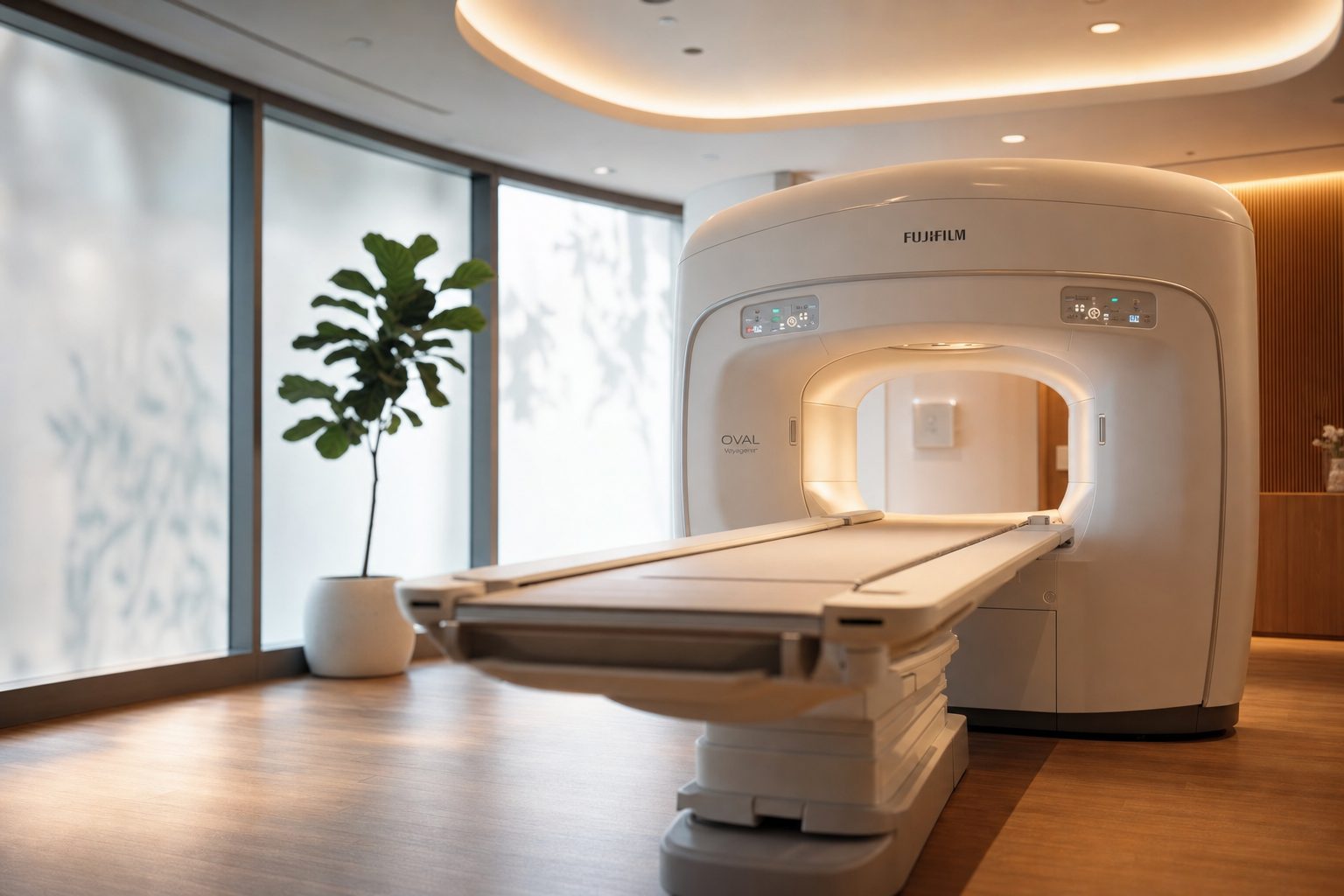
You may have seen the celebrity endorsements. You may have gotten the targeted ad. The pitch is compelling: spend one hour in a scanner, get a comprehensive picture of everything happening inside your body — no radiation, no contrast dye required. The price tag: typically $2,499 for a commercial whole-body MRI like Prenuvo.
The question I get asked regularly is: is it worth it? The honest answer — and I say this as a physician who includes full-body MRI in our Executive Health membership — is: it depends. And the “depends on what” is more nuanced than the advertising suggests. Let me walk you through the actual evidence.
What Is Full-Body MRI Screening?
Whole-body MRI (WB-MRI) uses magnetic resonance imaging to scan from head to thigh in a single session, typically lasting 45–75 minutes. Unlike CT scans, MRI uses no ionizing radiation — a meaningful safety advantage for repeated screening over time. Unlike PET scans, it doesn’t require radioactive tracers.
Commercial services like Prenuvo have standardized these protocols and made them accessible to the general public without a physician referral. Their current offering ($2,499) covers head, neck, chest, abdomen, pelvis, and extremities using multiparametric sequences — T1, T2, diffusion-weighted imaging (DWI), and others — designed to detect soft tissue abnormalities including:
- Solid organ tumors (kidney, liver, pancreas, adrenal)
- Brain masses and aneurysms
- Spinal cord and disc abnormalities
- Lymph node enlargement
- Vascular aneurysms
- Musculoskeletal pathology
What it is not optimized for: breast cancer (because it typically does not use intravenous contrast, which is required by the American College of Radiology for standard breast MRI), colorectal cancer (which requires colonoscopy), and it has inherent limitations compared to dedicated organ-specific protocols for each body part it covers.
Why It Matters: What the Research Actually Shows
The Incidentaloma Problem Is Real
A review of 12 studies cited by Fred Hutchinson Cancer Center in 2025 found that 95% of asymptomatic patients had at least one “abnormal finding” on whole-body MRI for cancer screening. But 91% of those findings were not clinically relevant.
Read that again: 9 out of 10 abnormal findings on a full-body MRI are not clinically meaningful. Yet each one requires clinical follow-up — specialist referrals, additional imaging, sometimes biopsies. A BMJ Open analysis found that whole-body MRI led to elevated health service utilization and costs for at least 2 years after scanning — primarily driven by investigation of incidental findings, many of which were ultimately benign.
The Cancer Detection Rate — With Important Context
Prenuvo’s internal Polaris study, presented at the 2025 American Association for Cancer Research Annual Meeting and covering 1,011 primarily asymptomatic patients, reported that approximately 2.2% received biopsy-confirmed cancer diagnoses. Of those, 86% occurred in patients who did not indicate specific symptoms, and 68% were cancers for which there is no standard single-cancer screening method. Biopsies led to cancer confirmation in roughly half of cases.
The Fred Hutchinson analysis notes that published studies show a cancer detection rate of 1–2% in asymptomatic adults on whole-body MRI. But — critically — we don’t yet know whether the cancers found would have been clinically significant or required treatment. The American College of Radiology does not currently support asymptomatic whole-body imaging, noting the absence of documented evidence that it is cost-efficient or prolongs life.
Where WB-MRI Has Proven Value: High-Risk Populations
The evidence for whole-body MRI is substantially stronger in high-risk populations. For patients with cancer predisposition syndromes — Li-Fraumeni syndrome (TP53), neurofibromatosis, Von Hippel-Lindau, hereditary paraganglioma-pheochromocytoma syndrome — WB-MRI is formally recommended in NCCN and AACR guidelines.
A 2025 study from the National Cancer Center Singapore published in JCO Precision Oncology reported WB-MRI performance in 59 patients with cancer predisposition syndromes: sensitivity of 64%, specificity of 92%, and a cancer detection rate of 12% — meaningfully higher than the general population. In the highest-risk cohorts (Li-Fraumeni syndrome), WB-MRI surveillance detected cancers with a positive predictive value of 11.1% and a negative predictive value of 99.4% in cancer-naïve patients — meaning a clear scan is highly reassuring.
The Psychological Impact
One concern raised about false positives is the psychological burden — anxiety, unnecessary procedures, and the harms of chasing down benign findings. The evidence here is more reassuring than expected. Studies have shown that the psychological impact of whole-body MRI incidental findings is less severe than anticipated for most patients — particularly when managed by experienced physicians who can contextualize findings appropriately.
This points to a critical implementation principle: context is everything. A whole-body MRI done at a commercial kiosk with minimal physician involvement is categorically different from a whole-body MRI done as part of a comprehensive evaluation with a clinician who can interpret results in the context of your full medical history, genomic risk profile, and other biomarker data.
The Gap in Standard Care
The current medical system doesn’t offer proactive whole-body imaging to healthy adults — and there are legitimate reasons for that, primarily the unresolved incidentaloma problem and the absence of long-term outcome data showing mortality benefit. But the flip side is equally important: approximately 68% of the cancers detected in the Prenuvo Polaris study had no standard single-cancer screening test available. Pancreatic cancer — one of the deadliest — has no recommended screening for average-risk adults. Kidney cancer, ovarian cancer, and several others similarly lack early detection protocols.
For a 55-year-old who wants to know their complete health picture and is willing to engage with the findings intelligently — that gap matters. The question isn’t whether WB-MRI is perfect. It’s whether the information value outweighs the cost and the risk of incidentaloma follow-up when managed appropriately.
“Impressive technology and clinically useful technology are not the same thing. A whole-body MRI done at a commercial kiosk is categorically different from a whole-body MRI done as part of a comprehensive evaluation.”
How We Use This at Pravida Health
Full-body MRI is included in our Executive Health membership tier, and this is deliberate. We don’t offer it as a standalone consumer product for a reason. Our approach is built around five integrated principles:
- Pre-scan genomic context. Before you ever get into the scanner, we know your genetic risk profile — BRCA status, Lynch syndrome status, TP53 status (Li-Fraumeni), VHL, and other cancer predisposition variants. This changes the pre-test probability for relevant findings and informs how aggressively to investigate borderline results. A 3mm liver lesion means something different in a patient with a BRCA2 variant and elevated AFP than in a patient with no genetic risk factors and normal liver function.
- Clinical integration. The scan is read in the context of your complete biomarker picture — not in isolation. We combine imaging findings with laboratory values, genomic risk profile, and clinical history to contextualize every finding before a follow-up plan is made. Schedule a consultation to discuss how this integrated approach works in practice.
- Experienced interpretation. We work with radiologists experienced in whole-body MRI protocols and the specific nuances of incidental finding management. The skill of the interpreting radiologist — and their familiarity with WB-MRI-specific artifacts and normal variants — matters enormously for the quality of the report you receive.
- Complementary screening. We combine WB-MRI with cell-free DNA cancer screening (Episeek) — available through our precision cancer screening program — because the two technologies detect different cancer signals through different mechanisms. MRI detects anatomical masses; cfDNA detects the epigenetic signature of circulating cancer DNA. Together, they are more comprehensive than either alone.
- Managed follow-up. If the scan reveals a finding that warrants follow-up, we manage that process — specialist referral, interval imaging, or further evaluation — with a physician’s hand on the wheel throughout. The goal is to extract maximum signal from the scan while minimizing the anxiety and unnecessary intervention that can arise when findings are managed without adequate clinical context.
What You Can Do Today
- Know your cancer predisposition risk. If you have a known cancer genetic syndrome (BRCA, Lynch, Li-Fraumeni, VHL, etc.), whole-body MRI is closer to mandatory than optional. Get it done through a clinical program, not a commercial kiosk. Contact us to discuss your genetic risk profile and how it informs your screening plan.
- Understand what WB-MRI does and doesn’t screen for. It is not a substitute for mammography, colonoscopy, cervical Pap smear, or PSA. It complements these; it doesn’t replace them. Make sure your standard guideline-recommended screenings are current before adding WB-MRI to your protocol.
- Pair it with cell-free DNA screening. cfDNA testing detects cancer signals through the bloodstream — particularly useful for cancers that don’t shed much on MRI (like some hematologic malignancies). The combination provides broader coverage than either technology alone.
- Consider your risk profile honestly. For a 35-year-old with no family history and no genetic risk factors, the incidentaloma probability may outweigh the benefit. For a 52-year-old with a family history of pancreatic or ovarian cancer, the calculus is different. This is exactly the kind of individualized recommendation that should come from a physician who knows your complete health picture — not from an advertisement. Talk to a Pravida physician about whether WB-MRI makes sense for your specific situation.
- Don’t do this without a physician in the loop. The value of WB-MRI is almost entirely determined by what happens after the findings come back — how they’re interpreted and how the follow-up is managed. A scan result without clinical context is not actionable; it is a source of anxiety. Physician-guided interpretation is not optional — it’s the entire point.
Frequently Asked Questions
Is full-body MRI safe?
Yes. MRI uses no ionizing radiation (unlike CT scans), making it safe for repeated use over time. The main safety contraindications are implanted metal devices (certain pacemakers, cochlear implants) and severe claustrophobia. For patients not receiving gadolinium contrast, there are no known long-term risks associated with the scan itself. If you have any implanted devices or metal hardware, a pre-scan safety screening is required before scheduling.
What cancers does full-body MRI screen for?
WB-MRI is useful for detecting solid organ tumors (kidney, liver, pancreas, adrenal glands), brain masses, spinal cord abnormalities, lymph node enlargement, and vascular aneurysms. It is less reliable for breast cancer (requires dedicated breast MRI with IV contrast per ACR guidelines), colorectal cancer (requires colonoscopy), and some hematologic malignancies. WB-MRI complements but does not replace standard organ-specific screening protocols.
How often should I repeat full-body MRI screening?
There is no established consensus for screening intervals in average-risk populations. For patients with cancer predisposition syndromes, annual WB-MRI is recommended by NCCN and AACR guidelines. For average-risk patients who have undergone a clear baseline scan, many clinical programs use a 2–3 year interval. The appropriate interval for any individual depends on their risk profile, prior findings, and the clinical judgment of their physician.
What is an “incidentaloma” and how common are they?
An incidentaloma is an unexpected finding discovered during imaging performed for screening or another purpose. Studies show 95% of asymptomatic adults will have at least one finding on WB-MRI, with approximately 91% of those findings not being clinically relevant. This high rate of incidental findings is the central challenge of whole-body screening — managing these findings appropriately, without unnecessary intervention, requires experienced clinical oversight and contextual interpretation of every result.
How does full-body MRI compare to cfDNA cancer screening?
They detect cancer through completely different mechanisms. MRI detects anatomical masses — the physical presence of a tumor that has grown large enough to be visible on imaging. cfDNA (cell-free DNA) screening detects the epigenetic signature of circulating tumor DNA in the blood, potentially identifying cancer signals before a visible mass forms. Neither is universally superior; they have complementary strengths and weaknesses. The combination of both technologies provides the most comprehensive early detection coverage currently available.
Is full-body MRI the right tool for your health picture?
A consultation at Pravida Health includes a review of your cancer risk profile — genetic, familial, and clinical — to determine whether full-body MRI, cfDNA cancer screening, or a combination is appropriate for you. Our Executive Health program integrates both technologies with experienced physician oversight throughout. The value of WB-MRI is almost entirely in what happens after the scan. Let’s make sure you have the right team managing it.
Schedule a Consultation