
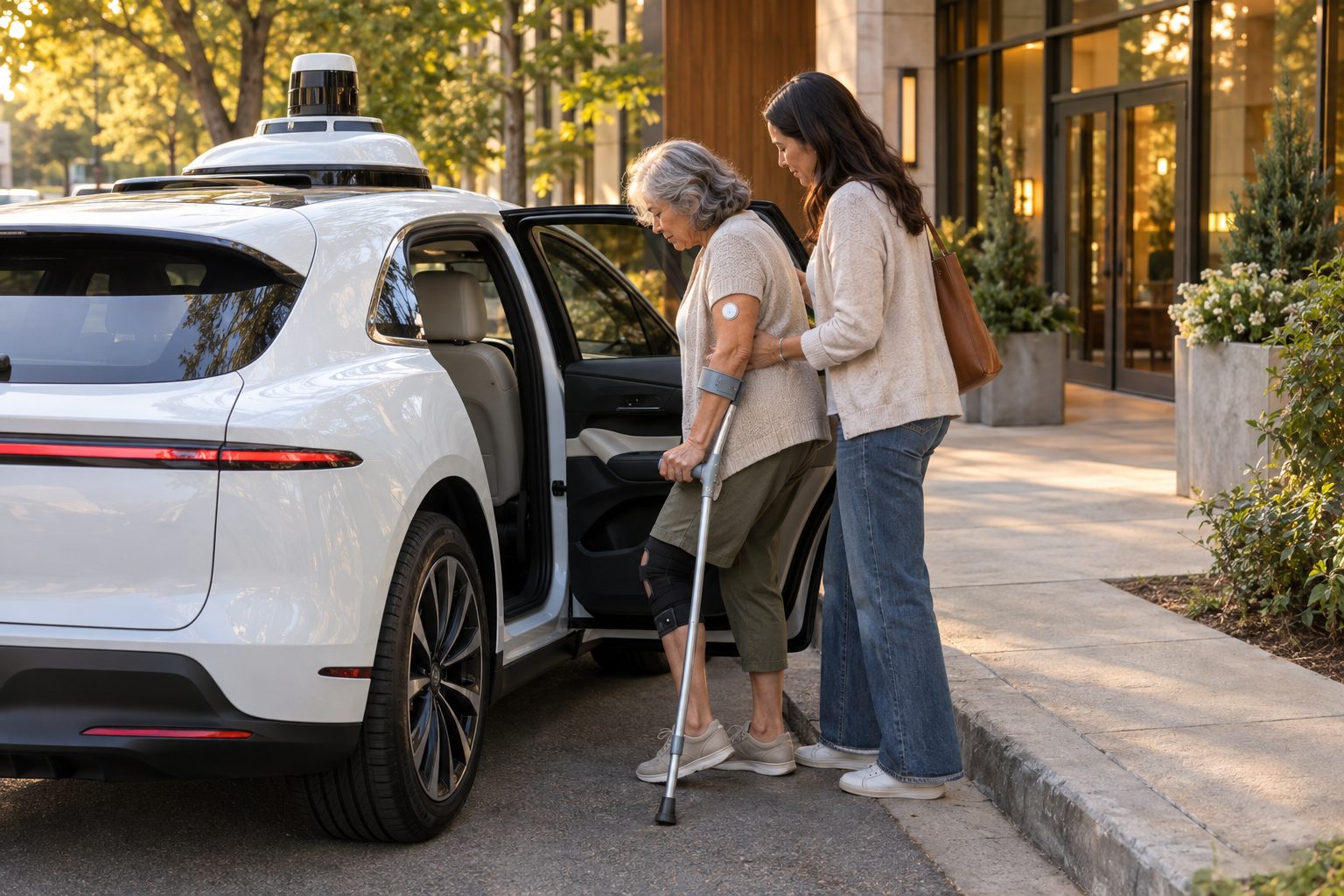
Key takeaways
- Driverless rides are real in Atlanta today. Waymo runs fully driverless rides on the Uber app from South Atlanta through Downtown to Buckhead, and May Mobility operates with Lyft in Midtown.
- Transportation is part of healthcare. An estimated 3.6 million Americans miss or delay care each year because of transportation barriers.
- A robotaxi is not an escort. After sedation or anesthesia, professional standards still call for discharge to a responsible adult, and no autonomous vehicle changes that.
- The patient, not the car, should be monitored. The most realistic “connected ride” pairs a validated wearable with a clinician-watched alert pathway. In-vehicle vital-sign sensing is still a research topic.
- The biggest gaps are human ones: wheelchair access, help getting to the door, older adults with cognitive changes, and privacy.
Why a regenerative medicine physician is writing about robotaxis
Every week in my practice, someone’s care depends on a ride. An older patient can’t drive after a knee injection. A busy executive wants to come in for a DEXA scan without losing half a day to traffic and parking. A patient recovering from a procedure lives alone, and the hardest part of the day isn’t the procedure. It’s getting home.
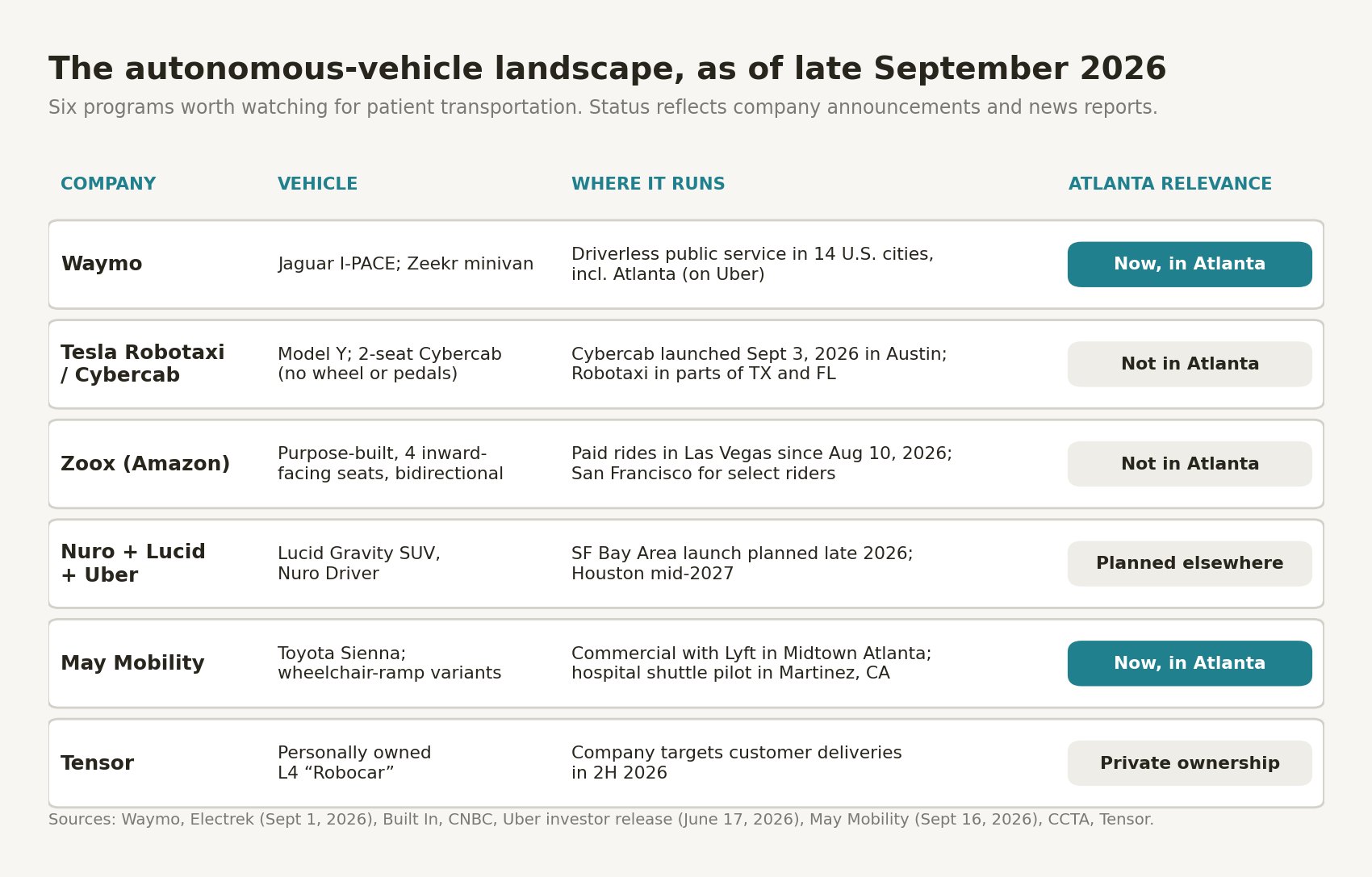
I have been following the autonomous-vehicle industry closely: Waymo, Tesla’s Cybercab, Zoox, the Nuro–Lucid–Uber robotaxi, May Mobility, and Tensor’s personally owned “Robocar.” The question I keep asking is not whether the technology is impressive. It clearly is. The question is where it fits in the continuum of care, and where it does not, including the idea that connected devices could keep an eye on a patient’s vital signs on the ride home.
This is my evidence-graded view as of late September 2026. Pravida Health has no partnership with any company mentioned here, and nothing below is an endorsement.
Transportation is a health problem, not just a logistics problem
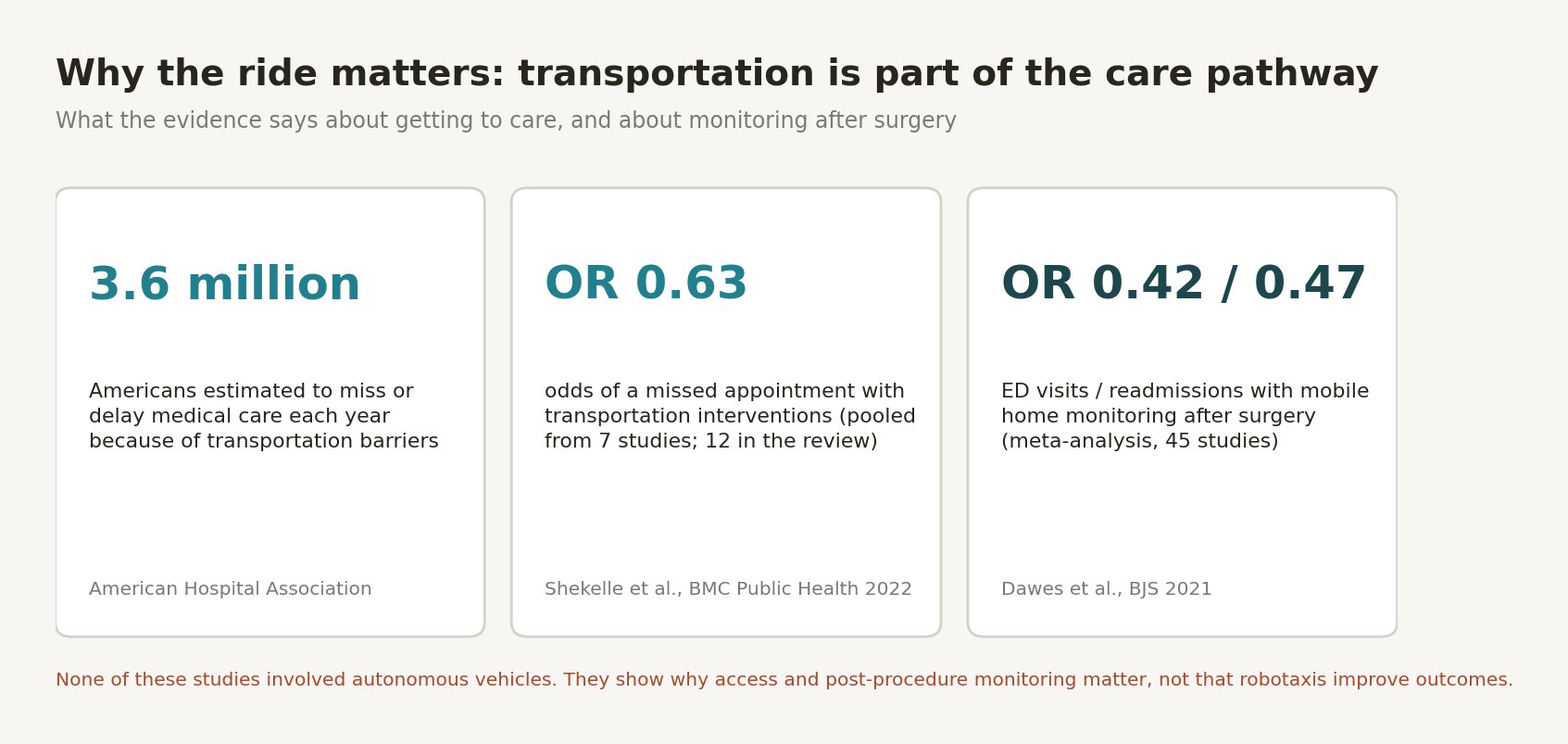
The American Hospital Association estimates that 3.6 million people in the U.S. do not obtain medical care because of transportation barriers (AHA). Medicaid alone spent $2.6 billion on non-emergency medical transportation in fiscal year 2018, covering more than 60 million ride-days for about 3.2 million beneficiaries (MACPAC).
Solving the ride does seem to help. A 2022 systematic review and meta-analysis in BMC Public Health identified 12 studies of non-emergency transportation interventions. Pooling seven of them, it found lower odds of missed appointments with the intervention (odds ratio 0.63, 95% CI 0.48–0.83). Uptake was often low, though: in one controlled trial only about 20% of eligible patients used the rideshare offered (Shekelle et al., BMC Public Health 2022). A free ride is not the same as a ride people actually use.
Who is building what: the 2026 autonomous-vehicle landscape
“Robotaxi” covers very different programs. Here is where the six I follow stand, based on company announcements and news reports as of this writing.
Waymo
Waymo opened public driverless service in Denver, San Diego and Tampa on September 1, 2026, bringing it to 14 U.S. cities, and has said it is aiming for one million paid rides a week by year-end (Electrek). One count puts its fleet at nearly 4,000 robotaxis (Built In). In Atlanta, Waymo rides are booked through the Uber app, and Waymo describes the service area as running “from South Atlanta, to Downtown, to Buckhead” (Waymo). That exclusivity with Uber is set to end in Atlanta and Austin in early 2028 (CNBC).
Tesla Robotaxi and Cybercab
Tesla put the Cybercab, a two-seat robotaxi with no steering wheel or pedals, into service in geofenced parts of Austin on September 3, 2026. The initial rollout was 45 registered vehicles, while Tesla’s broader Robotaxi service has expanded to Dallas, Houston, Tampa and Miami (Built In).
Zoox
Amazon-owned Zoox began charging fares in Las Vegas on August 10, 2026, after federal regulators granted an exemption from rules requiring human controls. Its carriage-style vehicle has inward-facing seats for up to four passengers and no steering wheel (CNBC).
Nuro, Lucid and Uber
This partnership pairs a Lucid Gravity SUV with Nuro’s driving system, available only on Uber. It plans to launch in the San Francisco Bay Area later in 2026 and in Houston in mid-2027, with a program target of at least 35,000 vehicles globally (Uber).
May Mobility
May Mobility is the program with the clearest healthcare track record. It operates commercially with Lyft in Atlanta and reports more than 550,000 commercial autonomous rides in the U.S. and Japan (May Mobility). In 2024, it launched PRESTO with the Contra Costa Transportation Authority in Martinez, California: a free service with seven vehicles, three of them wheelchair-accessible with ADA ramps, carrying county-hospital patients to appointments and pharmacies on weekday afternoons (CCTA).
Tensor
Tensor is taking a different path: a Level 4 autonomous car you own rather than hail, with more than 100 sensors and customer deliveries scheduled for the second half of 2026 (Tensor; Tensor Robocar). For a patient who can no longer drive but wants independence, private ownership is an interesting model. But price, regulation and real-world performance are all still to be proven.
What about safety?
Waymo publishes the most detailed safety data in the industry. Its September 2026 update covers more than 270 million rider-only miles in Phoenix, San Francisco, Los Angeles, Austin and Atlanta. Compared with human benchmarks, it reports an 82% reduction in injury-causing crashes and 95% fewer crashes causing serious injury or worse (Waymo).
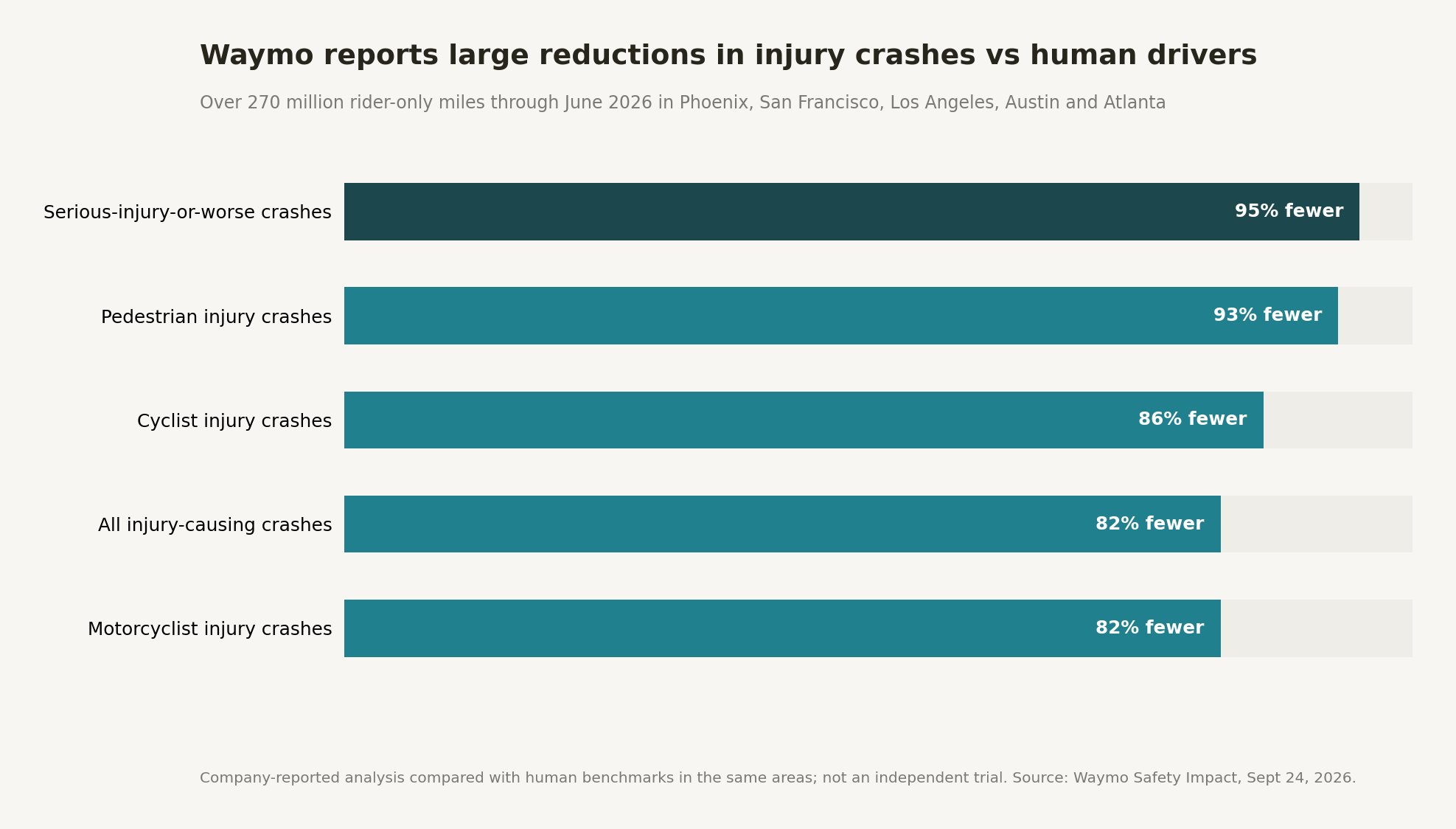
I find those numbers encouraging, with two caveats a physician would apply to any study. First, this is company-reported data compared against human benchmarks the company constructed; it is not a randomized trial. Second, it describes one operator in specific cities. It does not automatically carry over to other companies, other vehicles, or other road conditions.
The escort rule: why a robotaxi can’t take you home after sedation
This is the most important point in the article for anyone having a procedure.
If you receive sedation or anesthesia, you should not go home alone in any car, whether it’s driven by a person or a computer. A 2026 review in Patient Safety concluded that current regulations, accreditation standards, and professional guidelines still require patients to be accompanied by a responsible adult after anesthesia or sedation, that “the safest default remains patient discharge with a responsible adult,” and that exceptions “must be rare, structured, and supported by augmented safeguards” (Thomas & Ferenschak, Patient Safety 2026). The American Society of PeriAnesthesia Nurses now uses the term “responsible individual” (ASPAN).
The reason is not the driving. Sedative drugs can leave people unsteady, forgetful, and slow to recognize a problem for hours. An escort helps you out of the car, up the steps, and through the first evening, and notices if something is wrong. A robotaxi gets you to the curb. Even Waymo’s human-driven wheelchair-accessible vehicles make that limit explicit: drivers can help riders in and out of the vehicle but cannot assist for extended periods outside it, for example “entering a hospital with you and signing you in for an appointment” (Waymo Help).
So the realistic post-sedation use case is a robotaxi with a responsible adult on board, which can still be easier than coordinating a family member’s car and parking.
The connected ride home: monitoring vital signs on the way
Now the idea that excites me most: extending the continuum of care into the vehicle.
Remote monitoring after surgery already has meaningful evidence behind it. A meta-analysis of 45 studies in the British Journal of Surgery found that mobile home monitoring after surgery was associated with fewer emergency department visits (odds ratio 0.42) and fewer readmissions (odds ratio 0.47) (Dawes et al., BJS 2021). The ride home is simply the first few minutes of that monitoring window.
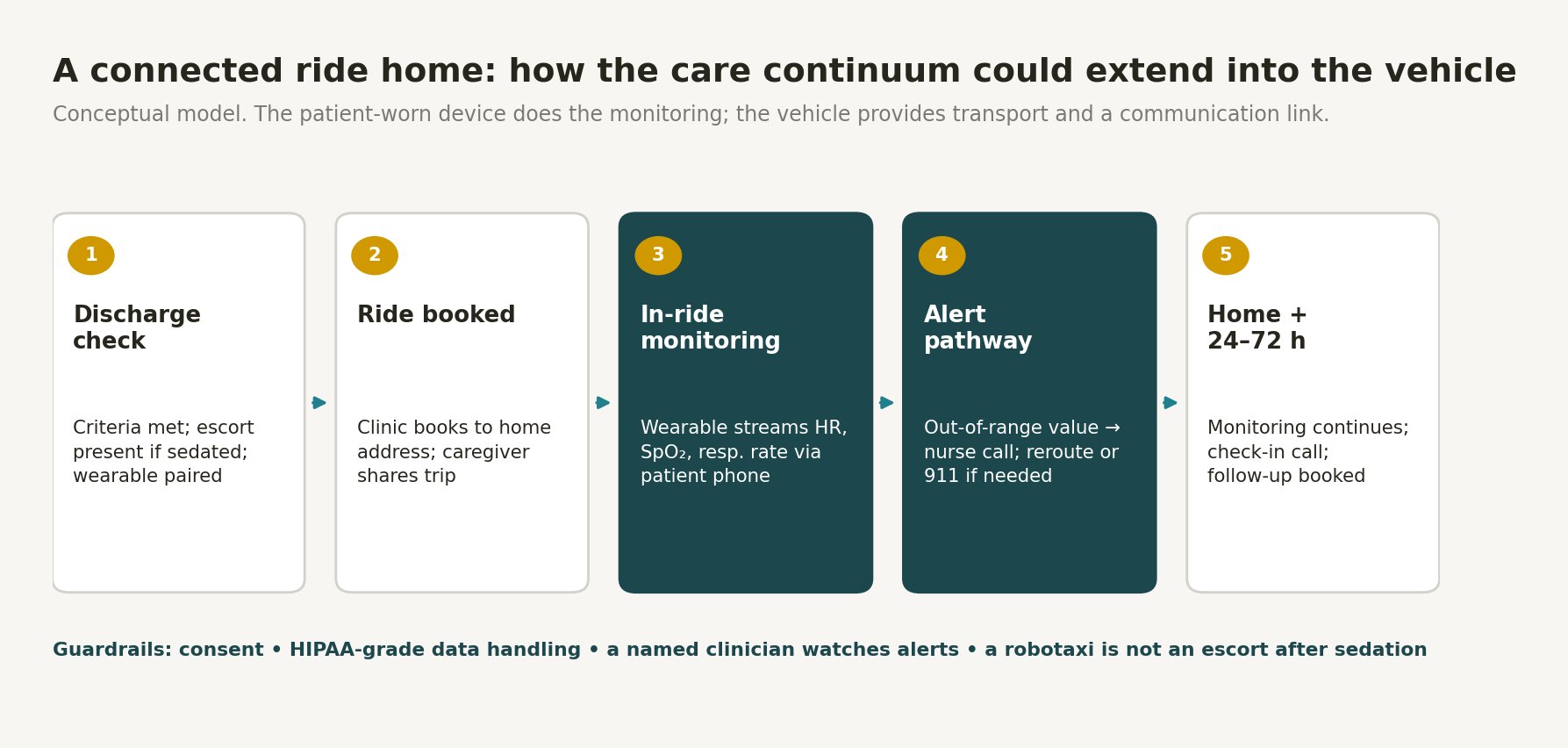
Notice where the monitoring lives. In my view it should be on the patient, in the form of a validated wearable that keeps working once they walk through their front door, not built into the car. In-cabin vital-sign sensing is a real research field: a 2025 review describes unobtrusive in-vehicle measurement of physiological signals such as heart rate and respiration (PMC review, 2025), and companies have developed millimeter-wave radar systems that track occupants’ heart rate and breathing (IEEE Spectrum). These systems are designed mainly for driver fatigue and occupant safety. I am not aware of any that is validated as medical monitoring in a commercial robotaxi.
The part that actually protects patients is less glamorous: a named clinician who sees the alerts, clear thresholds, and a plan for what happens next. That might be a nurse call, a reroute back to the clinic, or 911. Without that human loop, a heart-rate stream is just data.
Where autonomous rides fit today
Putting it all together, here is how I would sort common patient trips for an outpatient orthopedic and longevity practice like ours.
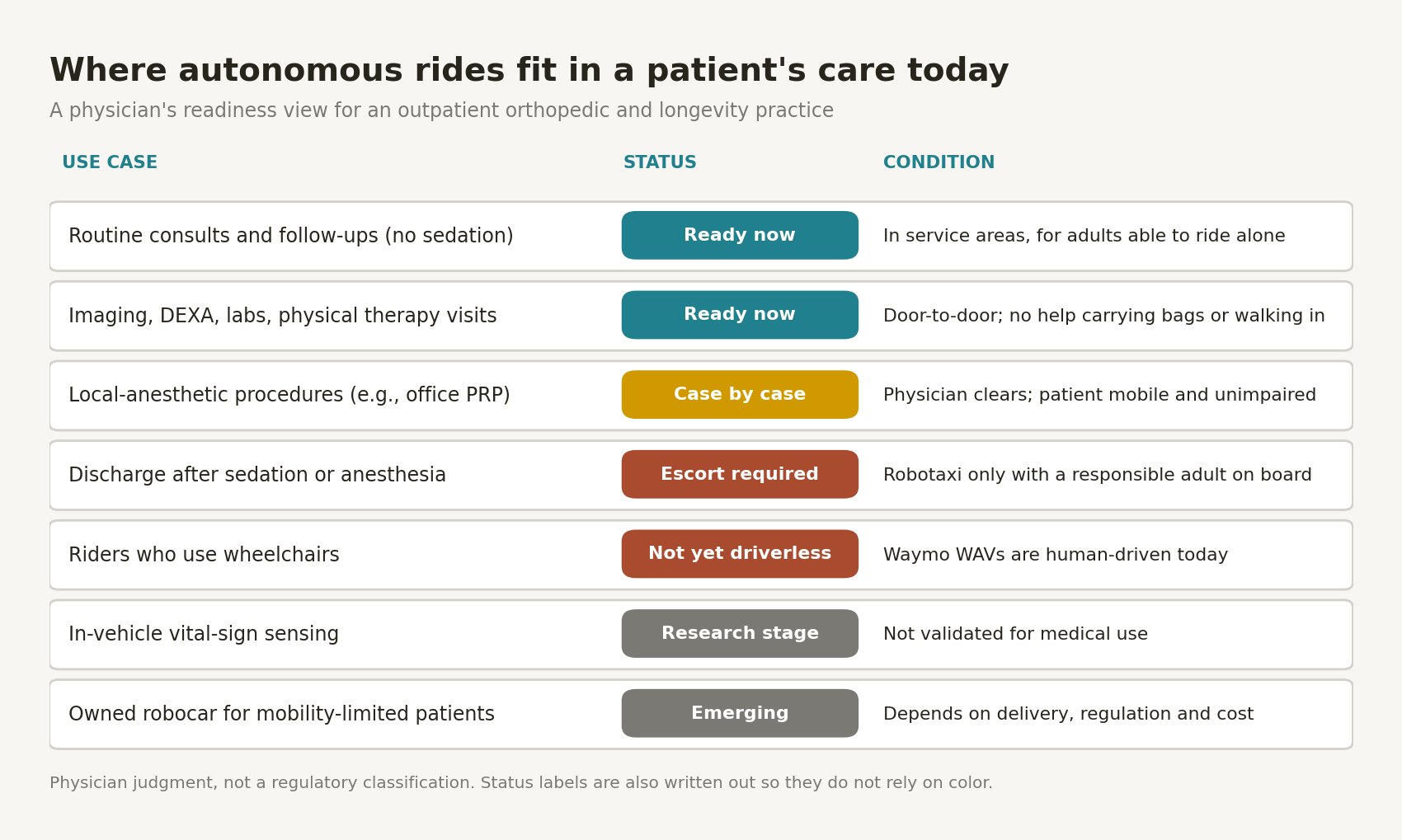
Access is the gap that concerns me most. Waymo’s wheelchair-accessible service uses vehicles that are driven manually and is available in San Francisco, Los Angeles and Phoenix (Waymo Help). Riders generally must be 18 or older to ride alone, apart from linked teen accounts in select cities (Waymo FAQ). And older adults, who stand to gain the most from not having to drive, are also the group most likely to need a hand at the door (PMC review, 2025).
Questions to ask before using a robotaxi for a medical visit
- Will I have sedation? If yes, plan for a responsible adult to ride with you and stay with you afterward.
- Can I get in and out, and from the curb to the door, on my own? Crutches, a brace, or a new joint can change the answer.
- Are both my home and the clinic inside the service area? Check the app for your exact addresses.
- Who knows where I am? Share your trip with a family member or caregiver.
- What data am I sharing? Ride apps are generally not healthcare providers. Assume trip and location data fall outside the privacy protections that cover your medical record.
What this means at Pravida
Our clinic sits on the Peachtree corridor at 1801 Peachtree St NE, and autonomous rides are already on the streets around us. For many of our visits, such as consultations, DEXA and body-composition scans, labs, and follow-ups, a driverless ride is simply another option, much like a rideshare, and some patients will find it calmer and easier.
For procedures, our discharge rules do not change. If a procedure involves sedation, you will need a responsible adult to take you home. When we build remote-monitoring pathways for recovery, they will center on the patient, a validated device, and a clinician who is actually watching, however you get home.
Frequently asked questions
Can I take a Waymo or other robotaxi to a doctor’s appointment in Atlanta?
Yes, if both addresses are in the service area and you can ride safely on your own. Waymo operates on the Uber app in Atlanta, and May Mobility operates with Lyft in Midtown.
Can a robotaxi take me home after a procedure with sedation?
Not by yourself. Current standards call for discharge to a responsible adult after sedation or anesthesia. A robotaxi can be the vehicle, but an escort still needs to ride with you and stay with you.
Can a self-driving car monitor my vital signs?
Research systems can sense heart rate and breathing inside a car, but none is validated as medical monitoring in a commercial robotaxi. The practical approach is a clinician-prescribed wearable with an alert pathway monitored by your care team.
Are robotaxis safe?
Waymo reports 82% fewer injury-causing crashes and 95% fewer serious-injury crashes than human benchmarks across 270 million miles. That is company-reported data for one operator, not a randomized trial.
Are autonomous vehicles wheelchair-accessible?
Not in fully driverless form in most places today. Waymo’s wheelchair-accessible vehicles are human-driven, and some shuttle pilots, such as May Mobility’s PRESTO in California, have included ramp-equipped vehicles.
Where I land
Autonomous vehicles will not replace nurses, escorts, or good discharge planning. They could remove one of the most stubborn barriers in medicine, which is simply getting there, and they could become part of a connected recovery pathway, with the patient wearing the sensor and a clinician watching the data. The technology is arriving faster than the clinical protocols. Our job as physicians is to write those protocols carefully, before the convenience outruns the safety.
If you are planning a procedure and wondering how to get there and back safely, or you want to talk through recovery monitoring, you can book a consultation here.
Key sources referenced in this article
- American Hospital Association. Social Determinants of Health Series: Transportation and the Role of Hospitals. 2017. AHA.
- Medicaid and CHIP Payment and Access Commission. Mandated Report on Non-Emergency Medical Transportation. June 2021. MACPAC.
- Shekelle PG, Begashaw MM, Miake-Lye IM, et al. Effect of interventions for non-emergent medical transportation: a systematic review and meta-analysis. BMC Public Health. 2022;22:799. PMC9026972.
- Dawes AJ, Lin AY, Varghese C, Russell MM, Lin AY. Mobile health technology for remote home monitoring after surgery: a meta-analysis. Br J Surg. 2021;108(11):1304–1314. doi:10.1093/bjs/znab323.
- Thomas A, Ferenschak J. Should patients be accompanied when discharged from ambulatory surgery? Patient Safety. 2026;8(2). doi:10.33940/001c.161476.
- American Society of PeriAnesthesia Nurses. FAQ: definition of responsible adult. ASPAN.
- Waymo. Safety data update, September 24, 2026. Waymo; Waymo on Uber (Atlanta). Waymo; Wheelchair-accessible vehicles. Waymo Help; Rider FAQ. Waymo Help.
- Waymo opens robotaxi rides to the public in 3 new cities, now 14 total. Electrek, Sept 1, 2026. Electrek.
- Uber and Waymo to end exclusivity arrangement in Atlanta and Austin. CNBC, July 24, 2026. CNBC.
- What Is the Tesla Cybercab? Built In, Sept 2026. Built In.
- Amazon’s Zoox to launch paid robotaxi rides in Las Vegas. CNBC, Aug 5, 2026. CNBC.
- Uber, Nuro, and Lucid to bring robotaxi service to Houston in 2027. Uber press release, June 17, 2026. Uber.
- May Mobility business combination announcement, Sept 16, 2026. May Mobility; PRESTO Martinez health-care shuttle launch, Sept 12, 2024. CCTA.
- Tensor unveils world’s first personal autonomous vehicle. Tensor; Robocar specifications. Tensor.
- A comprehensive review of unobtrusive biosensing in vehicles. 2025. PMC12189504; Pontosense millimeter-wave in-cabin radar. IEEE Spectrum.
- Applications of self-driving vehicles in an aging population. 2025. PMC12052292.