
In a published study on long bone nonunion, PRP alone achieved a fracture union rate of 71.4%. PRP combined with extracorporeal shockwave therapy (ESWT) achieved 92.6% — with healing time five weeks shorter. That is the principle of synergy in action: two treatments that complement each other biologically in ways that neither achieves alone. Understanding why the combination works — not just that it works — is the foundation of using these tools correctly in clinical practice.
Chronic tendinopathy is one of the most common and most mismanaged problems in musculoskeletal medicine. The conventional treatment ladder — rest, NSAIDs, cortisone, surgery — addresses the symptom without engaging the biology. ESWT and PRP, used together in the right sequence, represent a biologically coherent approach to the actual problem: failed tendon healing in a tissue environment that has become hostile to repair.
Here is what the science shows, how the two treatments interact at the cellular level, and how we apply this at Pravida Health.
What Is Shockwave Therapy?
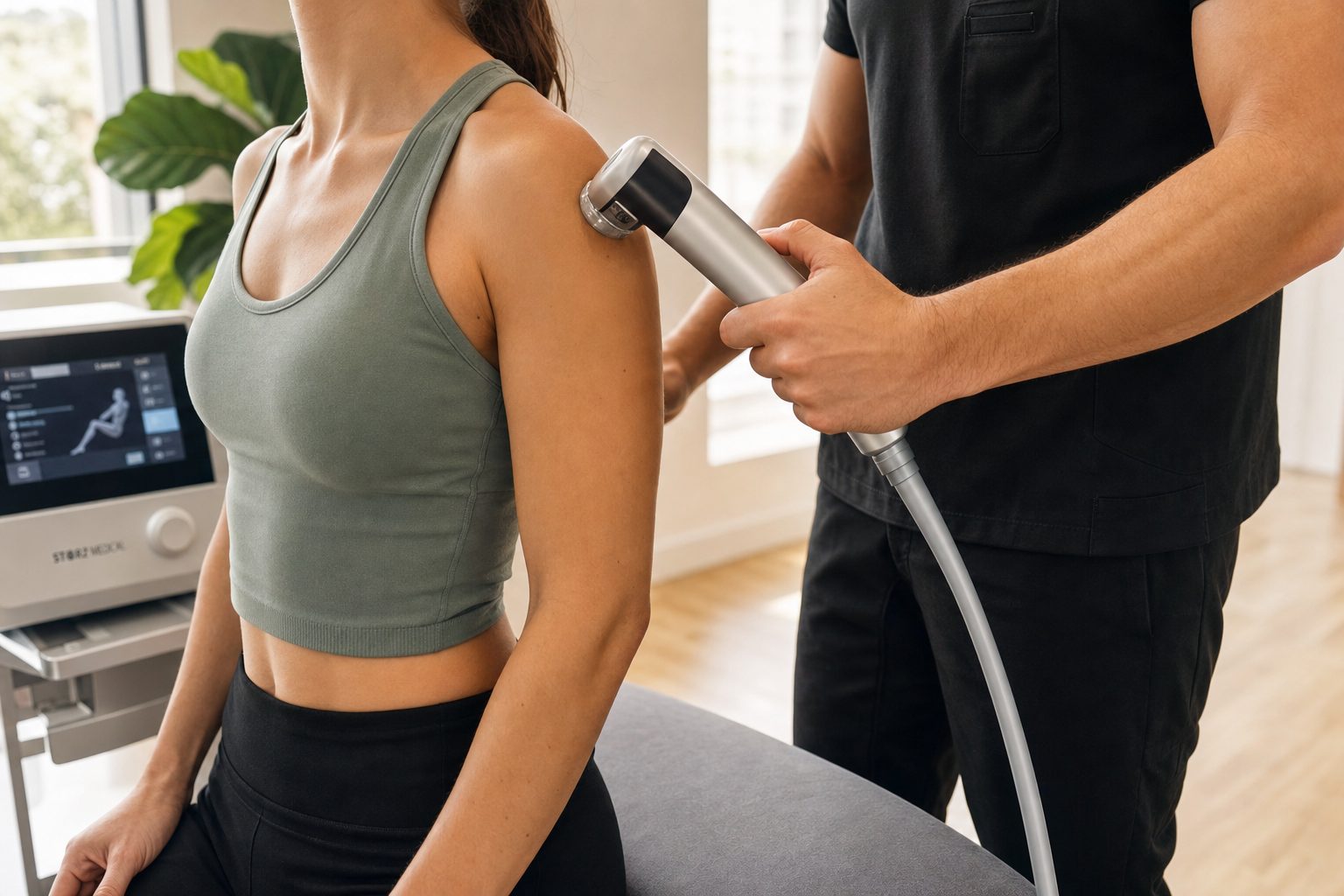
Extracorporeal shockwave therapy delivers high-energy acoustic pressure waves through the skin to biological tissue. Originally developed to fragment kidney stones, clinicians in the 1990s discovered that subthreshold shockwaves applied to tendons produced significant therapeutic effects — not through tissue disruption, but through biological stimulation. The clinical applications expanded rapidly once the mechanotransduction mechanism became better characterized.
Two primary device types are used in clinical practice:
- Focused ESWT (fESWT) — Higher-energy waves converging at a precise focal point. Better suited for deeper structures, calcific deposits, and cases where targeted energy delivery is important.
- Radial ESWT (rESWT) — Lower-energy waves dispersed radially from the applicator tip. Generally better tolerated, and well suited to more superficial structures and broader treatment areas.
The therapeutic mechanism is mechanotransduction — the conversion of mechanical energy into cellular biological responses. Specifically, ESWT has been shown to produce the following effects in tendon tissue:
- Upregulates angiogenic factors (VEGF, eNOS) → drives neovascularization in hypovascular chronic tendons
- Stimulates fibroblast activity and collagen synthesis → initiates new extracellular matrix production
- Activates local mesenchymal stem cells → recruits reparative cell populations to the treatment site
- Modulates nociceptors and substance P → reduces pain signaling independent of tissue repair
- Disrupts microfibrosis and calcific deposits in chronic tendinopathy → mechanically remodels the pathological tissue environment
- Induces release of extracellular vesicles (exosomes) → described in a December 2025 Life review as “a major breakthrough in EV-based regenerative medicine”
Each of these effects has direct relevance to why ESWT is not simply a pain-reduction tool — it is a biological preparation device that changes the tissue environment in ways that matter enormously when a growth factor-rich injection follows.
What Is PRP, and Why Does It Work Better After Shockwave?
Platelet-rich plasma is produced by centrifuging the patient’s own blood to concentrate platelets and their associated growth factors — including PDGF, TGF-β, VEGF, IGF-1, and EGF — which are then injected directly into the target tissue under ultrasound guidance.
PRP’s limitation as a standalone treatment for chronic tendinopathy is biological context. Chronic tendons are hypovascular, fibrotic, and in a state of failed healing. Growth factors dropped into a fibrotic, poorly vascularized environment may not have sufficient cellular machinery to respond to them effectively. The cells that need to receive PRP’s signals may be present in too low a density, have downregulated receptor expression, or be inaccessible due to scar tissue blocking distribution. PRP is a powerful biological payload — but the tissue needs to be ready to receive it.
This is where the synergy mechanism becomes clinically decisive. Shockwave prepares the soil. PRP plants the seed. The sequence matters as much as the components.
The tissue-priming mechanism operates through five interconnected steps:
- Shockwaves disrupt microfibrosis and chronic scar tissue — creating a more mechanically receptive environment for cellular infiltration and growth factor distribution.
- ESWT upregulates growth factor receptors — cells that have been in a dormant or refractory state become more sensitive to PRP’s signals. The receptor landscape changes before the ligand arrives.
- ESWT increases local vascularity — through VEGF and eNOS upregulation, new vessel formation improves the distribution of PRP growth factors once injected.
- Mechanical microtrauma recruits MSCs and tenocytes — a larger, more activated pool of cellular responders is present at the site when PRP is delivered.
- ESWT-induced platelet activation may amplify degranulation — when PRP follows shockwave within the critical 48–72-hour window, the pre-activated cellular environment may enhance the biological response to the injected platelets.
“Shockwave prepares the soil. PRP plants the seed. Get the sequence right and the biology does the rest.”
The Clinical Evidence
The evidence base for ESWT and PRP individually is substantial. The emerging evidence for the combination is compelling — and mechanistically consistent with what basic science predicts.
Tendinopathy Meta-Analysis (Nature Scientific Reports, February 2026)
A February 2026 meta-analysis published in Nature Scientific Reports, synthesizing 12 studies, found that ESWT produced better outcomes than comparators in pain relief, function, and long-term results for tendinopathy — with the strongest signal for Achilles tendinopathy and plantar fasciitis. The analysis reinforced ESWT’s role not merely as a symptom-management tool but as a treatment that produces durable improvement through biological mechanisms.
Plantar Fasciitis (Foot and Ankle Surgery, 2024 Meta-Analysis)
A 2024 meta-analysis in Foot and Ankle Surgery directly compared PRP, ESWT, and corticosteroid injections for plantar fasciitis. PRP was significantly superior to ESWT and corticosteroid injections at reducing VAS pain scores, with a standardized mean difference vs. ESWT of 0.86 (95% CI 0.30–1.41, p = 0.002). What this finding reveals — counterintuitively — is not that ESWT is inferior, but that the two treatments have complementary temporal profiles. ESWT produces earlier structural changes; PRP drives longer-term biological repair. Combining both leverages the temporal strengths of each modality in sequence.
Rotator Cuff Partial Tears (Delos Sports Medicine RCT, 2024)
A 2024 randomized controlled trial published in Delos Sports Medicine compared ESWT+PRP versus PRP alone for partial rotator cuff tears. The combination group showed additional significant improvements in forward flexion (p = 0.033) and shoulder abduction (p = 0.015) at one month compared to PRP alone. Critically, the combination group also demonstrated significantly lower inflammatory protein levels — S100A8 (p = 0.042) and S100A9 (p = 0.034) — suggesting that ESWT’s tissue-priming effect modulates the post-injection inflammatory response favorably. This is not merely an additive effect; it is a synergistic one.
Long Bone Nonunion (Orthopaedic Traumatology, Surgery & Research, 2024)
The most quantitatively striking comparison comes from a 2024 study in Orthopaedic Traumatology, Surgery & Research examining long bone nonunion. PRP alone achieved a union rate of 71.4% with a mean healing time of 21.5 ± 3.7 weeks. PRP combined with ESWT achieved a union rate of 92.6% — a 21-percentage-point improvement — with healing time reduced to 16.3 ± 5.2 weeks (p < 0.05). Callus scores were significantly higher in the combination group at every measured timepoint. The magnitude of benefit from adding ESWT to PRP in this model is not subtle.
Calcific Rotator Cuff Tendinopathy
For calcific rotator cuff tendinopathy, ESWT is the most evidence-supported non-surgical treatment and carries FDA clearance. Its ability to disrupt and resorb calcium deposits — through focused acoustic energy and local biological response — is well established. Adding PRP to the protocol supports the post-calcification repair process, addressing the tendon biology that remains after calcium resorption and reducing the risk of recurrence driven by ongoing degenerative pathology.
The Gap in Standard Care
The default treatment pathway for chronic tendinopathy runs: relative rest → NSAIDs → corticosteroid injection → surgery. Each step is clinically defensible in specific contexts. The problem is what happens to tissue biology when the pathway is followed reflexively for chronic cases.
Corticosteroid injections are appropriate for acute inflammatory flares and short-term pain control. Their limitations for chronic tendinopathy are well documented: multiple meta-analyses show inferior outcomes compared to PRP at 6–12 months, with evidence of tendon matrix degeneration and collagen disruption following repeated steroid exposure. A 2020 Cochrane review found no benefit of corticosteroids over watchful waiting for Achilles tendinopathy at three or more months. For the chronic tendinopathy patient who has received multiple cortisone injections with diminishing returns, the biology has not been addressed — it has been palliated while potentially being further degraded.
NSAIDs suppress prostaglandin-mediated inflammation, which has a role in the acute phase. In chronic tendinopathy — a condition characterized not by active inflammation but by failed healing and degenerative matrix changes — COX inhibition may actually impair the residual healing response. The biological logic of using anti-inflammatory agents for a non-inflammatory condition is weak.
ESWT+PRP provides a biologically coherent path to actual tissue healing, not symptom suppression. The combination addresses the underlying biology of chronic tendinopathy: inadequate vascularity, fibrotic matrix, depleted cellular activity, and a growth factor environment that has collapsed. Restoring those conditions is what moves the biology from failed healing to active repair.
How We Use This at Pravida Health
Our combination protocol is built around diagnostic precision, biological sequencing, and structured rehabilitation — not a uniform template applied to every tendon complaint.
- ESWT priming (1–3 sessions). We begin with focused or radial ESWT depending on the structure, depth, and pathology involved. The goal is tissue preparation: disrupting fibrosis, stimulating neovascularization, upregulating growth factor receptors, and recruiting the mesenchymal stem cells and tenocytes that will respond to PRP. We use diagnostic ultrasound with Doppler to confirm tendon pathology — neovascularization, tendon thickening, intratendinous signal changes — before and to guide the procedure.
- Ultrasound-guided PRP injection (1–2 injections) within 48–72 hours of final ESWT session. Timing is critical. The window of maximal tissue receptivity — when growth factor receptors are upregulated, vascularity is increased, and cellular activity is elevated — closes over the days following shockwave. We schedule the PRP injection within this window to maximize the biological synergy. All injections are performed under real-time ultrasound guidance for accurate tendon placement. Schedule a consultation to discuss whether ESWT+PRP is appropriate for your tendon condition.
- Structured eccentric loading program during the recovery window. A regenerative procedure without structured mechanical loading leaves outcomes on the table. Eccentric loading provides the mechanical stimulus for collagen alignment and remodeling that translates biological repair into functional improvement. We coordinate this with the patient’s physical therapist as part of the protocol, not as an afterthought.
- Second ESWT/PRP series at 6–8 weeks for partial responders. For patients who show improvement but have not reached their functional goals by 6–8 weeks, a second combination series is indicated. The biology of tendon remodeling operates over months; a second priming-and-injection cycle can reinforce the healing trajectory in cases where a single round produced partial but incomplete response.
For patients with both tendinopathy and adjacent joint pathology — for example, patellar tendinopathy alongside knee osteoarthritis — we may layer BMAC for the joint component alongside ESWT+PRP for the tendon, addressing both the structural joint disease and the tendon pathology in a coordinated protocol.
What You Can Do Today
These four steps are actionable regardless of where you are in the tendinopathy timeline — newly symptomatic, managing a chronic tendon that has not responded to cortisone, or evaluating your options before considering surgery.
- Stop accepting cortisone as the primary treatment for chronic tendinopathy. If a tendon problem has lasted more than three months, ask specifically about ESWT and PRP. Cortisone has a role in acute management — it does not have a role as a repeat-dosing strategy for a tendon that has been symptomatic for months. The data on long-term outcomes with repeated steroid exposure is not favorable, and the biology of tendon degeneration it produces is well documented.
- Eccentric loading is non-negotiable. Injections accelerate biology; structured eccentric work provides the mechanical stimulus for collagen remodeling. Tendon tissue responds to load — the specific, progressive mechanical loading of an eccentric program is what signals the remodeling biology to organize into functional tissue. Work with a physical therapist experienced in tendinopathy rehabilitation. Generic stretching is not sufficient.
- Give it time. Combination ESWT+PRP typically shows maximum benefit at three to six months. Assessment at six weeks is too early to draw conclusions about treatment success. Tendon remodeling operates on a biological timeline that cannot be compressed by patience or impatience. Understanding that timeline prevents premature abandonment of a treatment that is working on a schedule the patient cannot feel yet.
- Get an ultrasound diagnosis first. Knowing the extent and character of tendon pathology — the degree of tendon thickening, presence or absence of intratendinous tears, neovascularization on Doppler — guides treatment intensity, injection targeting, and prognosis. A diagnosis of “tendinitis” without imaging tells you almost nothing clinically useful. Book a consultation at Pravida Health for a diagnostic ultrasound assessment and a protocol tailored to your specific tendon pathology.
Frequently Asked Questions
How is ESWT different from ultrasound therapy?
ESWT delivers high-energy acoustic pressure waves with documented effects on stem cell activation, neovascularization, and growth factor receptor upregulation that low-intensity ultrasound therapy does not produce. Therapeutic ultrasound works primarily through thermal and mild mechanical effects at much lower energy levels. Shockwave therapy operates through mechanotransduction — a fundamentally different biological mechanism that drives cellular responses including fibroblast activation, mesenchymal stem cell recruitment, and extracellular vesicle release.
Is shockwave therapy painful?
Focused ESWT can be uncomfortable — patients typically describe a repetitive tapping or pressure sensation at the treatment site. Radial ESWT is generally better tolerated because energy is dispersed rather than focused. In both cases, energy output is adjusted to the patient’s tolerance during the session. Some post-treatment soreness is normal and expected as part of the therapeutic response.
How many ESWT sessions do I need before PRP?
Standard ESWT protocols use 3–5 sessions, typically spaced weekly. In a combination protocol, the PRP injection is timed at or near the final ESWT session — ideally within 48–72 hours — to capitalize on the tissue-priming effects while they are still active. The optimal timing is based on the biology of growth factor receptor upregulation and increased local vascularity that ESWT produces.
Can ESWT+PRP replace surgery for tendon tears?
For partial-thickness tears, the evidence is favorable — combination ESWT+PRP can produce meaningful improvement in pain and function that avoids or delays surgery. For large full-thickness rotator cuff tears, surgical repair remains the standard of care. Biology cannot reconstitute a fully torn structure. The appropriate use of combination therapy is in chronic tendinopathy, partial tears, and calcific tendinopathy — not as a substitute for structural repair when repair is indicated.
What conditions does Pravida Health use this protocol for?
We use ESWT+PRP combination protocols for chronic Achilles tendinopathy, plantar fasciitis, patellar tendinopathy (jumper’s knee), lateral and medial epicondylosis (tennis and golfer’s elbow), rotator cuff tendinopathy including partial tears, and gluteal tendinopathy. For patients with adjacent joint pathology alongside tendinopathy — for example, patellar tendinopathy with knee osteoarthritis — we may layer BMAC for the joint component alongside ESWT+PRP for the tendon.
Want to know if you’re a candidate for ESWT+PRP combination therapy?
A shockwave and PRP consultation at Pravida Health begins with diagnostic ultrasound to confirm tendon pathology — we assess tendon thickness, neovascularization on Doppler, and the presence of intratendinous changes before any treatment decision is made. We then review candidacy for the combination protocol, discuss the published evidence as it applies to your specific tendon and pathology severity, and plan the sequencing of ESWT and PRP with your rehabilitation program. No generic protocols — a physician-led assessment of your biology.
Book a Consultation View Memberships