
If you've spent time on Reddit or in health forums looking for answers about knee pain, you've probably encountered the full spectrum of opinions on platelet-rich plasma (PRP) injections — from “it completely changed my life” to “it's a cash grab with zero evidence.” Both of those assessments deserve a direct response.
The truth is more nuanced than either camp acknowledges, and the nuance matters if you're trying to make a sound clinical decision about a painful joint. I'm a physician specializing in regenerative medicine and interventional spine and sports medicine. I've performed hundreds of image-guided orthobiologic procedures. Here's my honest assessment of where PRP stands in the evidence, how it compares to surgical approaches, and what the research actually supports.
What Is PRP and How Does It Work?
Platelet-rich plasma is prepared by drawing a patient's own blood, processing it through a centrifuge to concentrate the platelets several-fold above normal blood levels, and then injecting that concentrated plasma into the target tissue.
Platelets carry dense granules loaded with growth factors — platelet-derived growth factor (PDGF), transforming growth factor-beta (TGF-β), vascular endothelial growth factor (VEGF), and others. When concentrated and delivered to injured or degenerative tissue, these growth factors signal repair, modulate local inflammation, stimulate local stem cell activity, and support tissue remodeling.
What PRP is not: it is not a stem cell therapy. It does not directly introduce new cells into the joint. Its mechanism is primarily paracrine signaling — it sends biochemical messages that change the local environment. This distinction matters because PRP is sometimes marketed alongside true cell-based therapies in ways that conflate their mechanisms and their evidence bases.
What the Evidence Actually Shows
For Knee Osteoarthritis
This is the most studied indication for PRP, and the evidence has shifted considerably over the past few years.
A 2025 meta-analysis of six high-quality randomized controlled trials (1,162 patients total) published in Cureus found that PRP injections produced moderate but statistically significant improvements in both pain and function in patients with mild-to-moderate knee osteoarthritis compared to hyaluronic acid, corticosteroids, or placebo, with effects sustained at 6 and 12 months. The American Medical Society for Sports Medicine (AMSSM) position statement concluded that PRP outperforms both steroid and hyaluronic acid injections for knee OA, particularly in younger patients with early-to-moderate disease.
Mayo Clinic physicians reporting on their experience with more than 1,100 patients found a 60–70% success rate, defined as at least 50% improvement in pain and function for 6–12 months post-injection. That's a meaningful clinical response rate for a minimally invasive procedure with an excellent safety profile.
A multi-center randomized controlled trial (Chu et al., 2022) followed patients for five years. Not only did PRP outperform placebo in pain and function, but at five years the PRP group showed nearly 50% less arthritis progression on MRI than the placebo group. If that finding holds up in subsequent studies, it represents something no other injection therapy can claim: a disease-modifying effect.
A large 2024 meta-analysis in the American Journal of Sports Medicine confirmed that high-platelet PRP preparations provided clinically significant pain relief (exceeding the minimum clinically important difference) at 3, 6, and 12 months, while low-platelet preparations did not. Preparation quality is not a detail — it is a primary determinant of outcome.
For Tendons and Ligaments
The evidence for PRP in tendon pathology — particularly chronic, degenerative tendinopathies like lateral epicondylitis (tennis elbow) and patellar tendinopathy — is generally positive, though more mixed than the knee OA data. PRP consistently outperforms corticosteroid injections for tendinopathy in longer-term follow-up, despite steroids providing faster initial relief. The reason: corticosteroids suppress inflammation acutely but are catabolic to tendon tissue with repeated use. PRP works more slowly but supports tissue repair rather than breaking it down.
For Spine Conditions
PRP applied to degenerative disc conditions, facet joint arthropathy, and certain instability patterns can provide meaningful symptom improvement when delivered precisely under image guidance. The spine evidence base is less mature than the knee OA evidence, but growing. As an interventional spine specialist, this is an area I have particular clinical interest in, and one where careful patient selection and precise delivery matter enormously.
The most clinically relevant question isn’t “is PRP better than nothing?” It’s “when should I choose PRP over surgery, and vice versa?” — Dr. Trevor Turner, MD · Pravida Health
PRP vs. Surgery: A Direct Comparison
Surgery is clearly indicated in specific circumstances — and PRP is the clear choice in others. Understanding the distinction protects patients from both undertreating serious structural problems and overtreating conditions that respond well to regenerative alternatives.
| Factor | PRP Injection | Surgery |
|---|---|---|
| Invasiveness | Minimally invasive, office-based | Requires OR, anesthesia, hospital stay |
| Recovery | 24–72 hrs soreness; normal activity in days | Weeks to months of rehabilitation |
| Risk Profile | Excellent — autologous blood, no donor risk | Infection, clots, nerve injury, anesthesia risks |
| Best Indication | Mild–moderate OA, partial tears, tendinopathy | Structural injury, bone-on-bone OA, instability |
| Disease Modification | Emerging evidence (Chu 2022: ~50% less progression) | Arthroscopy may accelerate OA in some cases |
| Cost | Out-of-pocket; insurance typically excludes | Often insurance-covered when indicated |
| Repeatability | Safe to repeat; benefits can be reinforced | Limited; revision surgery carries higher risk |
- Complete ACL tears, large meniscal tears with mechanical locking, full-thickness rotator cuff tears in appropriate candidates
- End-stage joint disease: severe osteoarthritis with bone-on-bone contact and significant functional limitation
- Instability patterns compromising daily function that have failed conservative management
- Tumors, infections, fractures: where surgery is the standard of care regardless of regenerative options
- Mild-to-moderate knee osteoarthritis: particularly in patients not yet candidates for replacement, or who want to delay surgery while maintaining function
- Chronic tendinopathy: when initial conservative care has failed and before surgical tendon repair is considered
- Partial ligament and meniscal tears: where structural integrity is preserved but healing is incomplete
- Post-surgical augmentation: in select cases, to support tissue healing after surgical repair
A 2023 Cochrane review of arthroscopic surgery for degenerative knee disease found no significant benefit over physical therapy for most patients with degenerative meniscal tears — a finding that should prompt serious reconsideration of when arthroscopy is appropriate.
Why Image Guidance Matters
Not all PRP injections are created equal — and the delivery method is as important as the preparation quality.
Landmark (palpation-guided) injections — where the physician uses anatomical landmarks to aim the needle without imaging — miss the target in a meaningful percentage of cases. For a knee injection, accuracy may be acceptable with landmarks. For a tendon, a bursa, a specific facet joint, or a disc — the margin for error is too small to rely on palpation.
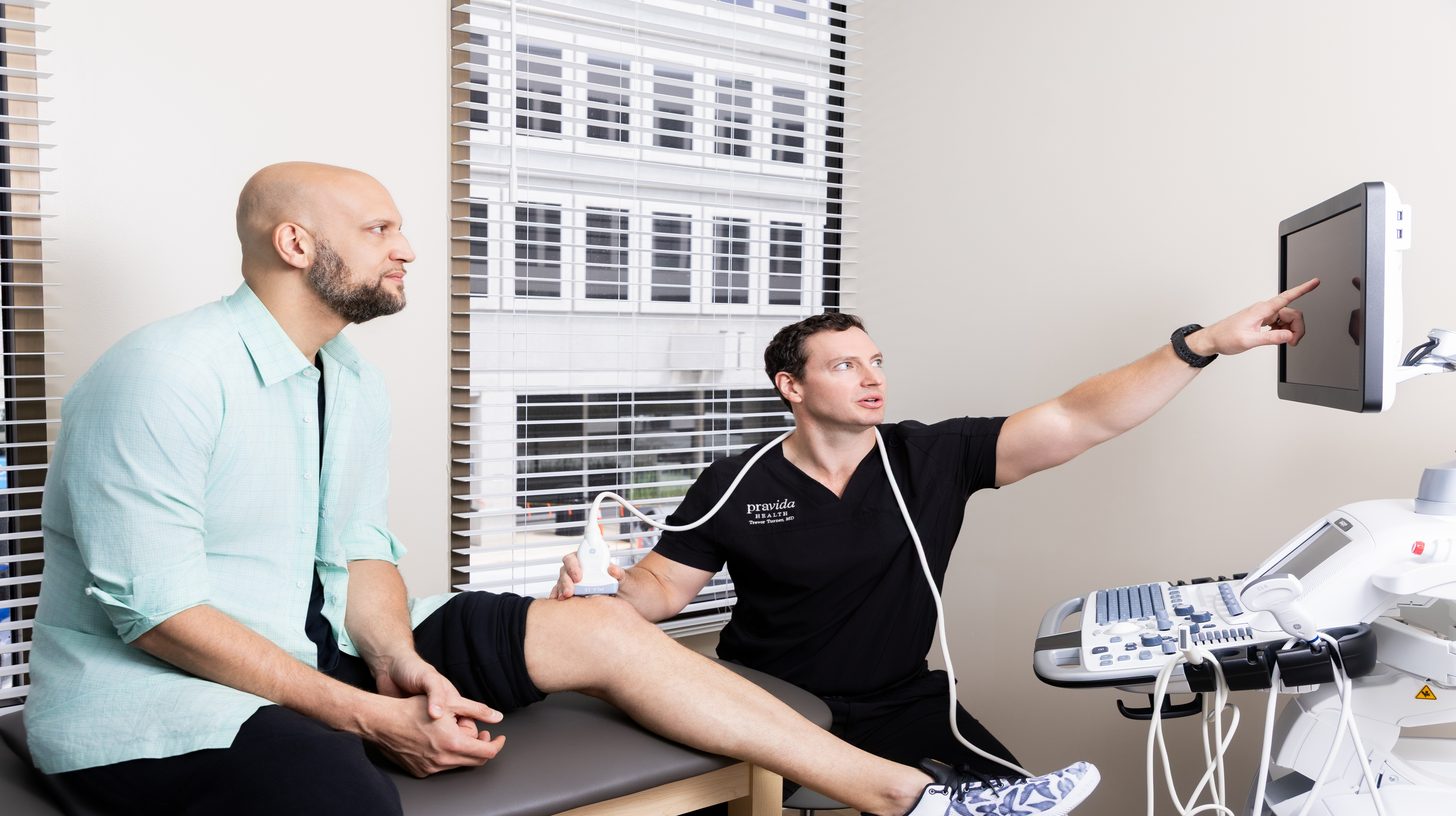
At Pravida Health, all orthobiologic injections are performed under ultrasound or fluoroscopic guidance, confirming needle placement before delivery. This isn't a minor technical detail. If the PRP doesn't reach the target tissue in adequate concentration, it cannot work regardless of how well it was prepared.
BMAC, MFAT, and the CartiNova Approach
For patients with more advanced joint disease, or in cases where PRP alone is insufficient, we have access to more advanced orthobiologic options.
BMAC (Bone Marrow Aspirate Concentrate) is drawn from the patient's iliac crest, concentrated, and injected into the target joint. It contains a broad spectrum of growth factors along with mesenchymal stem cell precursors with regenerative signaling capacity — a step up from PRP in biologic complexity and clinical potential for appropriate patients.
MFAT (Microfragmented Adipose Tissue) is processed from the patient's own fat tissue and contains a stromal vascular fraction rich in regenerative cells. It's a minimally invasive procedure that can deliver a concentrated regenerative signal to joints and soft tissue.
The CartiNova procedure — our most advanced cartilage restoration approach — combines image-guided delivery of regenerative biologics with Regenelease fractional laser treatment to address both the degenerative and inflammatory components of cartilage damage. For patients with intermediate-stage joint disease who are not ready for replacement surgery, this represents a clinically meaningful option that standard orthopedic practice typically doesn't offer.
Frequently Asked Questions
Does PRP actually regenerate cartilage?
Possibly, at the structural level — and more definitively at the symptomatic level. The most compelling structural data (Chu et al., 2022) showed 50% less radiographic arthritis progression at five years in PRP-treated patients compared to placebo. The primary and well-established benefit is pain reduction and functional improvement through anti-inflammatory and tissue-remodeling mechanisms.
How many PRP injections are needed?
For knee osteoarthritis, the evidence most strongly supports a series of three injections administered one week apart. Single-injection protocols show benefit, but series protocols appear more durable at 12-month follow-up in head-to-head comparisons. For tendon and ligament conditions, protocols vary by indication.
How long does PRP last?
In knee OA, well-designed studies show clinically significant benefit at 12 months in most responders, with some data extending to 24 months. Benefits can be reinforced with repeat treatment. This compares favorably to corticosteroid injections, which typically last 6–8 weeks and may be harmful with repeated use.
Am I a good candidate for PRP?
The best candidates are patients with mild-to-moderate osteoarthritis, partial soft tissue injuries (meniscus, rotator cuff, tendons, ligaments), or chronic degenerative tendinopathy. Patients with severe bone-on-bone arthritis, active joint infection, or blood disorders affecting platelet function are generally not candidates. An individualized assessment with imaging review is the appropriate first step.
Does insurance cover PRP injections?
Currently, most commercial insurance plans do not cover PRP injections because the evidence base, while growing, has not yet met the threshold for standard coverage determination. This reflects the lag between clinical evidence and insurance policy decisions. We are transparent about costs upfront and will discuss what is and isn't covered during your consultation.
When is surgery the right choice over PRP?
Surgery is clearly indicated for acute structural injuries (complete ACL tears, large meniscal tears with mechanical locking, full-thickness rotator cuff tears), end-stage joint disease with bone-on-bone contact and significant functional limitation, joint instability patterns that have failed conservative management, and conditions such as tumors, infections, or fractures where surgery is the standard of care.
Dealing with Joint Pain? Let's Review Your Options Together.
The right answer depends on your specific diagnosis, imaging findings, prior treatment history, and goals. A consultation with Dr. Turner will include a review of your imaging, a frank discussion of the evidence for your specific condition, and a clear explanation of what regenerative options are appropriate and what realistic outcomes look like.
Schedule a Consultation Learn About CartiNovaExisting patient? Patient Portal