
You've never had diabetes. Your last fasting glucose was 94 mg/dL — normal. Your hemoglobin A1c was 5.3% — excellent. Your doctor said your blood sugar is "perfectly fine."
What she didn't tell you is that fasting glucose and A1c are backward-looking tests that miss roughly half of meaningful glucose dysregulation in metabolically healthy adults. They measure average and baseline — not the spikes, crashes, and patterns that accumulate day after day and begin damaging blood vessels, driving inflammation, and accelerating aging long before any lab value crosses a diagnostic threshold.
Continuous glucose monitors — CGMs — were designed for diabetics. But in the past three years, the data on using them in metabolically healthy people has become compelling enough that the FDA approved over-the-counter CGMs for non-diabetics in 2024. Entrepreneurs and executives are now the fastest-growing non-diabetic CGM user group.
Here's what a month of CGM data actually reveals — and what it means for longevity.
What Is a CGM, and How Does It Work?
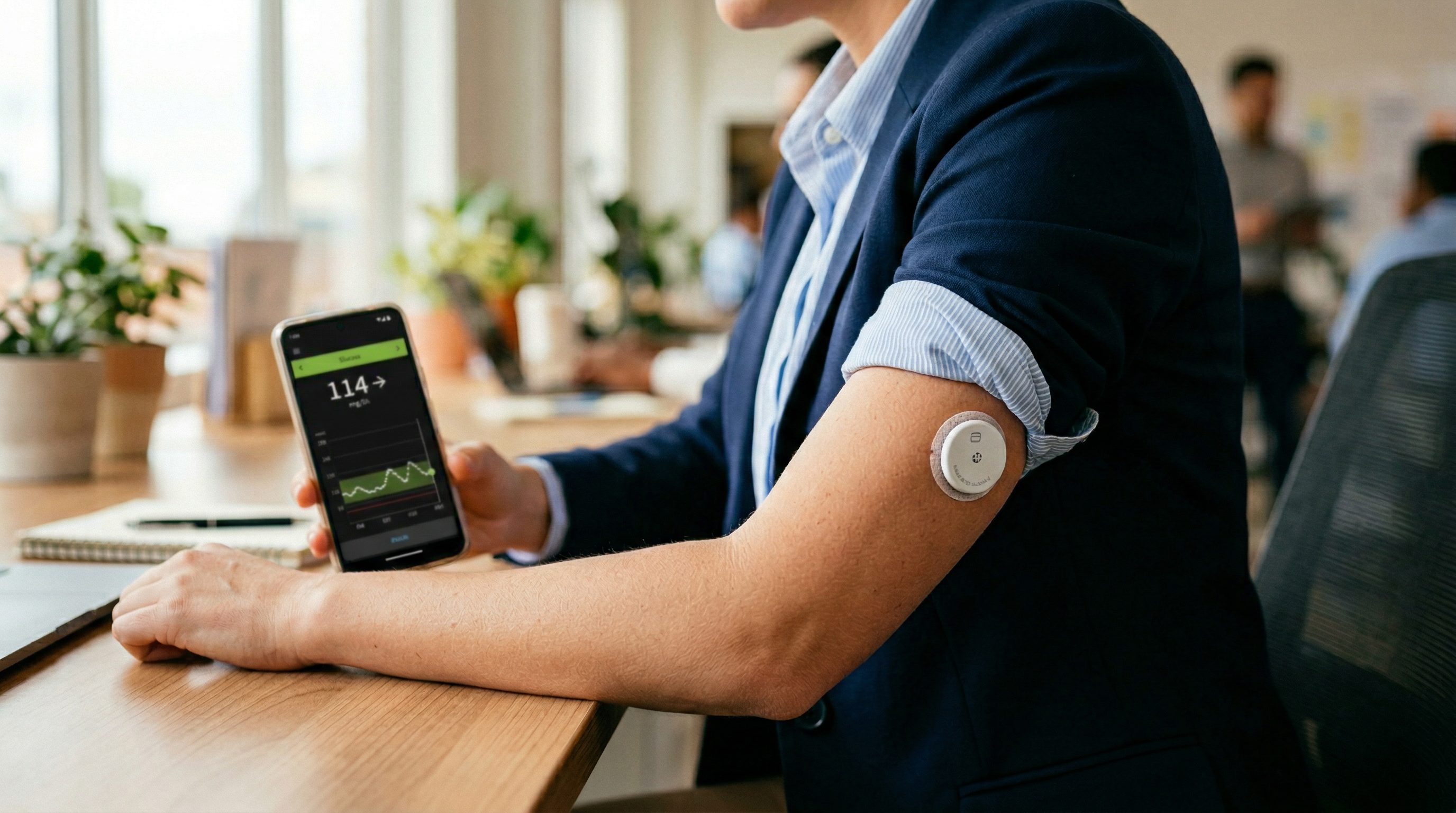
A continuous glucose monitor is a small wearable sensor — typically applied to the upper arm or abdomen — that measures interstitial glucose (the glucose in the fluid between cells) every 1 to 15 minutes and transmits readings to your phone. Current consumer devices include the Dexcom Stelo, the Abbott Libre 3, and the Nutrisense platform.
Unlike a fasting glucose test, which captures a single point in time, CGM captures your glucose dynamics across the full day and night. You see:
- How high glucose rises after each meal (postprandial peak)
- How quickly it returns to baseline (glucose recovery time)
- Whether you experience nocturnal glucose fluctuations
- How different foods, exercise types, stress, sleep, and alcohol affect your glucose in real time
- Your overall time in range — the percentage of time glucose stays within a healthy window
For a metabolically healthy adult, the conventional target is glucose consistently between 70 and 140 mg/dL, with most time spent between 80 and 110 mg/dL.
Why It Matters: What the Research Shows
Glycemic Variability Is a Cardiovascular Risk Factor
The key insight from CGM research is that glycemic variability — the magnitude and frequency of glucose swings — may matter as much as average glucose level. A 2021 observational study found a significant correlation between glycemic variability parameters (including mean amplitude of glycemic excursions, or MAGE) and blood pressure variability in normotensive individuals — meaning elevated glucose swings correlated with elevated cardiovascular risk markers even in people without diabetes.
A 2025 systematic review of CGM use in non-diabetic individuals — covering 1,127 total participants across seven studies published between 2020 and 2025 — concluded that CGM shows "promise for personalizing lifestyle interventions and improving glycemic outcomes in non-diabetic individuals, which are key surrogates for cardiovascular risk."
The same review noted that CGM's primary clinical value in non-diabetics is not measuring average glucose — it's identifying subclinical glycemic patterns, motivating lifestyle change, and detecting at-risk metabolic phenotypes before traditional diagnostics flag them.
The Food-Specific Response Problem
One of the most clinically valuable aspects of CGM in non-diabetics: the dramatic variation in individual postprandial glucose response. Two people can eat the same meal and have completely different glucose curves. A 2025 exploratory clinical trial (CGM-HYPE study, PLOS Digital Health) monitored healthy young adults wearing CGMs through controlled dietary, exercise, and stress challenges. Key findings:
- High-carbohydrate meals produced the highest glucose peaks, averaging 161.4 ± 15.59 mg/dL
- Anaerobic exercise caused significant glucose spikes — rising like a meal — while aerobic exercise kept glucose relatively stable
- Psychological stress caused significant glucose elevation compared to control conditions (p = 0.0113)
- Individual glucose recovery times varied considerably, even with identical challenges
For an entrepreneur managing a portfolio of stressors — client presentations, travel, intermittent fasting, late-night meals, alcohol — CGM makes these individual metabolic responses visible for the first time.
Exercise Timing and Glucose Optimization
One of the most actionable CGM-derived insights for non-diabetics: the timing of exercise relative to meals significantly affects postprandial glucose. A 2021 RCT using CGM guidance found that walking 20 minutes before a postprandial glucose peak reduced 4-hour incremental area under the glucose curve, insulin levels (by 28.7%), and C-peptide (by 28.7%) — all markers of improved insulin sensitivity. Effects were strongest in overweight men. This is the kind of precision that CGM enables: not "exercise more," but "walk before your highest-glycemic meal."
Zone 2 aerobic exercise — sustained moderate-intensity cardio at roughly 60–70% of max heart rate — is the exercise modality most consistently associated with glucose stabilization. The PLOS Digital Health data directly supports this: aerobic exercise profiles were flat while anaerobic exercise produced glucose excursions equivalent to a carbohydrate-heavy meal.
"CGM doesn't tell you that you have a problem. It tells you exactly which meal, which stress event, and which sleep pattern is creating the problem — and it does so years before any diagnostic threshold is crossed."
The Dawn Effect
Approximately 50% of people using CGM for the first time observe the dawn effect: a natural glucose rise in the early morning hours (typically 4:00–8:00 a.m.) driven by cortisol, growth hormone, and glucagon — the hormones that prime you for waking. For most metabolically healthy people, this rise is modest. But for individuals with early insulin resistance, the dawn effect is amplified — glucose can spike to 130–140 mg/dL before eating anything. CGM is the only tool that catches this without the person being awake to do a fingerstick at 5 a.m.
What CGM Doesn't Replace
Honest caveat here. A 2025 study from Mass General Brigham analyzed CGM data from 972 adults across glycemic status groups. In people with diabetes, CGM metrics correlated tightly with A1c — the gold standard for glucose control. In people with normal blood sugar, CGM metrics were largely uncorrelated with A1c. This makes sense: A1c reflects sustained average glucose over 3 months, which only changes meaningfully when glucose is consistently elevated. For non-diabetics, short-term CGM data captures variability and behavioral feedback — but doesn't replace A1c as a diagnostic tool for diabetes risk.
The Framingham Heart Study, a 2025 analysis in the Journal of Clinical Endocrinology & Metabolism, provided normative CGM reference ranges for 560 adults without diabetes — helping clinicians understand what "normal" CGM profiles look like in metabolically healthy people. This is important context: CGM data in non-diabetics requires interpretation against appropriate reference ranges, not the diabetic thresholds built into CGM apps.
The Gap in Standard Care
Standard metabolic screening — fasting glucose, A1c — is designed to diagnose diabetes, not optimize metabolic function. By the time A1c crosses 5.7% (prediabetes threshold), significant insulin resistance has typically been present for years. By the time fasting glucose rises above 100 mg/dL, the postprandial glucose spikes that precede and drive that rise have been accumulating for a decade.
CGM for non-diabetics turns this timeline on its head. Instead of waiting for a diagnostic threshold to be crossed, we can observe — in real time — the metabolic patterns that predict where you're heading. That's not treatment of disease. That's prevention of disease. And it's exactly the kind of intervention that makes clinical sense for entrepreneurs in their 40s who want to be performing at the same level in their 60s.
How We Use CGM at Pravida Health
Our Pinnacle membership includes one month of CGM, which we use as a metabolic education and intervention tool. Here's how we actually apply it:
Week 1: Baseline discovery. We run CGM on your typical diet and lifestyle with no changes. This reveals your baseline glycemic patterns, your highest-variability meals, and any concerning nocturnal patterns.
Week 2: Food-specific testing. We test specific foods — breakfast options, your typical lunch, alcohol, late-night meals — to build an individualized glycemic map. One patient discovered his "healthy" morning oatmeal with fruit was spiking him to 168 mg/dL. Another found that his standard low-carb dinner barely moved his glucose but his two glasses of wine before bed were causing significant nocturnal variability.
Weeks 3–4: Intervention and verification. We implement targeted modifications — exercise timing, meal sequencing, fiber-first eating, post-meal walks — and watch in real time whether glucose profiles improve.
We pair CGM data with fasting insulin and HOMA-IR to give us a complete picture: not just what glucose is doing, but what insulin is doing in response.
The goal is not perfection. It's insight — and then durable behavior change backed by personal data rather than generic dietary advice.
What You Can Do Today
1. Track your fasting glucose trend. A fasting glucose consistently above 90 mg/dL (not just above 100) warrants investigation of insulin resistance, even if it's "normal." Ask your doctor for a fasting insulin alongside your next fasting glucose.
2. Note your worst-glycemic meals. Without a CGM, you can still identify likely glucose spikes by noting energy crashes 90 minutes after eating — a functional proxy for postprandial hyperglycemia.
3. Implement fiber-first eating. Starting meals with vegetables or protein before carbohydrates blunts the postprandial glucose curve by 30–40% in most individuals — one of the most consistently validated CGM-derived insights.
4. Walk after your highest-carbohydrate meal. A 10–20 minute walk within 30 minutes of a carbohydrate-heavy meal significantly reduces postprandial glucose in most people. CGM-validated, easy to implement, costs nothing.
5. Consider a month of CGM. Even a single 14-day CGM cycle provides more metabolic insight than years of annual fasting glucose tests. FDA-approved over-the-counter options are now available without a prescription.
Frequently Asked Questions
Is a CGM useful if I don't have diabetes?
Yes, with appropriate expectations. CGM for non-diabetics is most useful as a behavioral feedback tool — helping you understand how specific foods, exercise timing, stress, and sleep affect your glucose in real time. It does not replace diagnostic tests like A1c for assessing diabetes risk, but it can reveal early glycemic patterns that precede diagnostic threshold crossings by years.
What is a normal CGM reading for someone without diabetes?
For metabolically healthy adults, most CGM readings should fall between 70 and 140 mg/dL, with the majority of time spent between 80 and 110 mg/dL. Postprandial peaks above 140 mg/dL, particularly if sustained for more than 30 minutes, may indicate early insulin resistance or significant glycemic variability. The Framingham Heart Study (2025) provides normative reference ranges for non-diabetics.
What is glycemic variability and why does it matter?
Glycemic variability refers to the magnitude of glucose fluctuations throughout the day — both the peaks after meals and the troughs between them. High glycemic variability in non-diabetics has been associated with inflammation, blood pressure variability, and surrogate markers of cardiovascular risk, independent of average glucose level.
How is Zone 2 exercise different from high-intensity exercise for glucose management?
Zone 2 aerobic exercise (sustained moderate intensity, 60–70% max heart rate) tends to stabilize glucose by increasing muscle glucose uptake without triggering the cortisol and adrenaline spike that anaerobic/high-intensity exercise produces. CGM data consistently shows that aerobic exercise blunts postprandial glucose peaks, while intense exercise can paradoxically raise glucose in the short term.
Does CGM replace an A1c test?
No. A1c reflects average glucose over 3 months and remains the standard diagnostic tool for diabetes risk stratification. CGM in non-diabetics is a complementary behavioral and educational tool, not a replacement for diagnostic blood testing.
Understand Your Glucose Metabolism at a Level Your Annual Physical Never Provides
Our Pinnacle membership at Pravida Health includes one month of CGM with integrated data interpretation — paired with comprehensive biomarker analysis, genomic profiling, and VO2 max testing for a complete metabolic picture.
Schedule a Consultation View Memberships